
The latest jobs report from Washington showed a robust economy, with employers adding 147,000 jobs in June, even as the unemployment rate fell to 4.1 percent (from 4.2 percent in May). But over at the other end of the country, in Seattle, news from the tech sector signaled a different reality.
A few days ago, Microsoft quietly laid off 9,000 employees from its global workforce of approximately 228,000. The move followed a more publicized round of layoffs in April, which primarily affected mid-level managers.
What makes this latest round notable is its targeted nature. It disproportionately impacted software engineers and product managers, the equivalent of assembly line workers at traditional manufacturers like General Motors or Ford.
First reported by The Seattle Times, the layoffs were quiet, swift, and impersonal. One software engineer described coming into the office as usual, only to be summoned two hours later for a group call with Human Resources, presumably via Microsoft Teams. For the duration of the call, all employee cameras were disabled, and names and accounts were anonymized. No one could see who else was on the call, and only HR knew the identities of those present. One hundred fifty people were laid off during that call. Those terminated were told to clear their desks and leave.
When the Department of Government Efficiency employed similar tactics earlier this year to trim the federal workforce, the backlash was swift and furious. Public employee unions joined forces with sympathetic state governments, filed lawsuits in federal courts, and secured temporary nationwide restraining orders. The mainstream media amplified sob stories of families unable to make mortgage payments or put food on the table. Activist groups sprang into action, organizing nationwide protests. Tesla became a symbolic target; its vehicles were vandalized in retaliation against founder Elon Musk and his policy advisors, who were involved in executing the cuts. These actions were from the same ideological circles that once hailed Tesla as a climate champion leading the electric vehicle revolution. But all that goodwill vanished the moment Musk aligned himself with President Trump. Now that Musk and Trump are no longer seen as allies, those Tesla attacks have mysteriously stopped.
The difference in how these events were covered speaks volumes. There was an outcry over federal workforce reductions but deafening silence from the media regarding Microsoft's move. Yes, major outlets reported the layoffs, but few provided meaningful analyses of what they actually signify.
These pages have long highlighted the seismic impact that artificial intelligence and machine learning are having on the American workforce. Microsoft's recent layoffs underscore that reality. When the company recognized the potential of ChatGPT, it made two transformative investment decisions. First, it committed $1 billion to OpenAI, then a nonprofit with limited capital-raising capacity. Shortly afterward, it announced an additional $10 billion investment to integrate OpenAI's technology into Microsoft's enterprise AI engine, known as Copilot.
This strategic brilliance was further enhanced by Microsoft's earlier acquisition of GitHub, a global repository of open-source code used by millions of developers worldwide. GitHub functions as the Wikipedia of software development—a place where programmers contribute, refine, and validate code. Microsoft's masterstroke was to fuse GitHub with Copilot, powered by OpenAI, and promote the platform to corporate developers as the future of enterprise software engineering.
The result was a revolution. Over 15 million developers, from hobbyists to professionals, adopted Copilot. Many enterprise projects now begin with Copilot, where software engineers use natural language to instruct AI to generate and test code. The transformation has led to dramatically lower costs, faster development, and higher code quality. At Amazon, developers are already working in this futuristic environment. A recent blog post by an Amazon engineer demonstrated how AI can generate production-ready code in under 30 minutes using a series of natural language prompts.
Industry leaders have taken note. Mark Zuckerberg and executives at Anthropic, creators of the Claude AI model, have confirmed that AI will increasingly absorb entry and mid-level software roles. The real-world implications of that forecast became clear last week at Microsoft.
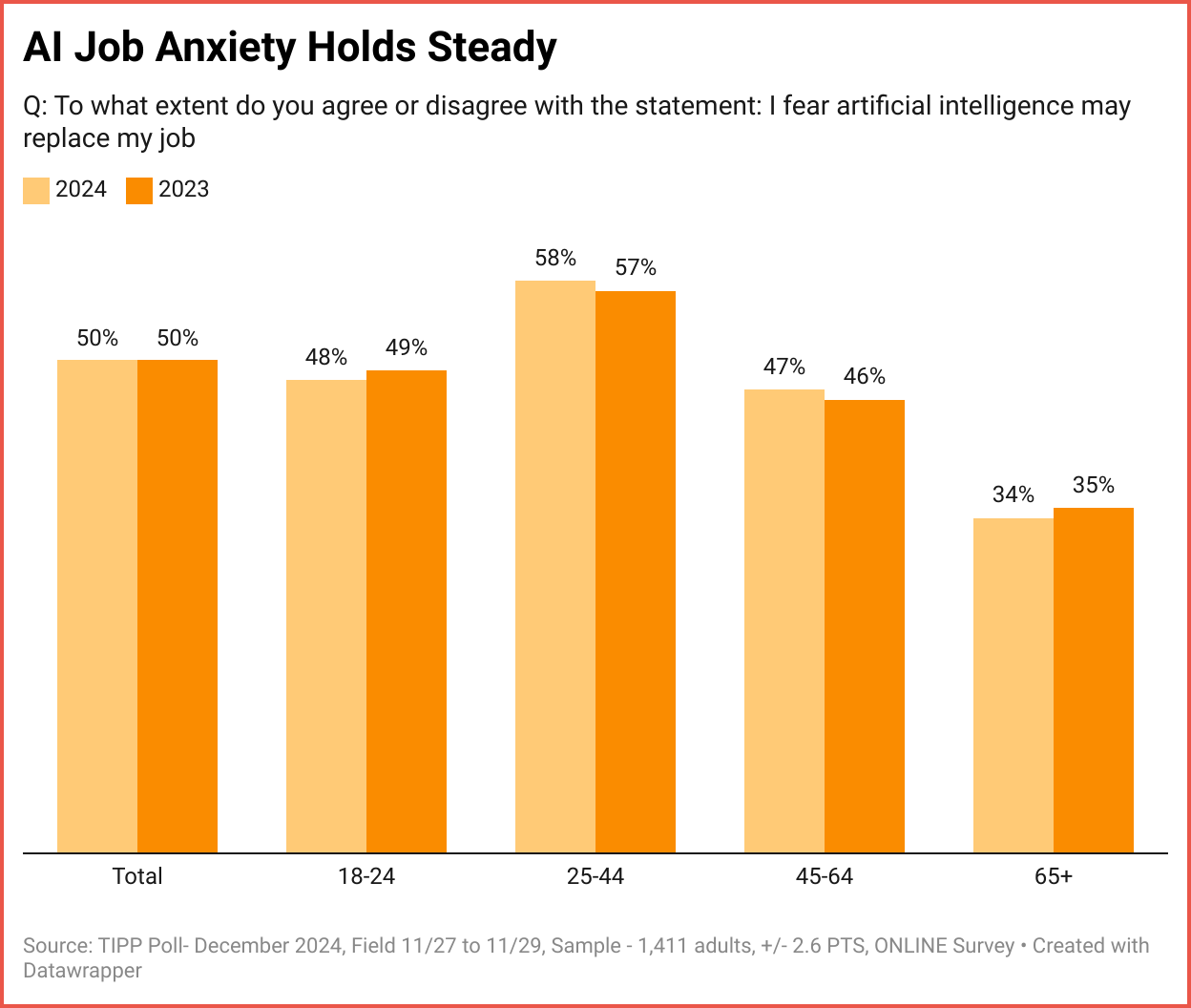
Much of the unease surrounding AI stems from the fear that automation and AI-powered systems will eliminate jobs, particularly at the entry and mid-career levels. Despite promises of job creation, concerns remain widespread. TIPP Poll data shows that half of Americans—across both 2023 and 2024—fear AI may replace them at work.
Anxiety runs especially high among younger adults. In the latest survey, 58% of those aged 25-44 reported fearing that AI will take their jobs, followed closely by 48% of those aged 18-24. Even among older workers, concerns persist—47% of those aged 45-64 and 34% of seniors aged 65 and older share the same worry.
The Federal Reserve Bank of New York has been publishing reports on how college-educated youth fare in the job market. For at least 25 years, industry leaders have consistently asserted that there is a substantial shortage of skilled labor in the science, technology, engineering, and mathematics (STEM) professions. These leaders have unilaterally supported the recruitment of qualified international students and engineers to provide the American industry with a steady stream of talent.
However, the April 2025 report from the Federal Reserve Bank of New York showed something shocking. Domestic college graduates in computer engineering faced unemployment rates of 6.7%, far higher than the rest of the labor market. Even more captivating was that domestic graduates in the humanities, such as sociology or communications, fared better than the STEM graduates.
Despite this tectonic shift, the federal government continues to issue over 120,000 H-1B visas annually for "specialty occupations," primarily in the technology sector. International students still flock to the U.S. for Optional Practical Training (OPT) slots, hoping to enter a market that is rapidly closing for junior and mid-level developers. The supply and demand imbalance in the tech labor market has never been more stark.
Ordinary Americans feel the strain. Running a household, saving for college, or buying a home has never been more difficult. And yet, the only real power left to them is their vote. Last week in New York, a far-left candidate who once declared that "billionaires should not exist" won the Democratic nomination for mayor. His campaign promised to solve the city's economic woes by expanding budgets, cracking down on landlords and businesses, and imposing a $30 minimum wage. That such a fantasy could gain traction is a grim reminder of how disconnected our political class is from economic reality and how desperate Americans are to follow such a pipe dream.
Rajkamal Rao is a columnist and a member of the tippinsights editorial board. He is an American entrepreneur and wrote the WorldView column for the Hindu BusinessLine, India's second-largest financial newspaper, on the economy, politics, immigration, foreign affairs, and sports.
Related Article
How AI Will Disrupt Big Tech—Charles Ferguson, Project Syndicate
TIPP Market Brief – July 9, 2025
Your Morning Snapshot
📊 Market Snapshot
- S&P 500: ▼ 6225.12 (0.07% )
- 10-Year Yield: ▲ 4.415%, (2 basis points)
- Crude Oil (WTI): ▲ $68.18 (0.38%)
- Bitcoin (BTC): ▼ $108,814.39
- US Dollar Index (USD): ▲ 97.55 (0.04%)
- Gold: ▼ $3,302.97 (1.02%)
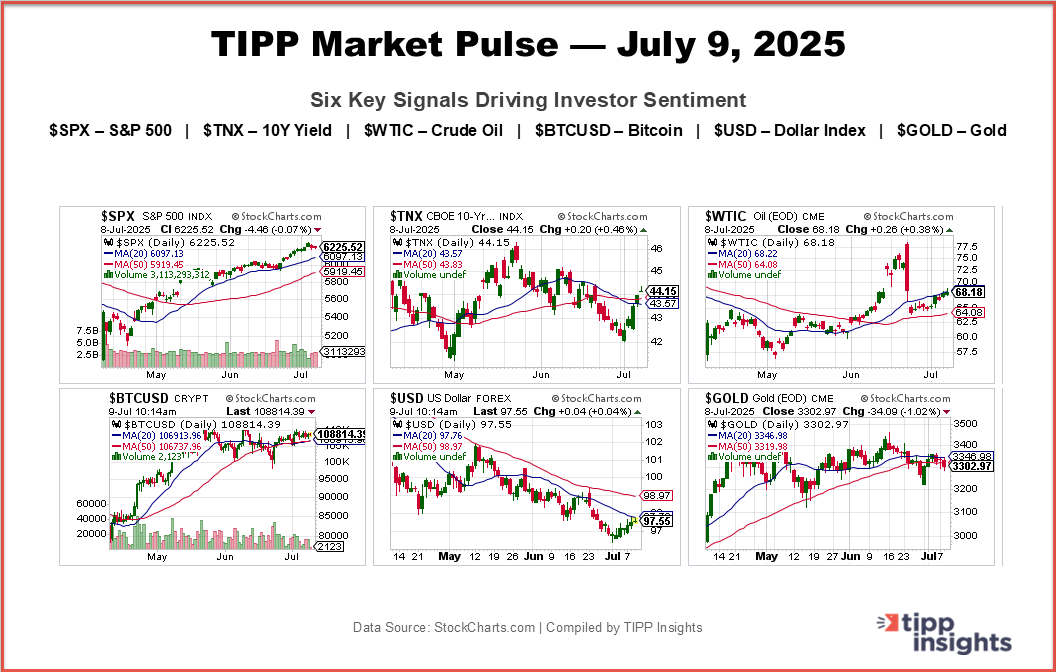
Bigger Charts: $SPX | $TNX | $WTIC | $BTCUSD | $USD | $GOLD
📈 Featured Stock
Our pick for today’s featured stock
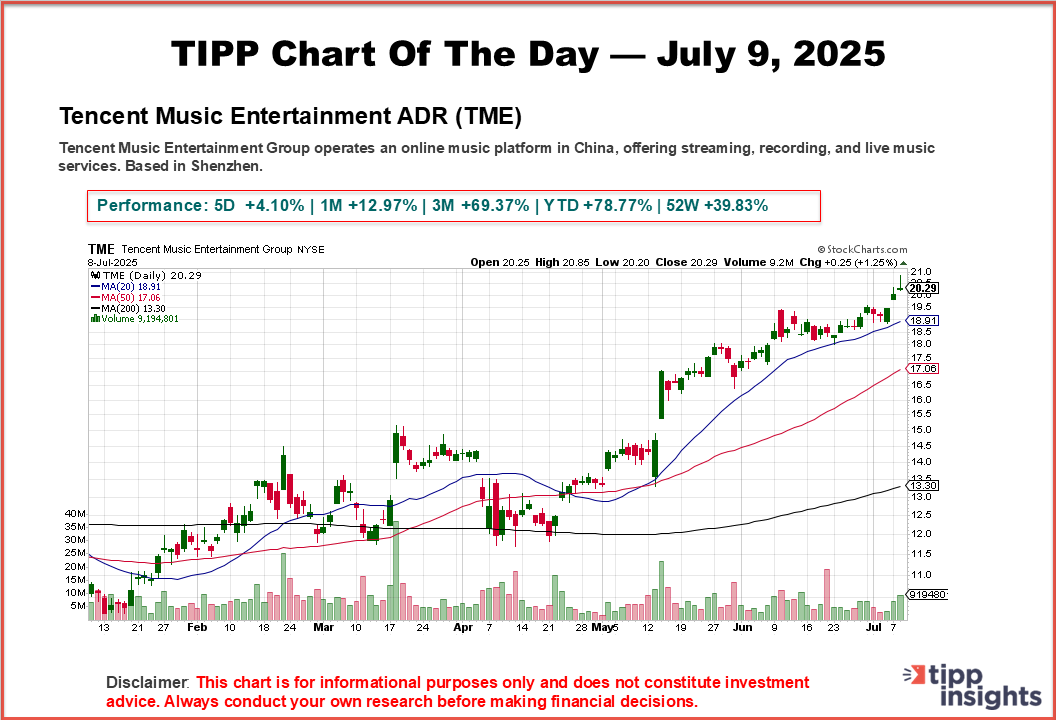
📰 News & Headlines
Tencent Music Shares Double on Break From China Price Cut Script—Charlotte Yang, Bloomberg
Why Tencent Music Entertainment Group (TME) Skyrocketed On Wednesday—Angelica Ballesteros, Insider Monkey
⭐Recent Featured Stocks
Rocket Lab Corporation (RKLB) (7/8)
Blacksky Technology Inc (BKSY) (7/7)
Dave Inc (DAVE) (7/3)
Seagate Technology (STX) (7/2)
Ouster Inc (OUST) (7/1)
Carpenter Technology Corp (CRS) (6/30)
MP Materials Corp (MP) (6/27)
Celestica, Inc. (CLS) (6/26)
TSS, Inc. (TSSI) (6/25)
Avis Budget Group (CAR) (6/24)
More here
🧠 Macro Insight
🟩 Futures Flat as Traders Eye Fed Minutes and Tariff Moves
Markets remain muted as investors digest tariff threats and await the Fed's minutes for clues on rates. Trump’s looming copper tariff and speculation about the Fed keep sentiment cautious.
🟨 Trump Threatens 50% Copper Tariff, Holds Firm on August 1 Deadline
Trump signals no more extensions on tariff deadlines and proposes a steep 50% tariff on copper, expanding his trade fight to key industrial sectors. Europe and China remain in negotiations.
🟦 Hassett Now Top Pick to Replace Fed Chair Powell
Kevin Hassett emerges as Trump’s leading candidate to replace Jerome Powell, according to WSJ. The White House could move swiftly on the nomination amid ongoing Fed tensions.
🟧 Oil Steady as Inventory Surge Offsets Red Sea Disruptions
Crude prices hold near two-week highs after a surprise U.S. inventory build offsets concerns about shipping attacks. Traders await official government inventory data.
🟥 Fed Minutes in Focus as Rate Cut Bets Hold
Investors await the Fed’s June meeting minutes, seeking signals on potential rate cuts. Markets still expect two cuts by year-end, with the first likely in September.
📅 Key Events Today
🟩 Wednesday, July 9
- 10:30 – Crude Oil Inventories
Weekly report on U.S. oil stockpiles; key for energy markets. - 13:00 – 10-Year Note Auction
Government auction for 10-year Treasuries; gauges demand for U.S. debt. - 14:00 – FOMC Meeting Minutes
Detailed notes from the Fed’s last meeting may offer rate outlook clues.