Editor’s Note
America is often accused of “deregulating” AI, but that storyline misses how our system actually works. With 50 states and a strong legal culture, the country is not stepping back. It is regulating through many hands at once. That may look messy to outsiders, but it is part of our constitutional DNA. In a fast-moving field like AI, this decentralized, trial and error approach may turn out to be one of America’s quiet advantages.
By Angela Huyue Zhang, Project Syndicate | November 19, 2025
While critics of decentralized technology regulation warn of higher compliance costs for businesses, Chinese-style centralization is hardly preferable. In fact, not only do regulatory patchworks tend to converge, but they also provide the flexibility that rapid technological change demands.
LOS ANGELES – It is widely assumed that America is “deregulating” AI, and it’s not hard to see why. The Trump administration has rescinded President Joe Biden’s AI executive orders and unveiled an “AI Action Plan” promising to “dismantle unnecessary regulatory barriers.” When Vice President JD Vance attended the Paris AI Action Summit back in February, he warned Europeans that “excessive regulation” would cripple their AI industry.
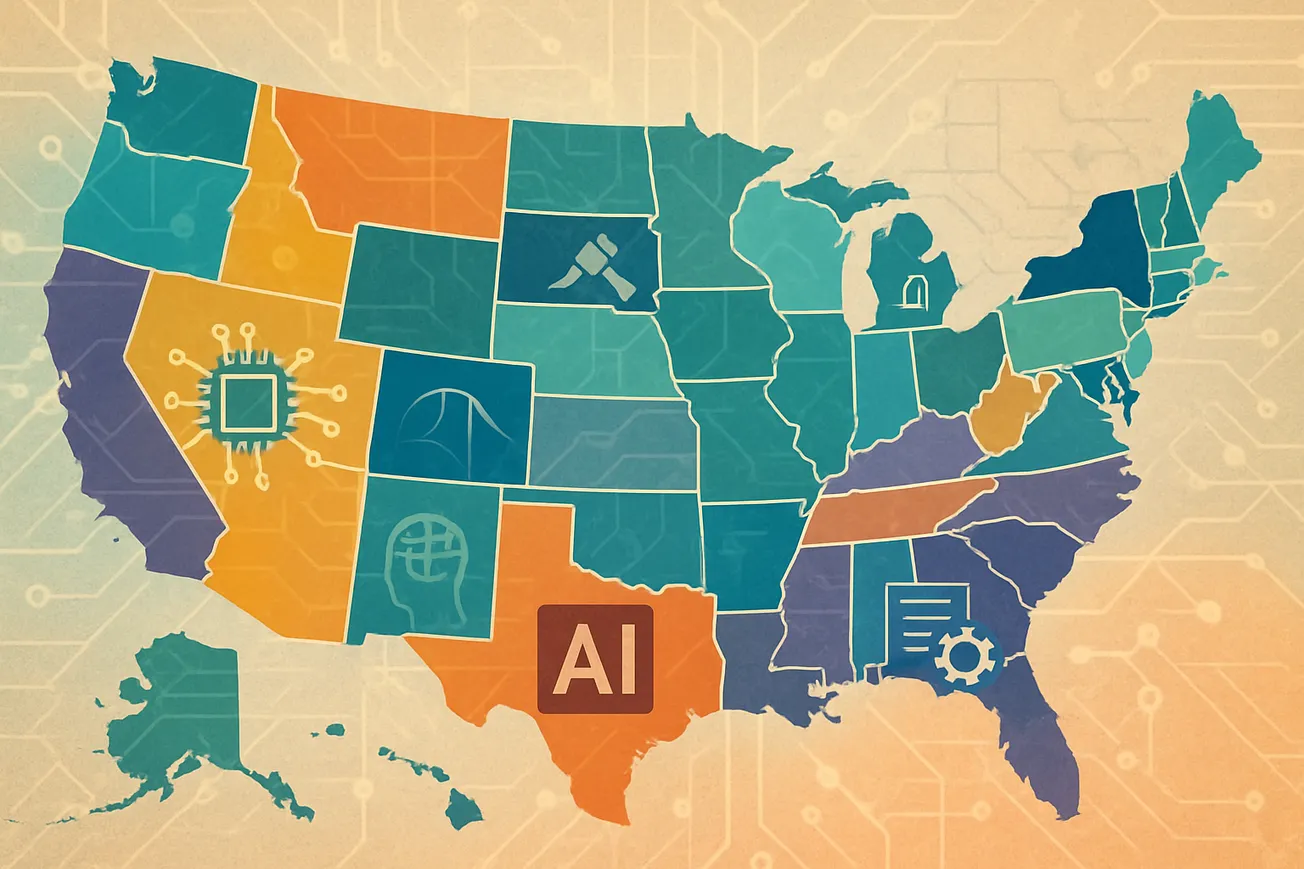
But this deregulatory narrative elides how the United States is actually governed. The federal government is not the only regulator in town. There are 50 state governments that can legislate and enforce rules when federal authorities decline to act, as well as independent courts that intervene in cases brought before them by private individuals or entities. The result is a decentralized patchwork, not a regulatory vacuum.
As of October, lawmakers in 42 states had introduced 210 AI-related bills to regulate the private sector, with Democratic-controlled states leading the charge. One is California, which just enacted a sweeping package that requires bot disclosures and youth safeguards for “companion chatbots”; introduces a phased data disclosure regime, so that platforms can flag AI-generated content; sets limits on unlicensed “AI medical” advice; strengthens the remedies for nonconsensual deepfake pornography; circumscribes the “AI-did-it” defense in litigation; and explicitly bans algorithmic price-fixing.
Meanwhile, New York has barred landlord rent-pricing algorithms and is weighing measures on frontier-model safety, labeling, and disclosures for synthetic performers (AI “actors”). Illinois has banned “AI therapy” without licensed professionals and limited AI use in hiring. And last year, Colorado adopted the first comprehensive “high-risk AI” law focused on preventing algorithmic discrimination.
Republican-controlled states have also moved this year. Texas passed an omnibus law targeting manipulative and discriminatory uses of AI. Tennessee (the capital of the country-music industry) has regulated the use of AI voice cloning. And Utah has set disclosures and guardrails for chatbots offering mental-health services.
Clearly, there is bipartisan support for protecting children, regulating bots, and banning AI deception, which helps to explain why a recent effort to pre-empt all state AI laws for ten years – tucked into the Republicans’ “One Big Beautiful Bill” – failed after strong pushback from states and civil society.
To be sure, decentralization increases compliance costs, especially for smaller companies, and supporters of pre-emption argue that legislation across 50 states could lead to 50 definitions of AI, 50 disclosure requirements, and 50 enforcement approaches. But that is a caricature. Markets rarely run 50 playbooks, because patchworks tend to converge, with companies harmonizing to the strictest workable standard. Many industries are already familiar with the “California effect”: rules set in Sacramento often become the de facto national norm, as seen in auto emissions and data privacy.
Moreover, a decentralized system enables the US to run real-time experiments in AI regulation. When states adopt rules with varying intensity, they become laboratories of governance. Policymakers can see what works, discard what doesn’t, and devise a practical template for better regulation.
At the same time, the divergence among states is unlikely to be as stark as many assume. Since states compete for investment, heavy-handed rules can drive away innovative firms. That is why California Governor Gavin Newsom vetoed SB 1047, legislation that would have imposed heavy compliance duties on frontier AI developers. In the end, state lawmakers opted for a narrower transparency-and-disclosure measure instead. And OpenAI’s restructuring offers another example of the same pattern. As the firm shifted from a nonprofit to a public-benefit structure, California’s attorney general, Rob Bonta, pushed for stronger guardrails. After securing governance and safety concessions from OpenAI, he compromised and declined to object.
Don’t just follow AI. Understand it.
Subscribe now for the best AI coverage, $99/year.
If this all sounds familiar, that is because AI’s rollout is replaying the politics of the US data-privacy debate. Here, too, it is incorrect to say that America has “no data privacy law.” The US has many such laws – just not a single, coherent federal one. Although the American Data Privacy and Protection Act sailed out of the US House Energy and Commerce Committee with overwhelming bipartisan support in 2022, it then stalled. With Democratic-controlled states, led by California, urging Congress to adopt a federal floor (not a ceiling) and to preserve concurrent state attorney-general investigative and enforcement powers, US businesses lobbied against legislation that would not override stronger state-level regimes.
We can expect the same dynamic with AI regulation, unless Congress opts for a bill that sets federal baselines while allowing states to go further. Yes, critics will warn that patchwork regulation might handicap US firms relative to their Chinese competitors. China’s centralized system can indeed move fast: when market chaos emerges, the authorities can impose sweeping controls with little institutional resistance; and when growth falters under heavy-handed intervention, they can just as quickly ease rules to lure investors back.
But Americans tempted by China’s approach should remember the other side of the coin. As I elaborate in my book High Wire: How China Regulates Big Tech and Governs Its Economy, China’s mishandling of the COVID-19 pandemic, its sweeping internet crackdown (which erased vast tech fortunes), and the lingering economic malaise from heavy-handed property reforms are stark reminders that with centralization comes fragility.
So, no: America isn’t deregulating AI. It is decentralizing its governance. This messier, noisier, more pluralistic path is an inherent feature of its constitutional order and the foundation of its regulatory resilience. Rather than seeing decentralization as a drag on innovation, it should be viewed as one of America’s most important competitive advantages.
Angela Huyue Zhang, Professor of Law at the University of Southern California, is the author of High Wire: How China Regulates Big Tech and Governs Its Economy (Oxford University Press, 2024) and Chinese Antitrust Exceptionalism: How the Rise of China Challenges Global Regulation (Oxford University Press, 2021).
Copyright Project Syndicate
TIPP Curated
Handpicked articles from TIPP Insights & beyond
1. The Smithereens—Lawrence Kudlow, TIPP Insights
2. Why the US Economy Has Remained Stronger Than Expected—Pinelopi Koujianou Goldberg, Project Syndicate
3. Fix The H-1B, Now—Editorial Board, TIPP Insights
4. This Show Won’t Go On: America Can’t Trust Zelensky—Steve Cortes, TIPP Insights
5. Government Intervention, Not BlackRock, Is To Blame For The Housing Crisis—Diyar Kasymov, Mises Wire
6. How To Actually Solve The Affordability Crisis—Connor O'Keeffe, Mises Wire
7. The Difference between Formal And Substantive Equality— Wanjiru Njoya, Mises Wire
8. Why I Won’t Be Mourning Dick Cheney—Llewellyn H. Rockwell Jr., Mises Wire
9. Does A Decline In “Aggregate Demand” Cause A Recession?—Frank Shostak, Mises Wire
10. The Hidden Costs Of “Buy Now, Pay Later” Culture—Hunter Smathers, Mises Wire
From TIPP Insights News Editor
11. Britain Warns Russia As Spy Ship Nears U.K. Waters
12. Russia’s Overnight Barrage Triggers Deadly Blackouts Across Ukraine
13. Corruption Probe Shakes Kyiv As Pressure Mounts On Zelensky’s Inner Circle
14. U.S. Sends Senior Army Officials To Ukraine As Trump Pushes New Peace Plan
15. Why Trump’s F-35 Plan For Saudi Arabia Is Shaking Up U.S. Policy
16. Washington Delivers $700M Worth NASAMS Deal To Bolster Taiwan Defense
17. What China’s New Spy Claims Reveal About Rising Tensions With Japan
18. China Continues Long Retreat From U.S. Treasuries Despite Small Uptick
19. China Becomes Global Leader In Scientific Publishing, Data Shows
20. Nexperia: How A Dutch Reversal Helped Restart China’s Critical Auto-Chip Exports
21. Top Democrat Seeks U.S. Probe Into Chinese Chip Firms Tied To Nexperia
22. President Trump Vows U.S. Action In Sudan Following Saudi Appeal
23. Senate Unanimously Approves Epstein Files Bill
24. House And Senate Clear Epstein Files Bill; Trump Expected To Sign
25. DOJ To Release Epstein Files Within 30 Days, Bondi Confirms
26. Larry Summers Quits OpenAI Board After Epstein Emails Surface
27. Ford Recalls 230,000 Broncos Over Dashboard Display Failure
28. Comer Says Clintons Must Testify As Epstein Files Head To Trump’s Desk
29. DOJ Admits Grand Jury Never Saw Final Comey Indictment
27. BLS Delays Jobs Report, Citing Massive Shutdown Disruptions
30. EU Hits Pause On Tough AI Regulations Amid Innovation Fears
29. AI Toy Recalled After Report Finds Graphic Sex Chats, Safety Risks
30. Retail Giant Target To Roll Out AI Shopping With ChatGPT Integration
31. Trump Threatens To Fire Treasury Secretary Over Fed Rate Cuts
📊 Market Mood — Thursday, November 20, 2025
🟩 Nvidia Sparks Big Rally After Blowout Earnings
U.S. stock futures surged early Thursday after Nvidia’s stellar results eased fears of an AI valuation bubble. The chipmaker posted 62% sales growth, strong Q4 guidance, and reaffirmed massive demand across cloud, enterprise, and edge devices. CEO Jensen Huang dismissed bubble concerns and highlighted $500B in bookings through 2026. The Trump administration is also pushing Congress to reject limits on Nvidia’s AI chip exports, adding another tailwind.
🟨 Futures Jump Across the Board
The rally follows a four-day slide, with Nvidia’s beat helping restore confidence in AI-linked tech stocks. Retail giant Walmart reports this morning, and markets await the delayed September nonfarm payrolls.
🟧 September Nonfarm Payrolls Up Next
The Labor Department releases the September jobs report today — delayed due to the 43-day shutdown. Economists expect ~50,000 jobs, more than double August’s 22K, while unemployment likely holds near 4.3%, a four-year high. The Fed faces December policy decisions without full data, keeping the rate-cut odds near 50-50.
🟩 Walmart Earnings in Focus
Walmart is expected to report $177.5B in revenue and EPS of $0.60, offering a read on consumer health heading into the holiday season. The update follows mixed results across retail this week: Target cut guidance, Home Depot warned on demand, while Lowe’s beat expectations and raised its outlook.
🟨 Oil Higher on Bigger-Than-Expected Crude Draw
Brent and WTI rose 0.6% as U.S. crude inventories fell by 3.4M barrels, beating expectations. Both benchmarks are set for weekly gains ahead of the Nov. 21 deadline for U.S. companies to wind down business with Russia’s Rosneft and Lukoil.
🗓️ Key Economic Events — Thursday, November 20, 2025
🟨 08:30 AM — Average Hourly Earnings (MoM, Sep)
Tracks month-to-month wage growth — a key signal for labor-market tightness and inflation pressure.
🟧 08:30 AM — Initial Jobless Claims
Weekly filings for unemployment benefits — an early read on labor-market momentum.
🟨 08:30 AM — Nonfarm Payrolls (Sep)
The most closely watched gauge of U.S. job creation, delayed due to the shutdown.
🟧 08:30 AM — Philadelphia Fed Manufacturing Index (Nov)
A regional snapshot of factory activity — often an early indicator for national trends.
🟨 08:30 AM — Unemployment Rate (Sep)
Measures the share of workers actively seeking jobs — a core benchmark of labor-market health.
🟧 10:00 AM — Existing Home Sales (Oct)
Tracks resale activity of U.S. homes — a key view into housing demand and consumer confidence.

editor-tippinsights@technometrica.com