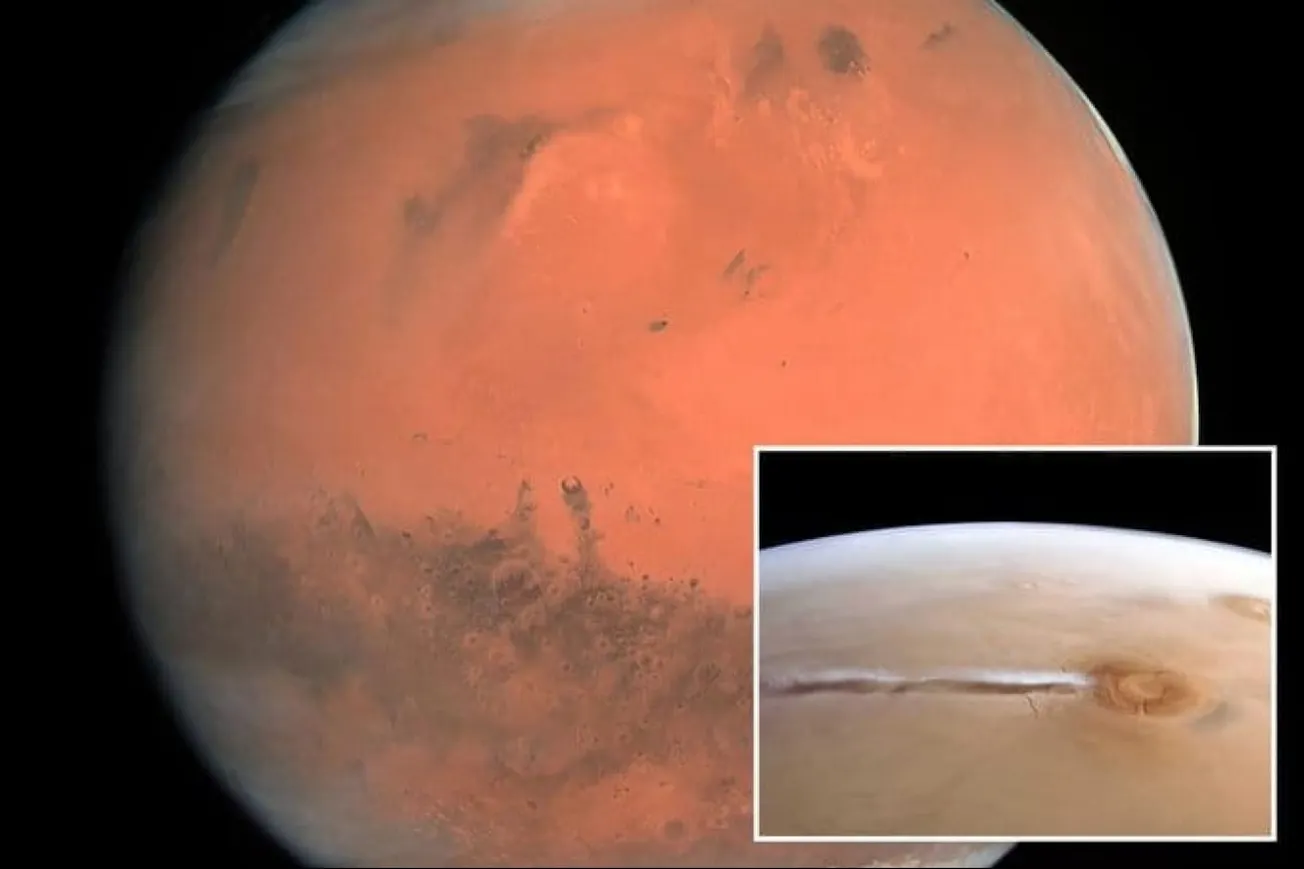
Scientists have identified a rare atmospheric process behind one of Mars’ most unusual weather features, the Arsia Mons Elongated Cloud, according to a study published Wednesday in Nature Geoscience.
The cloud stretches more than 1,100 miles and appears almost daily during Martian spring and summer as winds rise along the slopes of the 12-mile-high Arsia Mons volcano.
Lead author Jorge Hernández-Bernal said the study provides the first observation of “homogeneous nucleation” in a planetary atmosphere. The process occurs when water vapor freezes without requiring dust particles as surfaces for ice formation.
Researchers said the discovery highlights how atmospheric processes can differ dramatically between planets and could inform future exploration and studies of potential extraterrestrial environments.
Related Tweet:
Scientist explore the 'exotic physics' behind Mars' 'oddest cloud' https://t.co/FtxavFOWNi https://t.co/4TJ6A68Lsh
— New York Post (@nypost) October 8, 2026
Also Read:
 TIPP Staff