
By Ryan McMaken, Mises Wire | October 14, 2026
Wall Street and the federal government are both addicted to artificially low interest rates, and to easy money. The federal government wants lower borrowing costs to help finance the $40-trillion federal debt. And, Wall Street and wealthy asset owners want monetary inflation to help ensure that prices for assets—i.e., real estate and stocks—continue ever upward.
Yet, against the wishes of these interest groups, the Federal Reserve’s Federal Open Market Committee (FOMC) raised the policy interest rate last month. The Fed’s hand was essentially forced by political realities. As prices for food, energy, cars, and services have headed up in recent years, ordinary people have been squeezed. This has proven to dampen the popularity of the administration and the regime, so, after months of stalling, the FOMC at its September meeting finally raised the target interest rate. This was the first increase since 2023, and was a last resort in an effort to put a lid on price inflation.
Yet, no sooner was the ink dry on the FOMC’s new policy than the easy-money lobby started formulating scenarios in which it was imagined that price inflation would fall enough in the new CPI data to justify a reversal of the FOMC’s policy. The new narrative was that we’d get a new cut to the policy rate at least as soon as early 2027.
Well, September’s CPI report suggests the Fed many not be able to get away with any new interest-rate cuts any time soon. That’s the more likely scenario unless, of course, the job market tanks—but that brings with it its own set of political problems for the regime and its friends.
To the report details:
The federal government’s Bureau of Labor Statistics today released its September report, and it seems price inflation is headed upward yet again. According to the report, the consumer price index (CPI) rose in September by 3.7 percent, year over year, coming in hotter than forecasters had expected. Indeed, the year-over-year measure rose to a five month high in September. Meanwhile, the month-to-month measure of the CPI price inflation rose to a seven month high, coming in a 0.64 percent. By both measures, price inflation has growth for two months in a row,
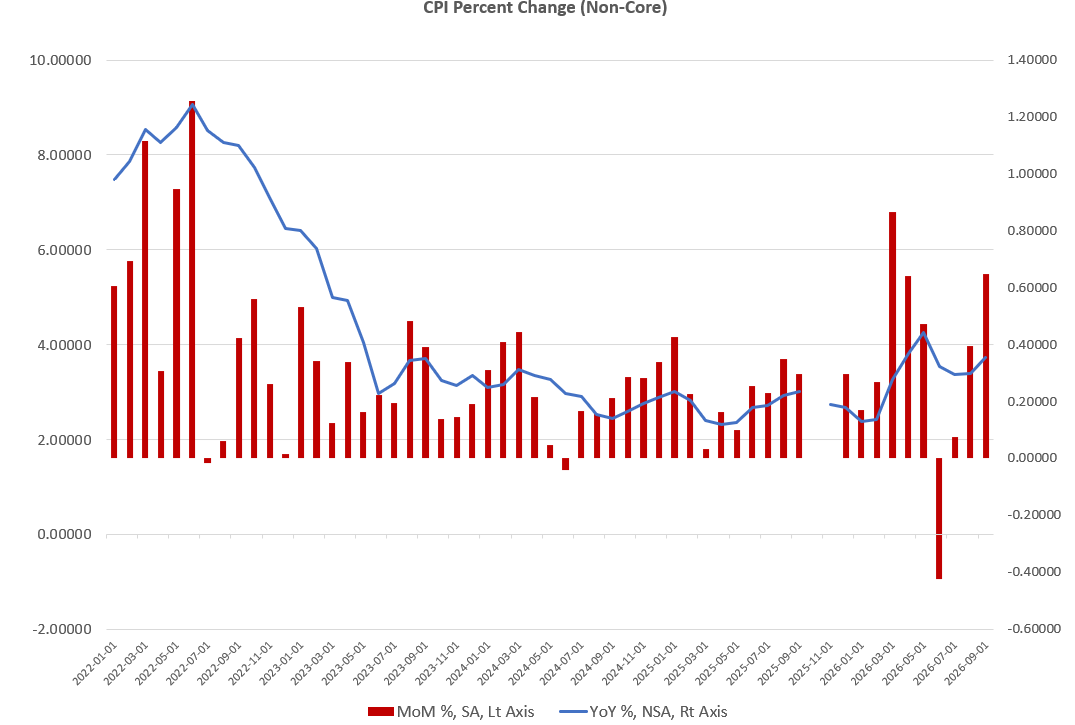
Apologists for the administration and the regime have attempted to cast current price-inflation as nothing more than a temporary blip caused by rising fuel prices. The administration insists price inflation will therefore soon disappear once the US wins its war against Iran. This war, we are assured by Trump and his allies, will be won very, very soon—any day now!—and gas prices will drop, driving down the CPI overall.
The core CPI numbers suggest this narrative may be a bit too optimistic. Even if we remove the more volatile price categories of food and energy from the CPI, we still find that price-inflation is rising. During September, the year-over-year growth in the core CPI was 2.56 percent, or a four month high. Measured month-to-month, the core CPI rose to a six-month high.
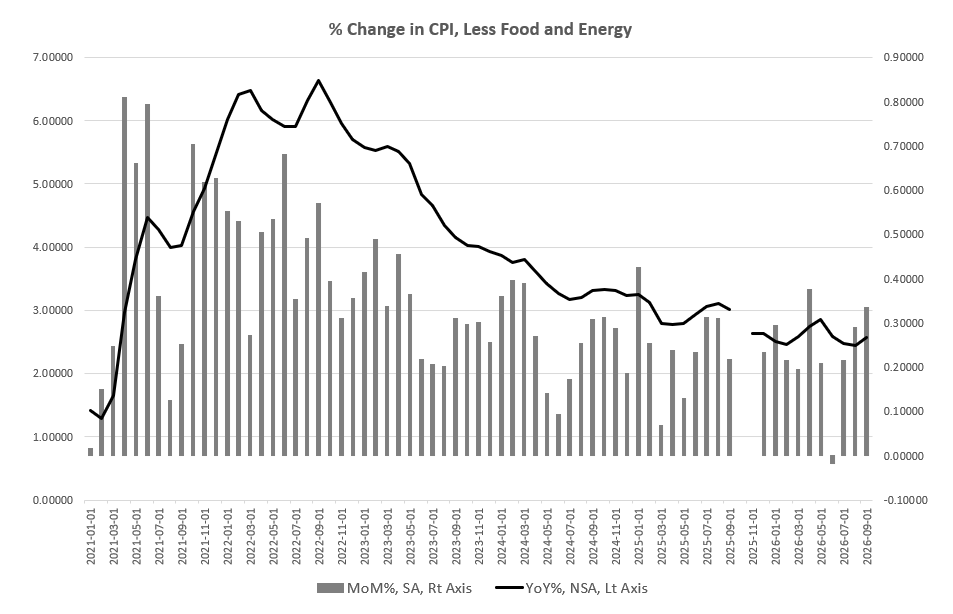
In other words, the factors behind CPI growth are apparently more broad than the administration had hoped. It is certainly true that rising prices in September were driven by a price surge in energy. Energy overall was up, year over year, by 20.4 percent in September, with gasoline prices up by 34.2 percent during the same period. Yet, many key categories remained elevated. Prices in shelter, medical care, apparel, and food all showed solid price growth.
In other words, this won’t be cured by an end to hostilities in the Strait of Hormuz, which don’t look to end soon in any case.
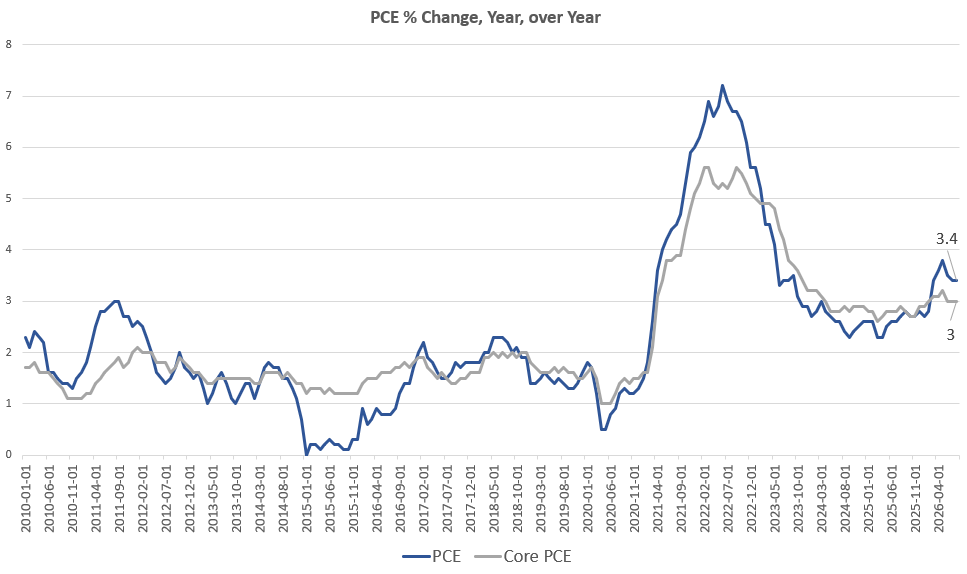
Most of these numbers, it should be noted, are well in excess of the Federal Reserve’s two-percent price-inflation target. Neither the CPI nor the core CPI have come in below two percent in more than five years. Moreover, even if we use the Fed’s preferred price inflation measure—personal consumption expenditure (PCE)—the Fed has still not hit its target in 66 months. In other words, Fed officials have been assuring the public for years that it will have a handle on price inflation any day now. We’re still waiting.
Perhaps most worrisome of all is the fact that growth in wages is not keeping up with rising prices. Last week, the Bureau of Labor Statistics released its employment report for September, and it showed that average hourly earnings were up in September by 3.02 percent. Unfortunately, price-inflation was up by more than 3.7 percent during the same period. In other words, inflation-adjusted wages fell during September. That’s the six month in a during which real wages have fallen.
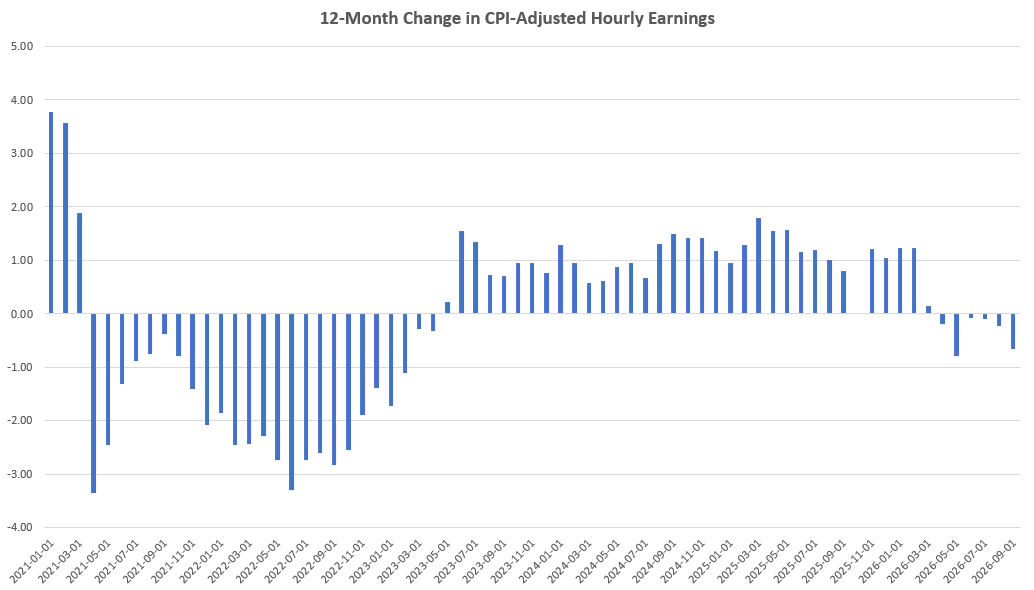
In fact, if we look at wage growth since early 2021, real wages are still below where they were five years ago. Yes, nominal wages have increased significantly during that period. But price inflation has repeatedly wiped out those gains.
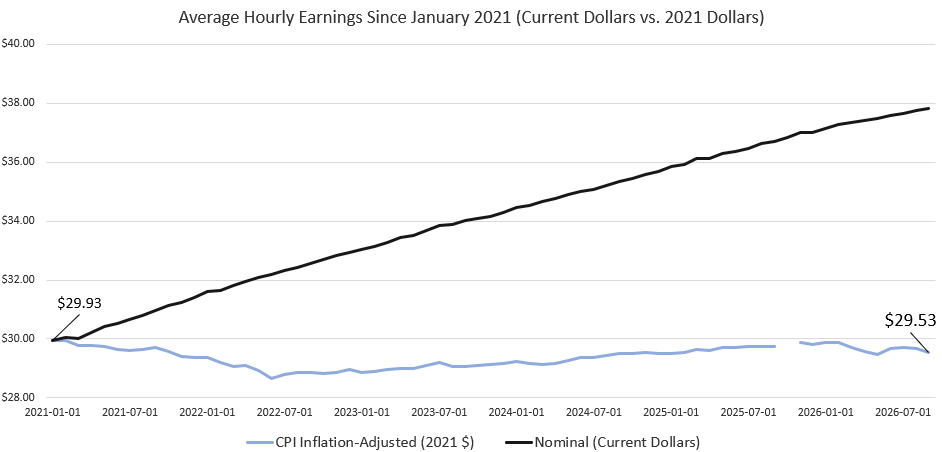
Even if a quick victory in the Strait could be achieved, that won’t erase the realities of falling wages. Will the administration embrace policies that will bring this impoverishing trend to an end? That is extremely unlikely. To reverse the current inflationary trend would require the federal government to slash federal spending so as to relieve pressure on the central bank to keep interest rates—i.e., borrowing costs—low. Moreover, if the central bank actually wanted to do something about the cost of living crisis, it would sell off its stockpile of mortgage-backed securities to bring down asset prices in real estate. This would also remove dollars from the economy and bring down inflation. We know that’s unlikely because President Trump has declared that he is committed to propping up home prices as a means of securing political support from older homeowners. More broadly, Trump has also made it clear that his fiscal plan does not involve any spending cuts. Rather, Trump has suggested that the best way to deal with massive federal debts and 2026’s $2-trillion deficit is to inflate it away. As Trump put it early this month: “You know, inflation, certain levels of inflation, will also pay off that debt very rapidly. Very rapidly.”
So we can forget about fiscal restraint or sound monetary policy from this administration. Nor will this be fixed even if recession sets in. That would lead to a falling CPI growth in the short run, and to falling interest rates as the Fed doubled down on monetary stimulus to “fix” the recession. In case of recession, interest rates, in some cases, would fall as inflation expectations fall. But a recession would also lead to massive amounts of new spending to create fiscal stimulus, and tax collections would fall, as they do during all recessions. So, this would create massive new deficits, leading to accelerating debt, and further upward pressure on longer-term interest rates. Naturally, a recession would also lead to falling nominal wages, so even a decline in overall price inflation would likely end with falling real wages.
The only real way out of this cycle is austerity and a recession that serves its purpose of popping the many malinvestment bubbles that have grown up since 2009. This process of malinvestment has strangled true market-based economic growth by inflating asset values in areas that are reliant on continual monetary inflation, and which are not based on the actual wants and needs of real consumers. What we have ended up with is a bubble-based economy that relies on continual new injections of easy money to keep the bubble economy afloat. This benefits the wealthy who own bubble-fueled assets and who benefit from easy-money fueled speculative manias. Ordinary people, however, will continue to see repeated bouts of falling real wages, as has been the case since 2021.
Ryan McMaken is editor in chief at the Mises Institute, a former economist for the State of Colorado, and the author of two books: Breaking Away: The Case of Secession, Radical Decentralization, and Smaller Polities and Commie Cowboys: The Bourgeoisie and the Nation-State in the Western Genre.
Original article link