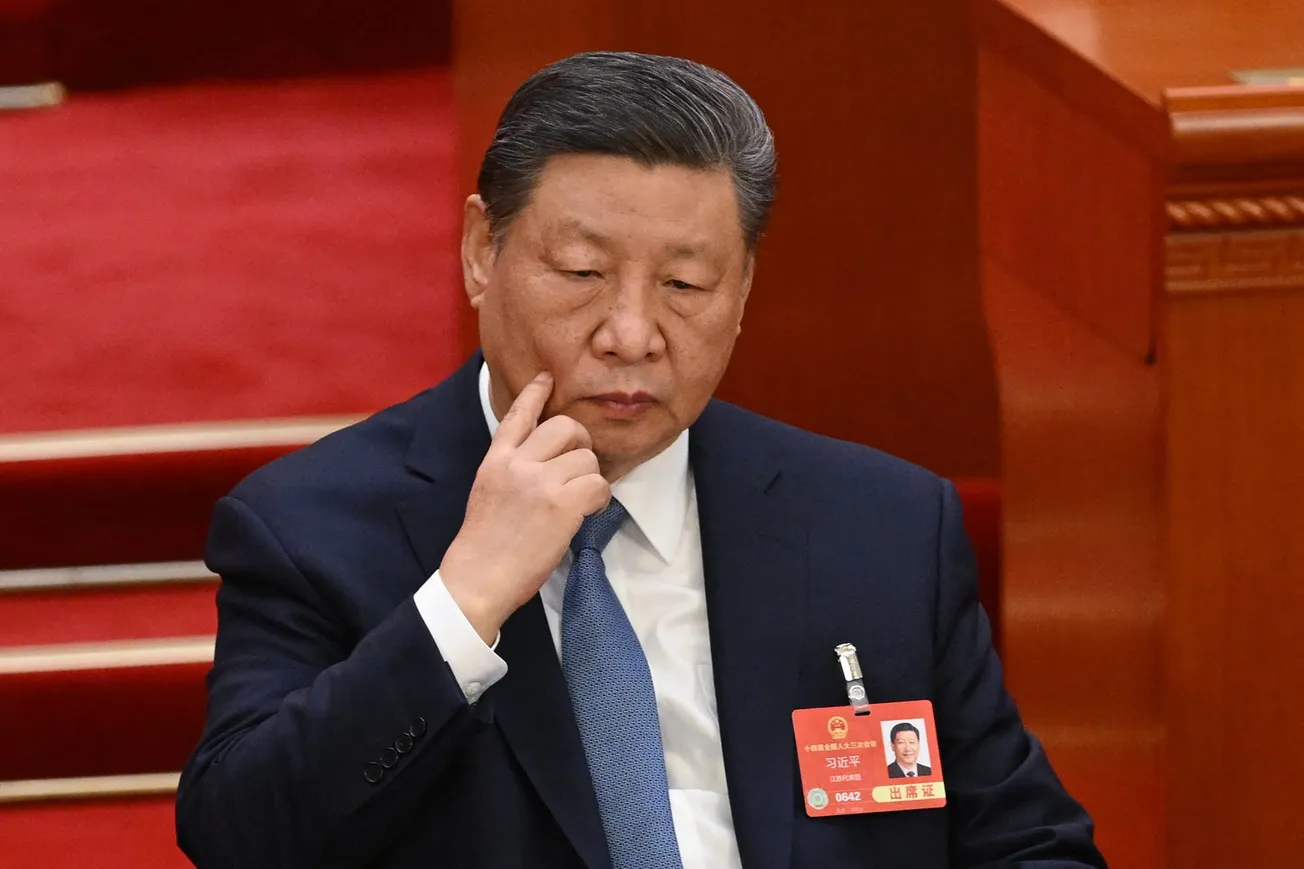
By Brahma Chellaney, Project Syndicate | October 22, 2025
From surveilling and repressing Chinese citizens to firing and prosecuting potential rivals, Chinese President Xi Jinping seems able to rule only through fear. But fear is not a foundation for long-term stability, and the more Xi seeks to consolidate power, the more vulnerable his position becomes.

NEW DELHI – During his 13 years in power, Xi Jinping has steadily tightened his grip on all levers of authority in China – the Communist Party of China (CPC), the state apparatus, and the military – while expanding surveillance into virtually every aspect of society. Yet his recent purge of nine top-ranking generals, like those before it, shows that he still sees enemies everywhere.
After taking power in 2012, Xi launched a crackdown on corruption within the CPC and the People’s Liberation Army (PLA). The campaign was initially popular, because China’s one-party system is rife with graft and abuse of power. But it soon became clear that enforcement was highly selective – a tool not for building a more transparent or effective system, but for consolidating power in Xi’s hands. In Xi’s China, advancement depends less on competence or integrity than on earning the leader’s personal trust.
But even after more than a decade of promoting only loyalists, Xi continues to dismiss officials regularly, including top military commanders. According to the US Office of the Director of National Intelligence, nearly five million officials at all levels of government have been indicted for corruption under Xi. And this is to say nothing of those who simply disappear without explanation.
True to form, Xi’s regime claims that the military leaders swept up by his latest purge – including General He Weidong, a member of the Politburo, Vice Chair of the Central Military Commission, and the third-highest-ranking figure in China’s military hierarchy – committed “disciplinary violations” and “duty-related crimes.” But a more plausible explanation is that Xi is playing an interminable game of Whac-a-Rival, desperately trying to preserve his grip on power.
Xi’s fears are not entirely misplaced: each new purge deepens mistrust among China’s elite and risks turning former loyalists into enemies. From Mao Zedong to Joseph Stalin, there is ample evidence that one-man rule breeds paranoia. By now, Xi may well have lost the ability to distinguish allies from foes. At 72, Xi remains so insecure in his position that, unlike even Mao, he has refused to designate a successor, fearing that a visible heir could hasten his own downfall.
None of this bodes well for China. By refusing to lay the groundwork for an eventual leadership transition, Xi sharply increases the risk that the end of his rule – however that comes – will usher in political instability. In the meantime, Xi’s emphasis on personal fealty over ideological conformity is weakening institutional cohesion in a system once grounded in collective leadership. Coupled with his arbitrary firings and prosecutions, Chinese governance is now increasingly defined by sycophancy and anxiety, rather than competence and consistency.
China’s military is paying a particularly steep price for Xi’s insecurity. In recent years, the PLA has undergone sweeping structural reforms aimed at transforming it into a modern fighting force capable of “winning informationized wars.” But Xi’s purges risk undermining this effort by disrupting military planning and leadership. For example, his abrupt removal in 2023 of the leaders of the PLA’s Rocket Force, which oversees China’s arsenal of nuclear and conventional missiles, may have jeopardized China’s strategic deterrent.
📘 TIPP’s Dragon Series
Explore China’s expanding reach and rising power through our exclusive editorial series:
- 🐉 The Dragon’s Image Problem
- 🐉 The Dragon’s Chokehold
- 🐉 The Dragon Learns To Fly
- 🐉 The Dragon’s Quest
- 🐉 Bear, Dragon, Eagle
- 🐉 Highway To The Danger Zone: The Dragon’s Gambit In The South China Sea
👉 Subscribe for $99/year to unlock the full Dragon Series and future deep-dive briefings from TIPP Insights.
Replacing experienced commanders with untested loyalists might ensure Xi’s political survival – and Chinese leaders have often used the military to safeguard their own power – but it does nothing for national security. And when generals are preoccupied primarily with political survival, both morale and operational readiness suffer. Can the PLA fight and win a war against a major adversary like the United States or India while operating under the political constraints Xi has imposed on it?
So far, Xi has advanced his expansionist agenda through stealth and coercion rather than open warfare. But a paranoid leader surrounded by sycophants unwilling or unable to challenge him is always at risk of strategic miscalculation. Recall that Stalin decimated the Red Army’s leadership on the eve of the Nazi invasion – with disastrous results. In Xi’s case, it might be China that does the invading, if he orders an amphibious assault on Taiwan.
For all the pomp surrounding China’s rise, the country is beset by structural problems, including a slowing economy, rising youth unemployment, and an aging and declining population. Popular discontent may well be growing, but it is masked by repression, just as any potential challenge to Xi’s leadership is preempted by purges and prosecutions. Ultimately, Xi seems able to rule only through fear.
But fear is not a foundation for long-term stability. A leader consumed by fear of disloyalty may command obedience but not genuine fidelity. Obedience is not merely a poor substitute for strength; it can become a source of fragility, as it leaves little room for creativity, competency, or collaboration. The great irony of Xi’s approach is that the more he seeks to consolidate power in his own hands, the more vulnerable his rule becomes.
Mao’s purges culminated in chaos and national trauma. Xi’s methods are more sophisticated, but the underlying logic is the same – as could be the results.
Brahma Chellaney, Professor Emeritus of Strategic Studies at the New Delhi-based Center for Policy Research and Fellow at the Robert Bosch Academy in Berlin, is the author of nine books, including Water: Asia’s New Battleground (Georgetown University Press, 2011), for which he won the 2012 Asia Society Bernard Schwartz Book Award.
Copyright Project Syndicate
TIPP Takes
Geopolitics, Geoeconomics, And More
1. Russia Was Smug About Trump-Putin Talks. Now They’re On Hold, Moscow’s Anxious - TIPP Insights
President Donald Trump said Tuesday that he didn’t want to “have a wasted meeting” with Russia’s President Putin.

The Kremlin stressed on Wednesday that the dates for the face-to-face talks, due to take place in Budapest in Hungary, “weren’t set” and that this would still happen. Russian officials blamed Western media for spreading “fake news” about the talks.
2. Vance: U.S. Not In Israel To “Babysit” Gaza Ceasefire - TIPP Insights
Vice President JD Vance said the United States is not in Israel to “babysit” the Gaza ceasefire, stressing that Israel is a partner, not a vassal state, as both nations navigate the fragile truce brokered by President Donald Trump earlier this month.

Speaking alongside Prime Minister Benjamin Netanyahu in Jerusalem, Vance reaffirmed Washington’s support while emphasizing Israel’s right to make its own security decisions.
3. U.S. Pressures Venezuela With Military Forces In Caribbean - TIPP Insights
The U.S. is carrying out its largest military build-up in the Caribbean for decades, with about 10,000 troops deployed to the region as the Trump administration increases pressure on Venezuela.

4. India To Cut Russian Oil Purchases, U.S. To Slash Tariffs As They Near Trade Deal: Indian Media Report - CNBC
India and the U.S. are close to reaching a trade deal, according to Indian media outlet Mint.

Washington may cut its tariffs on Indian exports to 15%-16% from the current 50%, the report said. New Delhi may agree to gradually wind down its imports of Russian oil, it added.
5. North Korea Launches Ballistic Missiles Days Before Trump's Visit To The Peninsula - TIPP Insights
North Korea test fired multiple short-range ballistic missiles on Wednesday, just days before President Donald Trump is expected to meet with Chinese President Xi Jinping and other leaders in South Korea.

South Korea’s military said the missiles, which were the first launched by its neighbor in five months, originated from an area south of Pyongyang and flew about 220 miles toward the northeast. The missiles did not land in the sea, the military added.
Trump is set to leave for Asia at the end of the week in what will be his first trip to the region during his second term. He plans to go to Malaysia first for a regional summit, and then head to Japan before traveling on to South Korea for an Asia-Pacific Economic Cooperation meeting.
6. Bessent Defends $20 Billion Argentina Aid Amid U.S. Shutdown - TIPP Insights
Treasury Secretary Scott Bessent defended the Biden administration’s decision to finalize a $20 billion emergency lifeline to Argentina during the ongoing U.S. government shutdown, calling it a “mission-critical” effort for national security and global financial stability.

His remarks came in response to Sen. Elizabeth Warren’s letter questioning why the Treasury was advancing foreign aid while federal operations were limited.
7. AI Experts Demand Global Pause On Superintelligence Development - TIPP Insights
A coalition of scientists, policymakers, and public figures is urging a global pause on the development of artificial intelligence systems that could surpass human intelligence.

The call, organized by the Future of Life Institute, has gathered over 800 signatures, including AI pioneers Yoshua Bengio and Geoffrey Hinton, Apple co-founder Steve Wozniak, and public figures like Richard Branson, Steve Bannon, and Susan Rice, Axios reported.
8. Meta Cuts 600 AI Jobs, Shifts Focus To New Superintelligence Lab - TIPP Insights
Meta Platforms is cutting about 600 jobs from its long-standing artificial intelligence operations as part of a major reorganization aimed at streamlining decision-making and boosting innovation, Axios reported Tuesday.

The layoffs affect teams within the company’s FAIR research division, AI infrastructure, and product-related AI units but exclude Meta’s new TBD Lab, which is expanding aggressively.
9. Study Finds GLP-1 Drugs May Help Prevent Risks From Sleep Apnea – Health News
Weight-loss drugs like Ozempic and Zepbound might help protect people from health risks related to sleep apnea, a new study says.

Type 2 diabetes patients taking GLP-1 drugs were overall less likely to die within the next year, but those with sleep apnea did even better, researchers reported Monday at a meeting of the American College of Chest Physicians in Chicago.
10. Market Pulse