
By Glenn Hubbard, Project Syndicate, April 16, 2026
The Wealth of Nations offers a useful lens for understanding why US President Donald Trump’s mercantilist agenda has fallen short of its own stated goals. It also points to a better path, combining competitive markets with policies that help workers and communities build skills and keep pace with economic change.
NEW YORK—November’s midterm elections pose a serious challenge for US President Donald Trump. Key components of his economic agenda, especially its protectionist measures, have raised concerns about the rising cost of living, prompted a rare rebuke from the Supreme Court, and cast doubt on the legal basis for his tariffs. Fortunately for Trump and the Republicans, they still have time to pivot to a pro-growth agenda that better addresses voter anxieties before the midterms.
Trump’s agenda is rooted in voter concerns about economic disruption driven by technological change and globalization. Breaking with the bipartisan embrace of market-friendly policies, his administration has sought to shield US producers from competition. While Treasury Secretary Scott Bessent has hinted that a pivot to a pro-growth strategy is in the works, reconciling it with the administration’s mercantilist approach will be difficult.
There is, however, an alternative path that better aligns with Trump’s stated goal of helping people and communities buffeted by economic change. For guidance, it is worth turning to Adam Smith. The Wealth of Nations, published 250 years ago, grappled with many of the same tensions and pointed to a pragmatic middle ground.
At first glance, Smith may seem at odds with Trump’s approach. After all, The Wealth of Nations centers on Smith’s critique of the mercantilist order of his day. Mercantilism prizes trade surpluses and the accumulation of national wealth in the hands of the state. To work, it requires extensive government intervention in commerce, trade, and labor markets. But that expansive role invites rent-seeking and excessive control, a key concern for Smith.
Smith’s treatise turned this system on its head by posing a radical question: Where does national wealth come from? For Smith, the answer stood in contrast to mercantilism. A competitive economy, with limited government intervention, would be accompanied by openness and specialization, in turn raising living standards.
While Smith did not develop a formal theory of growth, his intuition about the importance of openness to markets and innovation is consistent with modern growth models and stands in contrast to Trump-era policymaking. As Nobel laureate economist Joel Mokyr has noted, science, practical knowledge, and openness to change are key drivers of long-term prosperity.
But Trump has also identified an important tension. Modern growth models are like a coin. The “heads” side is growth and its benefits for living standards; the “tails” side is disruption—the upending of existing investments, firms, jobs, and even communities. It is here that Trump’s mercantilism, with its focus on minimizing the effects of disruption on voters’ lives, gains political traction.
Smith challenges this perspective in two ways. First, he reminds us of the limits mercantilism places on living standards. Second, in The Theory of Moral Sentiments, which he considered his finest work, he emphasizes empathy and what my Columbia colleague Edmund S. Phelps calls “mass flourishing,” which aims to ensure that everyone benefits from economic progress, including those disrupted by its forward march.
Here, then, is the policy alternative to both Trumpian mercantilism and market orthodoxy: augmenting Smith’s concept of “competition” with the “ability to compete.” Such an agenda would center on preparation and reconnection, both vital for participation in—and support for—an open economy.
One place to begin is workforce development. In the United States, community colleges are well positioned to serve as training grounds for skill development and career transitions, often working closely with local employers to create quality jobs. While support for community colleges has declined in many states, a federal block grant focused on completion and skill development would significantly enhance their impact.
Similarly, a more generous Earned Income Tax Credit could boost labor-force participation and attachment. Increased funding for basic research, alongside support for applied research centers across the country, could raise productivity by bringing cutting-edge tools to businesses, much as land-grant colleges have historically done in agriculture and manufacturing.
To reconnect displaced workers, personal re-employment accounts—combining funds for training with re-employment bonuses—could help reduce the duration of joblessness. For communities affected by structural economic change, more effective place-based aid could support productivity-enhancing business services in lower-income areas with higher unemployment.
Such measures, along with a growth-oriented agenda, could reshape the electoral landscape. Investments in AI and electricity generation could be accelerated through regulatory reform, particularly by easing permitting rules under the National Environmental Policy Act. To increase the housing supply, a prerequisite for mobility and growth, the administration could propose incentives for state and local governments to scale back restrictive construction regulations.
Going further, the administration would need to abandon its nativist immigration policies. Increasing the number of high-skilled immigrants, particularly in STEM fields, would boost growth, as immigrants have been shown to drive technological innovation, leading to more patents, higher productivity, and rising incomes.
Likewise, expanding federal support for research and development would yield high returns. Some estimates suggest that the returns are so large that the net cost to taxpayers may be zero or even negative, as higher productivity generates enough additional tax revenue to offset the cost. Combined with a stable macroeconomic environment and pro-investment policies of the kind Trump has championed, these changes could significantly accelerate growth.
A more constructive approach to economic disruption would shift away from broad tariffs and protectionism, which tend to raise consumer prices and erode the competitiveness of US manufacturing by increasing input costs. The Supreme Court’s recent reversal of many tariffs imposed by Trump under the International Emergency Economic Powers Act has created an opportunity—and underscored the need—for a course correction.
Trump has rightly raised questions about the economic consequences of technological change and globalization. Two and a half centuries after its publication, The Wealth of Nations points toward a necessary pivot away from mercantilism and toward a more balanced, pro-growth framework.
Glenn Hubbard, a former chair of the US Council of Economic Advisers under President George W. Bush, is Professor of Economics and Finance at Columbia University.
Copyright Project Syndicate
👉 Show & Tell 🔥 The Signals
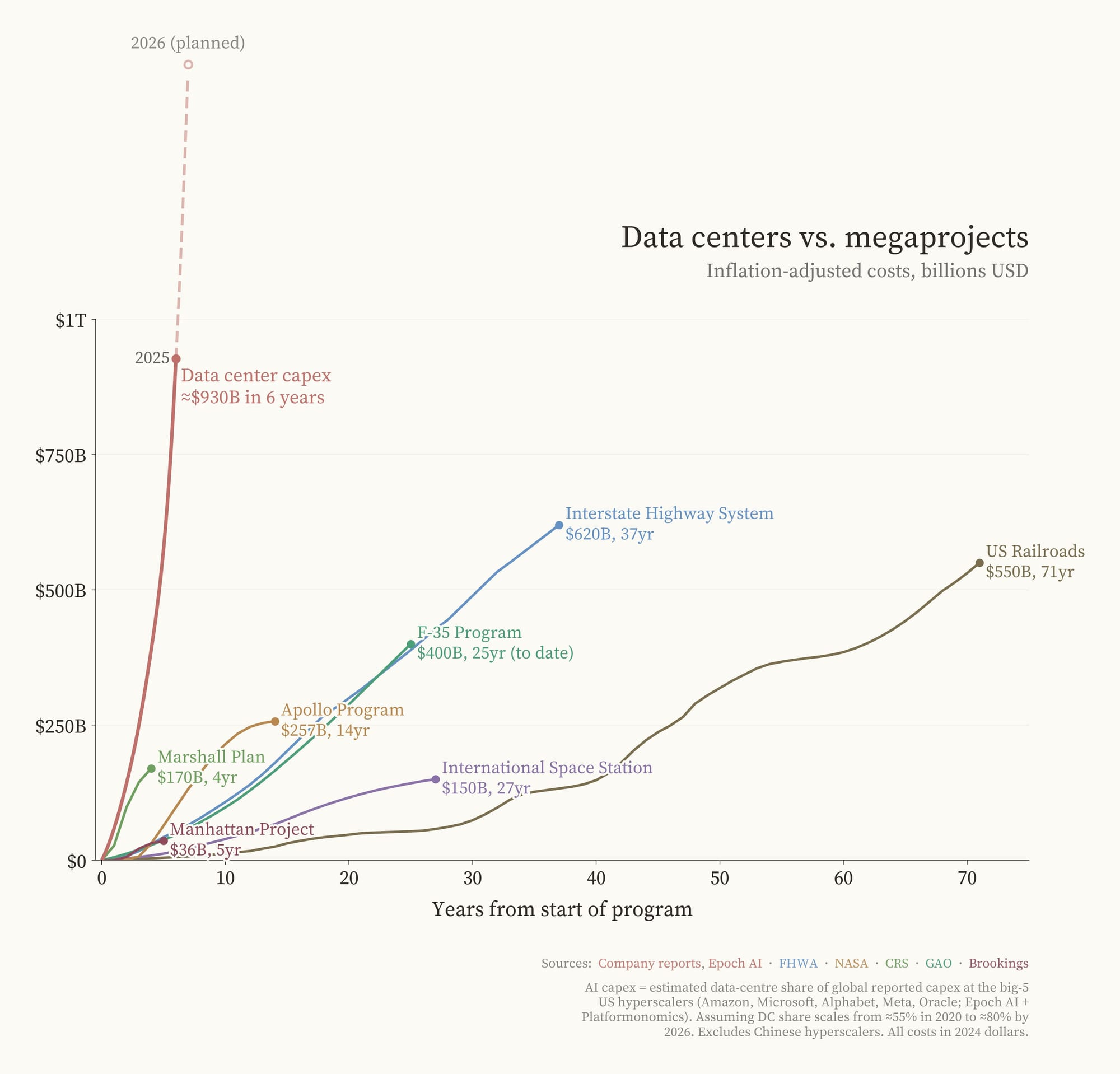
I. Big Tech Is Building Projects Once Reserved For Governments
America’s largest tech firms are now spending at historic scale. Combined data-center capex reached roughly $930 billion in six years through 2025, according to the chart—already above the Apollo Program ($250B over 14 years) and more than double the Marshall Plan ($170B over 4 years) in inflation-adjusted dollars. AI infrastructure is becoming this generation’s moonshot.
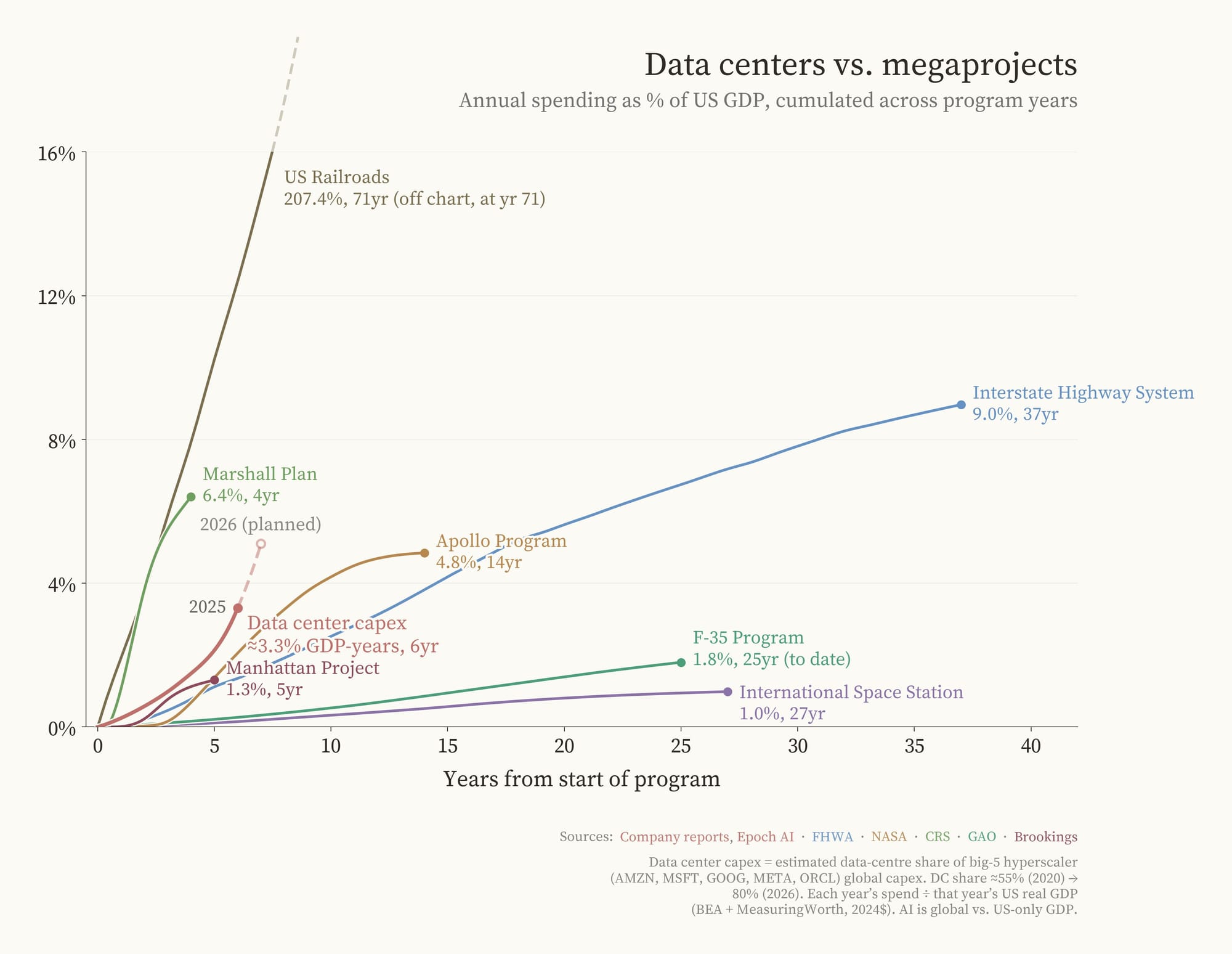
II. Huge in Dollars, Still Smaller Than Past National Mobilizations
The raw numbers are massive, but relative to the size of the economy they are smaller than earlier national efforts. The chart estimates data-center spending at about 3.3% of GDP over six years in 2025, versus 4.8% for Apollo, 8.4% for the Marshall Plan, and 9.0% for the Interstate Highway System. Big Tech is spending big—but not yet at nation-building scale.
📊 Market Mood — Friday, April 17, 2026
🟩 Markets Pause Near Highs as Peace Talks Loom
U.S. futures were muted as investors awaited possible weekend U.S.-Iran negotiations.
🟧 Oil Slips as Ceasefire Hopes Build
Crude stayed below $100 as prospects for a longer-term deal eased immediate supply fears.
🟦 Tech Recovery Meets Earnings Reality Check
AI-linked hardware names stayed strong, while Netflix fell on a soft outlook and leadership news.
🟨 Resilient Economy Supports Risk Appetite
Solid early earnings and steady growth signals helped sustain bullish sentiment.
🗓️ Key Economic Events — Friday, April 17, 2026
No events scheduled
editor-tippinsights@technometrica.com