By Shang-Jin Wei, Project Syndicate | Mar 18, 2026
Joining the S&P 500 can transform a company’s fortunes, making confidence in the selection process essential for investors and markets alike. But a new study finds that companies purchasing S&P credit ratings were more likely to be admitted, raising questions about the influence of commercial incentives on firms' inclusion.
NEW YORK – Few benchmarks matter more to financial investors than the S&P 500. Trillions of dollars track it directly, and many more are evaluated against it. Inclusion often boosts a firm’s stock price, lowers its cost of capital, and confers prestige. Many corporate boards even tie executive compensation to performance relative to the index.
Given the S&P 500’s influence, index membership should be determined objectively and transparently. Yet as a recently published research paper by Kun Li, Kelly Liu, and me shows, the process for adding companies allows for considerable discretion, potentially creating incentives for firms to purchase S&P’s credit ratings in hopes of improving their chances of getting into the index. This is suggested by a key finding: firms that recently obtained an S&P rating were more likely to be added to the S&P 500 than those that purchased ratings from Moody’s.
When the working-paper version of our study first circulated in 2021, S&P strongly objected to our interpretation, emphasizing that its index committee operates independently of its ratings business, with the two separated by a “Chinese wall.” According to the company, the index team does not communicate with ratings analysts about firm-level decisions, and therefore, index inclusion cannot be influenced by ratings-related revenue. While we take this claim seriously, the data reveal patterns that are difficult to reconcile with full separation between S&P’s index and ratings divisions.
S&P publishes detailed criteria for index inclusion, including minimum market capitalization, liquidity, financial viability, and sector representation. Thus, we began with a simple question: How closely did decisions to include firms follow these stated rules? Using data from 1980 to 2018, we found that the published criteria explained no more than 15% of additions to the S&P 500. Many firms that met all the criteria were passed over, while others were admitted despite seeming to fall short.
To be sure, there is nothing inherently wrong with discretion in stock-index construction, and S&P does not claim its methodology is purely mechanical. The index committee is expected to exercise judgment. But whenever discretion is involved, incentives matter.
With this in mind, we examined whether firms that recently purchased an S&P credit rating were more likely to be added to the index. S&P does not publicly disclose its rating fees, but estimates from other rating agencies suggest that they range from a few thousand dollars to several million. After accounting for the published selection criteria, we found a clear pattern: firms that had recently obtained an S&P rating were significantly more likely to gain admission to the S&P 500. For non-member firms, the unconditional likelihood of being added to the index was 15.5%; for firms that had recently purchased an S&P rating, it was 21.4%.
One possible explanation is that S&P tends to favor fast-growing firms, and that such companies are naturally more likely to issue debt and seek credit ratings. But if that were the whole story, we would expect to see the same pattern among firms that purchased ratings from Moody’s, and we did not. If rating purchases simply reflect firm quality or growth prospects, the effect should not be specific to S&P.
Firms’ behavior further suggests that they see a link between rating purchases and index inclusion. When mergers among S&P 500 firms create openings for new additions, large non-member firms disproportionately increase their purchases of S&P ratings. Conversely, after a 2002 rule change that made foreign firms ineligible for inclusion, non-US firms listed on US exchanges sharply reduced their purchases of S&P ratings relative to Moody’s. The implication is clear: when the prize disappears, so does demand. Taken together, these patterns suggest that firms believe purchasing S&P ratings increases their chances of joining the index.
What about another, more innocent explanation? S&P learns useful information during the ratings process, which helps it decide whether firms belong in the index. In that case, the correlation we observed between rating purchases and subsequent inclusion reflects improved information from the rating process rather than business incentives.
But this explanation is difficult to sustain. For starters, if index-addition decisions rely on non-public information obtained through the ratings process, that would mark a departure from S&P’s published methodology, which does not indicate that private ratings information is used in index decisions.
Moreover, such information-sharing would seem at odds with S&P’s public statements that the index committee and ratings department operate independently and do not exchange firm-specific data. In addition, the information uncovered during the rating process could just as easily lower a firm’s chances of inclusion as raise them.
Lastly, when we looked at how companies performed after joining the S&P 500, we found no evidence that discretionary additions – including those associated with recent rating purchases – systematically outperformed rule-based additions or even firms that met the criteria but were passed over. In other words, discretion does not appear to lead to better outcomes.
Whether or not S&P 500 membership is literally for sale, the evidence suggests that firms behave as if it might be. And when companies believe that paying for ratings can improve their odds of inclusion in the index, the credibility of the admission process is at risk.
Shang-Jin Wei, a former chief economist at the Asian Development Bank, is Professor of Finance and Economics at Columbia Business School and Columbia University’s School of International and Public Affairs.
Copyright Project Syndicate
Iran Restricts Hormuz Transit To Approved Vessels
Around 100 ships have passed through the Strait of Hormuz since early March, sailing close to the Iranian coast, suggesting an approved route that points to Tehran’s tightening grip on the narrow waterway.
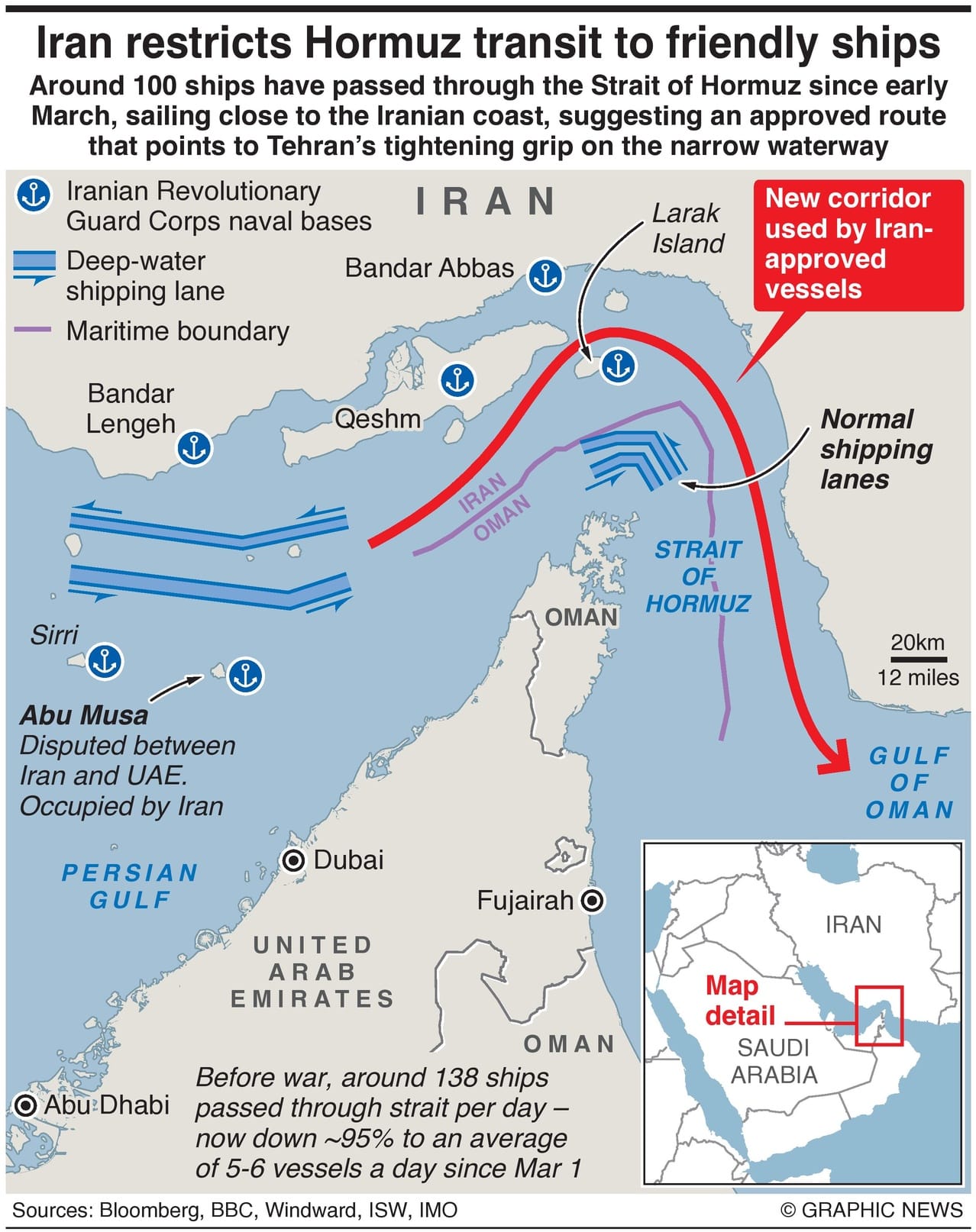
Traffic through the vital chokepoint has collapsed since the outbreak of hostilities. Before the conflict, roughly 138 vessels transited the strait; since March 1, that figure has plunged by about 95% to an average of just five to six ships a day.
Those vessels that do make the journey are also changing their behavior. Some ships crossing the strait appear to be taking longer, less direct routes than usual, avoiding the central shipping lanes in favor of paths that hug Iran’s coastline.
Tracking data underscores the shift. A Pakistan-flagged oil tanker, for example, sailed close to the Iranian coast during its passage on March 15, rather than following the more commonly used route through the middle of the strait.
Taken together, the patterns suggest that ships are adhering to routes implicitly sanctioned by Tehran –pointing to a more controlled, selective flow of traffic through one of the world’s most strategically important maritime corridors.
A-10 Warthogs Hunt For Iranian Boats In The Strait Of Hormuz
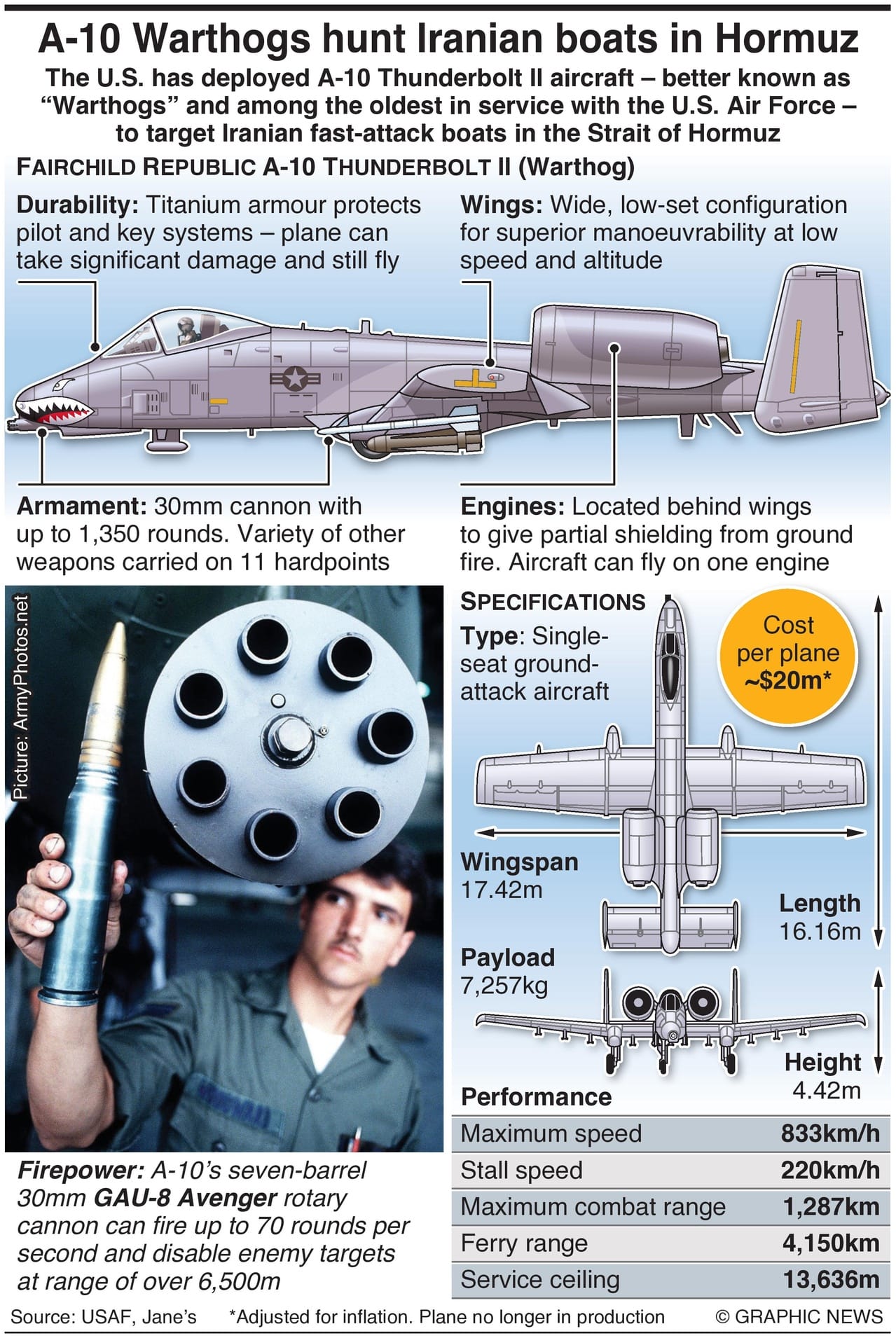
The U.S. has deployed A-10 Thunderbolt II aircraft – better known as “Warthogs” and among the oldest in service with the U.S. Air Force – to target Iranian fast-attack boats in the Strait of Hormuz.
According to Dan Caine, chairman of the Joint Chiefs of Staff, the aircraft are now actively engaged in the conflict. Speaking at a Pentagon briefing on Thursday, he said the A-10 “is now in the fight across the southern flank and is hunting and killing fast attack watercraft in the Strait of Hormuz.”
The A-10s are part of a broader U.S. effort to counter Iranian maritime threats in the strategic waterway. AH-64 Apache helicopters are also operating in the area.
Originally developed in the 1970s during the Cold War to destroy Soviet tanks in Europe, the A-10 was built for close air support missions, capable of flying low and slow over the battlefield and remaining near combat zones for extended periods. Its firepower is centered on a powerful seven-barrel Gatling gun, capable of firing nearly 4,000 rounds per minute, making it particularly effective against small, fast-moving targets.
editor-tippinsights@technometrica.com