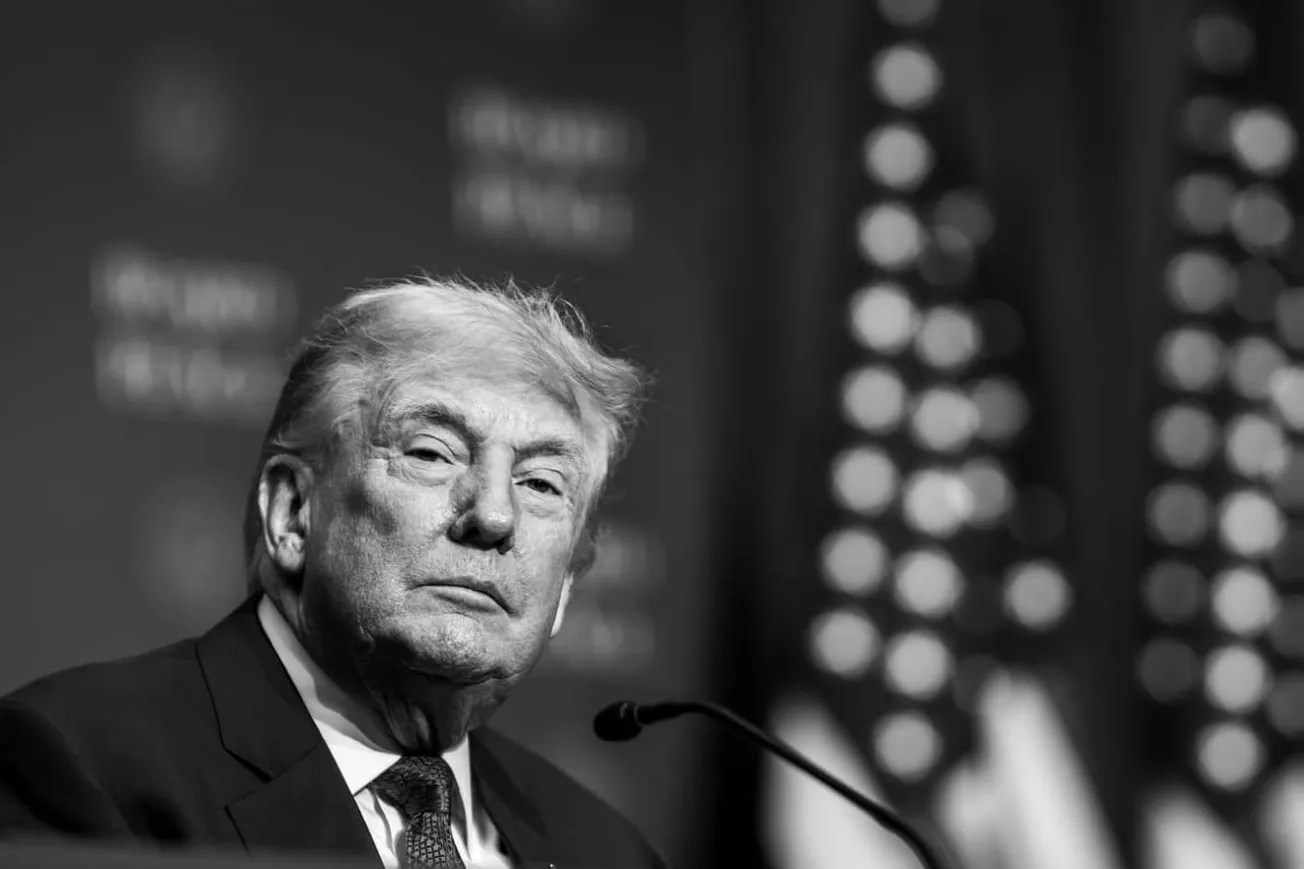

The federal income tax is abusive. It is inconsistent with liberty. It has, as Chief Justice John Marshall noted, the power to destroy. There is nothing positive to be said about it. It cannot even raise government revenues efficiently. As we said a year ago, of all the good Donald Trump could do in his second term, eliminating the federal income tax would be one of his greatest achievements.
It’s clearly one of his goals.
“As time goes by, I believe the tariffs paid for by foreign countries will, like in the past, substantially replace the modern-day system of income tax,” Trump said during his State of the Union address.
It’s unlikely, though, that there will be a one-for-one swap between the two.
“To put it simply, the math just doesn’t work,” said Alex Durante, Tax Foundation senior economist.
Just as Trump pointed out, tariffs were at one time the primary source of federal revenues. But the government was smaller then (and should be far smaller now), not only in nominal terms but in relative terms, as well.
In 1900, federal revenues as a portion of the gross domestic product were a mere 3%. The portion shot sky high to almost 20% in 1945 to fund the war effort. The peace dividend that followed was both meager and brief. From 1952 to the present, it has bounced around in tight neighborhood bounded by a low of 14.4% in 2010 and a high of 19.8% in 2000. Last year, it was roughly 17%.
Feeding the rapacious federal Leviathan today would require either a significant bump in tariff receipts (not a good idea) or a sharp shrinking of the size and scope of Washington (a beautiful idea).
Neither, of course, is likely.
But our friends at the Committee to Unleash Prosperity point out that a national sales tax of 18% “could replace the federal personal income tax, the capital gains tax, the corporate tax and the dividend tax.”
“Imagine that America had no income tax. This would be the greatest wealth and job generator in world history. The only problem would be that everyone in the world would want to come here. We’d need a bigger wall.”
Without income taxes, capital gains taxes, corporate taxes and dividend taxes, Americans would not only enter into a new era of economic freedom, they would have many more hours to spend as they please — working, relaxing, traveling, the list is endless — because the burden that requires them to burn more than 7.9 billion of their hours complying with IRS filing and reporting requirements would be lifted.
To understand how this translates into more approachable numbers, we go to Scott Hodge and Claire Rock of the Tax Foundation, who have calculated that the time and labor Americans waste on tax preparation “is equal to 3.8 million full-time workers doing nothing but tax return paperwork — roughly equal to the population of Los Angeles — and nearly 46 times the workforce at the IRS.”
“If we assume a reasonable hourly wage, the 7.9 billion hours Americans spend complying with the tax code costs the economy roughly $413 billion in lost productivity,” they say. “In addition, the IRS estimates that Americans spend roughly $133 billion annually in out-of-pocket costs to comply with the tax code. This brings the total compliance costs to $546 billion, or nearly 2% of GDP.”
The IRS is also a booted agency, by which we mean it has the administrative leverage and inclination to wreck people’s lives. We again bring up the story of Dan Pilla, who has spent decades helping Americans with IRS problems avoid the cruel treatment he experienced as a teenager. As an 18-year-old, he sued the federal tax collectors because he had “literally stumbled onto an area of the law that deals with taxpayers’ rights and limits the IRS’ power” after he figured out “the IRS was proceeding illegally to seize” his family’s home.
That would not happen if Washington were to replace its revenue-collecting system from one that has the power to destroy to one that is more civilized.
— Written by the I&I Editorial Board
U.S. Bases In Europe Used To Attack Iran
President Trump has sought to use U.S. military bases in Europe for attacks on Iran, threatening Spain with a trade embargo after it refused. Other European allies are offering varying degrees of support.
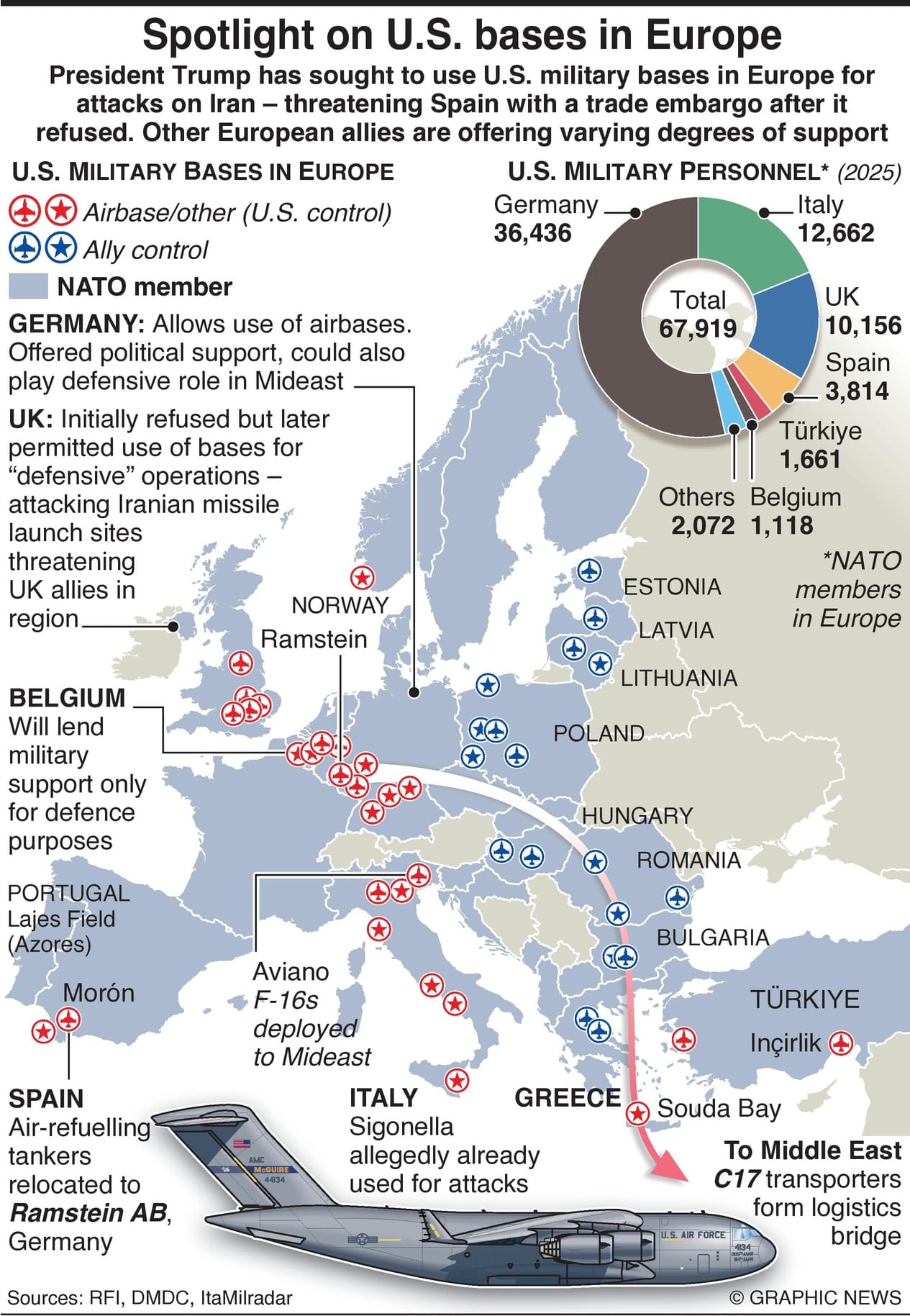
There are two U.S. bases and almost 4,000 military personnel based in Spain. Following the Spanish refusal, air-refueling tankers from Morón airbase were relocated to Ramstein AB in Germany, where the host nation has been more cooperative. Spain drew the ire of President Trump in 2025 when it refused to accept the NATO proposal for member states to increase their defense spending to 5% of GDP. However, as part of the EU, the U.S. cannot enforce trade embargoes on Spain without involving all member states.
Germany has offered political support to the U.S. and may take part in defensive operations in support of allies in the Middle East. Ramstein has emerged as a key hub for the operation, with C-17 transporters serving as a logistics bridge to the Middle East, which will be essential to maintain a steady stream of spare parts, munitions, ground crews, and specialized equipment as the conflict continues.
President Trump also criticized Britain for not co-operating more fully after Prime Minister Keir Starmer initially refused to allow the use of UK bases for the attacks, but later permitted the use of bases for defensive” operations only after UK allies in the region – including a UK base in Cyprus – came under attack by Iranian missiles and drones.
Belgium has said it will not provide military support to the “legally dubious” U.S.-Israeli attacks on Iran, although the defense minister agreed it was “righteous” and the country may provide support for defense purposes. Italy is bound by its constitution not to wage an offensive war, but its Sigonella base in Sicily has allegedly already been involved in attacks.
Oil Prices Continue To Rally As Iran War Expands
Global oil prices are continuing to rise in the wake of U.S. and Israeli attacks on Iran – and its response of bombing neighboring countries in a deliberate ploy to destabilize the region.
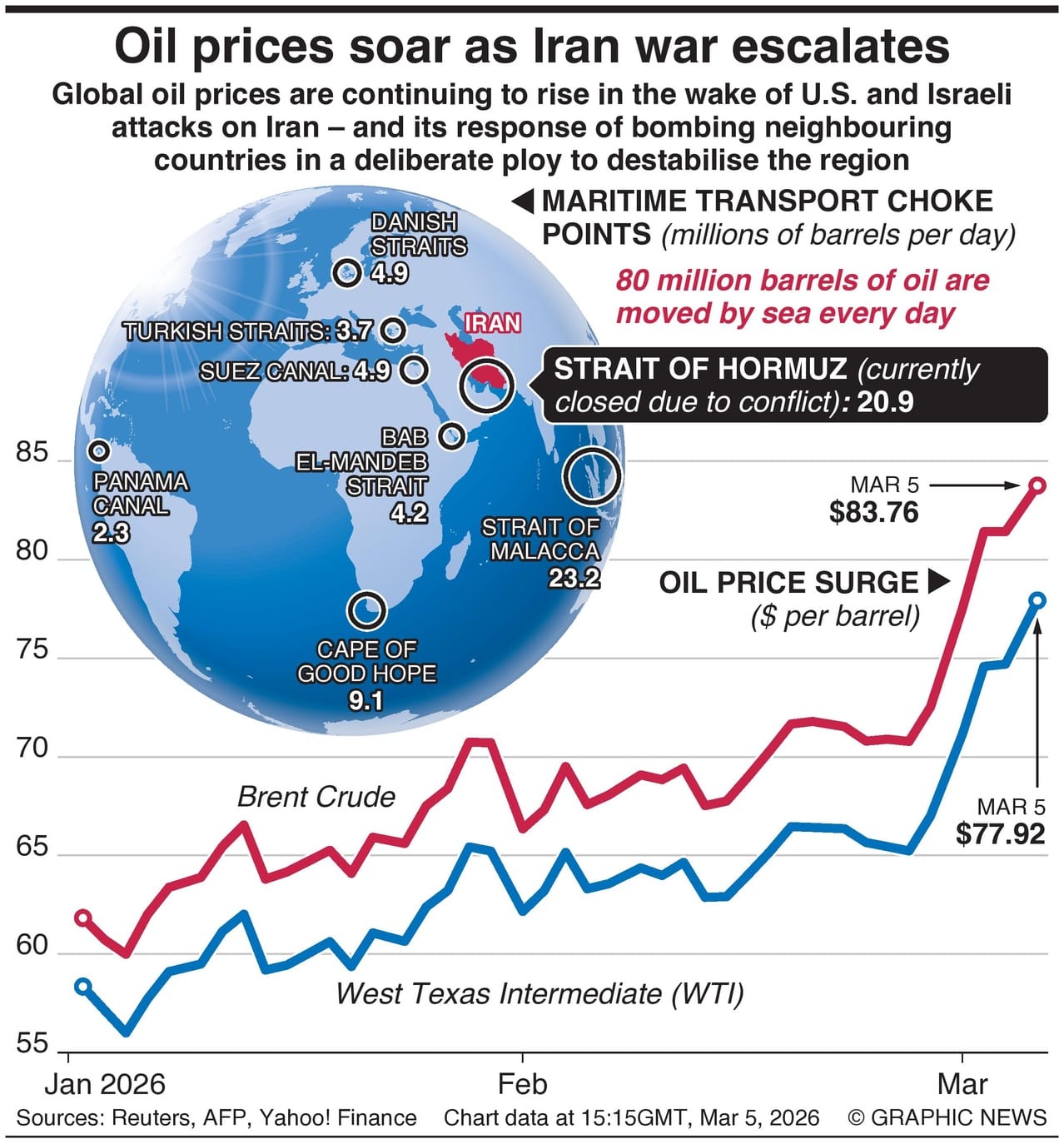
With munitions and drones raining down all over the Middle East, the Straight of Hormuz – a narrow and vital waterway transportation corridor for about 20% of the world’s oil supplies – is closed, sending oil prices skywards.
As of 15:15GMT, March 5, 2026, the Brent Crude oil price was $83.76 and the West Texas Intermediate (WTI) oil price was $77.92 – up 18% and 19% respectively on where they closed at the beginning of last week.
Catch up on today’s highlights, handpicked by our News Editor at TIPP Insights.
1. Iran's Revolutionary Guards Move To Secure Power With Mojtaba Khamenei Succession
2. China Ramps Up Diplomatic Spending To Strengthen Global Reach
3. Spain Rejects White House Claim Of Military Cooperation In Iran War
4. US Torpedo Attack Destroys Iranian Warship, Marks First Submarine Strike Since 1945
5. GOP Senators Reject Effort To Restrict Trump’s Military Action Against Iran
6. Venezuela To Send Up To 1,000 Kg Of Gold To U.S. Markets In New Deal
7. U.S. Submarine Sank Iranian Warship Off Sri Lanka’s Coast—TIPP Quick Takes
8. AI Boom Is Driving Massive Data-Center Expansion—TIPP Quick Takes
9. Global Markets Show Sharp Divergence—TIPP Quick Takes
10. Israel Hits Tehran Security Sites; Iran Strikes Dubai And Qatar—TIPP Quick Takes
11. 401(k) Hardship Withdrawals Hit Record 6%—TIPP Quick Takes
12. Trade Court Orders Trump Administration To Begin Tariff Refunds
13. Anthropic And Pentagon Resume Talks Over Military Use Of AI
14. Trump Administration Showcases Advanced U.S. War Technology In Iran Conflict
15. New Berkshire CEO Greg Abel Invests $15 Million As Company Restarts Buybacks
16. Iran Conflict Sends Shockwaves Through $11 Trillion Travel Industry
17. Lawsuit Targets Trump Over TikTok Deal And Alleged Conflicts Of Interest
18. David Ellison Says CNN Editorial Freedom Will Be Protected
19. Trump Weighs Replacing DHS Secretary Kristi Noem After Hearing Fallout
editor-tippinsights@technometrica.com