
There are never any winners when disaster strikes. Whether it is the devastating floods in Texas or the tragic loss of life in an aviation accident, the result is the same—hundreds of unsuspecting people suddenly and violently ripped from their lives.
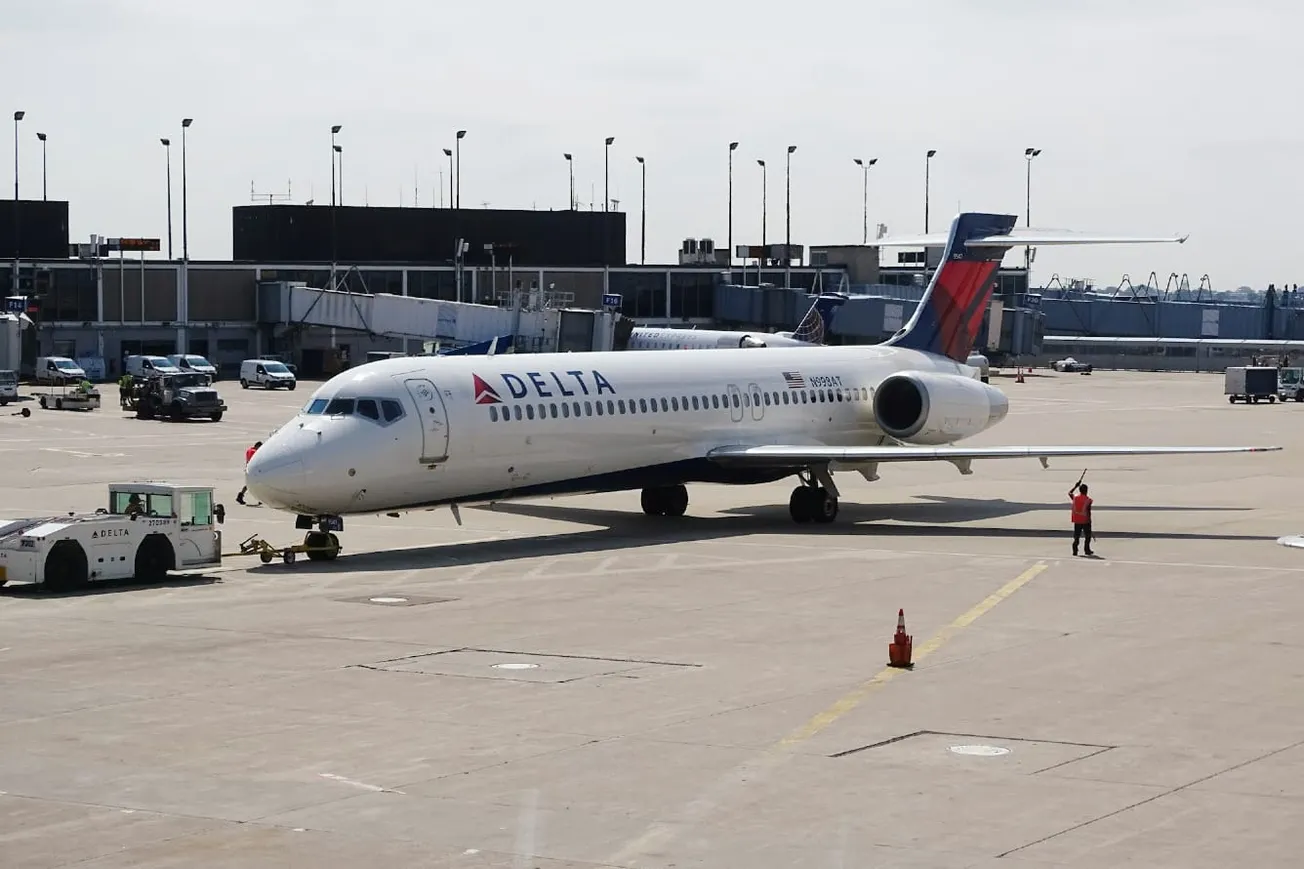
India's worst aviation disaster in nearly three decades occurred just over a month ago when a Boeing 787 Dreamliner equipped with GE Aerospace engines took off on a routine flight from Ahmedabad to London Gatwick and crashed within seconds. With assistance from the U.S. National Transportation Safety Board, along with engineers from Boeing and GE, Indian aviation authorities conducted an investigation and released the findings. While preliminary reports are rarely conclusive and may take years to finalize, this document has given two major American aerospace firms significant relief.
The aircraft was operated by Air India, the nation's historic flagship carrier, which was recently sold to the Tata Group at a deep discount. The Tata conglomerate is the crown jewel of Indian industry, with a vast presence spanning everything from salt and tea to steel and software consulting. It is also a major automotive force, owning iconic British brands like Jaguar and Land Rover.
According to the report, the aircraft showed no signs of malfunction as it prepared for takeoff. It had just arrived from New Delhi and completed its pre-flight procedures without incident. Pilot logs showed nothing out of the ordinary. The refueling process, often an area of scrutiny in such investigations, went smoothly, eliminating speculation that fuel contamination may have caused the crash.
At the helm were two experienced pilots. The captain had logged nearly 15,000 flight hours, while the first officer had approximately 3,500. At the time of the incident, the first officer was the pilot flying (PF), while the captain served as the pilot monitoring (PM), managing the aircraft’s systems. Modern aircraft like the Boeing 787 are highly advanced systems that are rarely involved in catastrophic incidents, especially when flown by seasoned professionals. Since entering commercial service in 2011—after early setbacks involving lithium-ion battery fires—the 787 had built a sterling safety record. Over 1,000 Dreamliners are in active service globally, many powered by GE's engines. If the report had identified any fault with either Boeing or GE, it would have triggered a public relations crisis, led to massive financial losses, and possibly existential consequences.
Instead, the report politely stated that there were "no recommendations" for Boeing or GE, a phrasing so deliberate it likely involved senior Indian government officials. That choice of words alone may explain the delay in releasing the document. Intriguingly, the report fails to assign blame to pilot error or maintenance issues, yet still offers a clean chit to Boeing and GE. Not everyone is convinced. Some Indian media voices accuse Western outlets of being condescending—and too quick to blame the disaster on pilot error while rushing to exonerate Boeing and GE.
We've seen this before. When the Boeing 737 Max crashed in 2018 and 2019, early narratives leaned heavily on pilot error, especially because the airlines involved were from developing countries. But the real story turned out to be a hidden software system—MCAS—that Boeing hadn’t properly disclosed or trained pilots to handle. That painful episode has since made aviation experts more cautious. With the Dreamliner crash, the switches clearly moved. But whether it was human, mechanical, or something deeper in the system remains far from settled, despite the clean chits.
There had been reason to believe this outcome was coming. Independent aviation experts, reviewing surveillance video and footage from a bystander on a nearby balcony, noted that everything appeared normal until just seconds after takeoff. The aircraft rotated properly and became airborne. But within 36 seconds, the plane plummeted into the dormitory of a medical school just beyond the airport perimeter. All 242 people onboard perished, except for one miraculous survivor. As per many news reports, around twenty more died on the ground.
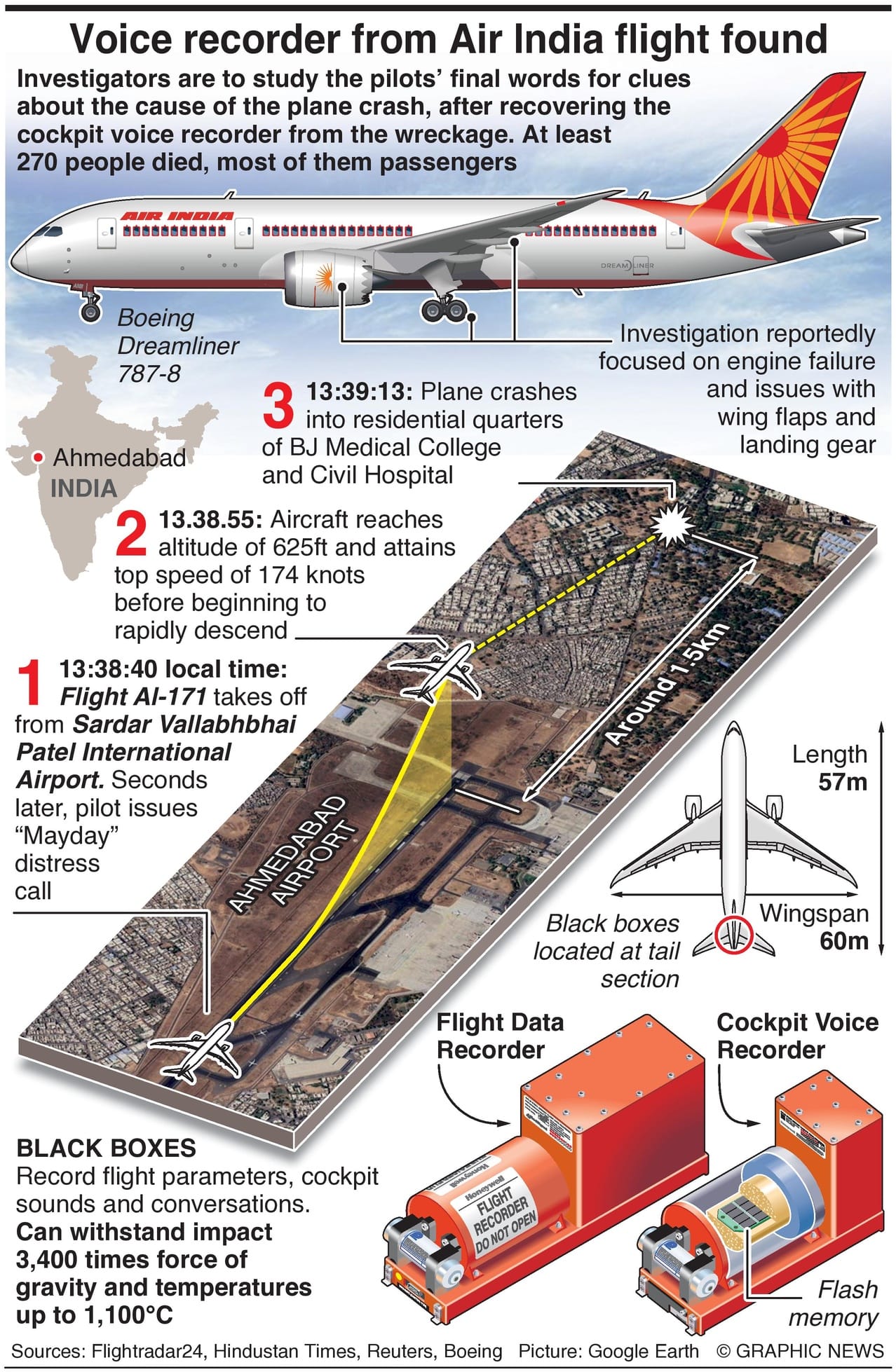
The report revealed that during the initial moments of the flight, confusion erupted in the cockpit. Data from the flight recorder indicate that the aircraft’s two fuel control switches transitioned from “run” to “cut-off” within a single second, shortly after takeoff. Cockpit voice recordings captured one pilot asking, “Why did you cut off?”—with the other pilot responding, “I did not do so.” It remains unclear who posed the question and who answered. Regardless, both engines lost power at the most critical point of flight—the climb out of takeoff.
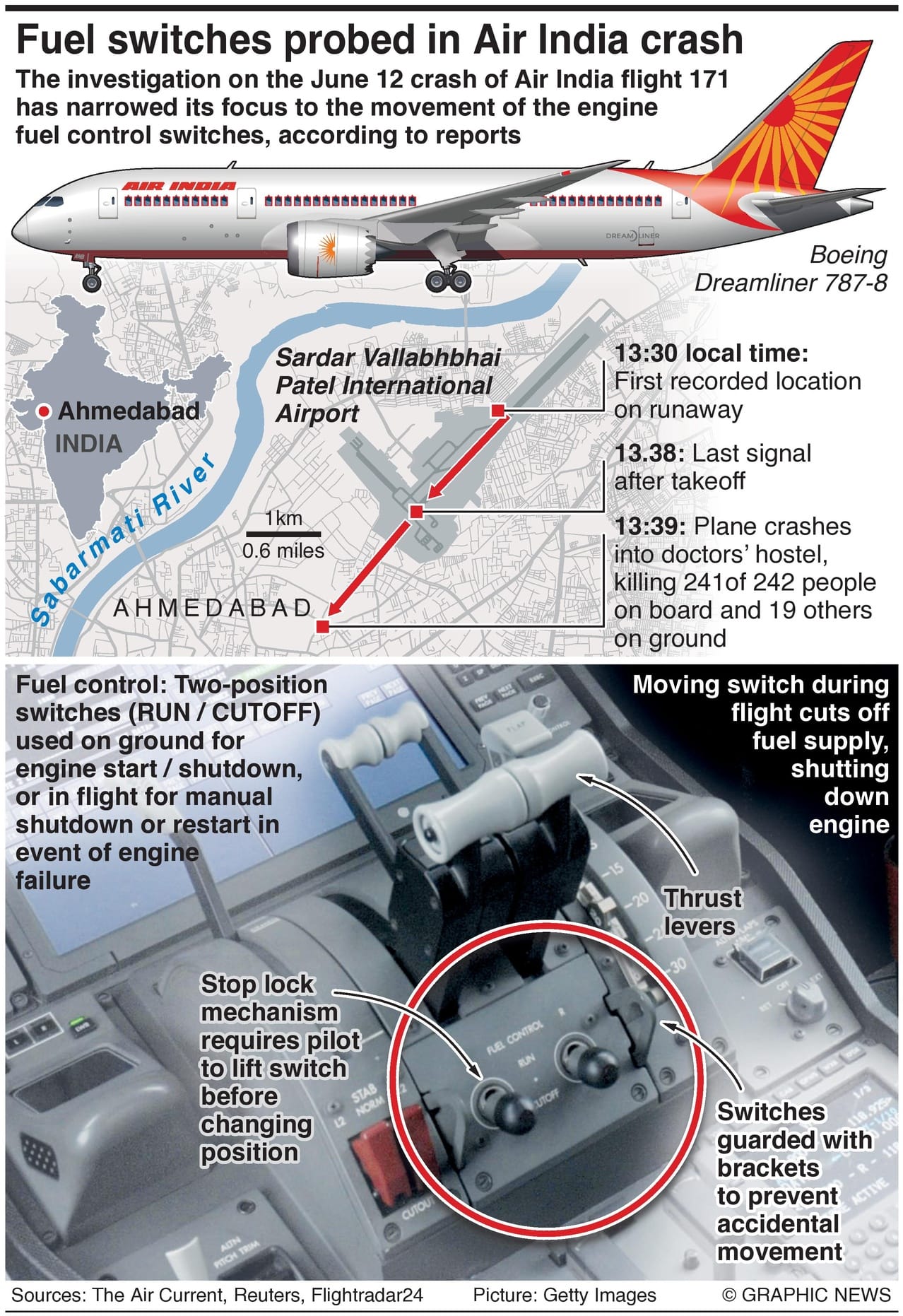
The idea that both fuel switches were turned off by accident has been met with skepticism by experts. These switches are protected by robust mechanical gates and spring-loaded safety locks, explicitly designed to prevent unintentional movement. To turn one switch off, a pilot must deliberately lift the switch over a metal guard and hold it in place. The idea that both switches simultaneously moved to “cut-off” because of a stray object—like a file folder or clipboard used to hold flight documents—defies logic, especially since mechanical guards protect the switches and require deliberate, forceful action to operate. A Canada-based air accidents investigator, speaking anonymously to the BBC, said: “It would be almost impossible to pull both switches with a single movement of one hand, and this makes accidental deployment unlikely.”
Investigators must determine whether it is mechanically feasible for both switches to be moved manually within such a short time frame or whether an electrical or automated fault could have triggered the change simultaneously.
The aircraft lost all electrical power, and one of the pilots attempted to restore fuel flow by turning the switches back on. The pilot managed to relight both engines, but only Engine 1 regained power, and Engine 2 did not. But by then, it was too late. The plane was descending rapidly. As a last-ditch measure, the aircraft deployed its Ram Air Turbine (RAT), a small propeller that uses airflow to generate emergency electrical power when both engines fail. Its deployment confirms that the engines were indeed no longer producing thrust, not because of any mechanical defect, but because they were starved of fuel.
Social media in India erupted with conspiracy theories as nationalist commentators sought to discredit the report. Some claimed the Modi government had tailored the findings to appease the Trump administration in exchange for more favorable trade negotiations. "The pilot is no longer in this world, so put the blame on him," one comment read.
The focus now turns to the cockpit. Was this a case of catastrophic pilot error or something darker? Did one of the pilots intentionally cut off fuel in a suicidal act? The exchange of confusion about the switches suggests that at least one of the crew members was unaware of what was happening. While such speculation may seem extreme, history offers sobering parallels, including the Germanwings disaster of 2015, in which a co-pilot deliberately crashed an aircraft into the French Alps. However, that line of thinking appears unlikely—especially since the captain, who was manning the systems, attempted to restore fuel flow by turning the switches back on and partially succeeded, an action inconsistent with any suicidal intent.
The Boeing 787 was fully fueled and carrying a full load of passengers. Takeoff and initial climb are among the most stressful, high-workload moments in any flight. Aviation consultants emphasize that the first few minutes after liftoff require absolute precision and discipline.
Meanwhile, Boeing continues to battle reputational damage from unrelated incidents. Its aerospace division recently launched a human-crewed mission to the International Space Station but lacked the readiness to return the astronauts to Earth. Closer to home, Boeing has endured a string of commercial aviation blunders, including structural failures and parts detaching mid-flight.
For Boeing and GE, this report is a reprieve. Both companies can now privately reassure global clients that the Dreamliner remains among the safest aircraft in the sky. They will not say it out loud, but in corporate boardrooms across the aviation world, there’s been a sigh of relief.
Related Editorial: Boeing’s Tryst With Trust
🗞️ Most Read Stories Of The Week
1. Supreme Court Tells Judge To Fall In Line—Hans von Spakovsky, The Daily Signal
2. AI Is Gutting Tech Jobs. Just Ask Microsoft—Rajkamal Rao, TIPP Insights
3. China’s Unbeatable New Export—Jeffrey Wu, Project Syndicate
4. Even After Trump's Mideast Wins, Voters Remain Skeptical About Peace In Region: I&I/TIPP Poll—Terry Jones, TIPP Insights
5. Copper Soars As Trump Imposes New 50% Tariff—TIPP Staff, TIPP Insights
6. Taiwan’s Tough Talk Is Stoking Cross-Strait Tensions—Ian Bremmer, Project Syndicate
7. The MAGA Moodswing—Editorial Board, TIPP Insights
8. More Millionaires Are Migrating Than Ever Before—TIPP Staff, TIPP Insights
9. The Fed’s $2.5 Billion Palace—TIPP Staff, TIPP Insights
10. Nicht Exit Ramp—Editorial Board, TIPP Insights
🧠 TIPP Investing Weekly
Week Ending: July 11, 2025
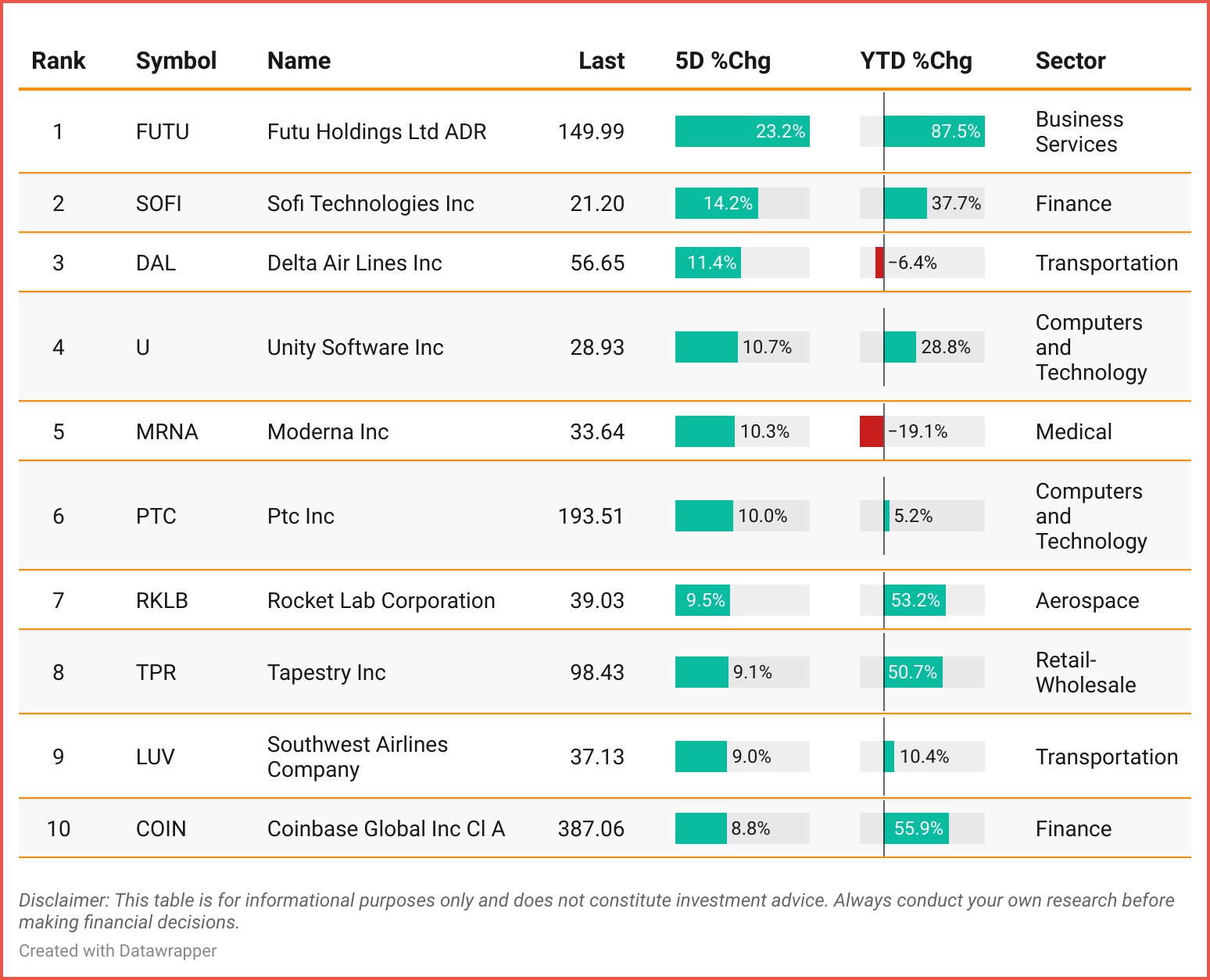
🧾 Top 10 Stocks This Week
A data-driven look at the 10 biggest winners, all above $20 and 1M in volume.
Tickers: FUTU| SOFI | DAL | U | MRNA | PTC | RKLB | TPR |LUV | COIN
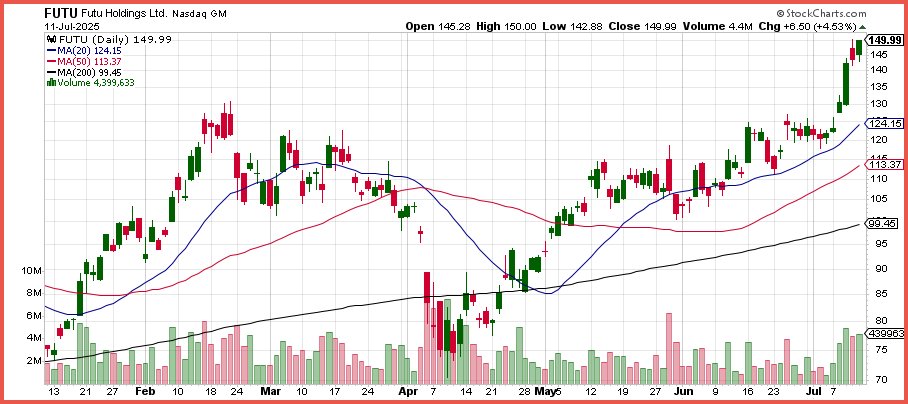
🔍 Stock to Watch: FUTU
Futu Holdings Limited (FUTU) is a tech company offering online brokerage and margin financing services through its digital platform, Futu NiuNiu, available on mobile, tablet, and desktop. The company is based in New York.
📊 Top 10 ETFs This Week
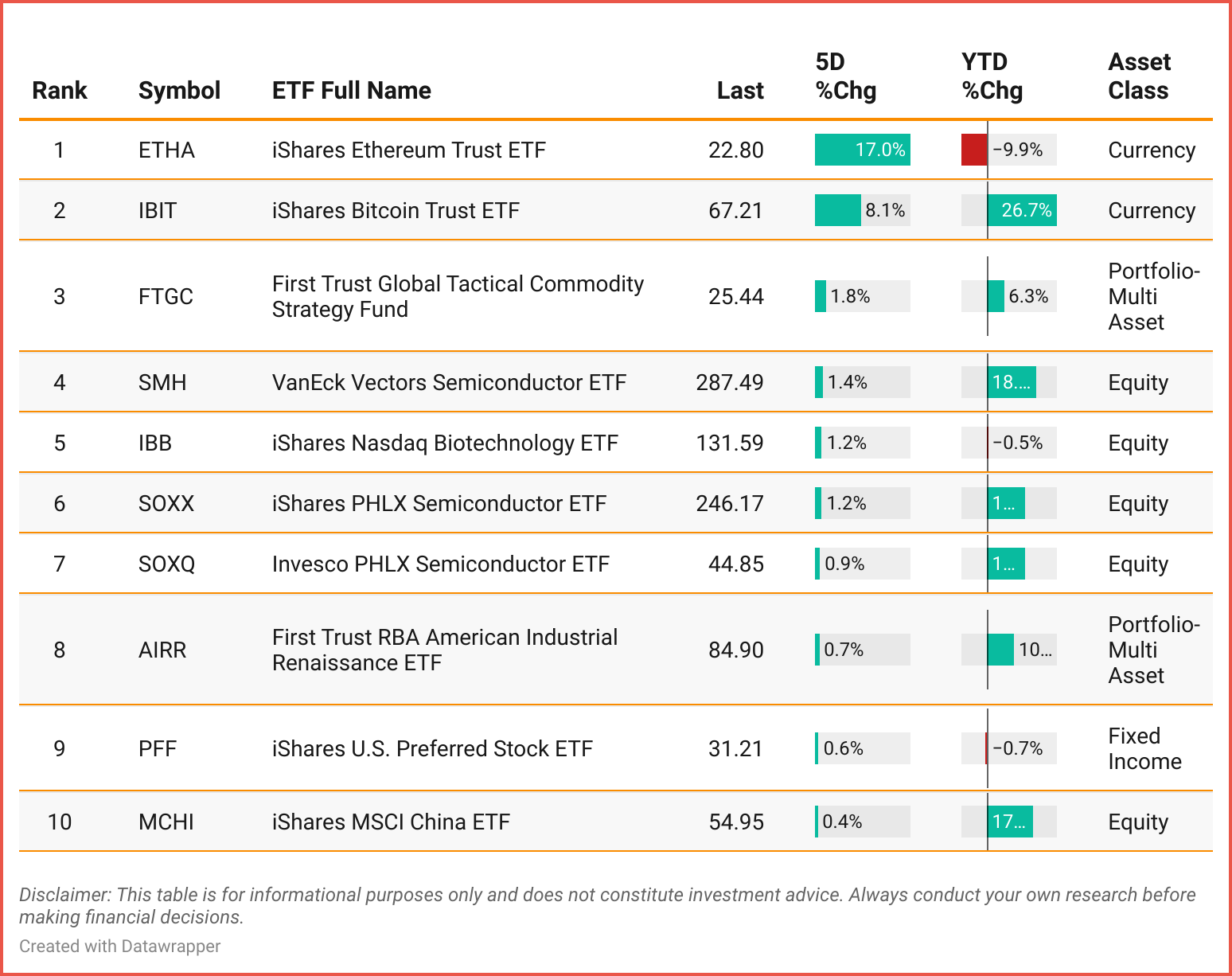
A data-driven look at the 10 best-performing ETFs, all above $20 in price, with over 300K in average volume and $ 250 M+ in assets.
Tickers: ETHA| IBIT | FTGC | SMH | IBB | SOXX | SOXQ | AIRR | PFF |MCHI
📈 ETF to Watch: ETHA
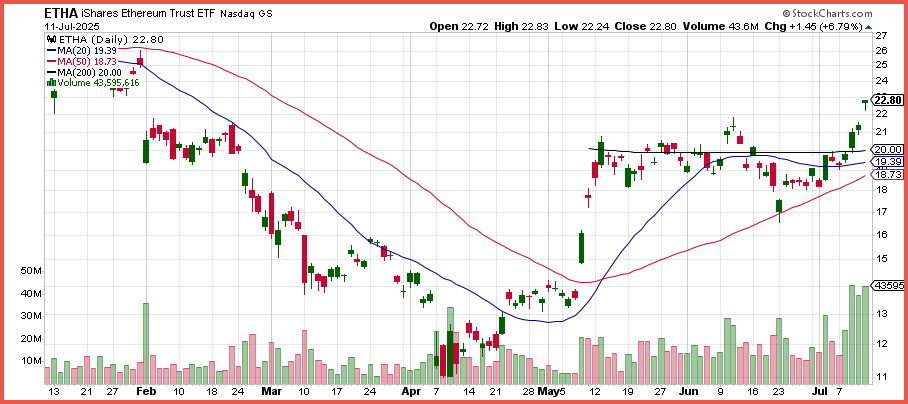
The iShares Ethereum Trust ETF seeks to reflect generally the performance of the price of ether.
📅 Key Events This Week
🟩 Monday, July 14
No key economic events scheduled.
🟩 Tuesday, July 15
08:30 – Core CPI (MoM) (Jun)
Tracks underlying monthly inflation excluding food and energy.
08:30 – CPI (YoY) (Jun)
Annual inflation reading; key for Fed rate outlook.
08:30 – CPI (MoM) (Jun)
Monthly headline inflation figure, includes all categories.
🟨 Wednesday, July 16
08:30 – PPI (MoM) (Jun)
Measures wholesale price inflation; early signal of consumer price trends.
10:30 – Crude Oil Inventories
Weekly change in U.S. crude stockpiles; impacts oil prices and energy sector.
🟦 Thursday, July 17
08:30 – Core Retail Sales (MoM) (Jun)
Excludes autos; reflects underlying consumer spending trends.
08:30 – Initial Jobless Claims
Weekly read on new unemployment claims; tracks labor market strength.
08:30 – Philadelphia Fed Manufacturing Index (Jul)
Regional snapshot of factory activity in the Mid-Atlantic.
08:30 – Retail Sales (MoM) (Jun)
Headline retail spending figure; key gauge of consumer demand.
🟩 Friday, July 18
No key economic events scheduled.