
By Enrique Krauze, Project Syndicate | Mar 31, 2026
While the ongoing US oil blockade has exacerbated Cuba’s economic and humanitarian crisis, the primary responsibility for its current predicament lies with the communist regime. If Cubans use this crisis as an opportunity to pursue ambitious economic and political reforms, they may yet restore the prosperity they once knew.
MEXICO CITY – Long before Marxism-Leninism became Cuba’s official ideology in the early 1960s, the island was the epicenter of Latin American nationalism. Throughout the 20th century, that sentiment was fueled by relentless US interference, particularly across the Caribbean, which stunted the development of Latin American republics and left liberals and democrats politically isolated.
It is hardly surprising, then, that much of Latin America has long sympathized with Cuba, cast as the David to America’s Goliath. That sympathy had lasting consequences, as generations of young people across the region sought to emulate Fidel Castro and Che Guevara. Today, as Cuba faces a deepening economic and humanitarian crisis exacerbated by US President Donald Trump’s oil blockade, that historic narrative continues to shape perceptions of the country’s plight.
Yet the United States’ missteps, including the 1961 Bay of Pigs invasion and its decades-long trade embargo, are only part of the story. Ultimately, the primary responsibility for Cuba’s current predicament lies with the communist regime itself.
When Castro emerged from his stronghold in the Sierra Maestra mountains, where he had waged an insurgency against Fulgencio Batista’s regime, he was widely seen as Cuba’s savior. His arrival in Havana in 1959 was later mythologized in the popular song “Y en eso llegó Fidel” (“And Then Fidel Arrived”), which portrays a country on the brink of collapse, awaiting rescue:
And here they thought they’d keep
Playing at democracy
And the people, who in their misfortune
Were on the verge of death…
The fun is over
The Commander arrived
And ordered it to stop.
But this narrative bore little resemblance to reality. Batista’s regime, which toppled a republic founded in 1902 and installed a brutal military dictatorship, was hardly “playing at democracy.” At the same time, however, Cuba under Batista retained elements of a pluralistic society, including dozens of newspapers and a vibrant cultural life.
Nor did Castro restore order. Instead, he established the first Latin American dictatorship that made no attempt to disguise its nature, dismantling the rule of law, abolishing freedoms, and imposing a single-party system. Marxist dogma prevailed, enforced through re-education and labor camps and a vast surveillance apparatus run by the Committees for the Defense of the Revolution (CDRs), which Castro himself described as “a million muzzles.”
Know someone who should be reading TIPP Insights? Forward this email. Sponsor inquiries: editor-tippinsights@technometrica.com
Importantly, the Cuban people “were not on the verge of death.” In 1958, Cuba had the third-highest GDP per capita in Latin America, trailing only Venezuela and Uruguay, and produced 80% of the food it needed. With over six million inhabitants, the country had roughly one head of cattle per person, and annual per capita beef consumption reached 34 kilograms (76 pounds).
That relative prosperity was soon undone as Castro’s regime dismantled the private sector, beginning with large companies before moving to medium-size firms and small businesses. In 1968 alone, about 58,000 small enterprises were expropriated, from street vendors to barbershops.
Paradoxically, many of those businesses had been created after the revolution. Their owners, derided as “petit bourgeois,” were often reassigned to manual labor in agriculture or construction. Even small private plots within state farms were eliminated. The only entrepreneur left was the state, personified by Castro.
Grand economic experiments followed, often with disastrous results: an absurd attempt to crossbreed zebu cattle with Holstein dairy cows, the destruction of mangroves for coffee plantations, and the ill-fated campaign to produce ten million tons of sugar. These policies devastated Cuba’s diverse rural economy.
Fortunately for Castro, he had friends in the Kremlin. Between 1960 and 1990, the Soviet Union provided Cuba with $65 billion in subsidies, enabling it to make significant gains in education and health care, though Cuba was already a regional leader in both before the revolution. When those subsidies dried up following the Soviet collapse, Castro could have followed China’s path and opened the economy while retaining political control. But he didn’t have to after a second lifeline appeared in the form of the late Venezuelan President Hugo Chávez, whose regime provided Cuba with subsidies exceeding even Soviet support at its peak. In 2012 alone, Venezuelan subsidies totaled $14 billion.
When this assistance began to wane, then-President Raúl Castro, who succeeded his ailing brother in 2008, faced another opportunity to pursue meaningful change. Confronted with a sclerotic state-controlled economy, he insisted that “the notion that Cuba is the only country where people can live without working must be erased forever.” But he, too, refused to introduce meaningful economic reforms, let alone consider political liberalization.
Cuba’s current economic reality stands in stark contrast to that of the pre-communist era. By 2023, sugar production had fallen to just 5% of its level before Castro, while the number of pigs had shrunk by two-thirds. The country now imports more than 70% of its food. In the first five months of 2025, imports from the US – including chicken, powdered milk, and pork – exceeded $200 million, a 16.6% increase from the same period the previous year.
Cuban exports have also collapsed, falling by 74% between 1985 and 2023. The cattle population has declined to 2.9 million (in a country of 11 million people), and slaughtering cows is severely punished. As a result, annual per capita beef consumption is just 438 grams, or 1% of what it was in 1958.
Statistics, of course, do not capture the full extent of the decline. Miriam Gómez, widow of the Cuban writer Guillermo Cabrera Infante, who lived in exile from 1965 until his death in 2005, offered me a sad account:
“Cuba is a country erased; her beautiful buildings are rubble where people sit to die. They say the stench is unbearable. Cuba, which smelled so good, is what I remember and miss most: how the scents shifted from jasmine to gardenia, to night-blooming jasmine, to honeysuckle, to fried ripe plantains – thousands of wonderful scents that the tropics accentuate! Unfortunately, now it only accentuates the stench; even the plants look wilted, and the people are different.”
Today, Cuba faces what may be its third opportunity for reform. But economic change, if it finally happens, must be accompanied by true political reform. Nothing less than the restoration of the original republic is admissible. When Cubans can finally read freely, they will be able to return to Infante’s works and recover the memory of the island they once knew, and may yet know again.
Enrique Krauze is a historian, essayist, publisher, and the editor of the cultural magazine Letras Libres. His books include Mexico: Biography of Power (2008) and Redeemers: Ideas and Power in Latin America (2011).
Copyright Project Syndicate
Gator Anti-Tank Landmine In Iran
U.S. forces appear to be using airborne-scattered anti-tank landmines to hinder the movement of mobile launchers near Iran’s suspected missile cities,” vast underground weapons storage facilities.
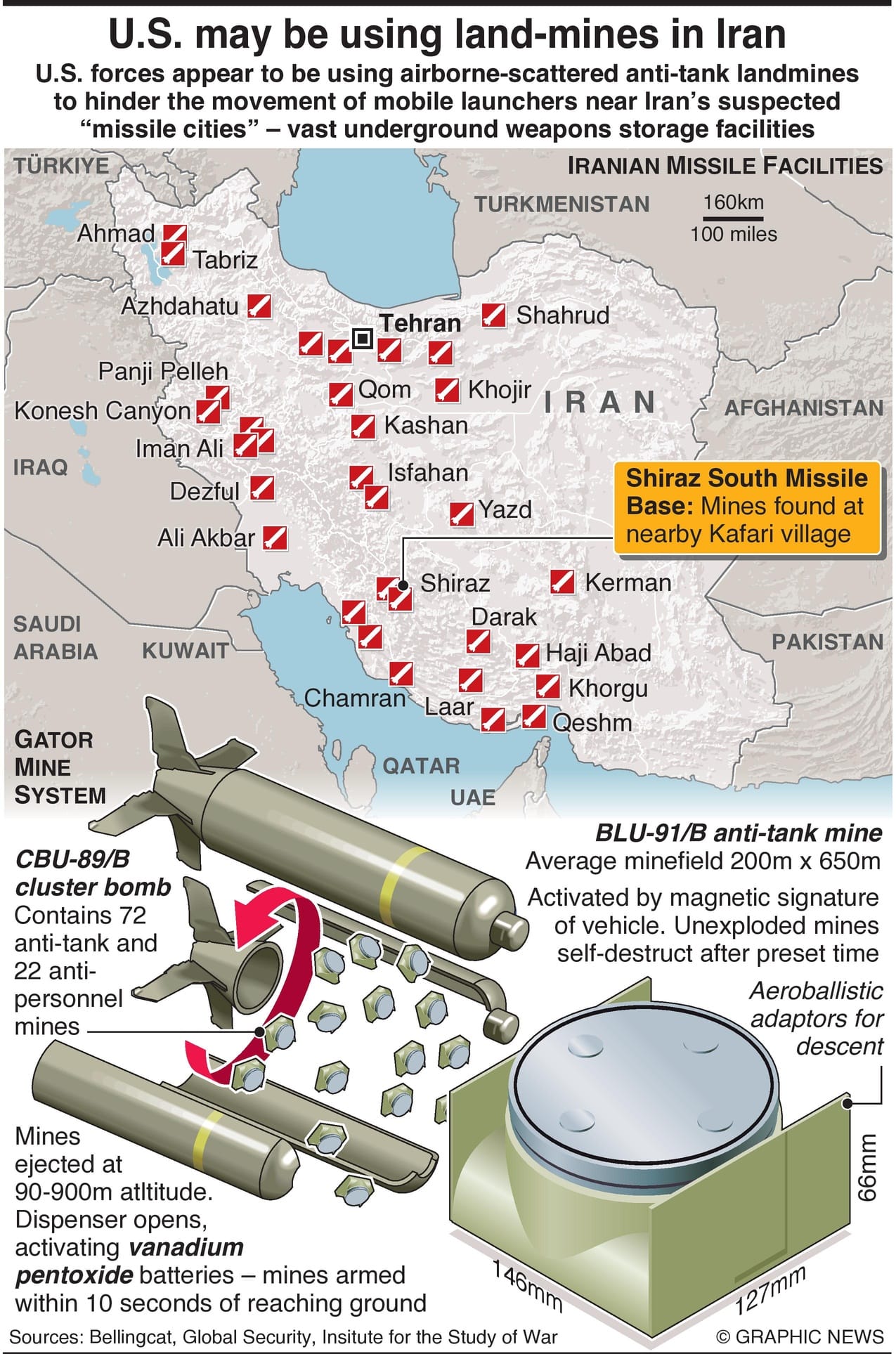
Experts believe U.S. forces are using the BLU-91/B anti-tank landmines – dispersed by the Gator mine airborne scattering system – for the first time in more than two decades. The gator system comprises the CBU-78/B or CBU-89/B air-delivered cargo bombs (cluster bombs), which contain up to 72 anti-tank and 22 BLU-92/B anti-personnel mines.
The mines are triggered by the magnetic signature of a vehicle, truck, or tank, but also have a self-destruct timer, meaning they may randomly explode hours or days after they are placed. They do not include an anti-handling device, but a significant change of orientation could cause them to explode.
According to Iran’s Tasnim news agency, the mines, which are slightly larger than tuna cans, were found in Kafari village near Shiraz South Missile Base, and have already killed several people. While photos available only show anti-tank mines, it’s unclear if the victims could have come into contact with an anti-personnel mine from the same system.
Catch up on today’s highlights, handpicked by our News Editor at TIPP Insights.
1. Trump May End Iran War Without Reopening Strait Of Hormuz: Report
2. Trump Criticizes U.K. And France Over Iran Conflict
3. Trump Says U.S. Will Continue To Pressure Iran To Reopen Strait Of Hormuz
4. China, Pakistan Push For Talks To End Iran Conflict
5. Hegseth To Testify As Pressure Mounts Over Iran War
6. Why Is Russia Benefiting From The Iran War
7. Iran War Impact: Gold Prices Drop Sharply In Volatile Market
8. U.S. Gas Prices Hit $4 Per Gallon As Oil Surges Amid Iran War
9. Strikes On Campuses Mark New Phase In Iran Conflict
10. Buckingham Palace Confirms King Charles U.S. Visit
11. Supreme Court To Review Trump’s Birthright Citizenship Order
12. Buffett Distances Himself From Gates Over Epstein Fallout
13. Vice President Vance To Release Memoir On Religion
14. Supreme Court Blocks Colorado Conversion Therapy Ban
15. Nvidia Expands AI Strategy With $2 Billion Investment In Marvell Technology
editor-tippinsights@technometrica.com