
There's little question that the Democratic Socialists of America are more influential than any time in recent history. Indeed, it's perhaps the most influential arm of the Democratic Party today, wielding policy clout and winning local elections. But are DSA policies really so popular? July's I&I/TIPP Poll asked voters to find out.
The DSA's recent "Workers Deserve More!" document outlined its main policy goals. For I&I/TIPP's July Poll, taken by 1,473 Americans from June 29 through July 2, voters were asked whether they agreed or disagreed with five separate DSA proposals. The poll has a margin of error of +/-2.8 percentage points.
First, I&I/TIPP asked about DSA's proposal for the "abolition of jails and prisons."
Only 26% agreed either strongly (10%) or somewhat (16%) with this plan, while 62% disagreed strongly (47%) or somewhat (15%).
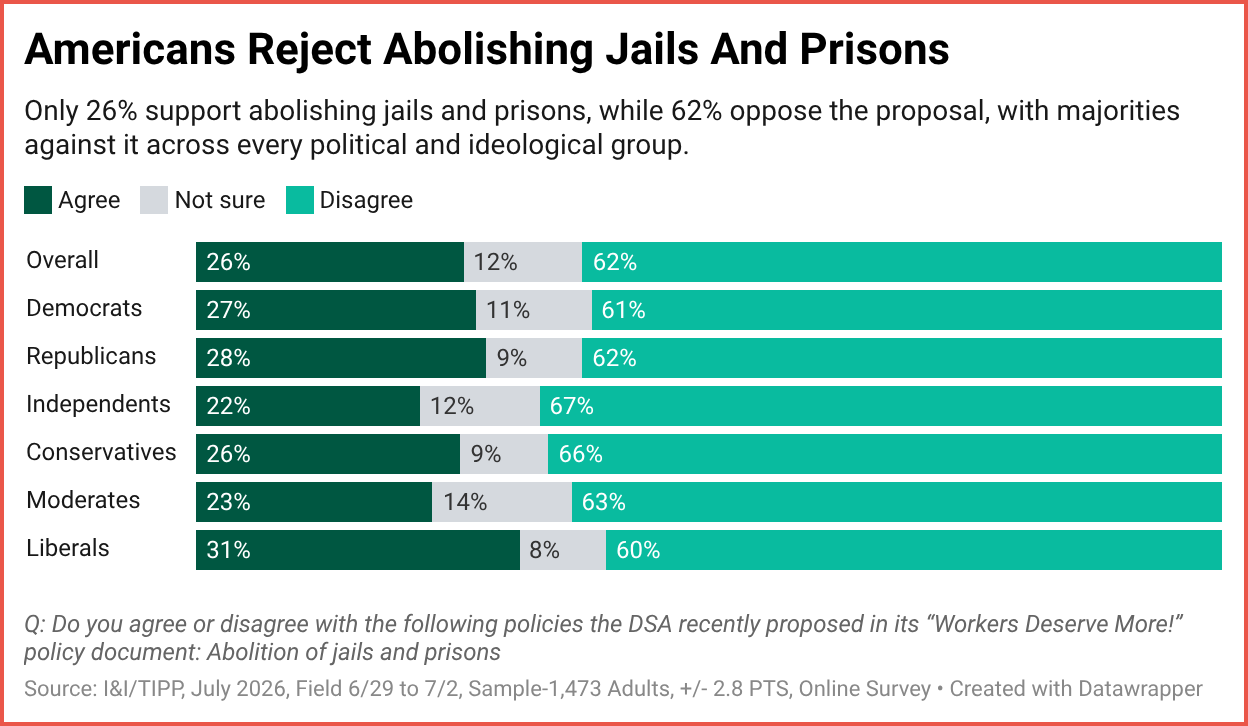
Political party preference made little difference in how people responded: Democrats (27% agree, 61% disagree) were surprisingly statistically similar to the Republicans (28% agree, 62% disagree). Independents took a somewhat harder line than the two mainstream parties (22% agree, 67% disagree), but the difference wasn't big, statistically speaking.
Next up: "Defunding the Defense Department." On this, overall 33% agreed either strongly (15%) or somewhat (18%), while a majority of 54% disagreed strongly (17%) or somewhat (37%).
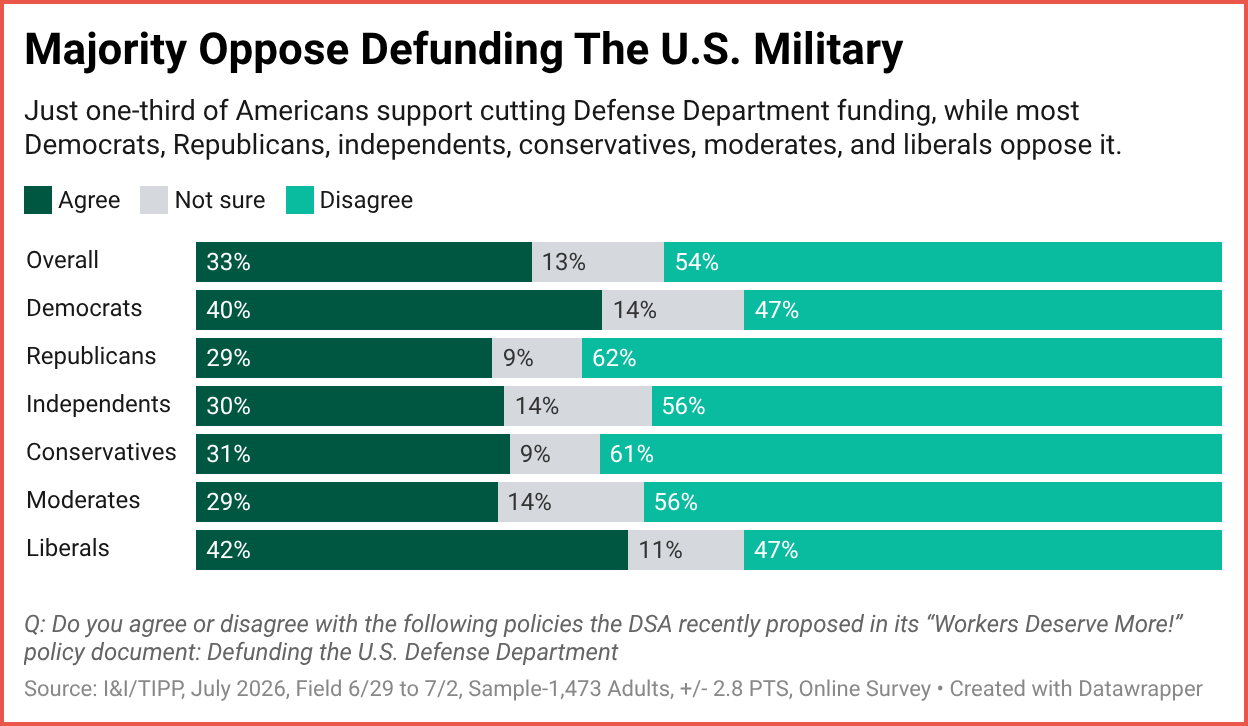
Party differences this time were more were apparent. Some 40% of Democrats agreed, while a small plurality of 47% disagreed. Among Republicans, the gap was far wider: 29% agreed, 62% disagreed. Independents straddled the middle again: 30% agreed, 56% disagreed.
For a third question, voters were asked to agree or disagree with "amnesty for all illegal immigrants."
This time, 34% agreed strongly (14%) or somewhat (19%), while a slim majority of 52% disagreed strongly (19%) or somewhat (33%).
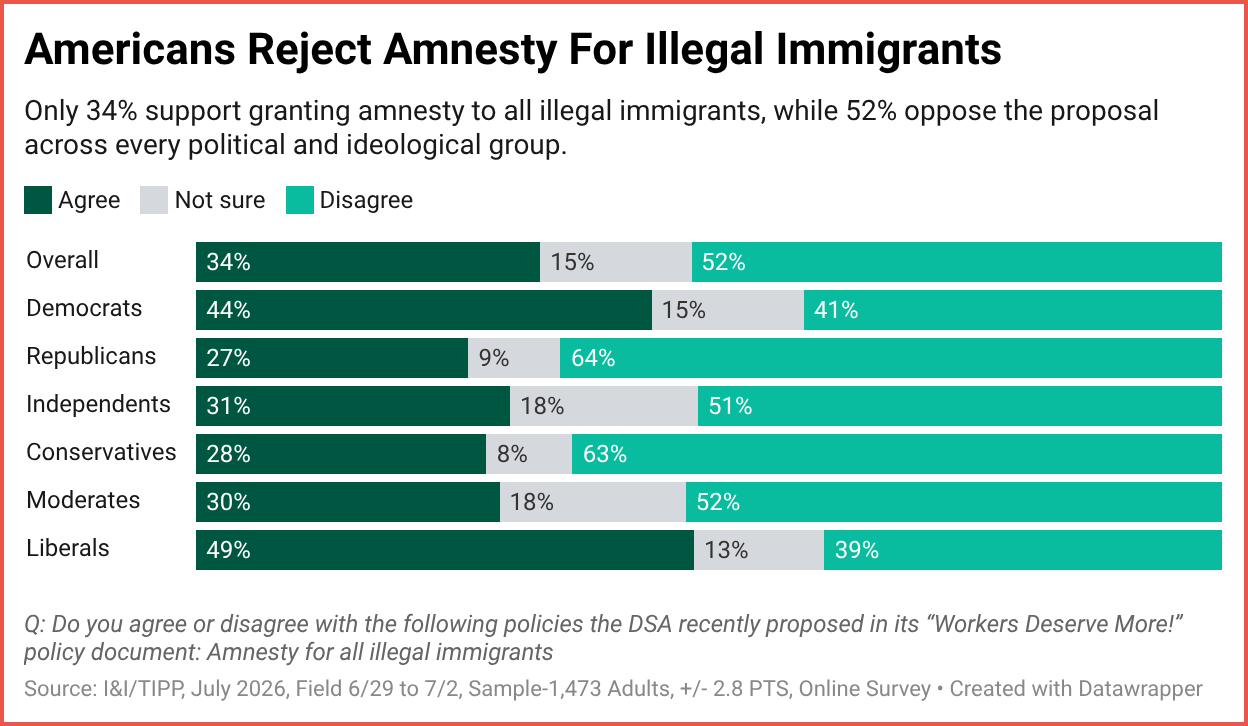
This time, political affiliation really shaped the responses. A plurality of Democrats (44%) agreed, while a slender minority disagreed 41%. Meanwhile, just 27% of Republicans agreed, as a solid majority of 64% rejected the idea. Independents came in at 31% agreed, 51% disagreed.
So far, this is the only topic that found a plurality of political support for a DSA policy from any of the three major political affiliations, perhaps explaining in part why immigration has become such a big wedge issue at all levels of American politics.
On the fourth question, respondents were asked about "getting rid of the U.S. president and U.S. Supreme Court to be replaced by a chief executive and high court selected by Congress, not the people."
An overall 27% agreed either strongly (13%) or somewhat (14%) with this proposal, while a more than 2-to-1 majority of 57% disagreed either strongly (42%) or somewhat (14%).
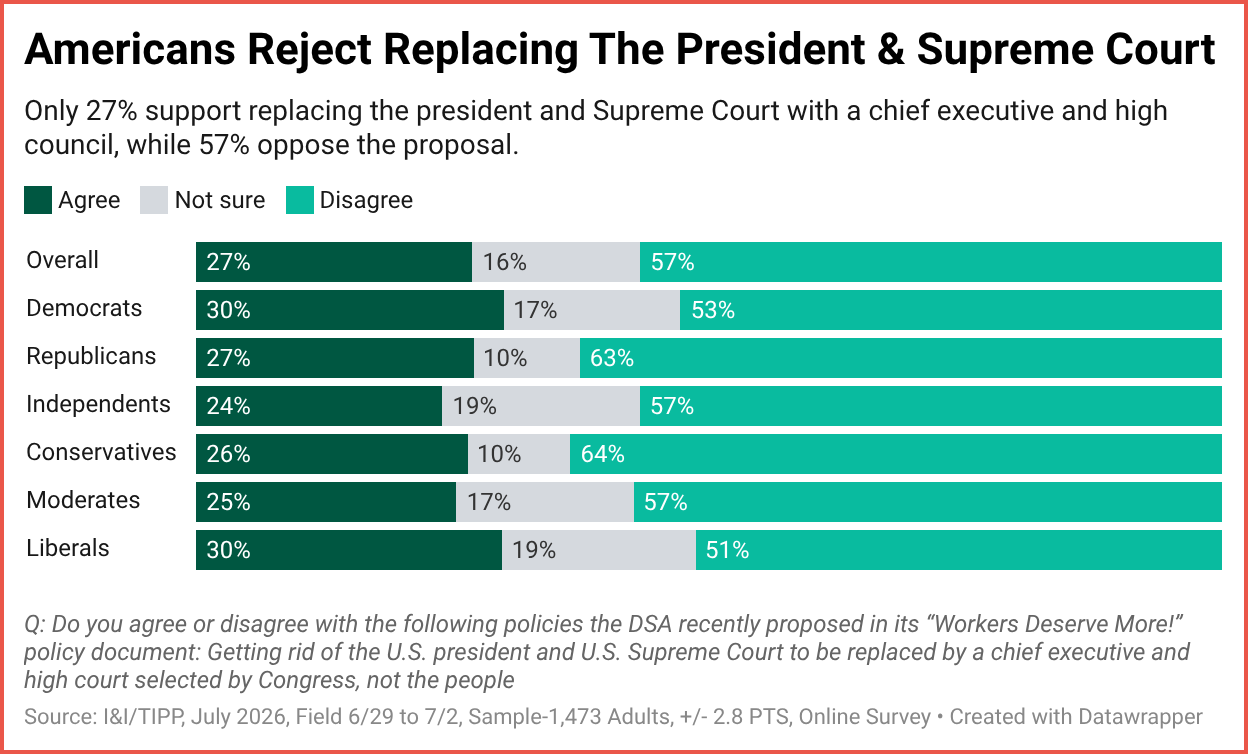
This time, a majority of all major political groupings oppose the idea: Democrats (30% agree, 53% disagree), Republicans (27% agree, 63% disagree) and independents (24% agree, 57% disagree) all reject the socialist plan for giving control of both our legal system and our presidency to Congress.
Finally, the fifth proposal of the DSA's plan: "Government ownership of the largest corporations and important industries."
Again, about a third — 33% — agree with the idea either strongly (13%) or somewhat (20%), while 52% disagree strongly (34%) or somewhat (18%).
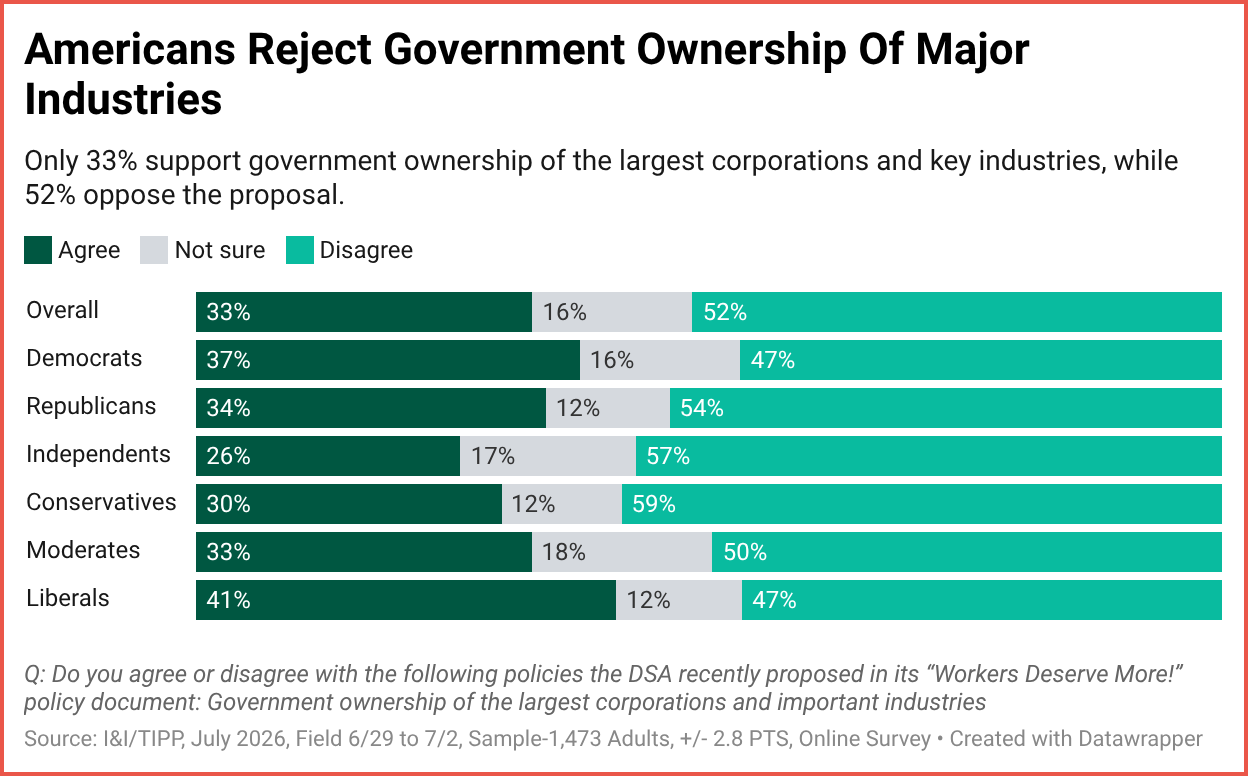
By political grouping, among Dems, 37% agree with government control, while 47% disagree. Republicans, perhaps shockingly, are not too far away in their views: 34% agree, 54% disagree. Independents are strongest in their rejection: 26% agree, 57% disagree.
All in all, the DSA proposals are deeply radical, as even the party would admit. But as the answers to the I&I/TIPP Poll show, they are resonating among some groups. Even double-digit poll results among both Republicans and independents.
This is remarkable given that DSA is not a large organization at all.
“On July 4, 2026, Democratic Socialists of America passed 120,000 members, making us the largest socialist organization in United States history and surpassing the Socialist Party of America under Eugene Debs, which reached its peak dues-paying membership in 1912,” the DSA noted in early July.
Is that a lot? Not really. By comparison, total membership of the Democratic Party was just over 45 million in April.
Yet, as I&I/TIPP noted last week, "As of 2025, there were 250 Democratic Socialists of America members in office nationwide, with 90% of those elected since 2019. Five DSA members won their congressional primaries this year and are expected to cruise to victory in the fall."
So the ideas are connecting. Last week's I&I/TIPP Poll showed that more than 40% of both major political parties and independents agree the government should "control or own" major sectors such as healthcare and energy.
Other polls find the same level of acceptance for socialism, which is what "control or own" clearly implies.
In a June survey, for instance, Economist/YouGov found that 34% of Democrats said socialism was a "better" economic system than capitalism, while only 22% said capitalism was better. Among all Americans, 44% preferred capitalism versus 19% choosing socialism. And overall, a third of all Americans said they'd vote for a socialist candidate.
Why is this?
One big reason could be age. In the I&I/TIPP Poll, 44% of respondents were in the 18-to-44 year age range. So even the oldest among this group would have only the vaguest of memories of the collapse of communism and the subsequent debunking of socialist ideas as economically workable.
Meanwhile, in recent decades formal public education has become saturated with leftist indoctrination, well documented in numerous studies, reports and first-hand accounts.
No surprise, then, that in the I&I/TIPP Poll, 46% of those 44 years and younger supported the takeover of major U.S. industries, while just 22% of those 45 years and older did. It's a generational thing.
Inevitably, today's students become tomorrow's voters. This, perhaps as much as anything, explains the current positive feelings that many younger voters seem to harbor for socialist candidates and the ideas they espouse.
I&I/TIPP publishes timely, unique, and informative data each month on topics of public interest. TIPP’s reputation for polling excellence comes from being the most accurate pollster for the past six presidential elections.
Terry Jones is an editor of Issues & Insights. His four decades of journalism experience include serving as national issues editor, economics editor, and editorial page editor for Investor’s Business Daily.
Loved it, hated it, or somewhere in between — tell us. Grade this article here and help shape what lands in your inbox next.
📊 Market Mood · July 20, 2026
How the trading day is setting up.
🟩 Markets begin the week with a cautious tone as rising oil prices and higher Treasury yields offset optimism ahead of a busy week of Big Tech earnings.
🟧 Geopolitical tensions in the Gulf are keeping investors on edge after fresh disruptions in the Strait of Hormuz pushed Brent crude above $90 a barrel, raising concerns that inflation could reaccelerate.
🟦 Investors are turning their attention to earnings from Alphabet, Tesla, Intel, and other technology leaders, looking for evidence that AI spending continues to translate into strong revenue and profits.
🟨 With the Fed in its pre-meeting blackout period and a light economic calendar today, market sentiment is likely to be driven by geopolitics, bond yields, and corporate earnings expectations
🗓️ Key Economic Events
On today's U.S. data calendar.
No major U.S. economic reports are scheduled.
Letters to the editor email: editor-tippinsights@technometrica.com
Subscribe Today And Make A Difference. Consider supporting Independent Journalism by upgrading to a paid subscription or making a donation. Your support helps tippinsights thrive as a reader-supported publication. Contact us to discuss your research or polling needs.
Reach our audience. For sponsorship and advertising opportunities, visit our Partner With Us page.