
We understand President Trump's grievances about election integrity. We have published more articles supporting the idea that Trump won the 2020 election than most other publications.
We wrote our seminal piece about this topic on November 21, 2024, a couple of weeks after Trump had reclaimed office. To prove our point, we compared election results from 2024 with those from 2020, 2016, and even 2008.
Despite one of the most considerable get-out-the-vote efforts in recent memory, with paid staff knocking on millions of doors before the elections, there were 2.2 million fewer total voters in 2024 than in 2020, a pandemic year. Harris, as a trailblazing woman candidate of color, won 5.8 million fewer votes than Biden.
Biden placed fourth and fifth, respectively, in the Iowa and New Hampshire primaries. We questioned how Biden could have won 15 million (24.6%) more votes than history-making candidates Barack Obama and Hillary Clinton in 2008 and 2016, respectively.
Going even further back, Trump received 11 million more votes in his 2020 reelection bid than he did in his 2016 victory, but still lost. This situation - where a candidate received more votes in their reelection bid than they did in their first and still lost the race - hasn't happened since 1892.
For decades, 20 bellwether counties around the country have predicted the winner. Vigo County, Indiana, has consistently voted for the winning candidate since 1956. Valencia County, New Mexico, has voted with the winner since 1952. The bellwethers again stood in 2024. Although New Mexico went for Harris, Valencia County went for Trump 57-41. Indiana decidedly went for Trump, as did Vigo County, 58-40.
But in 2020, Trump won 19 of the 20 bellwether counties and still lost the election!
Since returning to the White House, Trump has lobbied heavily for the SAVE America Act (Safeguard American Voter Eligibility Act), passed by the House. The bill dramatically improves election integrity by ensuring that the 2020 elections don’t repeat themselves.
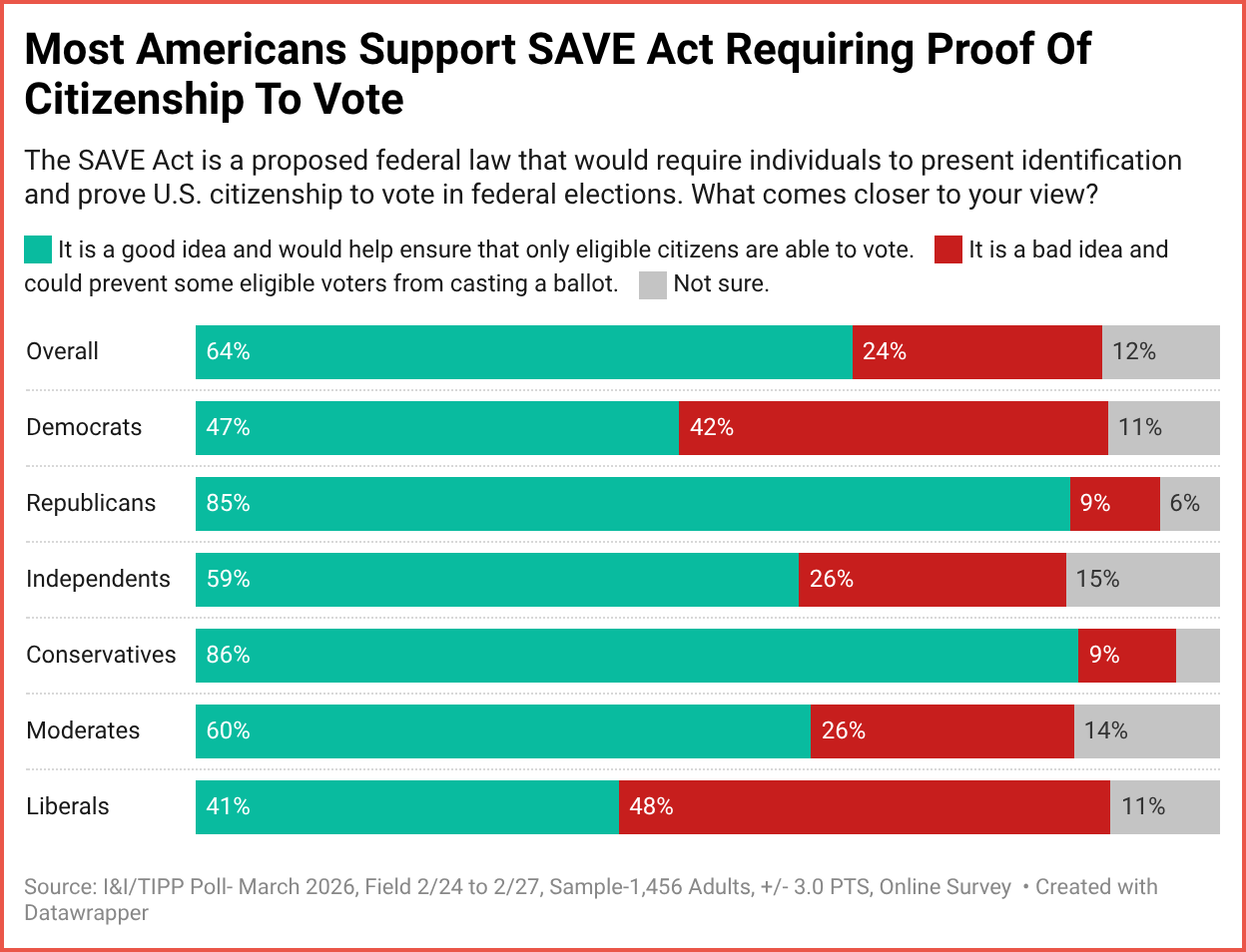
A recent I&I/TIPP Poll confirms that most Americans support requiring proof of citizenship to vote.
Proof of Citizenship to Register: States are prohibited from accepting voter registration applications for federal elections unless the applicant presents documentary proof of U.S. citizenship, such as a REAL ID-compliant identification.
Photo ID to Vote: Individuals voting in federal elections must present a valid photo identification document.
Alternative Verification Process: States must establish an alternative process allowing applicants to submit other evidence of citizenship if they lack standard documentation.
Legal Enforcement: The bill provides a private right of action for certain violations and establishes criminal penalties for offenses such as registering ineligible voters.
The issue is the United States Senate, where the Democratic Party is heavily opposed to passing this bill so that Trump can sign it into law. Their arguments are tired and often baseless. When a photo ID is required for the simplest of tasks, such as entering a federal courthouse or boarding a Greyhound bus, Democrats claim that the SAVE Act would impose too many burdens on some voters.
They argue the bill would hinder millions of eligible Americans from registering to vote by requiring a birth certificate or passport, documents that millions don't have. Rep. April McClain Delaney claims the bill would force "millions to pay $130 for documents and navigate more red tape," framing it as voter suppression rather than security.
Alexandria Ocasio-Cortez has argued the bill would disenfranchise married women who took their spouse's last name and haven't updated their passport or birth certificate. The NAACP Legal Defense Fund characterized it as a voter suppression technique "aimed at disenfranchising Black voters."
It does not require a rocket scientist to conclude that the Democrats' arguments are nonsense. Election integrity is so paramount that these non-issues have no place in public debate. If it costs $130 for documents, we would gladly support a bill that would reimburse voters who are financially unable to pay.
In the zeal to pass the bill, President Trump has been pressuring Senate Majority Leader John Thune to eliminate the chamber's vaunted 60-vote filibuster by "nuking" the filibuster provision altogether. It only takes 51 senators to kill the filibuster, and the GOP has a 53-47 majority, so mathematically, nuking the filibuster should be easy. Unfortunately for Trump, four GOP senators have said they will not kill the filibuster, so the president is two votes short.
Much as we would like for the SAVE America Act to pass, protecting the filibuster is far more important to the integrity of the country.
For one, many red states, like Texas, Georgia, and Florida, have already embraced Trump's argument that election integrity is needed and have passed numerous laws to strengthen election processes. It is under these new rules that Trump won in an electoral landslide, winning all toss-up battleground states, a feat last performed by President Reagan in 1984. So, elections are probably working well.
Secondly, once the filibuster is nuked to pass the SAVE America Act, it doesn't reset immediately afterward. All future legislation will be filibuster-free. Nothing would prevent the Democrats, when they gain control of the Senate, from passing statehood for the District of Columbia and Puerto Rico, expanding the Supreme Court, or granting a pathway to citizenship for all illegal aliens in the country.
We argued forcefully against Kamala Harris's proposals to end the filibuster. We now argue forcefully against President Trump's ideas to do the same.
For those who contend that we are needlessly sounding the alarm, we ask that they look at the previous Congress, when two bold Democrats - Sen. Sinema of Arizona and Sen. Manchin of West Virginia - indeed saved America by voting against their liberal colleagues to protect the filibuster and prevent nonsensical legislation from passing.
👉 Show & Tell 🔥 The Signals
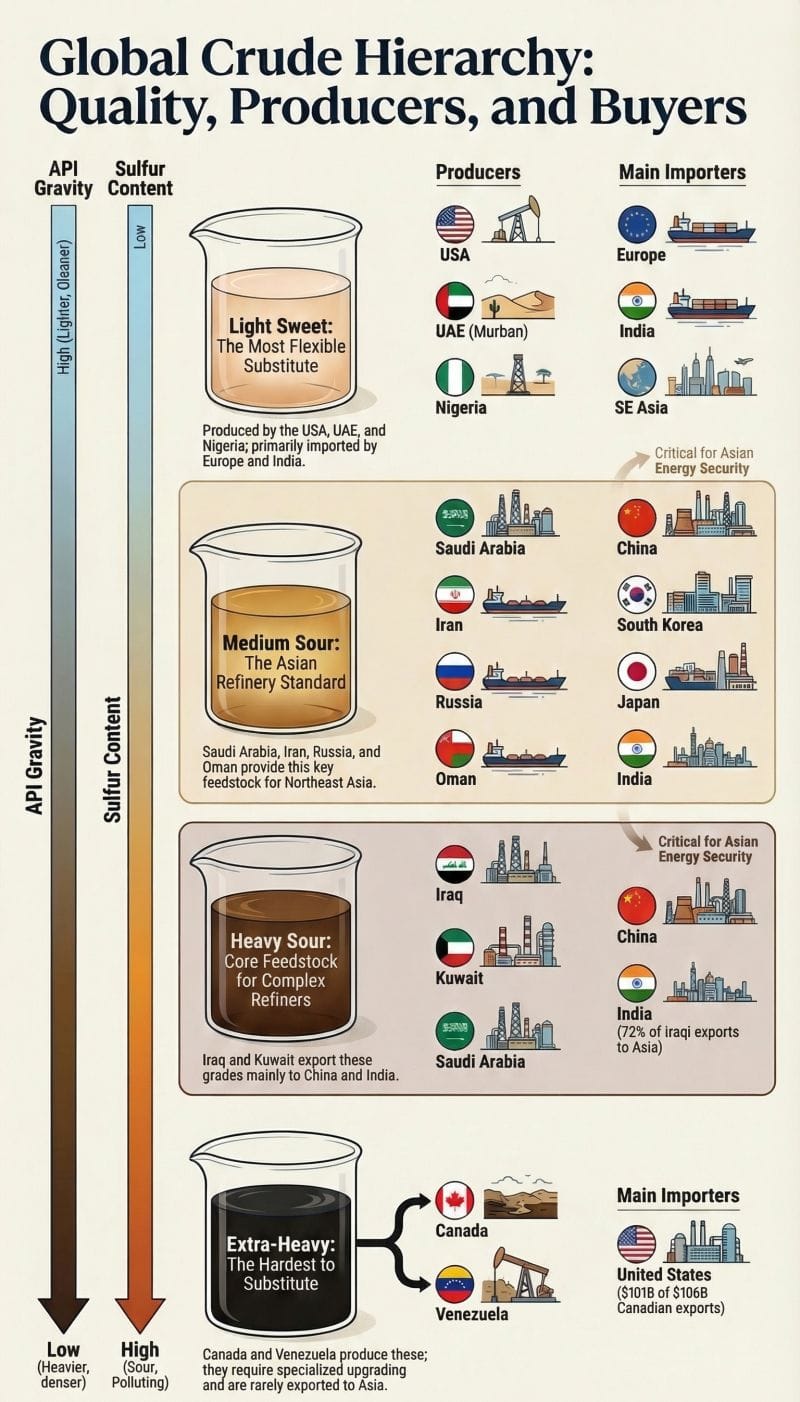
I. Gulf Crude Has No Easy Substitute For Asia
Asian refineries are largely configured to process medium and heavy sour crude from the Persian Gulf, making those barrels difficult to replace. U.S. light sweet crude and other grades cannot easily substitute without operational adjustments. As shipments through the Strait of Hormuz slow, refiners across Asia face tighter supplies of the specific crude types their facilities are built to run.
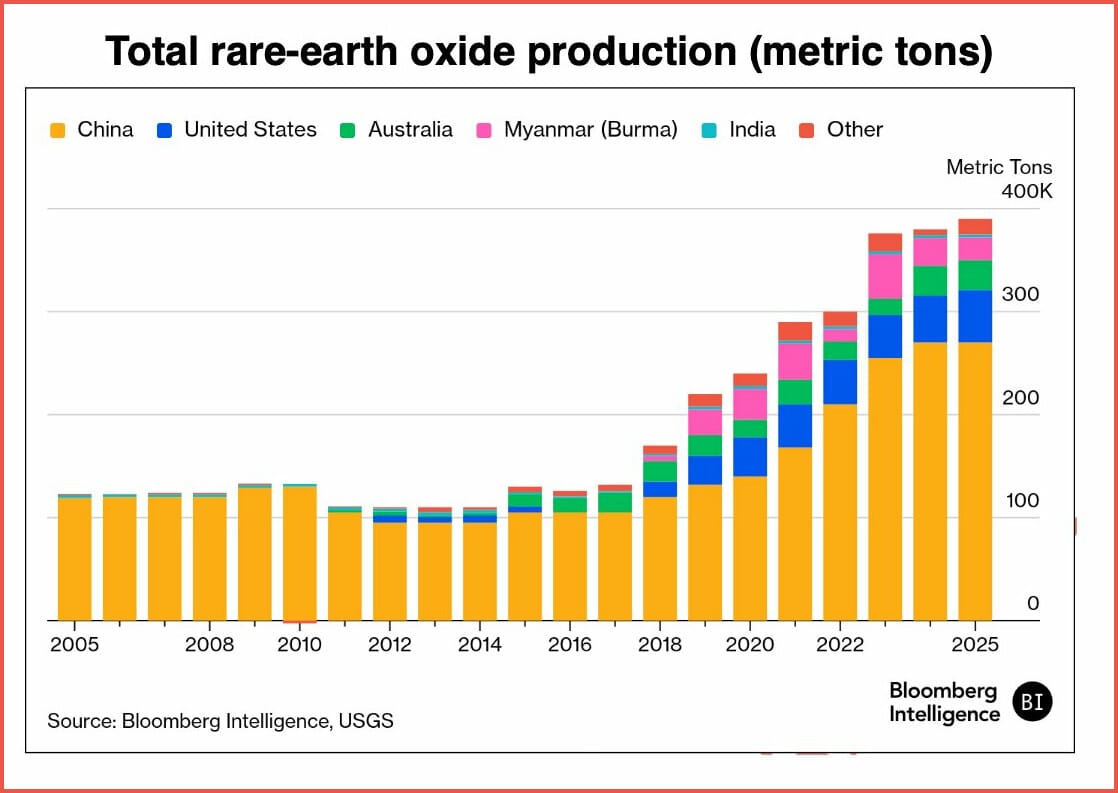
II. China’s Rare-Earth Dominance May Begin To Slip
China currently dominates the rare-earth supply chain, controlling a large share of global production. However, expanding output from North America and Australia could reduce China’s market share to about 69% by 2030, gradually diversifying supply for key materials used in electronics, electric vehicles, and defense technologies.
III. AI Could Reshape America’s Workforce And Its Politics
Palantir CEO Alex Karp offered a stark warning about the societal impact of artificial intelligence. Speaking to investors, he argued that AI will likely disrupt many high-skill, white-collar professions, the very jobs that dominate in major cities and among college-educated workers.

According to Karp, the economic shock could shift influence toward vocational and hands-on occupations that are harder for AI systems to replace. That shift, he suggested, could have political consequences because the groups most affected and those likely to benefit often align with different parts of the electorate.
Karp also framed the development of advanced AI systems as a national security imperative. In his view, the technologies carry real social risks but the United States cannot afford to fall behind geopolitical rivals in building them. If American companies hesitate, he warned, adversaries will not.
The result, Karp suggested, is an uncomfortable trade-off: AI may reshape the labor market and strain social stability, yet the pressure of global competition could push governments and industry to deploy it anyway.
Source: CNBC interview | Via: @Investinq on X
The TIPP Stack
Handpicked articles from TIPP Insights & beyond
1. What’s Behind Beijing’s Restraint?—Editorial Board, TIPP Insights
2. The Dragon’s Fragility—Editorial Board, TIPP Insights
3. America's Stalemate—Editorial Board, TIPP Insights
4. Are We Facing An AI Nightmare?—Raghuram G. Rajan, Project Syndicate
5. The Next Cuban Revolution Could Be Peaceful—Roberta Lajous, Project Syndicate
6. Why AI And Big Data Cannot Plan An Economy—Hamoon Soleimani, Mises Wire
7. Molinari On Secession, Monopoly, And “Freedom Of Government”—Gustave de Molinari, Mises Wire
8. The Real Threat Is Artificial Credit, Not Artificial Intelligence—George Ford Smith, Mises Wire
9. Vaccine Science Is Social Dynamics, And The Paradigm-Breaker Is Aaron Siri— James Anthony, Mises Wire
10. The Persona And Legacy Of Murray Rothbard— Jorge Muñoz, Mises Wire
11. The Duke Lacrosse Case 20 Years Later: How Durham Law Enforcement Promoted A Criminal Conspiracy—William L. Anderson, Mises Wire
📊 Market Mood — Friday, March 13, 2026
🟩 Oil Holds Above $100 as Iran War Drags On
Crude prices remained elevated with the Strait of Hormuz effectively closed and global supply concerns persisting.
🟧 Stocks Struggle for Direction After Volatile Week
U.S. futures were mostly flat as investors weighed geopolitical risks and energy-driven inflation fears.
🟦 Dollar Strength Pressures Gold
The greenback climbed on expectations of higher interest rates, putting gold on track for a weekly decline.
🟨 PCE Inflation Data in Focus
Investors await the Federal Reserve’s preferred inflation gauge for clues on the path of interest rates.
🗓️ Key Economic Events — Friday, March 13, 2026
🟧 08:30 ET — GDP (Q4 Final) & Core PCE Inflation
Final fourth-quarter GDP estimate and the Fed’s preferred inflation gauge offer key signals on growth and price pressures.
🟧 08:30 ET — Durable Goods Orders (Jan)
Tracks new orders for long-lasting manufactured goods, a key indicator of business investment.
🟧 10:00 ET — JOLTS Job Openings (Jan)
Measures labor demand by tracking available job openings across the U.S. economy.
editor-tippinsights@technometrica.com