France’s updated nuclear doctrine will aim to reassure European allies concerned about the U.S. commitment to NATO collective security following President Trump’s placatory line on Russia and threats over Greenland.
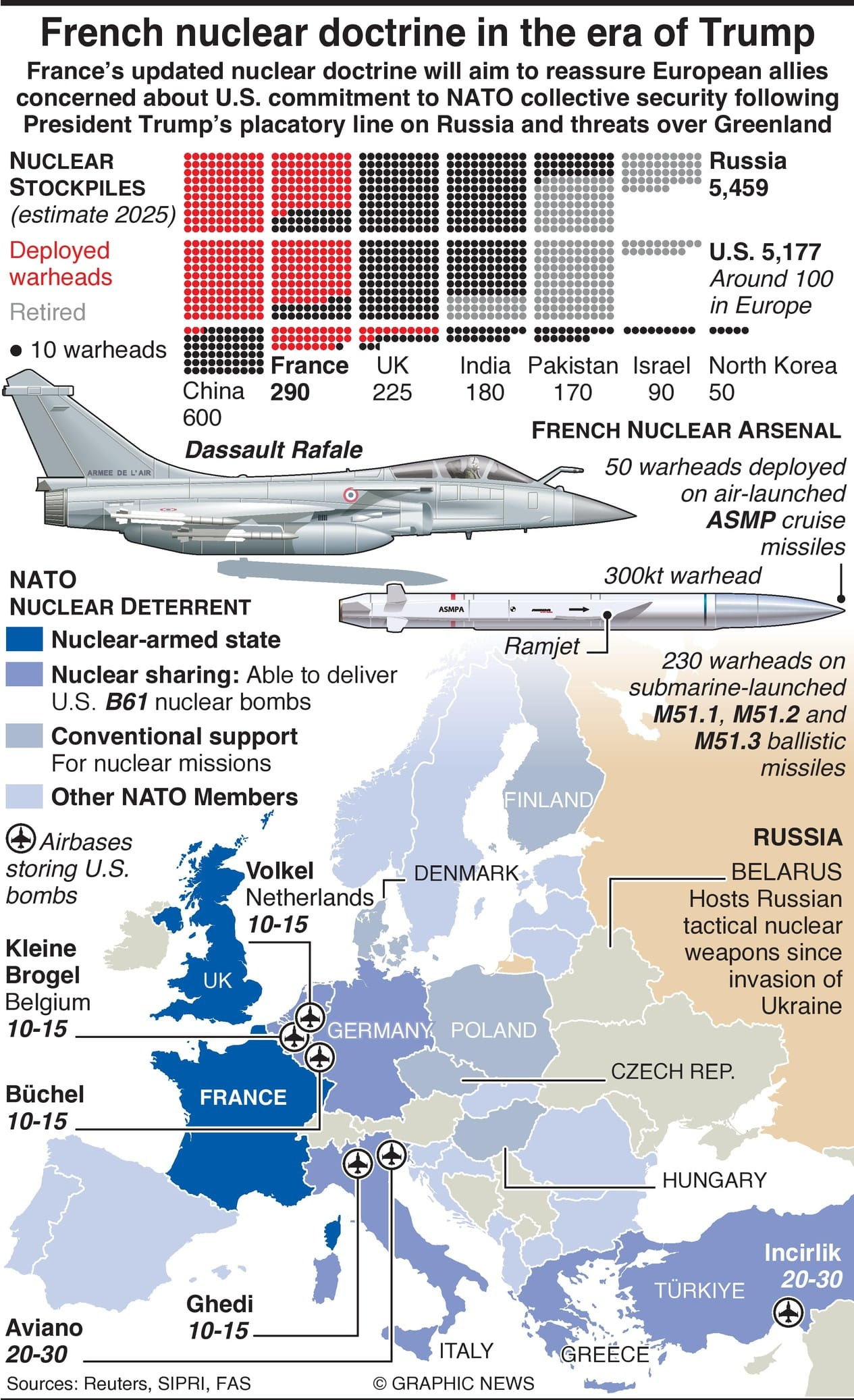
Since NATO was founded in 1949, European members have relied primarily on the protection of the U.S. nuclear umbrella to deter aggression by potential adversaries, initially the Soviet Union.
Since President Trump took office for his second term, however, his harsh attitude towards allies – including territorial threats towards Denmark over Greenland – while at the same time placating Moscow, has caused consternation in Europe. Many are now questioning whether the U.S. is still a reliable ally in the event of Russian aggression.
While Russia has an arsenal of over 5,500 nuclear warheads, and U.S. nuclear forces – with an estimated 100 bombs stationed in Europe – target adversary nuclear arsenals, France has an estimated 290, designed to act as a deterrent by aiming to inflict unacceptable damage on political, military, and economic centers.
France's nuclear doctrine currently maintains an element of “strategic ambiguity” over when weapons might be used, and unlike some nuclear-armed states, has not declared a “no first strike” policy. France spends around €5.6bn each year to maintain its stockpile, and is unlikely to relinquish this to ensure Paris maintains exclusive national control.