
Over the July 4th weekend, while Americans were celebrating Independence Day with fireworks and family barbecues, Elon Musk was launching his latest political venture: the America Party.
Billed as a third-party alternative to challenge what Musk calls the "Uniparty" stranglehold in Washington, the effort came with a slogan that reflects Musk’s signature social media style:
"No donors.
No puppets.
No strings.
Just a party built on common sense, not consultants.
The 'America Party'"
The idea of a party free from donor influence, lobbyist corruption, and manipulative consultants is a romantic fantasy. Who wouldn't want politics driven by reason rather than self-interest? America has witnessed similar efforts before. The credits rolled over its best scene in 1992, and the main character was another billionaire with a taste for charts and plain talk—Ross Perot.
Musk was likely still in school, either in South Africa or Canada, when Ross Perot, a Texan billionaire and founder of Electronic Data Systems, entered the 1992 presidential race. Perot had sold his company to General Motors in the 1980s, a time when American conglomerates were acquiring businesses far outside their core competencies. This was the era when Westinghouse bought CBS, and General Electric acquired NBC. Armed with billions and a Texas drawl, Perot jumped into the ring to challenge incumbent President George H. W. Bush and then-Governor Bill Clinton of Arkansas.
Perot dominated early media coverage with his sharp warnings about the dangers of the North American Free Trade Agreement (NAFTA). He famously warned of a "giant sucking sound" as American manufacturing jobs moved to Mexico and Canada. At the time, China was barely on the geopolitical radar. Thirty-two years later, Donald Trump would win the presidency by running on similar trade concerns, with his "Make America Great Again" policies that vow to revive American industry.
Perot shocked the political establishment by capturing 19 percent of the popular vote. One in five Americans voted for him despite the fact that few had heard of his running mate. Toward the end of the campaign, when polling showed Perot was unlikely to win a single electoral vote, the media lost interest. Still, Perot, ever the showman and data evangelist, bought prime-time infomercials to explain the state of America using charts and graphs. Ultimately, the country’s enthusiasm faded as voters refocused on their personal finances.
Predictably, Perot did not win a single state. But he siphoned off enough votes to help elect Bill Clinton, a young moderate known for his political slipperiness—hence the nickname "Slick Willie." In hindsight, Clinton's election proved to be a blessing. After Democrats were crushed in the 1994 midterms, Clinton pivoted to the center. He famously declared the era of big government was over and worked with Republican Speaker Newt Gingrich to reduce the deficit. Clinton eventually produced three consecutive budget surpluses. The third, delivered at the end of his second term, was wrongly credited to George W. Bush, who inherited it.
Perot returned in 1996, this time with diminished support. Still, he won a notable share of the vote and arguably denied longtime Senate Majority Leader Bob Dole a chance at the presidency. Perot knew he could not win, but he ran anyway, hoping to influence the debate and play spoiler, both of which he did.
Musk would be wise to study Perot's election bids, as history often repeats itself. Musk is an extraordinary engineer and businessman. His achievements in electric vehicles, particularly through Tesla, have revolutionized the automotive industry. His push for solar energy transformed China's manufacturing priorities, leading it to become the global leader in electric vehicles and renewable energy components. The environmental benefits of the shift are undeniable.
But Musk's most valuable contribution has been to the global public square. By acquiring the former Twitter, purging its content moderators, and positioning the platform—now X—as a free speech zone, Musk restored truth to the digital commons.
In 2024, Musk backed Florida Governor Ron DeSantis in the Republican primaries, hosting the candidate's botched campaign launch on X. Musk gambled that Trump, facing a wall of legal challenges, would fade away and that DeSantis could take the MAGA mantle. It was a colossal miscalculation. Trump skipped every debate and still crushed his opponents, winning 98 out of 99 Iowa counties. Nikki Haley stayed in the race to the bitter end, only to lose every state, including her home state of South Carolina.
To his credit, Musk eventually reversed course and backed Trump, campaigning vigorously and pouring $300 million into promoting him on X. He even joined Trump on the trail in Pennsylvania, the most critical battleground state. While Musk's support mattered, the political momentum was already on Trump's side, so Trump would have won the presidency even if he had lost Pennsylvania, as he carried Wisconsin and Nevada, sealing his electoral victory.
After the election, Musk remained close to Trump, traveling with him and appearing beside him at press conferences. For a time, Musk was given control of the newly created Department of Government Efficiency. But the Trump-Musk alliance quickly frayed. Musk made another high-stakes political gamble when he spent $10 million to back a Republican in a Wisconsin Supreme Court race without Trump's involvement. The Republican lost handily, exposing Musk's limited influence in electoral politics.
Then came the rift. Musk publicly disagreed with Trump on trade policy, MAGA's signature issue. The relationship soured. Two billionaires, each with strong convictions and ambitions, found themselves at odds. Estranged from Trump, alienated from the MAGA base, and viewed with suspicion by the very movement he once tried to court, Musk has become an outsider.
Musk is not eligible to be president. He was born in South Africa. But he still has the money, the platform, and a loyal circle of technocratic followers. However, MAGA voters trust Trump far more than they trust Musk. In their eyes, Musk is a defector, a man who has turned on the movement.
If Musk proceeds with his America Party, he will not be the disruptor he wishes to be. He will be a spoiler, peeling off enough independent voters to tip tight races in favor of Democrats, and his journey from Trump's staunch ally to inadvertent political spoiler will be complete.
Should that happen, history will not remember him kindly.
TIPP Market Brief – July 8, 2025
Your Morning Snapshot
📊 Market Snapshot
- S&P 500: ▼ 6229.98 (0.79% )
- 10-Year Yield: ▲ 4.395%, (4.7 basis points)
- Crude Oil (WTI): ▲ $67.92 (1.63%)
- Bitcoin (BTC): ▲ $108,845.24
- US Dollar Index (USD): ▲ 97.48 (0.12%)
- Gold: ▲ $3,336.83 (0.32%)
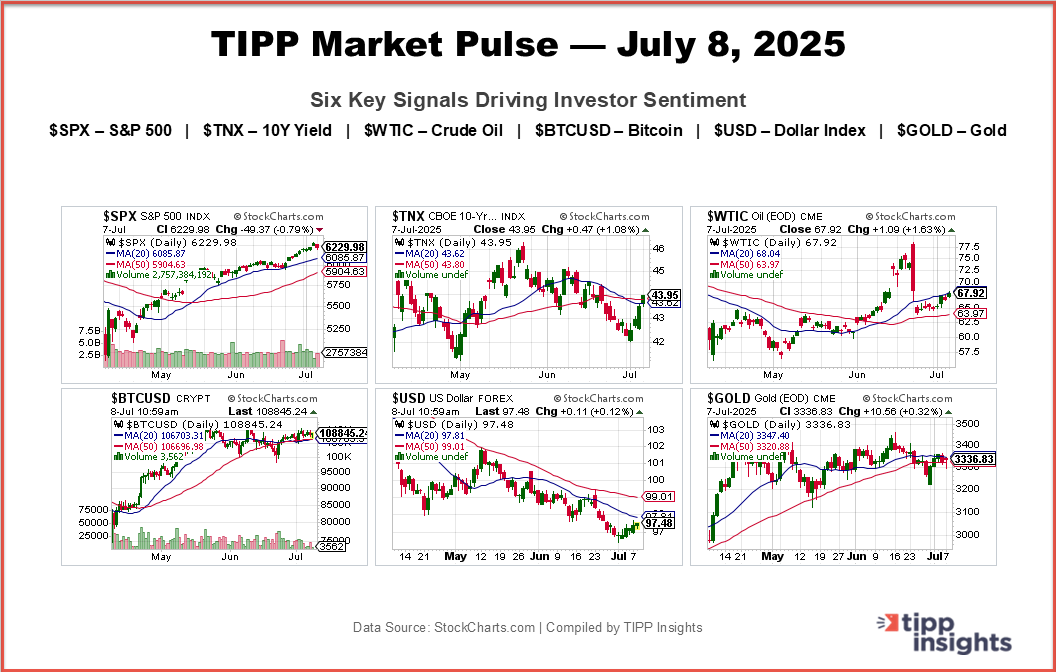
Bigger Charts: $SPX | $TNX | $WTIC | $BTCUSD | $USD | $GOLD
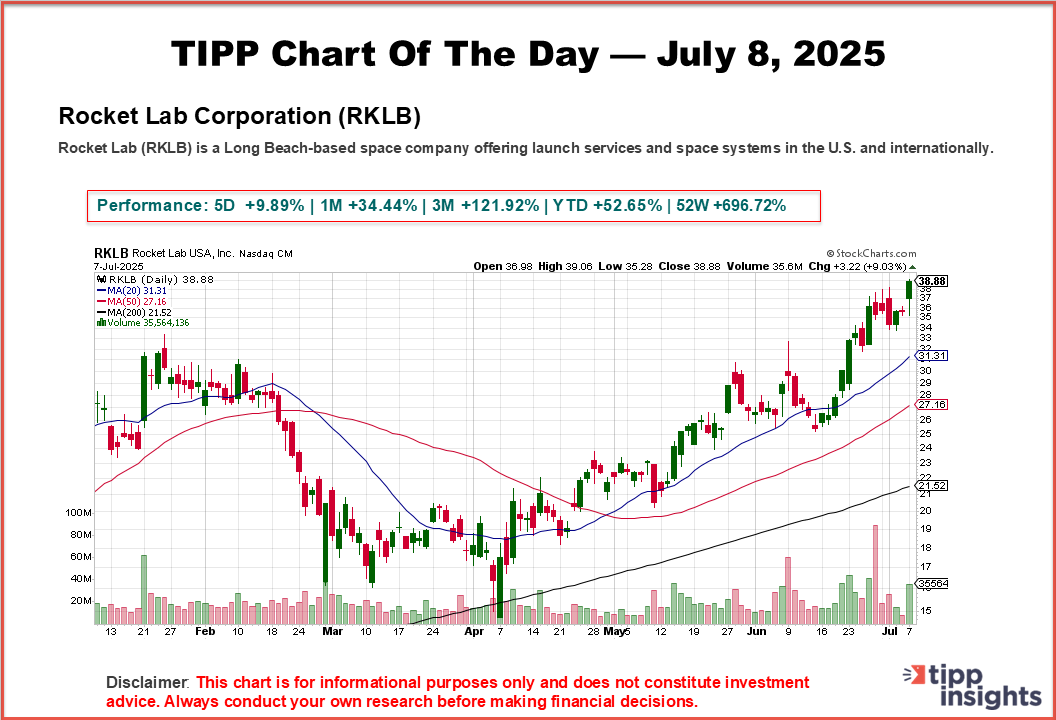
📈 Featured Stock
Our pick for today’s featured stock
📰 News & Headlines
The Best Growth Stocks I'd Buy Right Now—James Brumley, The Motley Fool
Rocket Lab Stock Soars Higher as Neutron's Maiden Flight Nears—Aparajita Dutta, Zacks
⭐Recent Featured Stocks
Blacksky Technology Inc (BKSY) (7/7)
Dave Inc (DAVE) (7/3)
Seagate Technology (STX) (7/2)
Ouster Inc (OUST) (7/1)
Carpenter Technology Corp (CRS) (6/30)
MP Materials Corp (MP) (6/27)
Celestica, Inc. (CLS) (6/26)
TSS, Inc. (TSSI) (6/25)
Avis Budget Group (CAR) (6/24)
AngloGold Ashanti (AU) (6/23)
More here
🧠 Macro Insight
🟩 Futures Mostly Higher After Tariff Moves
Markets edge up after Trump sends tariff letters to 14 nations and extends the levy deadline to August 1, easing immediate pressure on trade fears.
🟨 Trump Sends Tariff Letters, Sets New Deadline
Trump warns nations of higher duties but signals flexibility on the August 1 deadline. Japan and South Korea face 25% tariffs, but talks continue. India and the EU were notably excluded from letters, hinting at potential deals.
🟦 China Warns U.S. on Trade Spat
China pushes back on Trump’s tariff threats, urging continued dialogue. It faces a separate August 12 deadline before steep tariffs could return, risking renewed tensions.
🟧 Oil Slips Amid Trade Uncertainty and Rising OPEC+ Output
Crude dips as markets weigh tariff risks and OPEC+’s larger-than-expected August output hike, adding to supply concerns.
🟥 Amazon Prime Day Kicks Off
Amazon launches its extended four-day Prime Day event, with U.S. online sales expected to surge. Competition from Walmart, Target, and TikTok Shop intensifies.
📅 Key Events Today
🟥 No event today