By a slender margin, a plurality of Americans see China as a "threat" rather than as a "competitor" or "partner," the latest I&I/TIPP Poll shows. And nearly half say they would back further trade restrictions on China for national security reasons, even if it means higher prices.
Americans are at best ambivalent, the I&I/TIPP Poll indicates. The poll of 1,456 voters, taken from Feb. 27 to 29, has a margin of error of +/-3.0 percentage points.
The first question: "Do you view China primarily as an economic partner, an economic competitor, or an economic threat to the United States?"
By a razor-thin plurality, 33% of Americans described China as threat, while 32% called the world's second-most populous nation a competitor. Only 16% termed the Asian nation a "partner," while 19% were unsure.
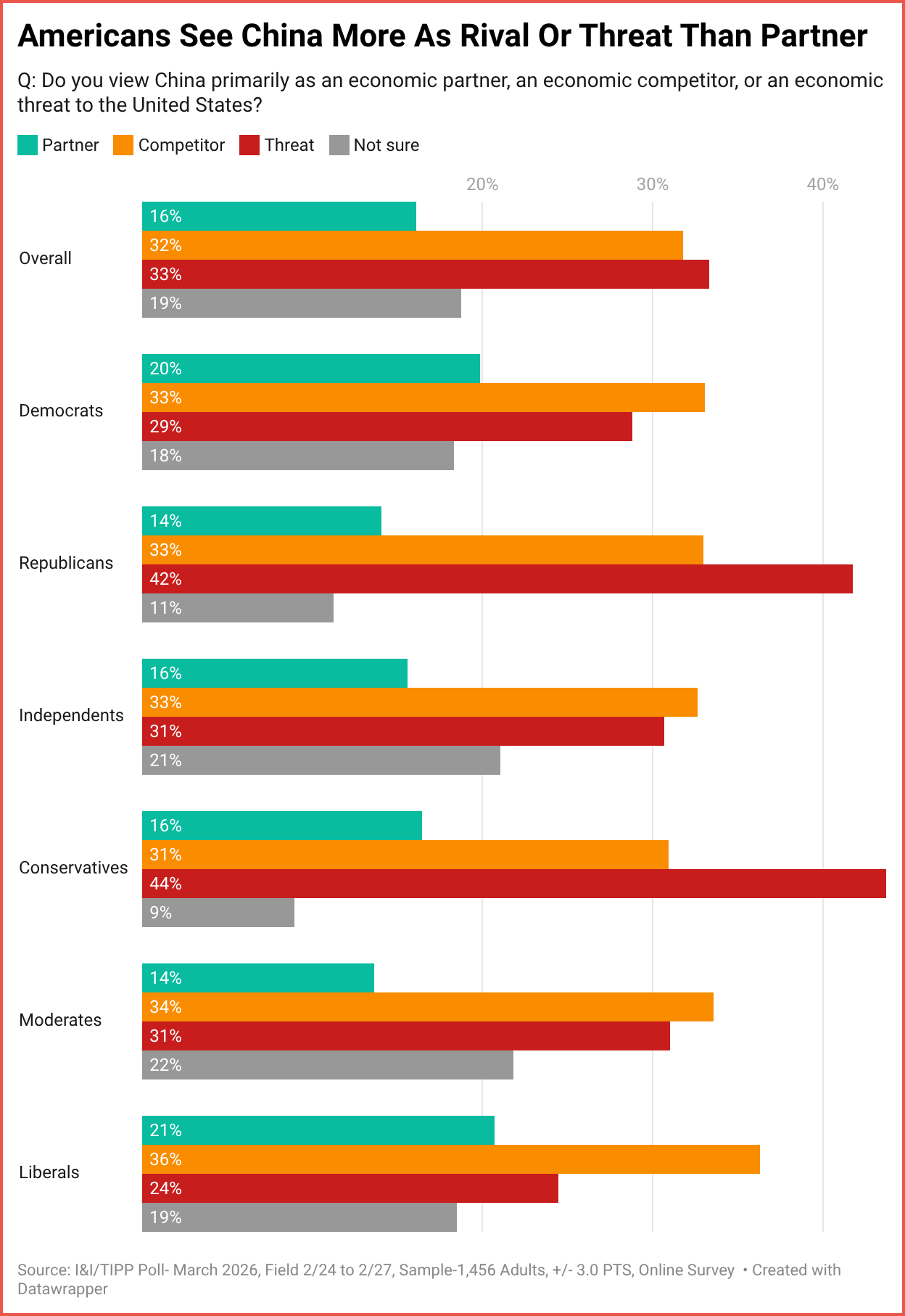
The usual political splits occurred, with Republicans (42% threat, 33% competitor, 14% partner) taking a harder line than either Democrats (29% threat, 33% competitor, 20% partner) or independents (31% threat, 33% competitor, 16% partner).
And one other glaring gap emerged: age. The older the respondent, the more likely they were to perceive China as a threat.
Among those 18 to 24, just 21% called China a threat, while an increasingly large share of those 25 to 44 years of age (27% threat), 45 to 65 years (31%) also were on the low end of the threat spectrum. But for those over 65, China was a very big threat indeed: 51%.
Why should that be? Those over 65 well remember when communist China was a closed, totalitarian society, and an implacable enemy of the West in general and the U.S. in particular. It wasn't until the late President Richard Nixon's ballyhooed "opening" to China in the early 1970s that relations improved at all.
For those in the younger age groups, they mainly remember the accession of China to the World Trade Organization, and the flood of inexpensive goods that accompanied increased trade with the Middle Kingdom.
China's dumping of trillions and trillions of dollars in goods into the U.S. and other markets helped make the first two decades of the 21st century a period of extremely low annual average consumer-price inflation of just over 2%.
But it also helped deindustrialized major swaths of what was once America's industrial heartland, which has had negative social and economic impacts now for two decades.
Know someone who should be reading TIPP Insights? Forward this email. Sponsor inquiries: editor-tippinsights@technometrica.com
I&I/TIPP followed up its first question with a closely-related second: "If restricting trade with China raised prices for American consumers, would you still support those restrictions for national security reasons?"
On this question, Americans on average took a harder line.
Among those answering, a sizeable plurality of 44% responded "yes," while only 27% said "no" and an even larger 29% said they were "not sure."
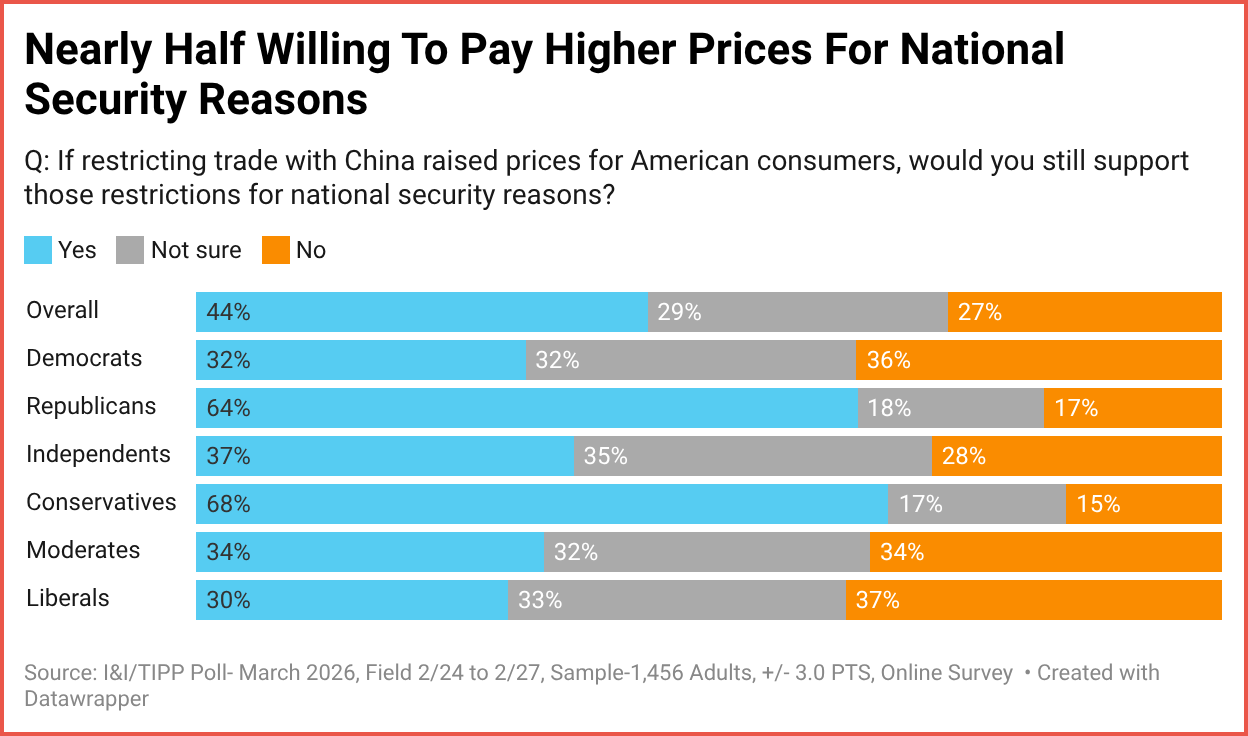
As with the previous question, party affiliation and age group to a large extent determined the response.
Republicans were strongest in their anti-China stance, with a big majority (64% yes, 17% no) saying they would support restrictions for national security, compared to Dems (32% yes, 36% no) and independents (34% yes, 28% no).
And, once again, age mattered.
Responses of those ages 18 to 24 (40% no), 25 to 45 years (29% no) and 46 to 64 years (26% no) were much higher than those over 65 (18% no) in rejecting trade protection.
Conversely, those saying yes to protection from Chinese imports on national security grounds equaled just 33% among the 18-24 group, 46% among the 25-44 group, 39% among those in the 45-64 range, but another majority — 54% — for the oldest demographic.
It's pretty clear that many Americans like the cheap, mostly well-made goods from China, but don't like the potential negative economic impact and perceived national security issues.
Can Trump fix this? Yes. He tried to do so using tariffs.
Trump earlier tried imposing on China a 10% "fentanyl" tariff and 10% reciprocal tariffs on other goods, part of a new "global" tariff, and vowed to raise those to 15% in coming months.
But in February, the U.S. Supreme Court struck down the duties imposed by Trump under the 1977 International Emergency Economic Powers Act, which gives the president power to impose duties during an economic emergency.
That decision did not include existing tariffs put in place under Sec. 301 of the Trade Act or Sec. 232 of the Trade Extension Act, leaving tariffs of about 5% on Chinese goods in place.
Responding, Trump earlier this month launched two separate investigations of China for violating a 2019 deal to buy more U.S. goods and services, respect intellectual property, and make access to China's market easier.
Not surprisingly, China last week announced it will investigate the U.S. for practices that "hinder the trade of green products" and "disrupt global production and supply chains." So don't expect a quick resolution.
As China Briefing noted Friday: "While the investigations suggest the possible return of the tit-for-tat tariff hikes seen in 2025, the Trump-Xi meeting rescheduled for mid-May could lead to a more enduring trade deal that would resolve these issues before any salvos are fired."
So whether Trump's tariffs stick, are nixed, or even grow, remains to be seen. But whatever happens, as the I&I/TIPP Poll suggests, a sizeable number of Americans will spend more for Chinese goods if it means shrinking the deficit, saving U.S. jobs and defending America from China's growing military threat.
I&I/TIPP publishes timely, unique, and informative data each month on topics of public interest. TIPP’s reputation for polling excellence comes from being the most accurate pollster for the past six presidential elections.
Terry Jones is an editor of Issues & Insights. His four decades of journalism experience include serving as national issues editor, economics editor, and editorial page editor for Investor’s Business Daily.
👉 Show & Tell 🔥 The Signals
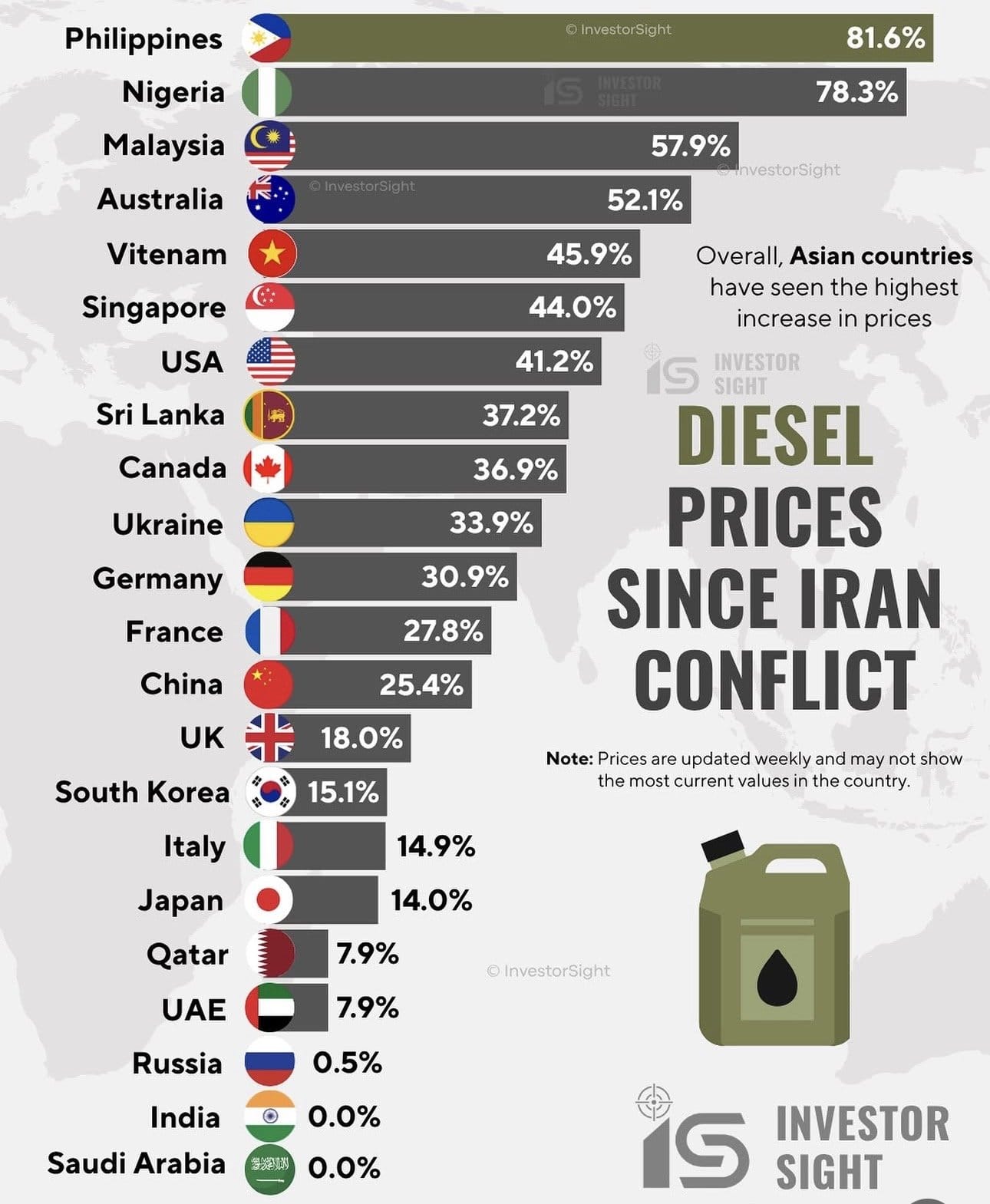
I. Diesel Prices Surge Unevenly Across Countries
Diesel prices have jumped sharply since the Iran conflict, but the impact varies widely. The Philippines (+81.6%) and Nigeria (+78.3%) have seen the biggest increases, while the U.S. is up about 41% and Europe more modestly. Some countries, including India and Saudi Arabia, have seen little to no change.
The divergence reflects differences in subsidies, supply chains, and pricing controls.
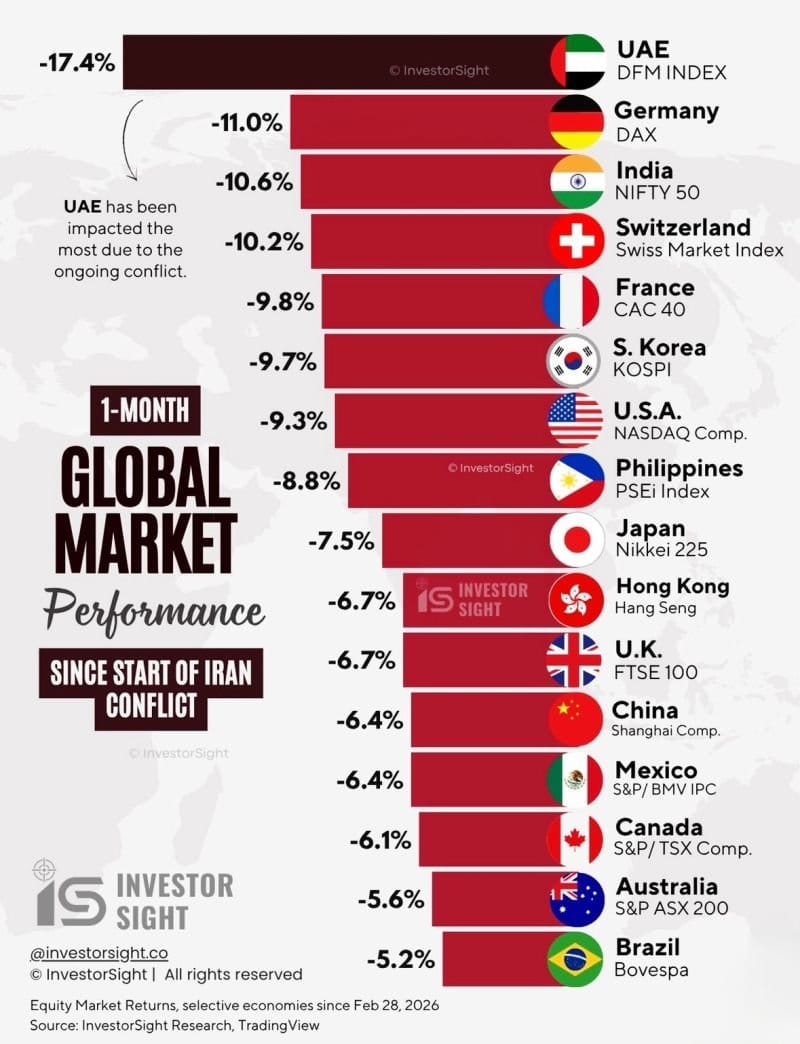
II. Global Markets Slide As Iran Conflict Weighs
Equity markets worldwide have declined since the start of the Iran conflict. Most major indices are down between 5% and 17%, with the UAE among the hardest hit and U.S. markets also under pressure. The broad selloff reflects rising geopolitical risk and energy-driven uncertainty.
📊 Market Mood — Monday, March 30, 2026
🟩 Stocks Edge Higher as Iran War Enters Second Month
U.S. futures rose as investors weighed escalating risks alongside tentative optimism on negotiations.
🟧 Oil Climbs on Escalation and Supply Threats
Crude pushed higher above $100 as troop buildups and widening conflict threatened global energy flows.
🟦 Markets Torn Between Diplomacy and Escalation Risks
Conflicting signals on a potential deal versus expanded military action kept sentiment fragile.
🟨 Key U.S. Data in Focus as Policy Outlook Shifts
Investors look ahead to ISM and jobs data for clues on growth and Fed response to the energy shock.
🗓️ Key Economic Events — Monday, March 30, 2026
🟧 10:30 ET — Fed Chair Powell Speaks
Remarks from the Fed Chair may provide guidance on inflation, interest rates, and the economic impact of the ongoing energy shock.
editor-tippinsights@technometrica.com