How do Americans feel about President Donald Trump's tariffs? As the U.S. Supreme Court mulls whether the president even has the constitutional power to impose tariffs, the general public's feelings about the import tax is at best ambivalent, at worst hostile, the latest I&I/TIPP Poll shows.
Along with interest rate policy and soaring federal spending, Trump's tariffs loom as among the most significant governmental economic policies proposed in the last two decades.
So what do average Americans think about them?
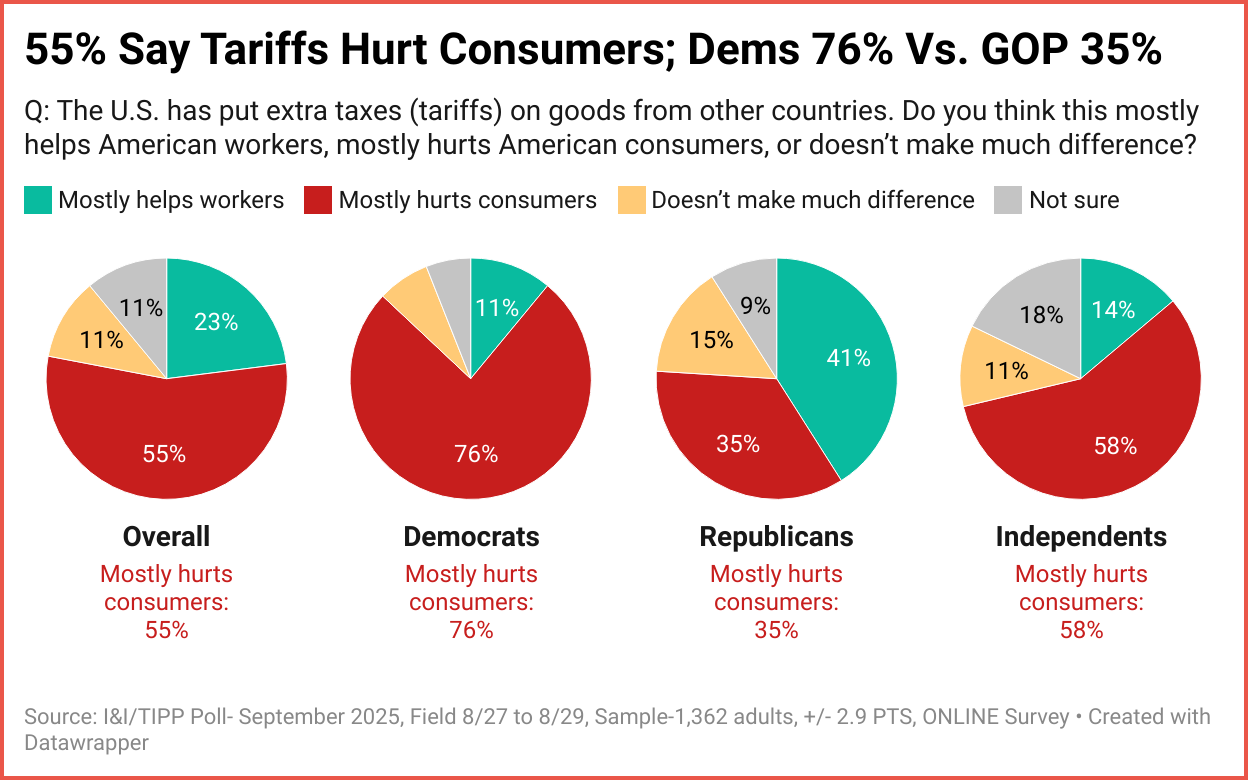
In the latest national online I&I/TIPP Poll of 1,362 adult Americans, taken Aug. 27-29, voters were asked the following question (one of three on tariffs): "The U.S. has put extra taxes (tariffs) on goods from other countries. Do you think this mostly helps American workers, mostly hurts American consumers, or doesn’t make much difference?"
Overall, 23% said tariffs mostly help U.S. workers, but more than twice as many – 55% – said they mostly hurt consumers. Another 11% said it doesn't make a lot of difference, while 11% were not sure.
Most of the 36 major demographic categories I&I/TIPP regularly tracks agreed that that the major impact would be on consumers, not on workers. There was one big exception: Political affiliation.
Democrats (11% "mostly helps workers," 76% "mostly hurts consumers") and independents (14% "mostly helps workers," 58% "mostly hurts consumers") overwhelmingly agreed that consumers were hurt by tariffs.
But among Republicans, 41% answered that the tariffs would help workers, compared to just 35% who said they would help consumers.
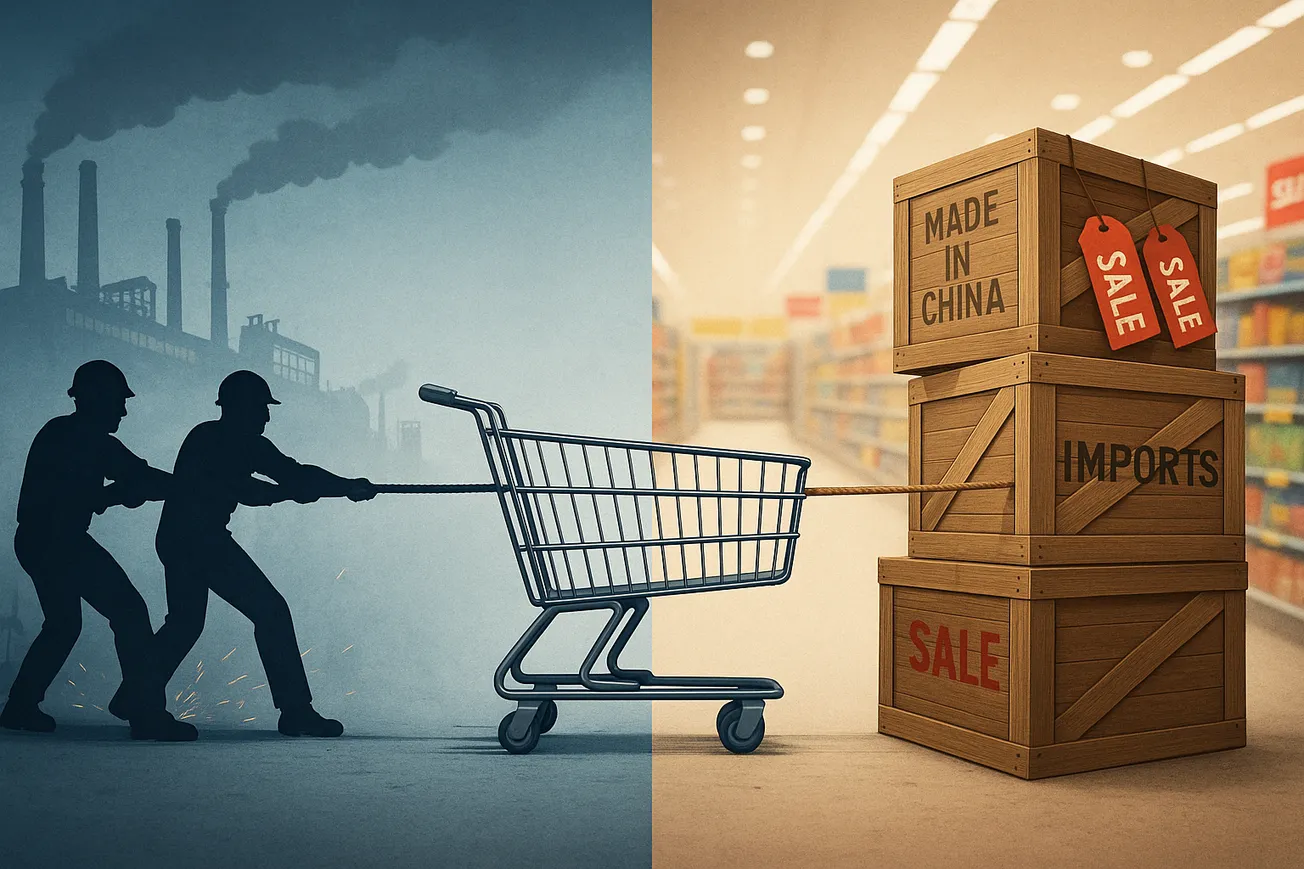
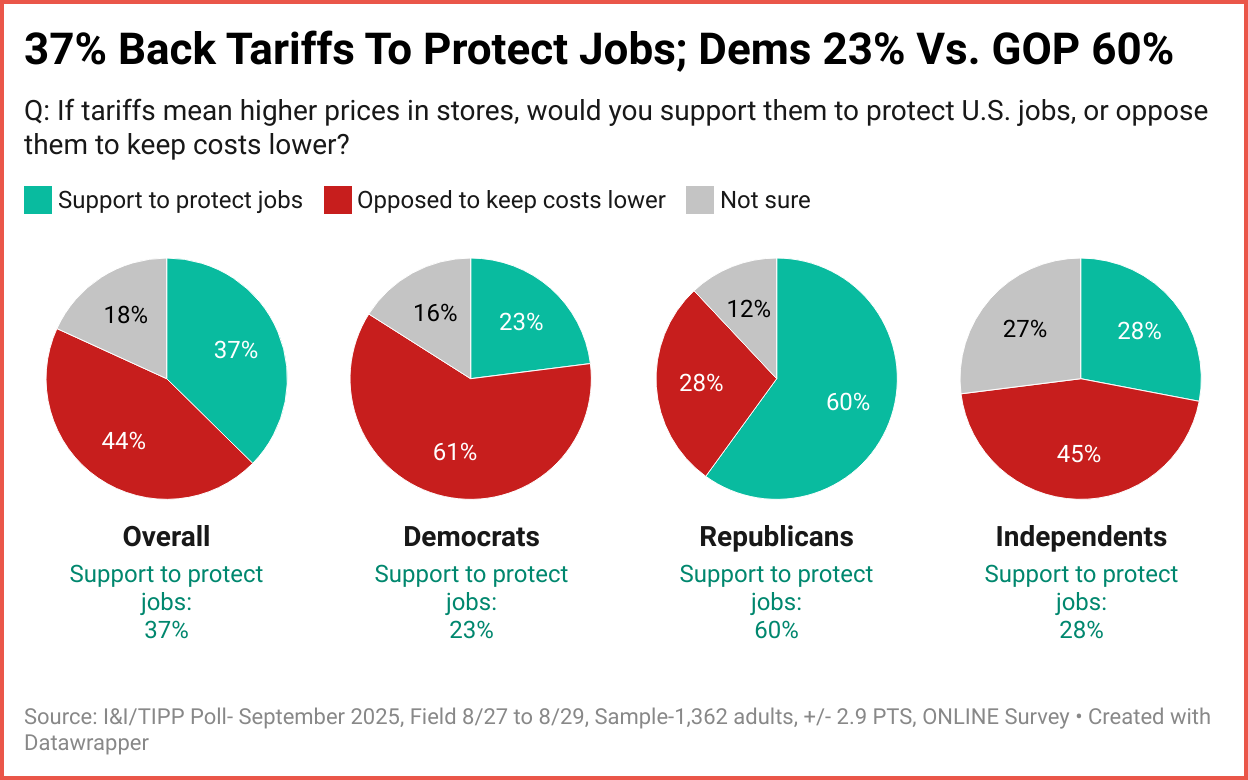
I&I/TIPP then asked voters a question about the practical results of tariffs: "If tariffs mean higher prices in stores, would you support them to protect U.S. jobs, or oppose them to keep costs lower?"
This time, 37% of all respondents answered that they would support tariffs to protect workers, versus a plurality of 44% who said they would oppose them to keep prices lower. In short, Americans appear to be more concerned about inflation than about job losses.
And, once again, political differences were sharp: Among Democrats, only 23% said they would back tariffs to protect U.S. jobs, while 61% said they would oppose them in order to keep prices down. For independents, 28% support tariffs to protect jobs, but 45% oppose tariffs to keep prices low.
Republicans reversed those results: 60% back tariffs as a way to bolster U.S. jobs, while only 28% oppose tariffs to bring prices down.
Gold standard in polling — the only national pollster to get six presidential elections right. Talent on loan from God. Subscribe now → $99/year
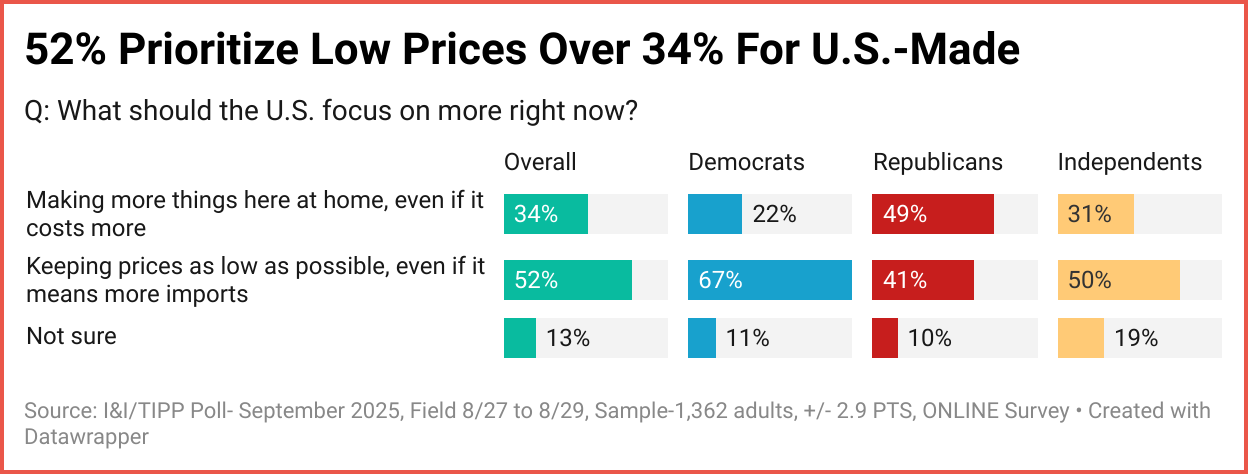
Finally, I&I/TIPP asked: "What should the U.S. focus on more right now?"
Among all respondents, 34% selected "Making more things here at home, even if it costs more," while a 52% majority picked "Keeping prices as low as possible, even if it means more imports." Another 13% weren't sure.
Political leanings again matter. Among Democrats, 67% opted for keeping prices low even if it means making things overseas, versus 22% picking making things here, even if it's more expensive. For independents, 31% said make things here, compared to 50% wanting prices to be as low as possible.
Republicans? While 41% wanted prices to be as low as possible, a plurality of 49% wanted more things to be made here, even at higher costs.
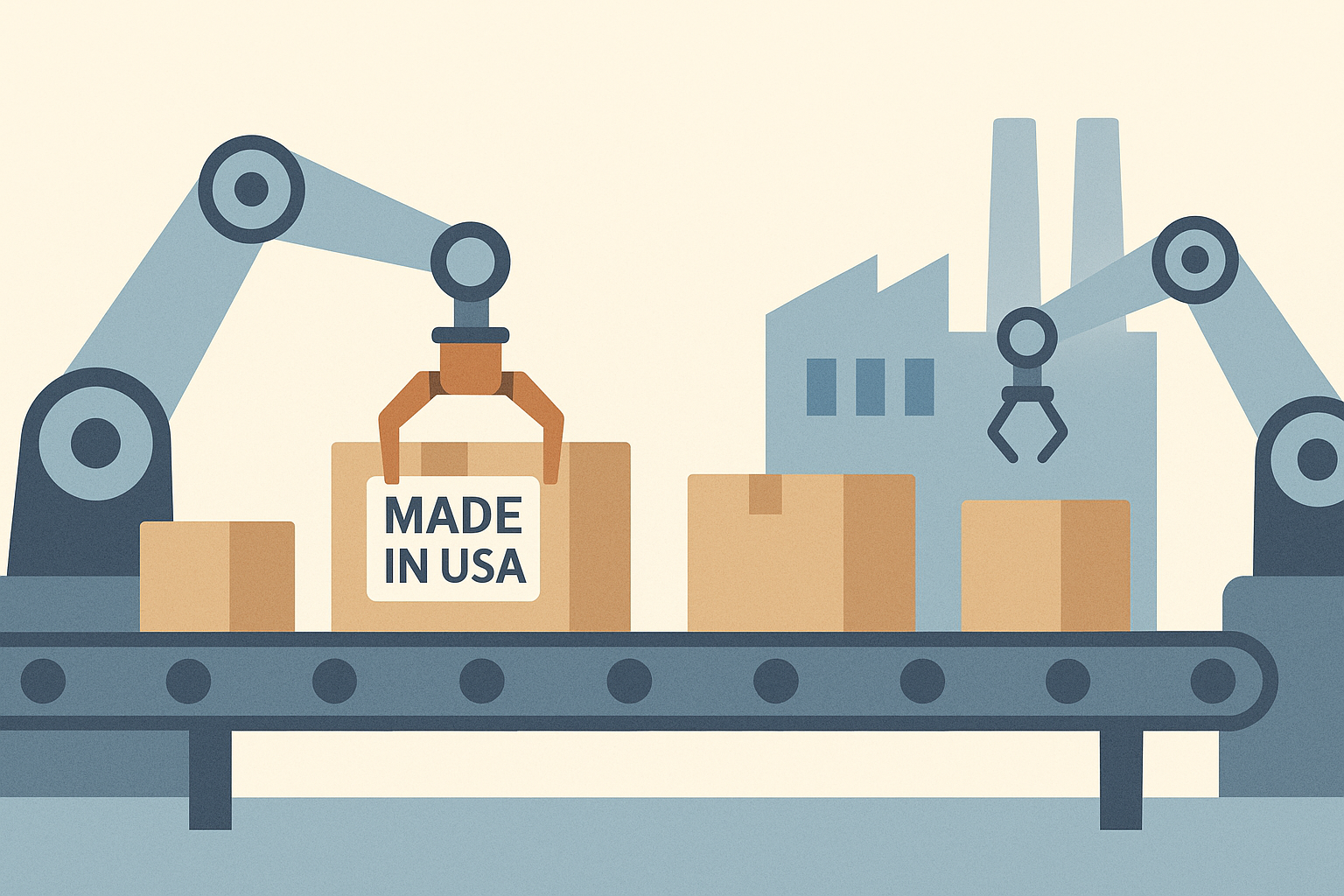
📦 Tariffs Are Pushing Major Companies To Build Here
Apple ($600 B)
Expanding U.S. manufacturing and supply chains, supporting 450,000 jobs.
TSMC ($165 B)
Building three Arizona fabs and packaging plants, creating tens of thousands of jobs.
Eli Lilly ($27 B)
Adding four new pharma plants to cut import reliance and create 3,000 jobs.
Hyundai ($21 B)
Building EV, steel, and battery facilities to localize production.
Roche ($50 B)
Expanding drug and diagnostics manufacturing, adding 12,000 U.S. jobs.
These results represent a switch of the traditional political party stances on trade and inflation. Republicans in the past were staunch free traders, regardless of its impact on jobs. Democrats often backed trade protection and federal support for domestic jobs. Independents stood somewhere in between.
But with Trump's call for tariffs as a means of redressing trade imbalances and boosting revenue, all this has changed. Elected Republicans today broadly support Trump in his tariff-trade crusade (with a few notable exceptions, such as Kentucky U.S. Sen. Rand Paul).
Republican Trump even gets big kudos from labor unions for supporting tariffs over the "free-trade disaster" that many blame for America's slumping Rust Belt economy.
It was once conventional wisdom among modern economists that barriers to trade such as tariffs and quotas were almost universally awful and led to negative economic consequences. Not so anymore.
Indeed, a recent study by the Atlanta Federal Reserve Bank found that the Trump tariffs were likely to lead to one-time inflation increases of anywhere from 0.81% to 1.63%, but wouldn't lead to an upward inflation spiral.
As for the overall economy, tariffs may slow economic growth, but that will likely be offset by Trump's "Big, Beautiful" tax cuts, which will boost the economy by increasing both capital investment and productivity, according to a recent Congressional Budget Office estimate.
As Treasury Secretary Scott Bessent told Laura Ingraham way in February, "relative to everything else President Trump is doing, lowering the energy costs, deregulating, and commonsense policies, inflation is going to go down overall.”
Even so, as the I&I/TIPP Poll shows, Americans feel the pangs from Biden's post-COVID inflation surge, which slashed Americans' purchasing power by 25% since 2020. As the I&I/TIPP Poll shows, Americans are very inflation-sensitive right now, and that negatively affects how they view tariffs.
I&I/TIPP publishes timely, unique, and informative data each month on topics of public interest. TIPP’s reputation for polling excellence comes from being the most accurate pollster for the past six presidential elections.
Terry Jones is an editor of Issues & Insights. His four decades of journalism experience include serving as national issues editor, economics editor, and editorial page editor for Investor’s Business Daily.
Related:
Tariff Dividends: Down Payment On A Golden Economic Age—Steve Cortes, Cortes Investigates
Trump’s Marbury v. Madison Showdown—Editorial Board, TIPP Insights
For Presidents, Not For A President— Editorial Board, TIPP Insights
📊 Market Mood — Monday, September 15, 2025
🟢 Futures Mixed: S&P and Nasdaq futures edge higher while Dow slips, as traders brace for a pivotal Fed rate decision this week.
🟡 Fed Decision Looms: Markets price a 95% chance of a 25 bps cut Wednesday as policymakers weigh slowing jobs data against sticky inflation.
🟣 U.S.–China Talks: Officials meet in Madrid for trade and TikTok divestment talks; a deadline extension for TikTok’s U.S. arm is likely.
🟠 China Chip Probe: Beijing launches anti-discrimination and dumping investigations into U.S. chip policies, pressuring analog chip stocks.
🟤 Oil Climbs: Crude rises on fears of Russian supply disruptions after Ukrainian drone strikes hit major oil terminals and refineries.
Market round-up in 5 minutes. We bring you up to speed. Subscribe to TIPP Insights for $99/year.
📅 Key Events Today
🟨 Monday, September 15
None today