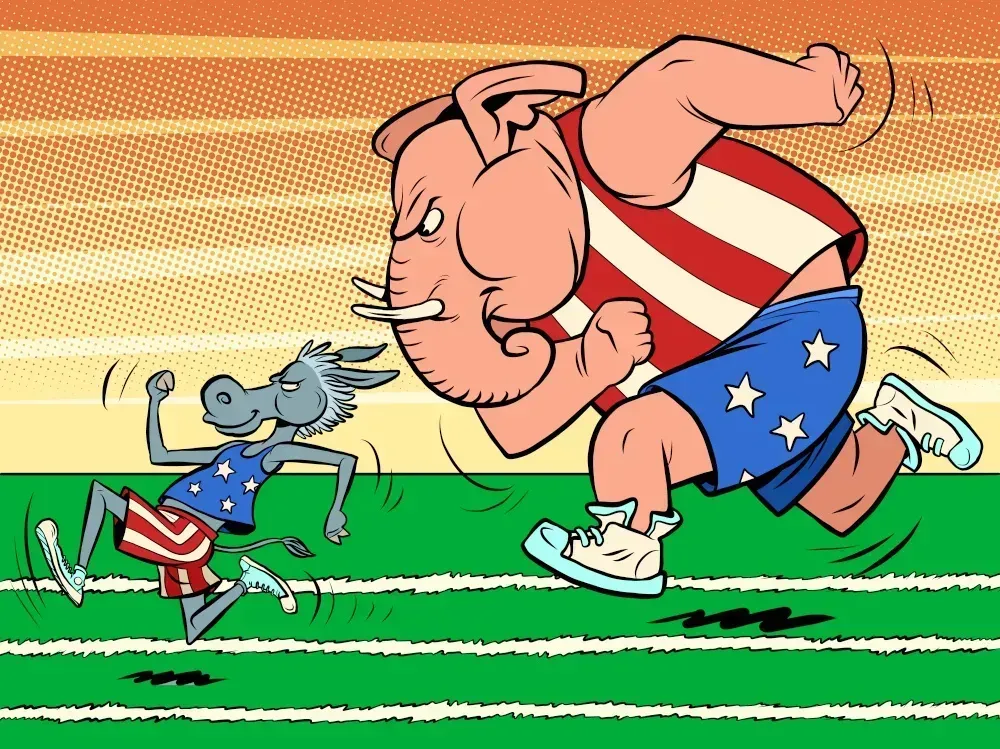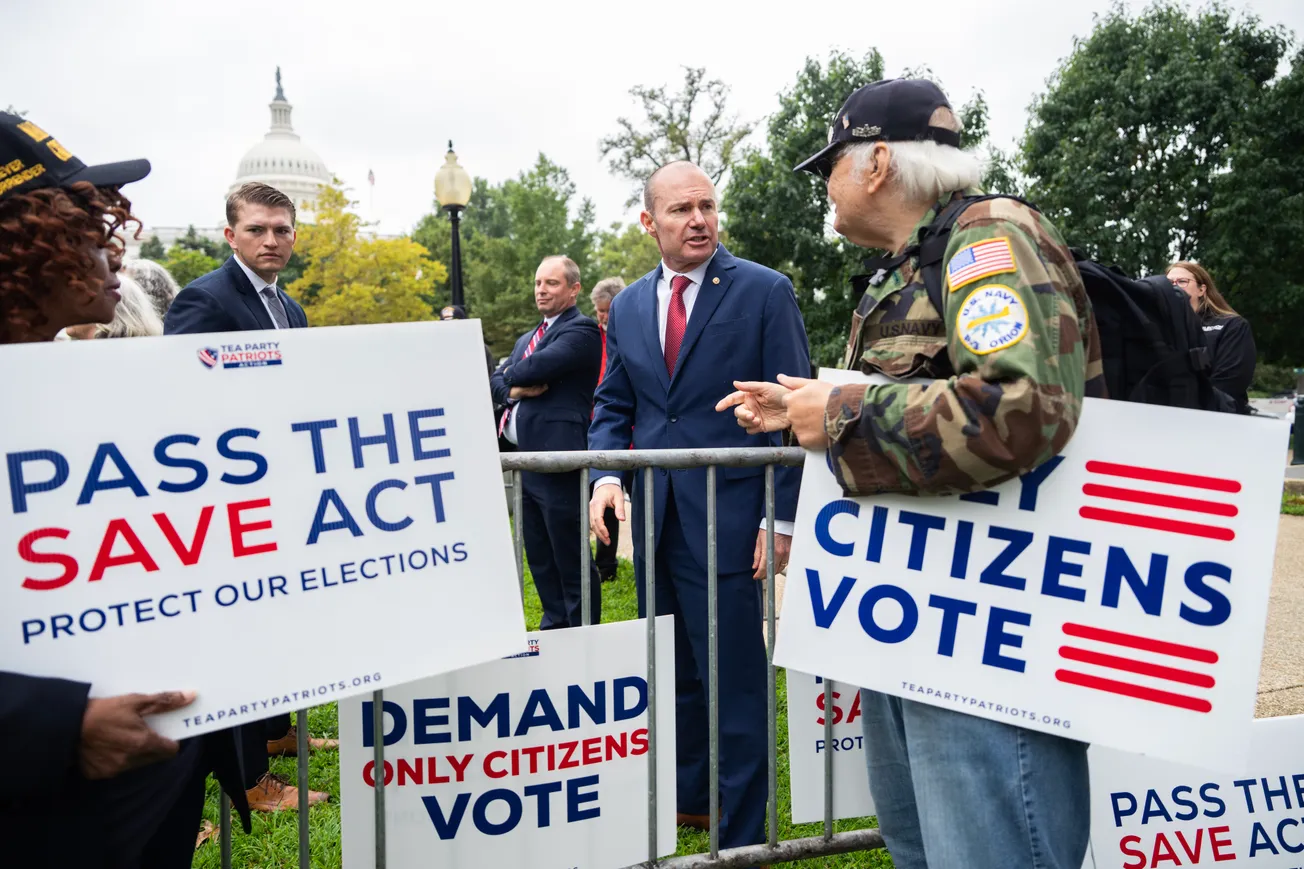

President Donald Trump's tariffs on imported goods suffered a Supreme Court legal rebuke in late February, but they're not doing much better in the court of public opinion. As the latest I&I/TIPP shows, most voters don't believe the economy will get a boost from tariffs, which win strong majority support only from Republicans.
It was once the case that most conservatives and many moderates rejected tariffs on imported goods as an unwanted distortion of free trade. Meanwhile, liberals embraced tariffs as a welcome tool of government "industrial policy."
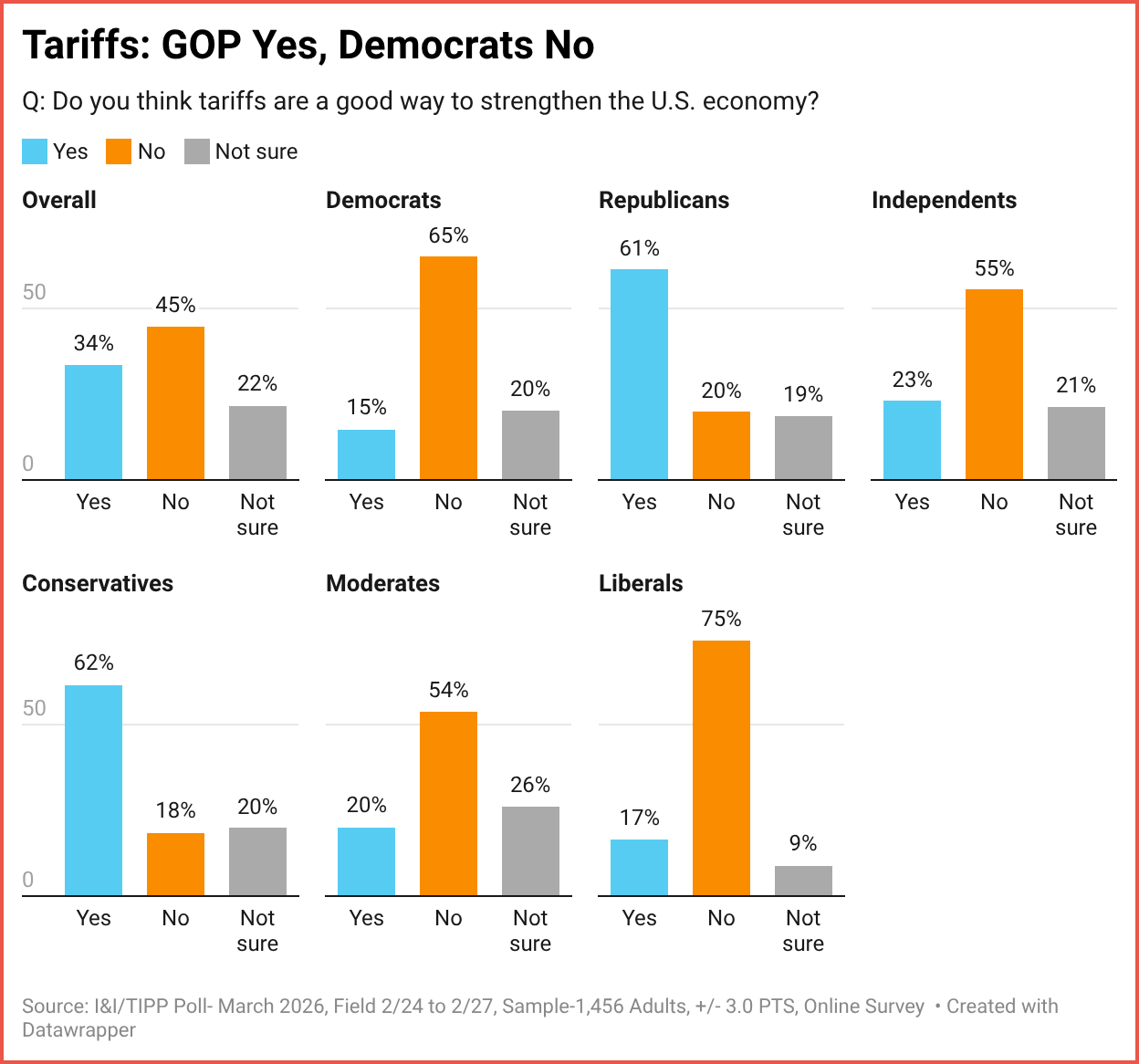
But President Trump has flipped the script. In the latest I&I/TIPP online national opinion poll, taken from Feb. 24 to Feb. 27 by 1,456 adults, voters were asked: "Do you think tariffs are a good way to strengthen the U.S. economy?"
By a solid plurality, Americans overall answered "no" (45%) rather than "yes" (34%). "Not sure" received 22% support. The poll has a +/-3.0 percentage point margin of error.
With Trump in office, self-described liberals are now anti-tariff, with 75% saying no, and 17% yes. Conservatives also reversed: Just 18% said no, while 62% answered yes. Those in the moderate camp were also anti-tariff: 54% no, 20% yes.
Politically, Republicans (61% yes, 20% no) were pretty isolated, with majorities of both Democrats (15% yes, 65% no) and independents (23% yes, 55% no) rejecting the economic benefit of tariffs.
That split showed up again earlier this year, as the New York Times reported: "While most Democrats have criticized Mr. Trump’s on-again, off-again approach as “chaotic” and “reckless,” they have displayed little consensus about embracing tariffs themselves as a policy tool."
In short, the left may hate "Trump's tariffs," but they don't object to their use in general.
Apart from political affiliation, there are notable differences among key demographic groups over tariffs.
Men (45% yes, 39% no), for instance, were much more likely to believe tariffs will boost the economy than women (23% yes, 45% no). Minorities also split: Blacks (25% yes, 49% no) diverged strongly from Hispanic voters (40% yes, 40% no) on the benefits of tariffs.
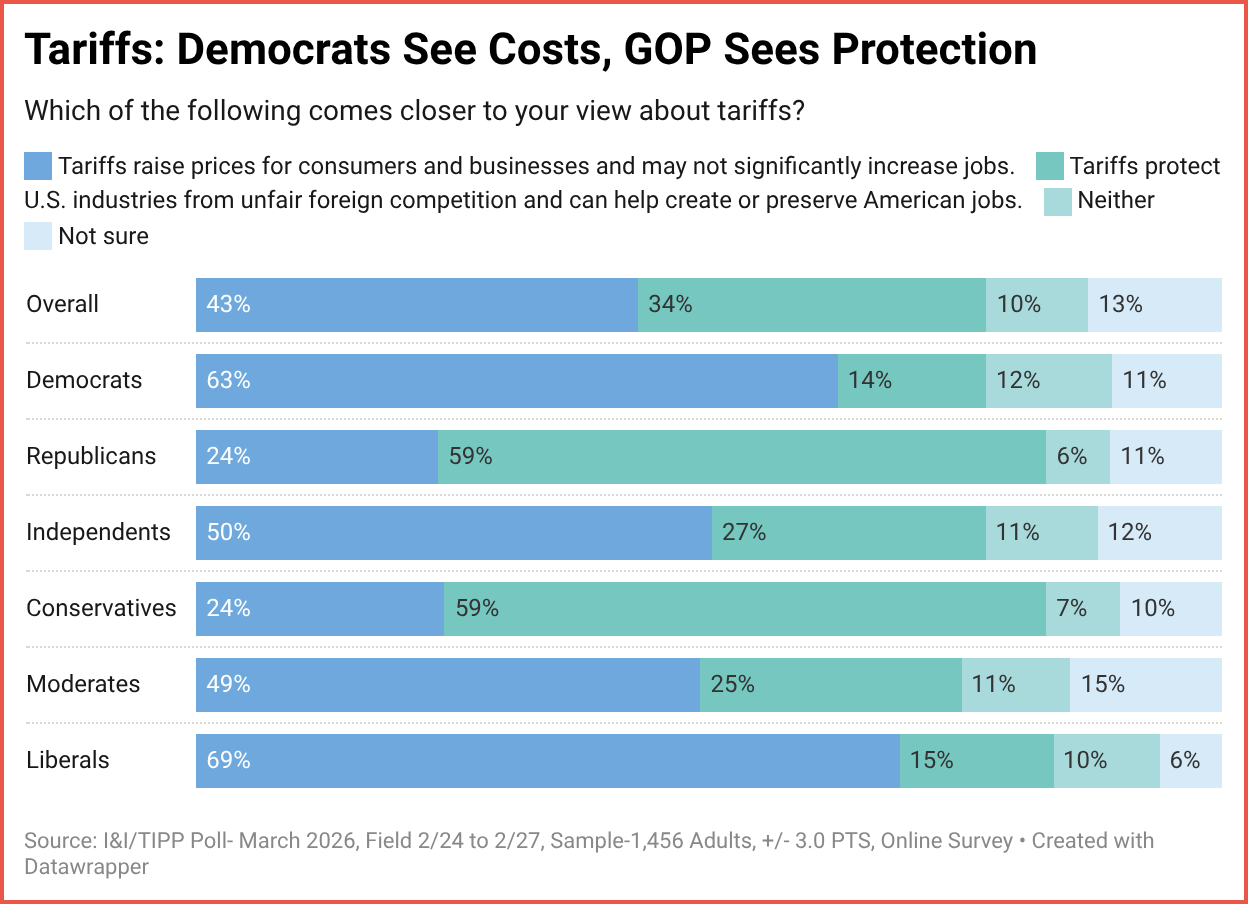
But how do Americans view the actual impact of tariffs? In a follow-on question, I&I/TIPP asked: "Which of the following comes closer to your view about tariffs?"
Among those polled, 43% agreed that "tariffs raise prices for consumers and businesses and may not significantly increase jobs," while 34% said "tariffs protect U.S. industries from unfair foreign competition and can help create or preserve American jobs."
Another 10% answered "neither," while 13% weren't sure. The poll has a +/-3.0 percentage point margin of error.
This is another area of American presidential policymaking in which responses track political affiliation.
Among Democrats, 63% were in the "tariffs raise prices" camp, while just 14% agreed that "tariffs protect industries." For independents, the comparable numbers were 50% and 27%. Republicans? They flip the numbers, with 24% saying tariffs raise prices, but a solid 59% majority saying the protect U.S. industries and boost jobs.
Without broad public support and a green light from the U.S. Supreme Court, can tariffs still remain in place? Perhaps.
The Supreme Court's decision did not ban tariffs or suggest they were illegal. Instead, the court found that Trump's tariffs, put in place under the International Emergency Economic Powers Act (IEEPA), which Congress passed in 1977, could not be permanent.
That law gives Trump the power to levy tariffs on an emergency basis. In a dissent, Justice Brett Kavanaugh noted that Trump erred in using IEEPA as the basis of his authority. Instead, Kavanaugh cited the Trade Expansion Act of 1962, the Trade Act of 1974 and the Tariff Act of 1930 as also justifying presidential authority for tariffs on a temporary basis.
Article 1, Section 8 of the U.S. Constitution clearly gives Congress the power "to lay and collect taxes, duties, imposts and excises . . . " But over the years, in six separate acts, Congress has given the president the tariff power, particularly during an emergency, but not to impose them permanently.
While, two dozen blue-state attorneys general are suing to stop Trump's tariffs, the Supreme Court's recent decision was extremely narrow. It looked only at the International Emergency Economic Powers Act of 1977, not others.
So, legally, it remains a viable policy debate. Former President Joe Biden, it should be remembered, kept many of the tariffs from Trump's first term in office, and even expanded some. But political criticism from Dems was muted or nonexistent.
Meanwhile, economists generally believe tariffs distort trade and boost costs of imports, leading to greater inefficiency, fewer jobs and a slowing economic output. But that hasn't happened. At least not yet.
“My guess is that if you told a hundred economists that the average tariff rate was going to jump from 3% to well over 20%, many would’ve predicted a recession,” noted Ben Harris, director of economic studies at the Brookings Institution, former assistant Treasury secretary for economic policy under Biden. “And that was in fact not what we saw.”
The debate will go on. But ultimately, it will be public opinion that decides the fate of Trump's tariffs. As of right now, as the I&I/TIPP Poll shows, public opinion on tariffs is not favorable.
I&I/TIPP publishes timely, unique, and informative data each month on topics of public interest. TIPP’s reputation for polling excellence comes from being the most accurate pollster for the past six presidential elections.
Terry Jones is an editor of Issues & Insights. His four decades of journalism experience include serving as national issues editor, economics editor, and editorial page editor for Investor’s Business Daily.
👉 Show & Tell 🔥 The Signals
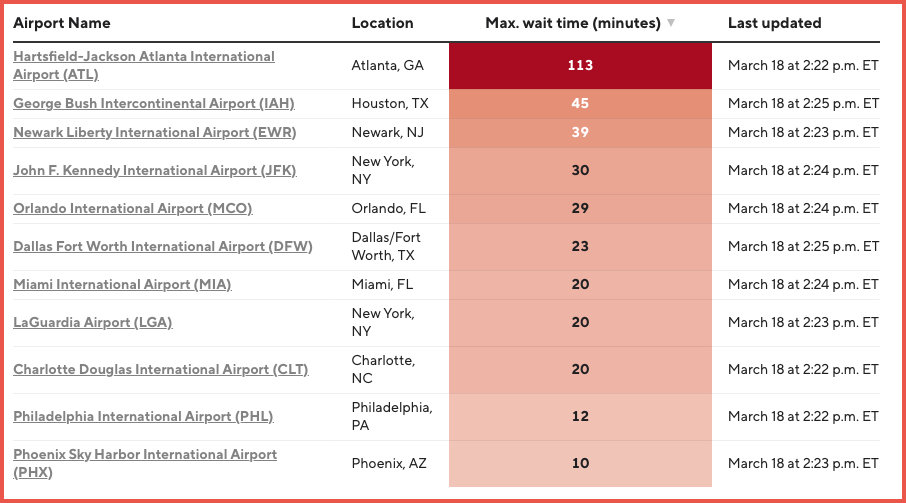
I. Airport Wait Times Spike At Major U.S. Hubs
Security delays at major airports have surged, with wait times exceeding 100 minutes at some hubs, including Atlanta. Other airports such as Houston, Newark, and JFK are also seeing extended lines.
The disruptions are tied to TSA staffing shortages, making wait times highly unpredictable. Travelers are being advised to arrive early and check real-time updates.
II. ICE Urges Chicago Officials To Hold Suspect In Sheridan Gorman Killing - DHS
U.S. Immigration and Customs Enforcement (ICE) has asked Illinois officials to honor a detainer request for Jose Medina-Medina, who is accused of killing 18-year-old Loyola University student Sheridan Gorman in Chicago.

According to authorities, Medina-Medina had previously been released after an earlier arrest in 2023, a detail now at the center of debate over sanctuary policies and cooperation between local and federal law enforcement.
The case is likely to intensify political tensions over immigration enforcement, public safety, and the handling of ICE detainer requests.
Source: U.S. Department of Homeland Security
III. iPhone Users Now Face Spyware Threat Once Limited To Governments - Axios
Advanced spyware tools once reserved for intelligence agencies are now in the hands of cybercriminals. Researchers found iPhones can be silently infected just by visiting a compromised website, allowing attackers to access messages, photos, contacts, and location data.
The spread of these tools means any iPhone user could now be a target, significantly raising the threat level despite recent security patches.

Source: Axios
📊 Market Mood — Monday, March 23, 2026
🟩 Energy Shock Deepens as Oil Crisis Fears Rise
Oil climbed further as the IEA warned of a “very severe” global energy crisis tied to the Iran conflict.
🟧 Stocks Slide as War Enters Fourth Week
U.S. futures and global equities fell amid growing concern over prolonged disruption to energy markets.
🟦 Dollar Strengthens on Risk-Off Sentiment
Investors moved into the U.S. dollar as geopolitical tensions and inflation risks intensified.
🟨 Inflation Fears Rise as Oil Fuels Policy Uncertainty
Surging energy prices are raising expectations of prolonged high interest rates and possible policy tightening.
🗓️ Key Economic Events — Monday, March 23, 2026
No Events Scheduled
editor-tippinsights@technometrica.com