‘April is the cruellest month,” T.S. Eliot wrote in his epic poem “The Waste Land.” This year, it seems many American taxpayers might be inclined to agree with the venerable poet. More people than not say they will be paying more in taxes this year, not less, and call the federal tax code unfair, the latest I&I/TIPP Poll shows.
In its monthly national online poll, I&I/TIPP asked 1,464 adults about their taxes. The poll, taken from March 31 to April 2, has a margin of error of +/-2.7 percentage points.
The first question: “Compared to last year, do you feel your federal taxes are …”, followed by six possible responses: “Much higher,” “Somewhat higher,” “About the same,” “Somewhat lower,” “Much lower,” and “Not sure.”
While not a majority, 40% of those responding said their taxes were either “much higher” (17%) or “somewhat higher” (23%). That compares with 10% who said their taxes were either “somewhat lower” (7%) or “much lower” (3%).
A significant chunk, 37%, said their taxes would be “about the same.”
While differences emerged among groups, one fact remained: None of the 36 demographic groupings were below 30% for saying their taxes would be higher, and none was over 12% for saying their taxes would be lower. That includes Democrats, Republicans and independents.
Overall, it was roughly 4-to-1 in favor of “higher” taxes over “lower.”
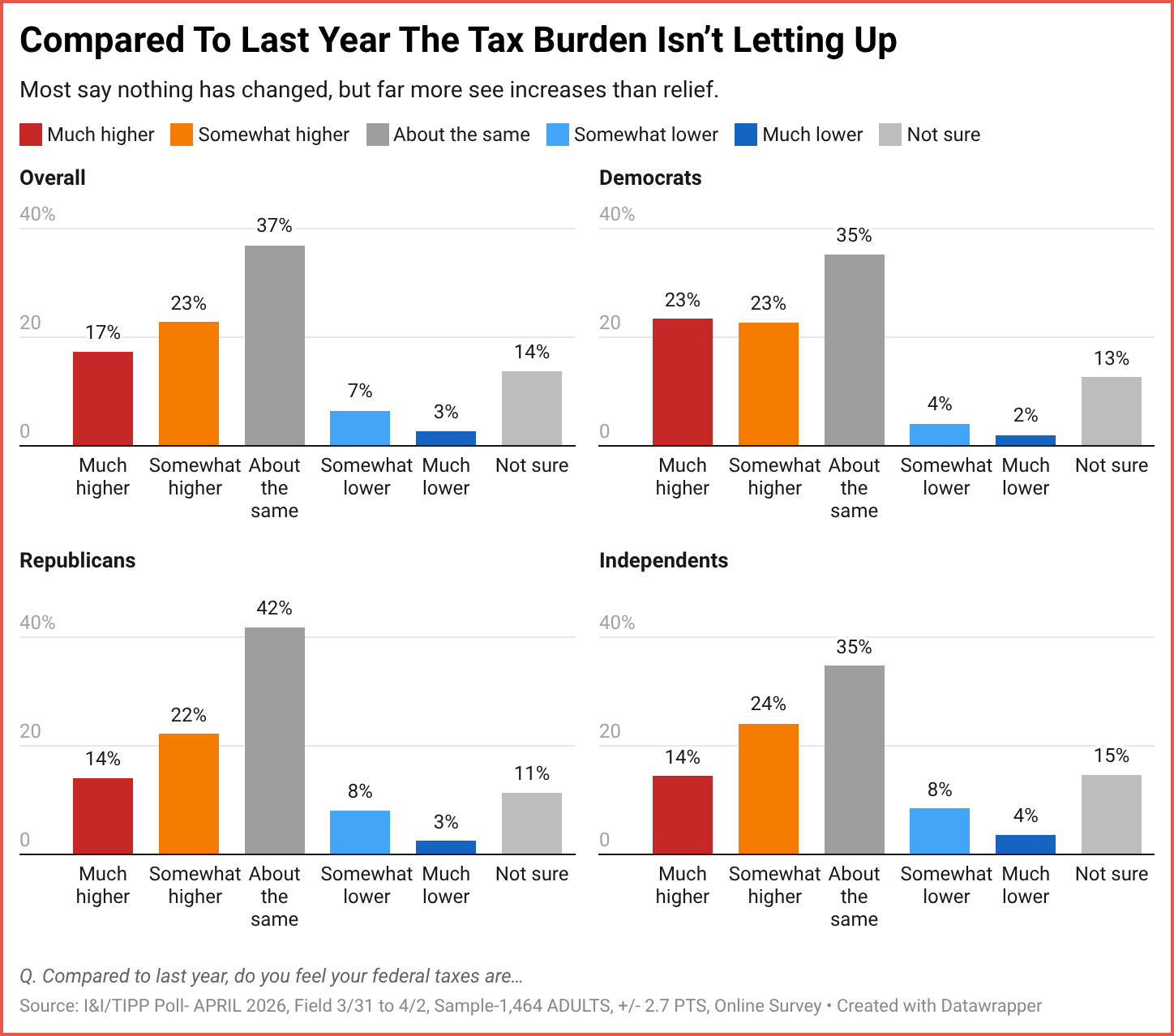
By age, the younger the person responding, in general the more likely they were to say their taxes were higher. By age, those 18 to 24 years its 40%; those 25-44 years, 49%; those 45 to 64 years, 37%; and those over 65 years, 32%. Clearly, younger, working-age Americans show a greater concern over higher taxes this year when compared to older workers and retirees.
I&I/TIPP’s second question asked: “Do you believe the federal tax system is fair to you?”
Once again, responses were divided into fair and unfair categories. This time, overall 40% said that federal taxes were either “very fair” (10%) or “somewhat fair” (30%). On the other side, 46% said they were either “somewhat unfair” (24%) or “very unfair” (22%).
This time, the “unsure” responses shrank to 15%.
Political affiliations once again tell the tale. Democrats (32% fair, 53% unfair) and independents (36% fair, 50% unfair) find a reverse-mirror image among Republicans (53% fair, 36% unfair).
This isn’t a simple matter of party fealty, but rather a function of basic political ideology.
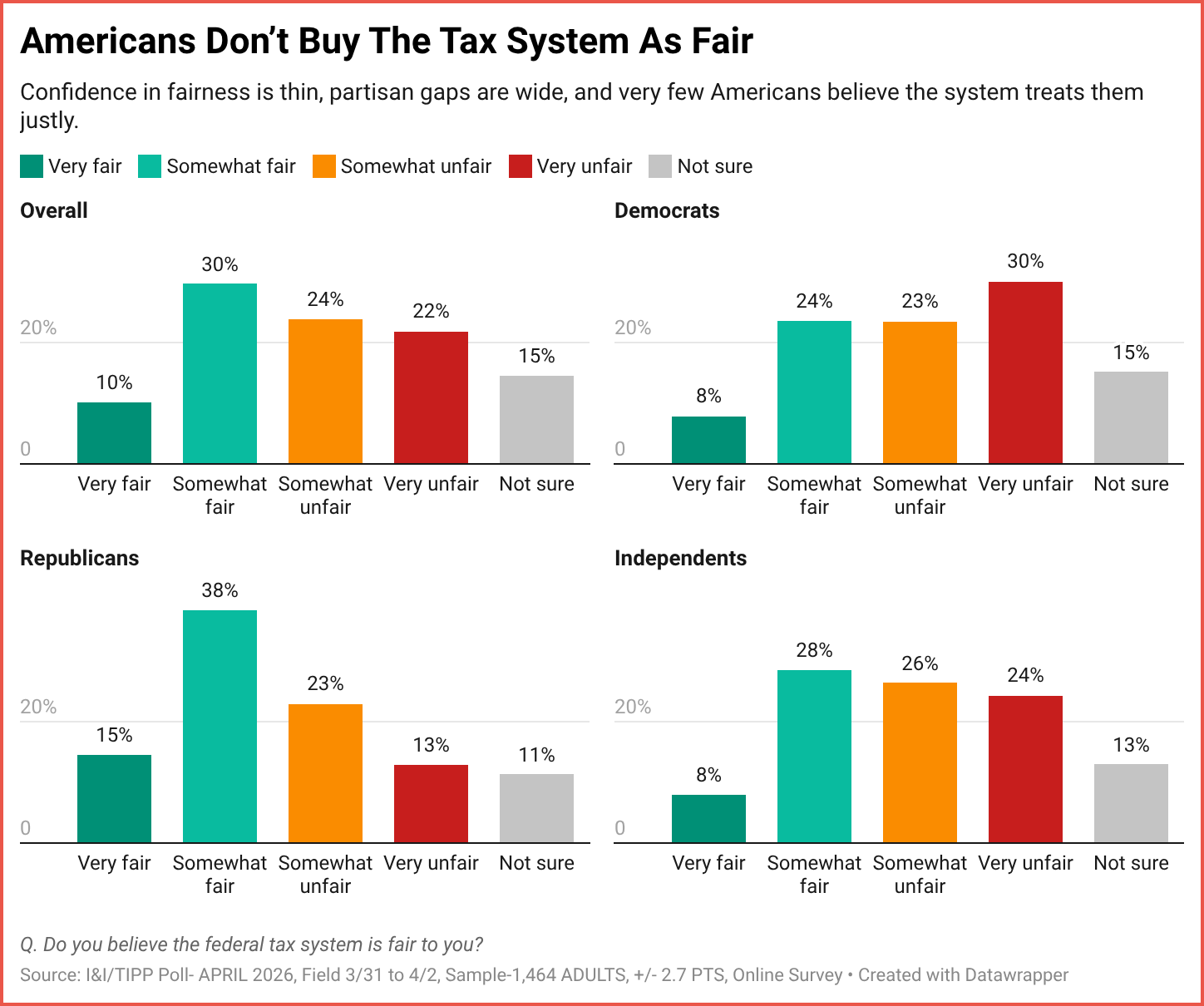
Those who self-identify as conservative were much more likely to see the tax system as “fair” (52%) than “unfair” (38%). Meanwhile, moderates (37% fair, 48% unfair) and liberals (31% fair, 56% unfair) viewed the tax system as skewed.
Know someone who should be reading TIPP Insights? Forward this email. Sponsor inquiries: editor-tippinsights@technometrica.com
A final question involved the Iran war, with peace negotiations ongoing in Islamabad between U.S. and Iranian negotiators. If no agreement is reached, it’s a very real possibility that the war will re-commence.
With $25 billion at least estimated to have been spent on the war so far, I&I/TIPP asked voters: “If the conflict with Iran increases government spending, which would you prefer?”
The five possible answers were, in descending order: “The U.S. should avoid deeper involvement to limit costs” (47%); “Reduce other government spending” (27%); “Increase borrowing/deficit spending” (7%); and finally, “Raise taxes to pay for it” (6%). “Not sure” accounted for 13%.
Republicans favored “reduce spending” (36%) over “avoid deeper involvement,” (33%), while an overwhelming 3-to-1 share of Democrats (61%) favored “avoid deeper involvement” over “reduce spending” (18%). Moderates stood 50% in favor of “avoid deeper involvement”, to 28% “reduce spending.”
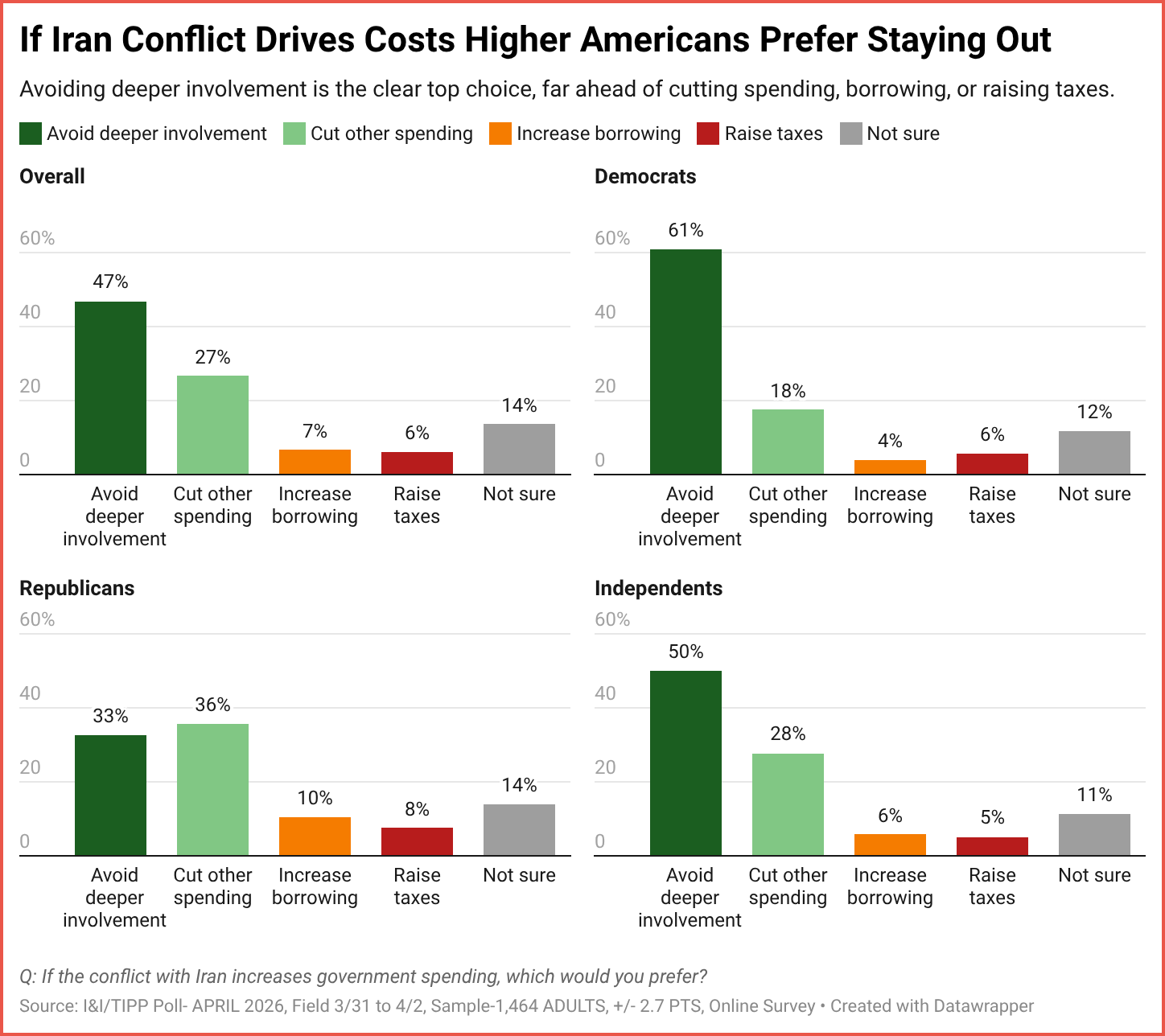
The share of responses favoring other possible means of paying for the Iran war were mostly in the single-digits. In sum, Americans break into two camps: Control costs by ending the conflict, and control costs by reducing other government spending, which together make up 74% of all responses.
Whether true or not, a plurality of Americans believe that the tax code is both “unfair,” and that they will pay higher taxes this year than the year before.
But of course, “unfair” is in the eye of the beholder. And the Democratic Party has used “unfairness” in the tax code as a political cudgel against its opponents.
This has been the force behind the recent calls to “tax the rich” and “tax the billionaires.” The idea is that these groups are so wealthy and so undertaxed that by merely taxing them, we could solve most of our fiscal problems.
Unfortunately, that doesn’t appear to be true. According to the National Taxpayers Union Foundation, as quoted recently in Issues & Insights:
On average, … the federal government spent about $19.2 billion per day (in 2025). At this level of spending, raising the average federal tax rate on the top 1% from its current level of 26.09% to 30% would fund the government for only 6 additional days. Even … seizing the entire income of the top 1% by taxing them at an average federal rate of 100% would not even fund the government for half a year — only raising enough revenue to fund 127 days of government spending.
So any “fairness” premised on going after the rich is, unfortunately, likely doomed to fail.
Knowing this, some, such as Sen. Bernie Sanders, have proposed massive “wealth taxes” on billionaires, claiming it would bring in as much as $4.4 trillion over a decade.
That’s problematic, as Issues & Insights once again has noted:
The idea that a 5% wealth tax on 938 billionaires would bring in $4.4 trillion over 10 years is fanciful, at best, given that the wealth tax itself would — if it weren’t found unconstitutional — instantly destroy much of the value of their holdings. Not to mention the fact that many billionaires would simply relocate themselves and their businesses to other countries that don’t confiscate wealth.”
The truth is that in 2023, the top 0.1% of all earners accounted for 10% of all income earned but paid almost 20% of all federal income taxes, while the top 1% paid 47% of all taxes. The bottom 50%? They paid less than 4% of all federal income taxes, and most paid no taxes at all.
But will Americans pay higher taxes this year, as they believe? Maybe if they earn a lot more money.
However, because of the One Big, Beautiful Bill signed into law last year, Trump’s tax cuts from his first term in office were permanently extended and included new tax deductions for both tips and overtime — an enormous boon to many working Americans.
On average, the nonpartisan Tax Foundation estimates the typical taxpayer will see a tax cut of $2,300 in 2026, while the IRS recently estimated average cuts of $3,571. Even so, Americans still feel the tax code is stacked against them, as the I&I/TIPP Poll clearly shows.
I&I/TIPP publishes timely, unique, and informative data each month on topics of public interest. TIPP’s reputation for polling excellence comes from being the most accurate pollster for the past six presidential elections.
Terry Jones is an editor of Issues & Insights. His four decades of journalism experience include serving as national issues editor, economics editor, and editorial page editor for Investor’s Business Daily.
👉 Show & Tell 🔥 The Signals
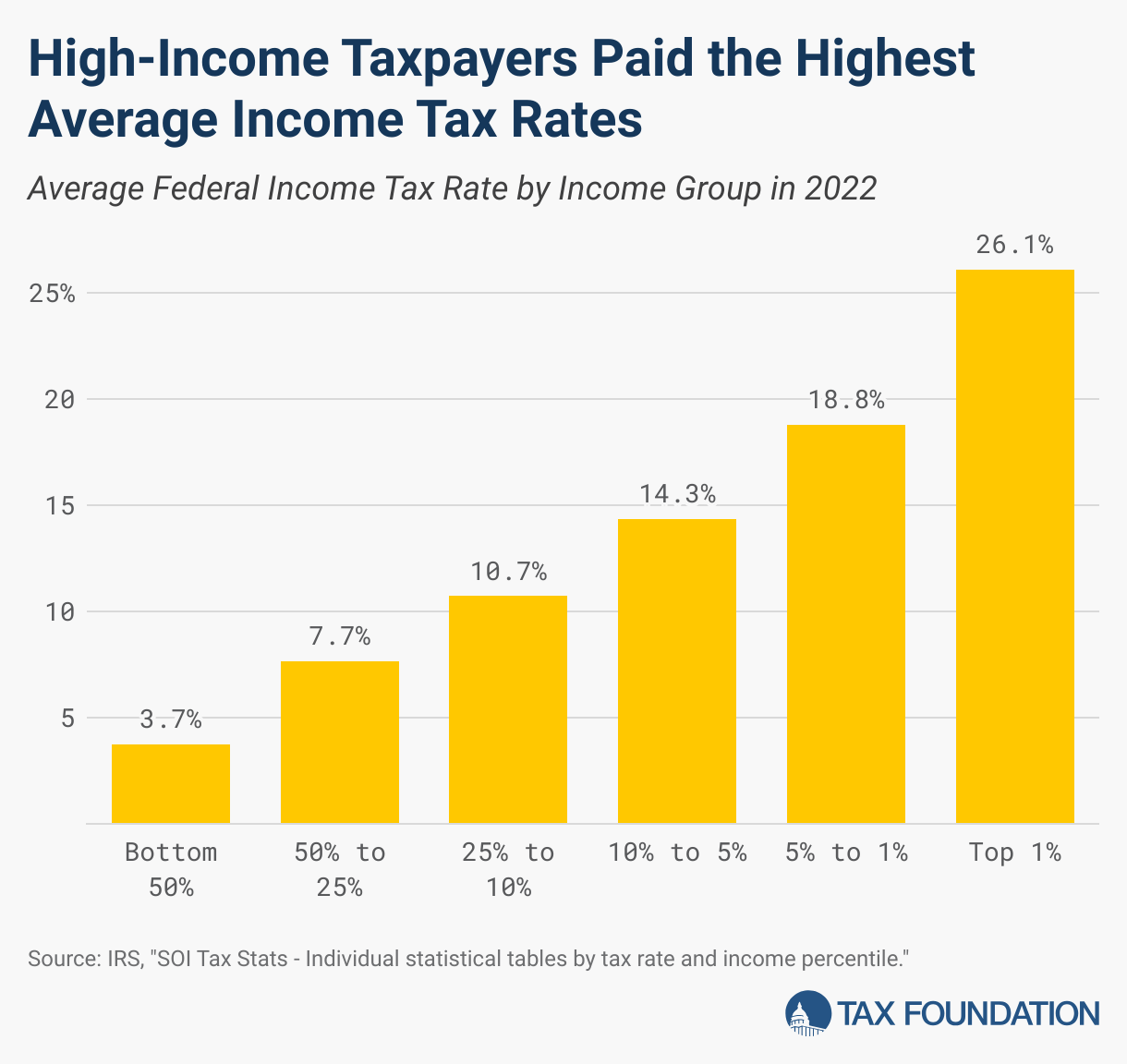
I. Who Really Pays Federal Income Taxes?
Higher earners shoulder a disproportionate share of income taxes. The top 1% pays an average rate of 26.1%, versus just 3.7% for the bottom half—about 7x higher. The system is clearly progressive, but the debate is whether it’s progressive enough—or too much.
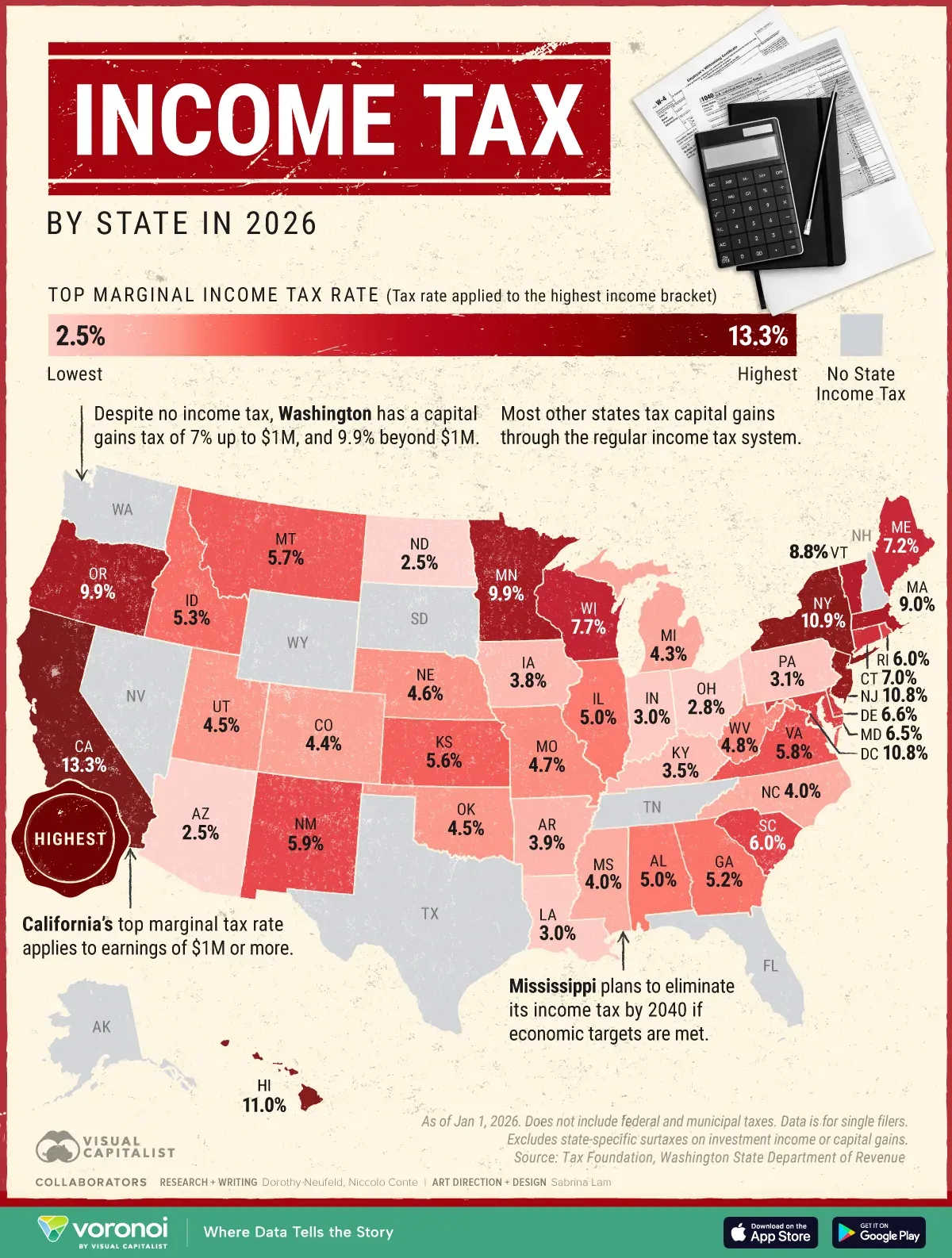
II. State Income Taxes Vary Widely in 2026
Where you live can dramatically change your tax bill. California leads at 13.3%, while several states impose no income tax at all. Others cluster in the mid-single digits, creating a wide patchwork of state-level tax regimes across the country.
📊 Market Mood — Wednesday, April 15, 2026
🟩 Markets Hold Near Highs on Talk Optimism
U.S. futures were steady as hopes for renewed Iran negotiations supported sentiment.
🟧 Oil Stays Below $100 as Supply Fears Ease
Crude remained contained despite the ongoing U.S. blockade and still-tight flows through Hormuz.
🟦 Resilient Economy Underpins Risk Appetite
Strong bank commentary and consumer activity pointed to continued economic strength.
🟨 Earnings Momentum Offsets Geopolitical Risk
A steady flow of bank results kept markets focused on fundamentals despite lingering tensions.
🗓️ Key Economic Events — Wednesday, April 15, 2026
🟧 10:30 ET — Crude Oil Inventories
Stockpiles expected at +2.100M (vs. +3.081M prior), offering a read on supply conditions as energy markets remain sensitive to Middle East developments.
editor-tippinsights@technometrica.com