

The United Nations this week will once again convene an estimated 100,000 diplomats, heads of state, U.N.-friendly scientists and NGO activists from around the world for its "31st Conference of the Parties to the United Nations Framework Convention on Climate Change," in Turkey. The goal? To deliver "major progress" in the battle against climate change.
So what do Americans expect of this 31st meeting since 1995? Not a whole lot, it seems, but they remain largely supportive of efforts to curb climate change.
"With climate impacts inflicting growing human and economic costs in every country, every COP is a vital global moment that must deliver major progress, and COP31 is no exception," the U.N. writes in its press release for the meeting.
With this in mind, the November I&I/TIPP Poll asked U.S. voters the following: "How effective, if at all, do you think the United Nations-organized international climate conferences have been in addressing climate change?"
The national online poll of 1,480 voters was conducted from Oct. 27 through Oct. 30 and has a +/-2.8 percentage point margin of error.
Among those responding, 44% said that the U.N.'s decades of climate-change conferences had been either "very effective" (16%) or "somewhat effective" (27%), while, 40% called the meetings either "not very effective" (23%) or "not at all effective" (17%).
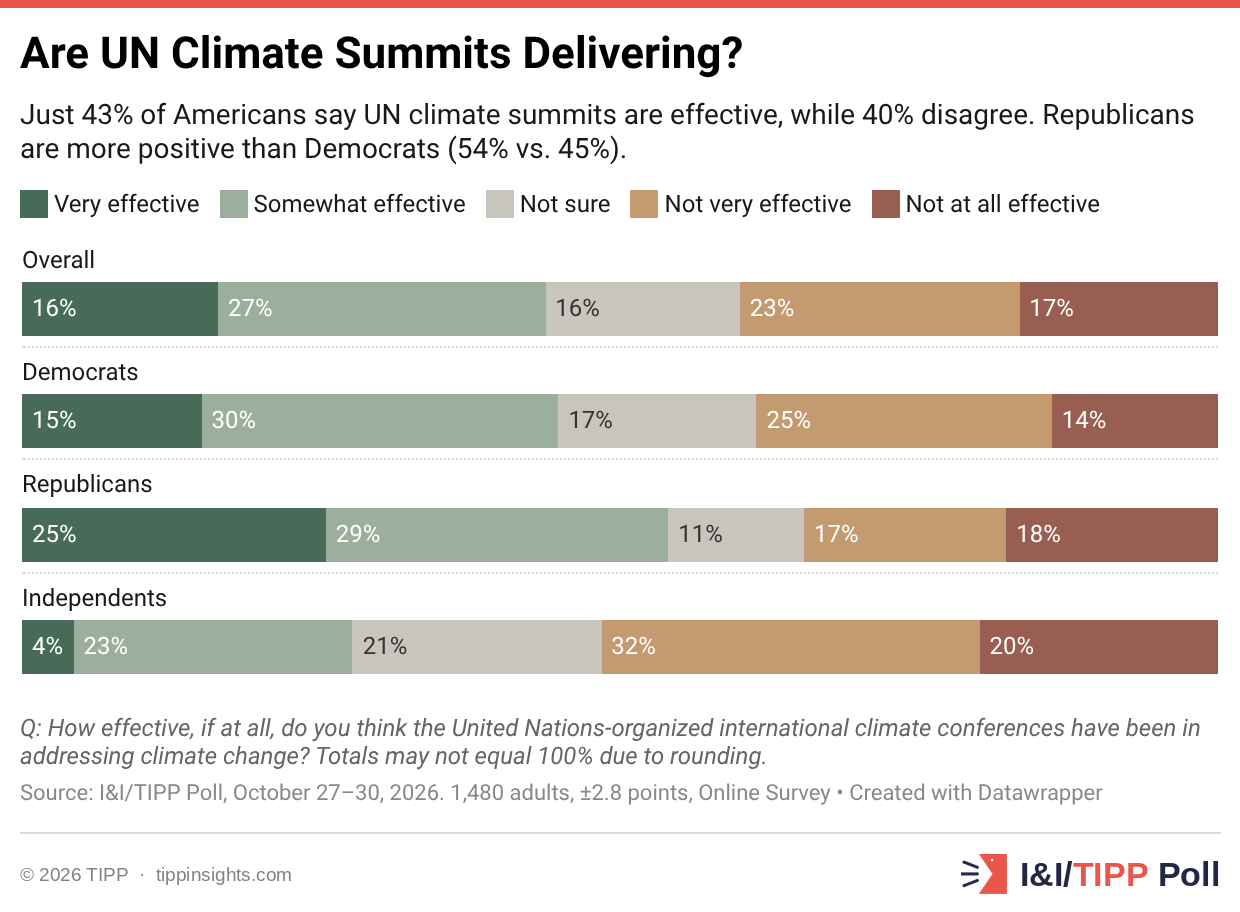
Note that the "not at all effective" responses are slightly higher than the "very effective" responses. And a hefty 16% were not sure.
But here's the real surprise: Republicans (54% effective, 35% ineffective) are more impressed by the U.N.'s efforts than either Democrats (45% effective. 39% ineffective) or, especially, independents (28% effective, 52% ineffective), who are deeply skeptical of the U.N. efforts.
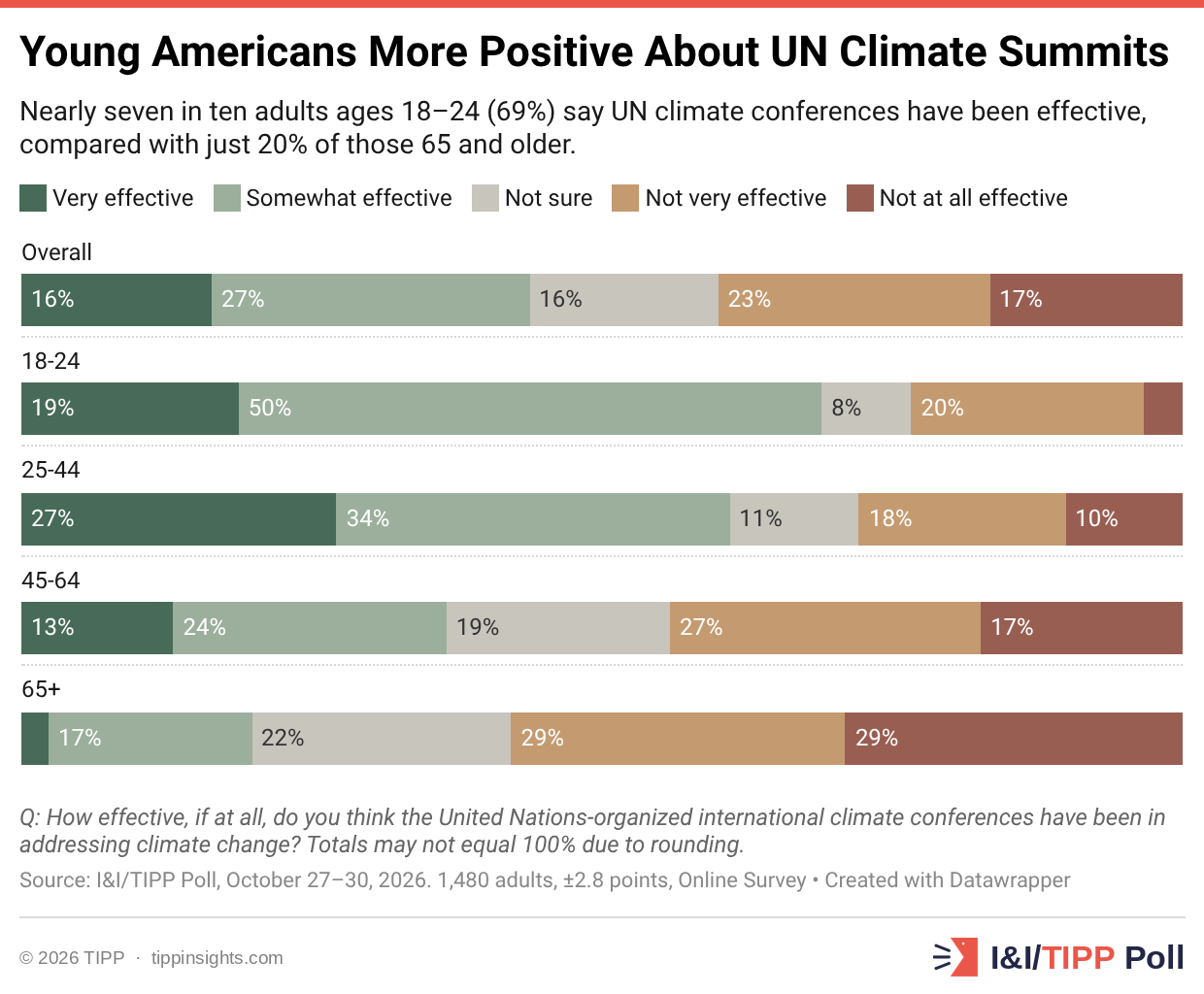
Not so surprising: The share calling it "effective" is highest among the young, and lowest among older voters.
For those 18-24 years of age, 69% called it effective, 23% not effective, while with those 25-44 years of age not far behind at 61% effective, 28% not effective. From there, the responses by age turn sharply negative: 45-64 years, just 37% effective, 44% not effective, and 65-plus years just 20% effective, 58% ineffective.
Another big gap: Men and women. Men (51% effective, 40% not effective) were overall more impressed with the climate-change efforts than women (37% effective, 40% not effective). Why the difference: 23% of women answered "not sure," compared to just 9% of men.
One other difference: race and ethnicity. Among white voters, just 39% found U.N. efforts effective, while 43% described them as not effective. For blacks and Hispanics, the numbers were 53% effective, only 33% not effective.
I&I/TIPP followed up with a second question: "Overall, do you think government policies aimed at reducing greenhouse gas emissions have a positive impact, a negative impact, or little impact on the U.S. economy?"
A large plurality of 43% answered the economic impact was either "very positive" (18%) or "somewhat positive" (25%), while only 15% called it either "somewhat negative" (7%) or "very negative" (8%).
However, the largest individual response was for "little or no impact" (26%).
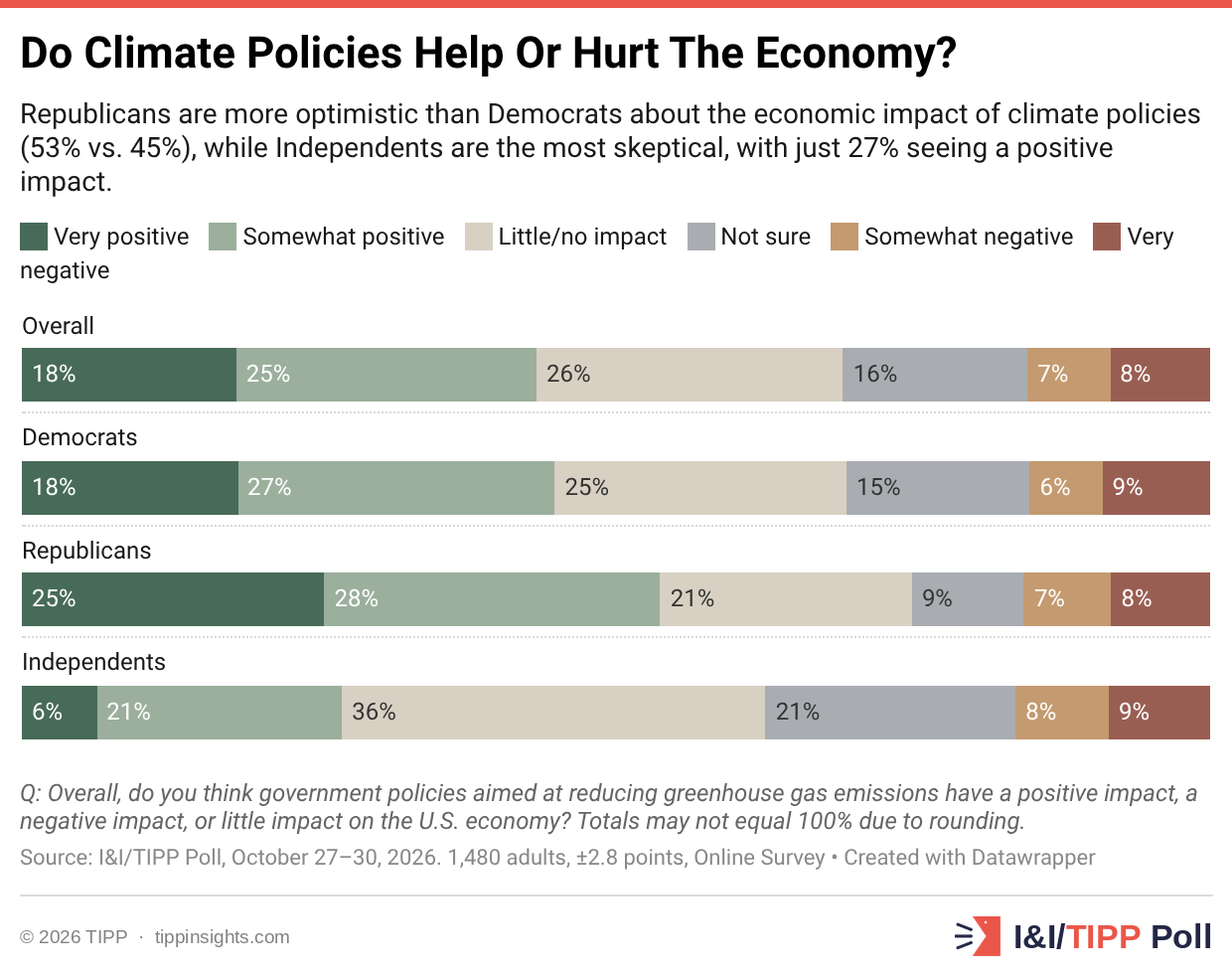
And, again, Republicans were far more likely to see a positive impact from government policies to cut greenhouse gases: 53% of GOP voters thought such efforts had either a "very positive" impact (25%) or a "positive" impact (28%) than either Dems (45% overall, with 18% "very positive," 27% "positive") or independents (27% positive overall, with just 6% "very positive," and 21% "positive").
Independents also were No. 1 in answering "little or no impact" (36%), compared to Republicans (21%) and Dems (25%).
When it comes to climate change policy, the independents show why they deserve their name. Dems and GOP voters see things more alike than the indie voters do.
A final question asked respondents: "Thinking about predictions you have heard concerning the effects of climate change, do you believe those predictions have generally: Accurately described the seriousness of climate change; Understated the seriousness of climate change; Overstated the seriousness of climate change; Haven't heard enough to judge; Not sure."
A 52% majority said the predictions had either "accurately described the seriousness" (28%) or "understated the seriousness" (24%) of climate change. Meanwhile, 39% answered that the predictions either "overstated the seriousness" (22%) or "haven't heard enough to judge" (17%). Another 9% were unsure.
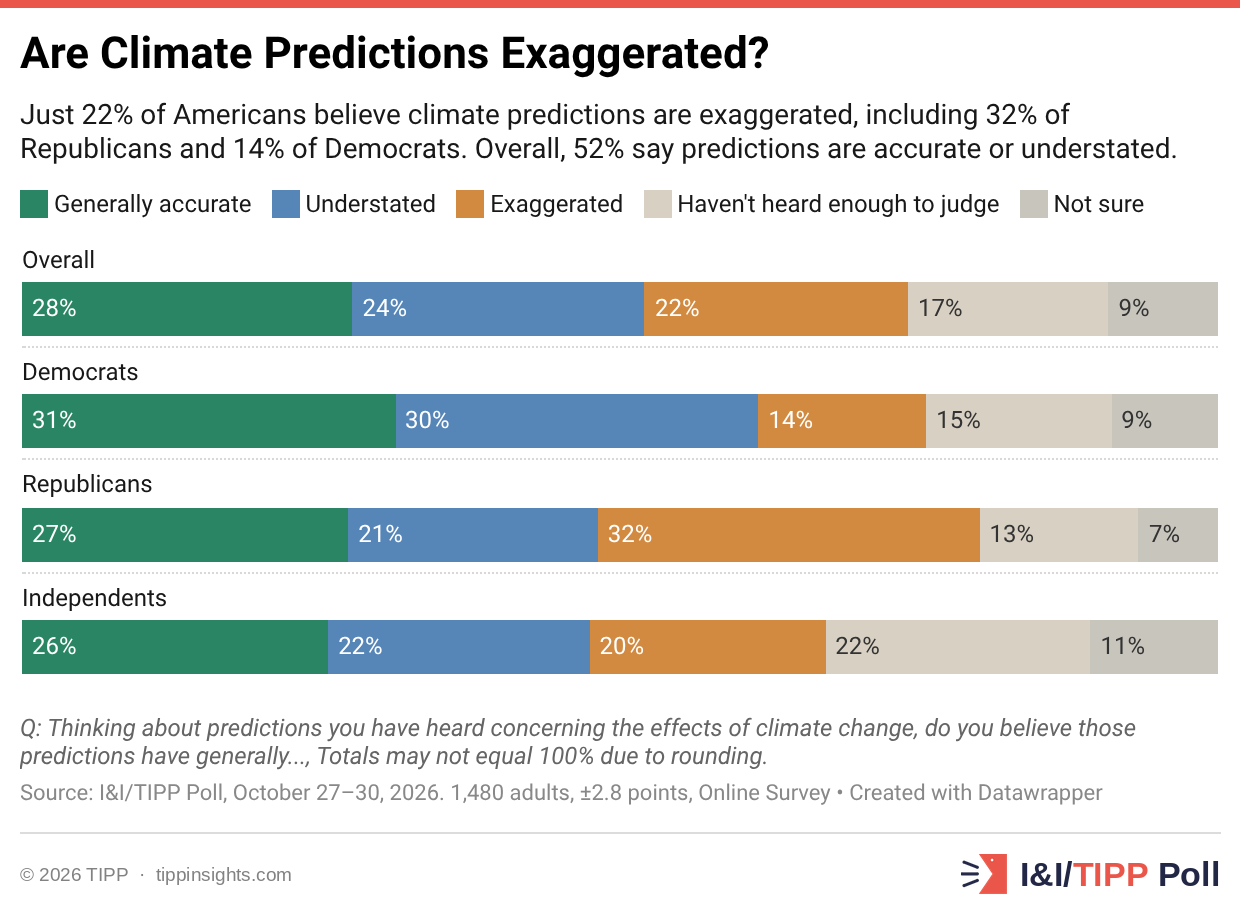
This time, Democrats lead the pack, with 61% saying that climate predictions are either "generally accurate" (31%) or "understated" (30%). Republicans lag a bit behind 48%, with 27% saying "generally accurate" and 21% "understated. Independents are virtually the same as Republicans at 48% overall, with 26% saying the forecasts are "generally accurate" and 22% "understated."
But it's the third possible answer that shows which group is most skeptical: whether climate predictions are "exaggerated." Overall, 22% said the predictions were exaggerated, but that included just 14% of Democrats and 20% of independents, but 32% of Republicans.
Is this a case of not keeping up with the news?
The ultimate goal of COP 31 and other efforts, the U.N. says, is to hold “the increase in the global average temperature to well below 2°C above pre-industrial levels” and “to limit the temperature increase to 1.5°C above pre-industrial levels.”
But is it really an emergency, as advocates suggest? In fact, the U.N. and others have been compelled recently to revise sharply down their estimates for future global warming as scientists have criticized overly pessimistic forecasts for future warming of the Earth's atmosphere.
The same has happened to rash predictions of "more and more severe storms" from a warming atmosphere, which unfortunately for the climate Cassandras has proven to be entirely false.
A number of other climate and environmental claims have likewise been debunked, such as the evil of plastics, the virtues of recycling, and the cleanliness and efficiency of wind and solar power.
Yet another scientific study asserts that that the next ice age was set to begin some 2,000 years ago but that human use of fossil fuels may have kept the world once again from being covered with ice.
In this case, general public opinion may be lagging the science field, which as noted above, increasingly questions the all assumptions underlying the entire "global climate crisis" scenario. We produce more food today, have higher incomes, and better lives than ever before.
Here in the U.S., voters might have missed the shocking and deeply cynical admission by former President Joe Biden about the "Inflation Reduction Act":
It has nothing to do with inflation. It has to do with the $368 billion, the single-largest investment in climate change anywhere in the world, anywhere.
No small wonder that the U.N. has come under fire lately and now suffers a "funding crisis" for its climate-related activities. They're on the wrong side of the debate. Even so, a significant share of Americans continue to believe that the global climate policies work, as the latest I&I/TIPP Poll shows. Will that end as recent scientific developments become better known?
I&I/TIPP publishes timely, unique, and informative data each month on topics of public interest. TIPP’s reputation for polling excellence comes from being the most accurate pollster for the past six presidential elections.
Terry Jones is an editor of Issues & Insights. His four decades of journalism experience include serving as national issues editor, economics editor, and editorial page editor for Investor’s Business Daily.
Loved it, hated it, or somewhere in between — tell us. Grade this article here and help shape what lands in your inbox next.
📊 Market Mood · November 9, 2026
How the trading day is setting up.
🟩 Global stocks are recovering after last week's selloff. Asian shares rebounded and U.S. futures edged higher, although confidence remains fragile following heavy losses in technology stocks.
🟥 Nvidia is facing fresh uncertainty. Its shares fell more than 4% in premarket trading amid an investigation into reports that CEO Jensen Huang was targeted by foreign intelligence.
🟧 Oil is retreating on hopes for Middle East peace. Brent has fallen about 2% to around $96 a barrel after President Trump signaled that further attacks on Iran were unlikely while negotiations continue.
🟦 Fed rate-hike expectations are rising. Friday's stronger-than-expected jobs report pushed the probability of a December increase to roughly 80%, making Tuesday's inflation report a critical market test.
🗓️ Key Economic Events
On today's U.S. data calendar.
No major U.S. economic reports are scheduled today.
🟧 Tomorrow's key event: The October Consumer Price Index, due at 8:30 a.m. ET, will provide an important test of inflation and expectations for the Fed's December meeting.
Letters to the editor email: editor-tippinsights@technometrica.com
Subscribe Today And Make A Difference. Consider supporting Independent Journalism by upgrading to a paid subscription or making a donation. Your support helps tippinsights thrive as a reader-supported publication. Contact us to discuss your research or polling needs.
Reach our audience. For sponsorship and advertising opportunities, visit our Partner With Us page.