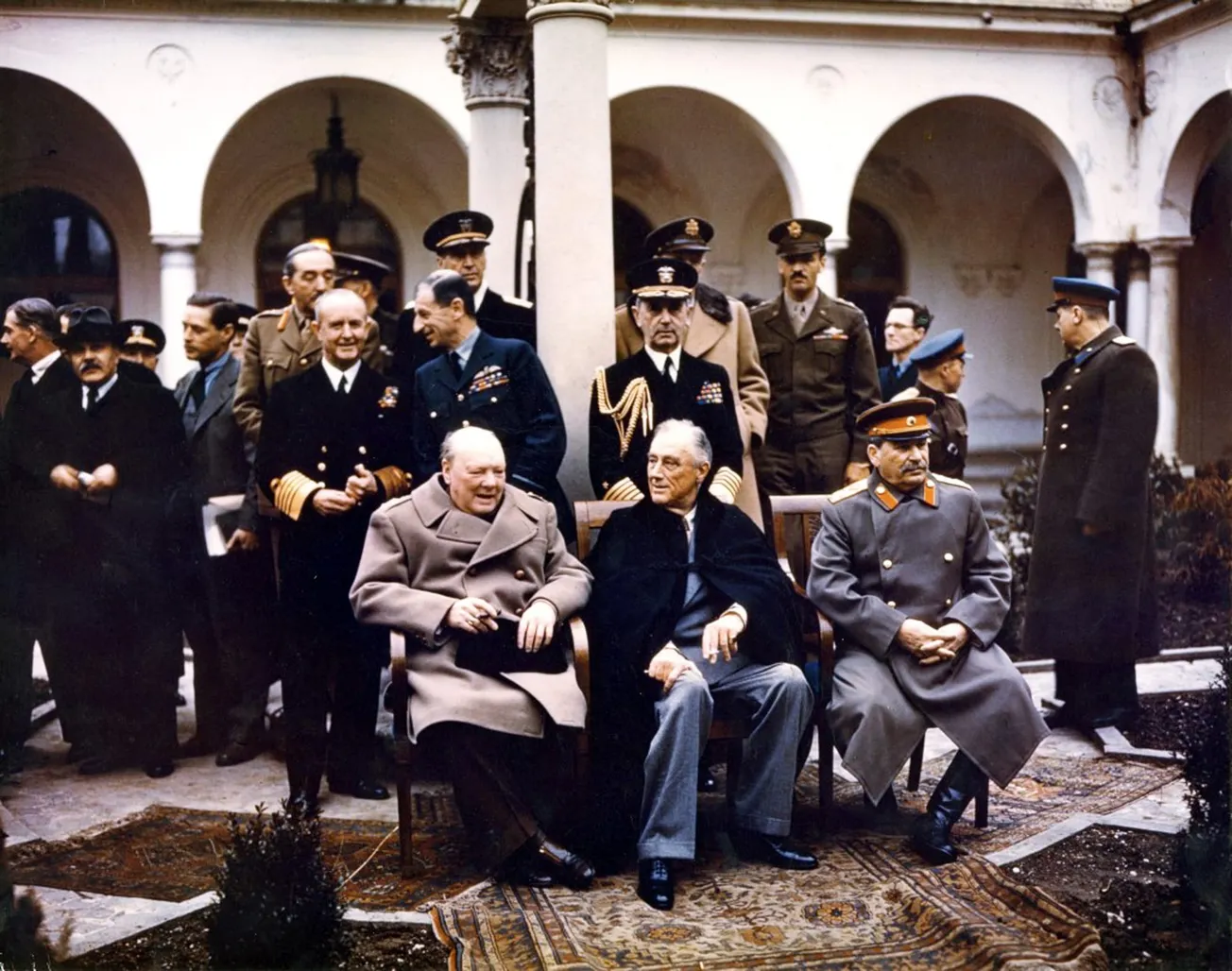
Last year, on the grounds of the Crimean palace where Franklin Roosevelt, Winston Churchill, and Joseph Stalin met in 1945, a Russian artist installed portraits of Donald Trump, Vladimir Putin, and Xi Jinping in the poses of the Big Three. The exhibition was called “Yalta 2.0.” Next week, the real thing may happen in Shenzhen.
The three leaders may meet on the sidelines of the Asia-Pacific Economic Cooperation summit, which runs November 18 and 19. Beijing has confirmed it is discussing such a meeting, and Trump told reporters over the weekend that he thinks it will. No meeting has been formally announced.
The comparison with Yalta has limits. In February 1945, the three leaders were wartime allies facing a common enemy. They disagreed often, but they shared an immediate goal: defeating Nazi Germany and shaping the peace that followed.
Today’s three powers share no such purpose. Trump has said he wants to talk about denuclearization and ending the war in Iran, while Putin has proposed discussing Ukraine, with Kyiv absent. Beijing has appeared lukewarm about a meeting that would hand Russia a diplomatic win.
Yalta is often remembered as the place where great powers settled the fate of smaller nations. Its deeper failure lay in what the Western allies accepted. Stalin signed the Declaration on Liberated Europe, which pledged free elections in the countries freed from Nazi occupation, and he agreed to free elections in Poland. He honored neither. When Poland finally voted in 1947, the election secured its place in the Soviet bloc. Roosevelt and Churchill had no effective means to enforce what Stalin signed.
That is the test for Shenzhen. A ceasefire pledge without monitoring, or a nuclear commitment without inspections, would repeat Yalta’s mistake. The recent record gives reason for caution. The United States found Russia in violation of the INF Treaty and withdrew in 2019. Russia halted New START inspections in 2022 and suspended its participation in 2023, and the treaty expired in February. Moscow says it will keep to the old limits as long as Washington does, while the State Department says no such arrangement exists. China, with an estimated 620 warheads and a Pentagon projection of roughly 1,000 by 2030, has refused to join arms control talks.
Verification can work. Under the 1987 INF Treaty, the United States and the Soviet Union destroyed some 2,700 missiles under on-site inspection, and inspections continued for a decade afterward. The Russian missile that Washington says broke the treaty was first tested in 2008, seven years after the inspections ended.
Talking to adversaries is not appeasement. Nor is meeting them an achievement in itself. Direct talks among nuclear-armed rivals can prevent dangerous miscalculation, and real progress on Ukraine or nuclear weapons would be welcome. Whatever is agreed in Shenzhen should come with the means to check it.
History will not judge Shenzhen by who sat at the table, but by what they accomplished across it.
Loved it, hated it, or somewhere in between — tell us. Grade this article here and help shape what lands in your inbox next.
🧭 Power & Capital · November 13, 2026
Where state power meets the boardroom.
🔷 Trump Suggests Tim Cook Replace Jensen Huang As Nvidia CEO – Power & Capital Desk, TIPP Insights
🔷 Why Has Congress Asked Former Nvidia CEO Jensen Huang To Testify – Power & Capital Desk, TIPP Insights
🔷 Former Nvidia CEO Huang Linked To Second Employee In New Report – Power & Capital Desk, TIPP Insights
🔷 Who Is Colette Kress, Nvidia's Interim CEO After Jensen Huang's Resignation – Power & Capital Desk, TIPP Insights
🔷 FBI Seizes $1.2 Billion In Cryptocurrency Stolen From Binance – Power & Capital Desk, TIPP Insights
🔷 Florida Congressman Invites Elon Musk To Move Tesla Headquarters From Texas – Power & Capital Desk, TIPP Insights
🌍 Global Affairs
The world's flashpoints, in motion.
🟥 Putin Rejects Territorial Compromise In Talks With US Envoys On Ukraine – TIPP News
🟥 Ukraine Faces Renewed Satellite Connectivity Limits Amid Russian Drone Attacks – TIPP News
🟥 France Warns Germany's Missile Plans Could Risk Nuclear Escalation With Russia – TIPP News
🟥 Why Is The US Investing $4.5 Million In Peru's Callao Port? – TIPP News
🟥 Economic Sanctions, State Power, And Cuba: A Rothbardian Critique Of U.S. Interventionism – Birsen Filip, Mises Wire
🟥 UAE Reports 14 Dead, 30 Injured In 23-Vehicle Pile-Up In Fujairah – TIPP News
🏛️ National Affairs
The fights shaping America right now.
🟫 One Dead, Four Injured In Shooting At Washington DC Fitness Centre – TIPP News
🟫 Washington DC Gym Shooter Identified As Emergency Physician Matt Lambert – TIPP News
🟫 Trump Directs JD Vance To Shift Focus From Iran War To Domestic Crime – TIPP News
🟫 Trump Urges Senate Republicans To Advance $350 Billion Defense Bill – TIPP News
🟫 ICE Reports Record 483,200 Deportations And 491,000 Arrests In 2026 – TIPP News
🟫 Pentagon Unable To Track $31 Billion In F-35 Spare Parts, GAO Finds – TIPP News
🟫 Texas Execution Looms For Father Convicted Of Killing His Three Children – TIPP News
🟫 Todd Blanche And The Department Of Political Justice – Andrew P. Napolitano, Ron Paul Institute for Peace and Prosperity
🟫 Sad: Dems Helped To Stymie Massie’s Impeachment Of Hegseth – Dennis J. Kucinich, Ron Paul Institute for Peace and Prosperity
🟫 Putting Pressure On A New US House Member To Fall In Line – Adam Dick, Ron Paul Institute for Peace and Prosperity
🟫 Betraying America’s Military And The Constitution They Swore To Defend – John W. and Nisha Whitehead, Ron Paul Institute for Peace and Prosperity
🟫 The Cruel Irony Of Veterans Day – Connor O'Keeffe, Mises Wire
🟫 On Veterans Day, Thank A Taxpayer – Ryan McMaken, Mises Wire
🟫 988 May Be A Government Experiment With No Exit Plan – Patrick N. Dempsey, Mises Wire
🟫 Murray Rothbard On John C. Calhoun – David Gordon & Wanjiru Njoya, Mises Wire
💼 Markets & Business
The deals and tickers making moves.
🟧 Elon Musk's SpaceX Expands AI Ambitions With Massive US Infrastructure Projects – TIPP News
🟧 Polymarket Cuts Jobs As Competition In Prediction Market Intensifies – TIPP News
🔬 Science & Tech
What's being discovered, built, and launched.
🟪 Global Warming Buffoonery – Editorial Board, Issues & Insights
🟪 Advocacy Groups Demand AI Development Freeze Over Safety Concerns – TIPP News
🟪 US Launches First Ibogaine Studies For PTSD Treatment In Veterans – TIPP News
🟪 Scientists Discover Rare Marine Ecosystems Largely Untouched By Humans – TIPP News
📊 Market Mood · November 13, 2026
How the trading day is setting up.
🟥 Nvidia turmoil continues to unsettle global markets. The chipmaker's leadership crisis is weighing on AI stocks, although gains in Japan, South Korea and Taiwan suggest investors remain confident in broader semiconductor demand.
🟧 Inflation fears are pushing the dollar and bond yields higher. The dollar is near a 19-month high as persistent price pressures and hawkish Fed comments reinforce expectations for further interest-rate increases.
🟦 Oil is heading for a second weekly decline. Brent is trading around $95 a barrel as supply concerns ease, despite continuing Middle East tensions and risks to energy shipments.
🟨 Today's wholesale inflation report is the main market test. Producer prices are expected to remain elevated, potentially reinforcing concerns about inflation and the Fed's December decision.
🗓️ Key Economic Events
On today's U.S. data calendar.
🟧 8:30 a.m. ET — Producer Price Index (October)
Forecast: +0.4% m/m, +6.6% y/y Pre: +1.3% m/m, +6.3% y/yWholesale inflation is expected to moderate on a monthly basis but accelerate annually, highlighting persistent price pressures.
🟧 8:30 a.m. ET — Core Producer Price Index (October)
Forecast:+0.3% m/m, +5.0% y/y Pre: +0.7% m/m, +5.0% y/yUnderlying producer inflation, excluding food and energy, will provide another indication of whether price pressures are easing.
Letters to the editor email: editor-tippinsights@technometrica.com
Subscribe Today And Make A Difference. Consider supporting Independent Journalism by upgrading to a paid subscription or making a donation. Your support helps tippinsights thrive as a reader-supported publication. Contact us to discuss your research or polling needs.
Reach our audience. For sponsorship and advertising opportunities, visit our Partner With Us page.