
Editor's Note
If you're on LinkedIn, I need 30 seconds of your time. We asked 1,300+ Americans in our recent TIPP national poll which Mag 7 company they'd most want to work for. Now I want to know what you think. Vote here → link. I'll share how LinkedIn members compare to the national results next week.
Iran is under intense pressure, and that pressure is quietly reshaping the system from within.
From the outside, the signals can seem almost reassuring. In a recent Foreign Affairs article, former foreign minister Javad Zarif sketched a potential off-ramp: declare victory, accept limits on the nuclear program, reopen the Strait of Hormuz, and secure sanctions relief in return for a return to a more normal economic life. It is not a white flag; it is a calculated framework meant to show that Iran still holds leverage and understands the stakes.
But Zarif's proposal only tells you what one faction wants the world to hear.
Inside the country, the strain is deeply divisive. Some voices within the system fear that sustained war, isolation, and infrastructure damage will push the economy toward outright breakdown. Others seem ready to bear severe economic and social costs to preserve their grip on power. The regime today appears torn between pragmatists who dread collapse and hardliners willing to sacrifice functionality for control.
That divide is real. But it does not mean the system is weakening in any simple way.
In fact, on the ground, a different dynamic is taking hold. The visible machinery of the state, including courts, ministries, and administrative offices, has been damaged or disrupted. Yet the core instruments of control have not disappeared. They have hardened.
Even after repeated strikes on infrastructure, the regime’s coercive apparatus continues to function. The security services, the Revolutionary Guard, and affiliated forces remain active and very much present. Arrests continue. Executions go on, including those linked to recent protests. Control is now maintained less through functioning civilian institutions than through raw force and swift repression. As one recent analysis by University of Chicago constitutional law scholar Pegah Banihashemi notes, Iran’s legal framework may be badly weakened, but its security apparatus remains intact and operational, filling the gap left by damaged institutions.
That suggests the system is tougher than it looks.
But a fourth, more decisive development now overshadows everything else.
Reports from the past week suggest that the Islamic Revolutionary Guard Corps is no longer operating from the shadows. It is assuming de facto control.
Civilian governance under President Masoud Pezeshkian has ground to a near standstill, leaving him in what sources describe as a “complete political deadlock.” Presidential appointments, including attempts to name a new intelligence minister, have been blocked. Key decisions are being overridden. A military council of senior IRGC officers now exercises day-to-day authority over core state functions.
In practice, a tighter security perimeter has formed around the center of power, restricting access and information flow, including reports to Supreme Leader Mojtaba Khamenei. His absence is itself telling. He has not been seen or heard from in weeks, and it remains unclear whether he is exercising real authority or serving largely as a figurehead above a system now run by others. Authority is quietly shifting away from civilian and clerical institutions toward the only organization still capable of decisive action under wartime conditions: the Revolutionary Guard, led by figures such as Commander Ahmad Vahidi.
Civilian authority remains de jure. Power now rests de facto with the Guards.
This is not a formal coup or an announced transfer of power. It is a real-time consolidation happening in the background.
These pieces help explain the apparent contradictions. Iran is not speaking with one voice because it is no longer governed through a single center. It is running on parallel tracks. Put simply, Tehran is not collapsing, but is adapting under extreme stress.
History shows that when authoritarian states face this level of pressure, power rarely disperses. Civilian processes slow or freeze. Formal institutions weaken. Those with the clearest chains of command, deepest loyalty networks, and highest tolerance for risk step forward to fill the vacuum. In Iran, that actor is the Revolutionary Guard, with its parallel economic empire and operational reach.
When figures like Zarif outline a path to reopen the Strait of Hormuz or limit the nuclear program, they signal one view within the system. But the final call will now rest with a narrower center of power, where control and security take clear precedence over economic relief.
That changes the terms of everything that follows.
A system shaped by the Revolutionary Guard will negotiate differently. It will concede less, absorb more pain, and care more about holding power than restoring normal economic life. Any agreement that ignores that reality will not hold.
The same shift is playing out inside Iran. As power moves into fewer hands, the system becomes easier to control in the short term. Decisions come faster. Dissent is contained more quickly. The regime no longer has to navigate competing institutions or prolonged internal debate before acting.
That tightening cuts both ways. A smaller, security-driven leadership now has to manage everything at once, from keeping the economy functioning to controlling information and keeping rival factions within its own ranks in check. There are fewer buffers and far less room for error.
Iran is not breaking apart. But it is no longer operating like a normal state with layered institutions and shared authority. Power is concentrated in the military. That gives the regime the ability to hold the line. It also makes every mistake far more consequential.
Mr. President, if no deal is reached by your deadline, the next step should not be broader pressure on Iran as a whole. It should be narrower and more precise. Focus directly on the Revolutionary Guard by targeting its revenue streams, commercial networks, and the channels it uses to move money and oil. At the same time, increase pressure on the Basij and affiliated paramilitary forces that enforce control on the ground. They interact daily with ordinary Iranians and carry out repression at the street level. Making that role more difficult raises the cost of enforcement where it matters most. The point is not more pressure. It is pressure aimed at the people who now hold power and the ones who enforce it. Go after the Guards.
Know someone who should be reading TIPP Insights? Forward this email. Sponsor inquiries: editor-tippinsights@technometrica.com
👉 Show & Tell 🔥 The Signals
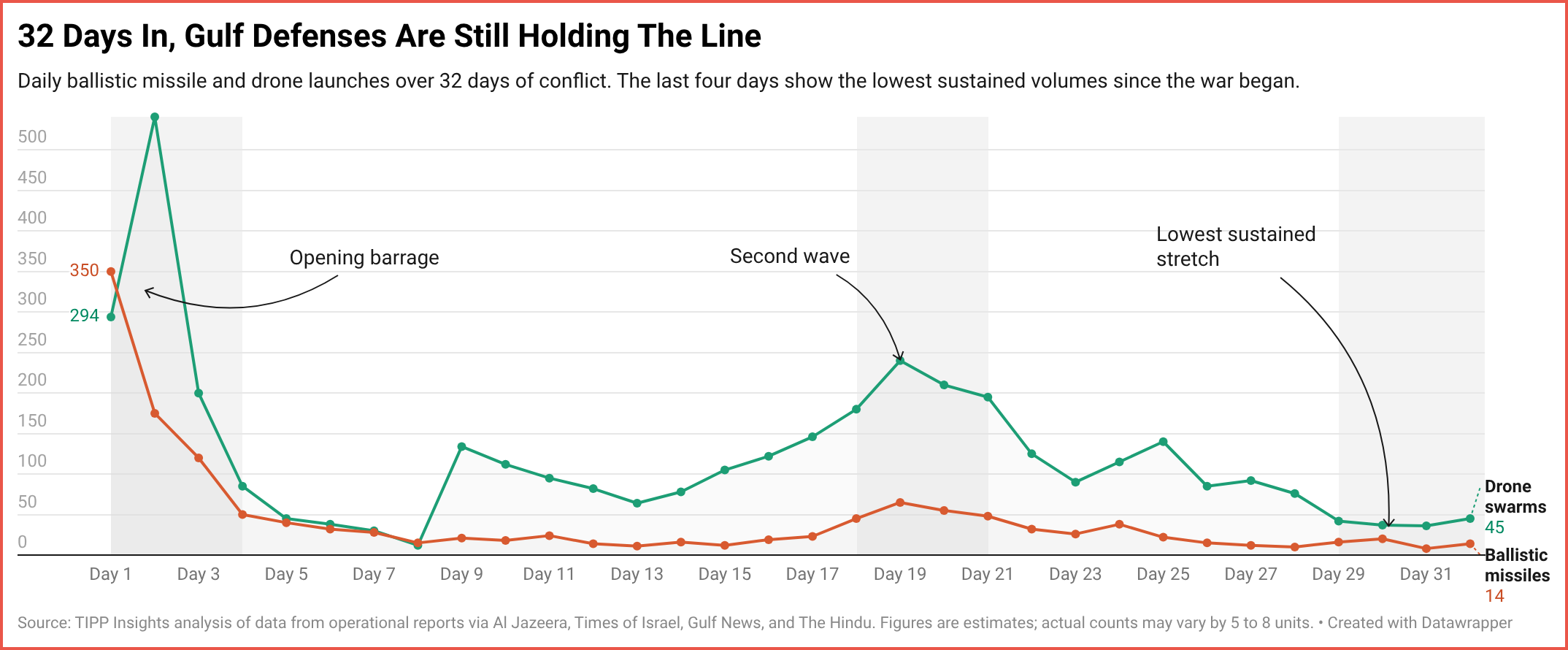
I. The Barrage Is Fading. Day 32 Hits the Lowest Stretch Yet
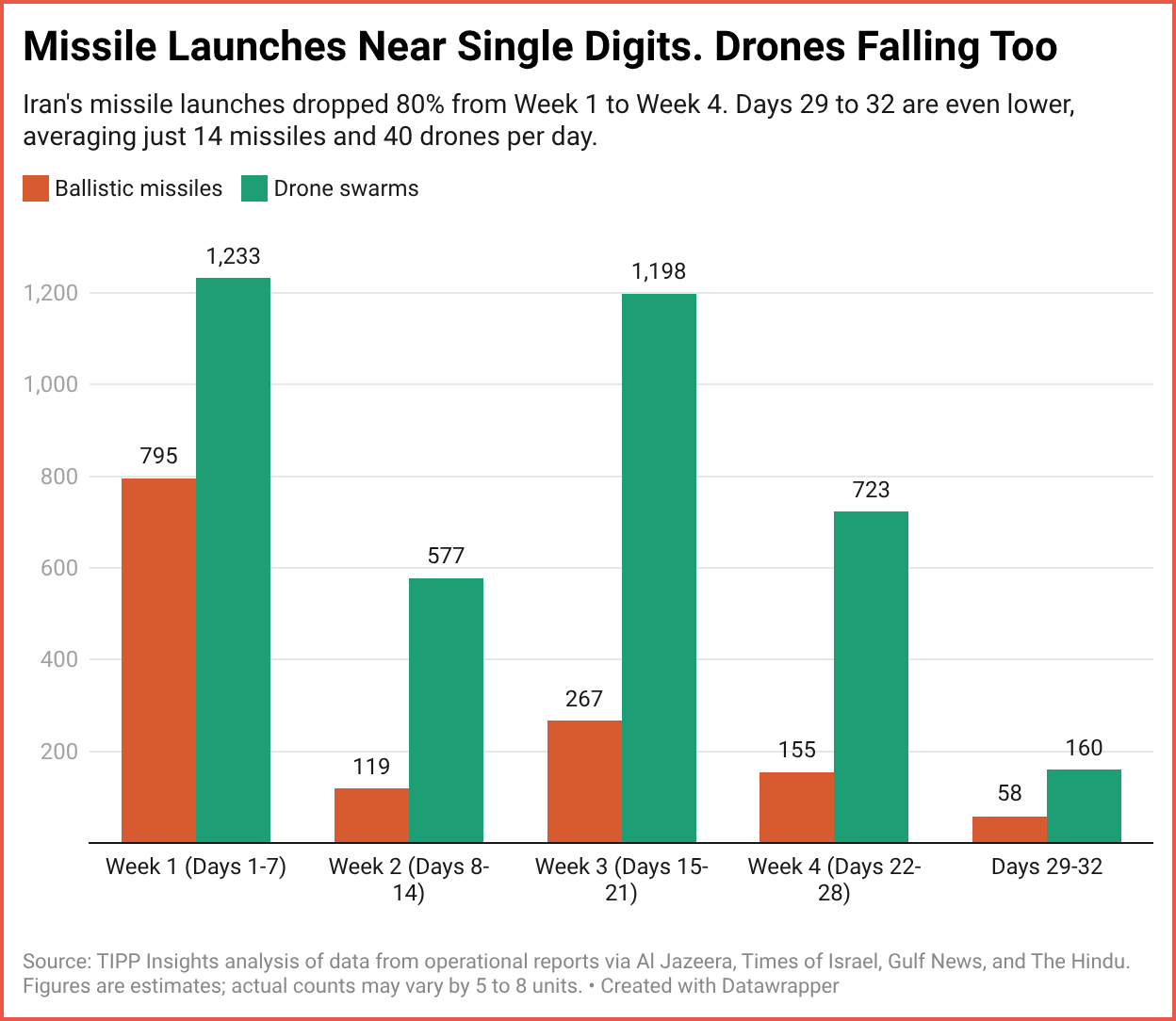
TIPP Insights analysis of 32 days of launch data shows Iran's aerial campaign is winding down. Daily combined launches have dropped below 60 in each of the last four days, down from 80 to 150 a week ago and over 800 on Day 1. Iran has now fired over 1,390 ballistic missiles and 3,890 drones since February 28. The trend line is clear. The opening barrage was the peak, and each week since has been weaker than the last.
II. Iran's Arsenal Is Running on Fumes
TIPP Insights analysis of weekly launch totals shows a steep and steady decline. In Week 1, Iran fired 795 ballistic missiles. In the four days since Day 28, just 58. That's a daily average of 14.5, down from 113 in Week 1. Drones are following the same path. Days 29 to 32 averaged just 40 drone launches per day, compared to 176 in Week 1. The expensive weapons are nearly spent, and even the cheap ones are thinning out.
III. Iran's Cost Advantage Is Shrinking With Its Stockpile
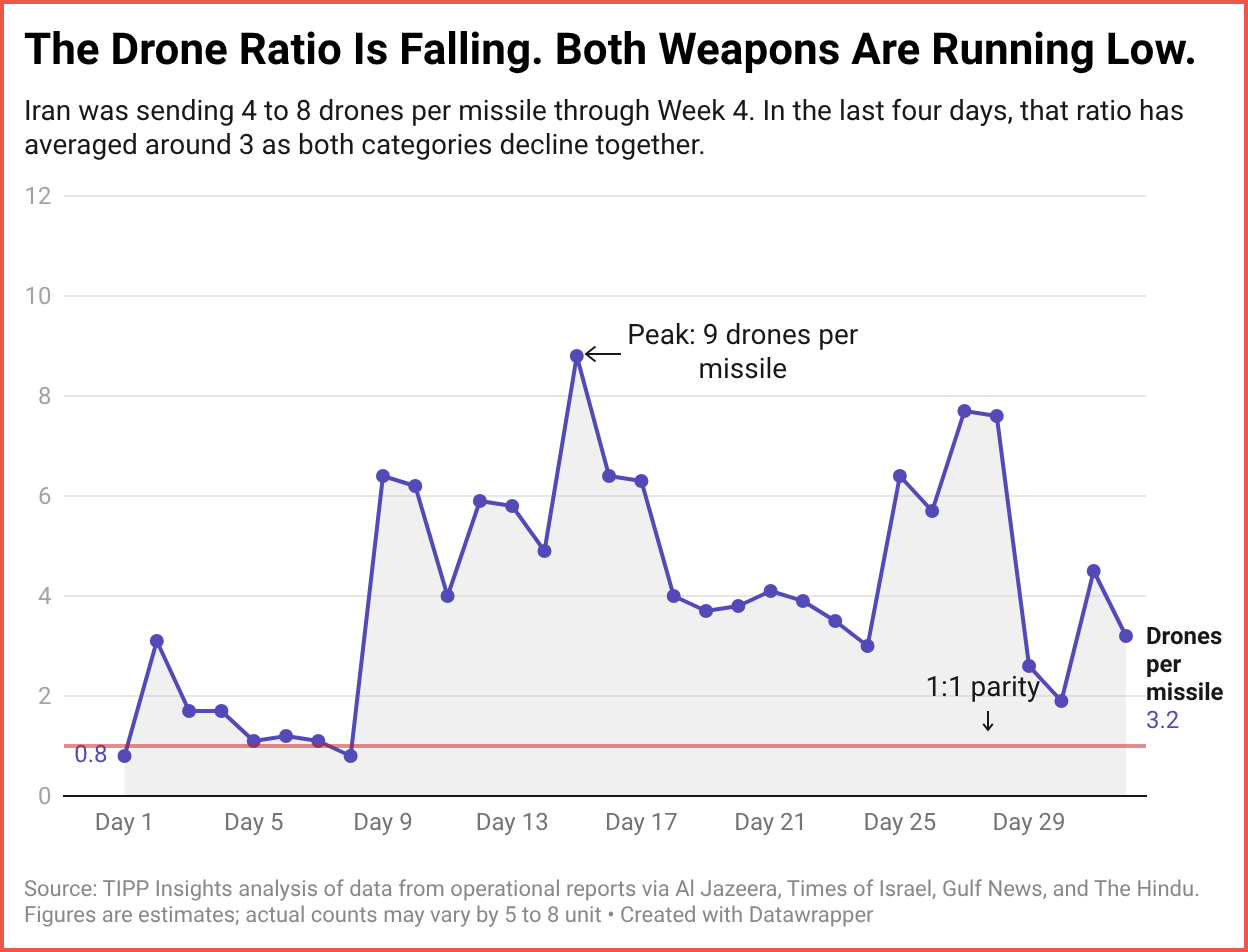
TIPP Insights analysis of the daily drone-to-missile ratio shows a shift. Through most of the war, Iran sent 4 to 8 drones for every missile. In the last four days, that ratio has dropped to around 2.8. The reason? Drone volumes are falling almost as fast as missiles now. On Day 31, Iran launched just 8 missiles and 36 drones. The cost asymmetry that favored Iran early on is narrowing as both stockpiles thin out.
IV. The Strait of Hormuz Is Showing Signs of Life
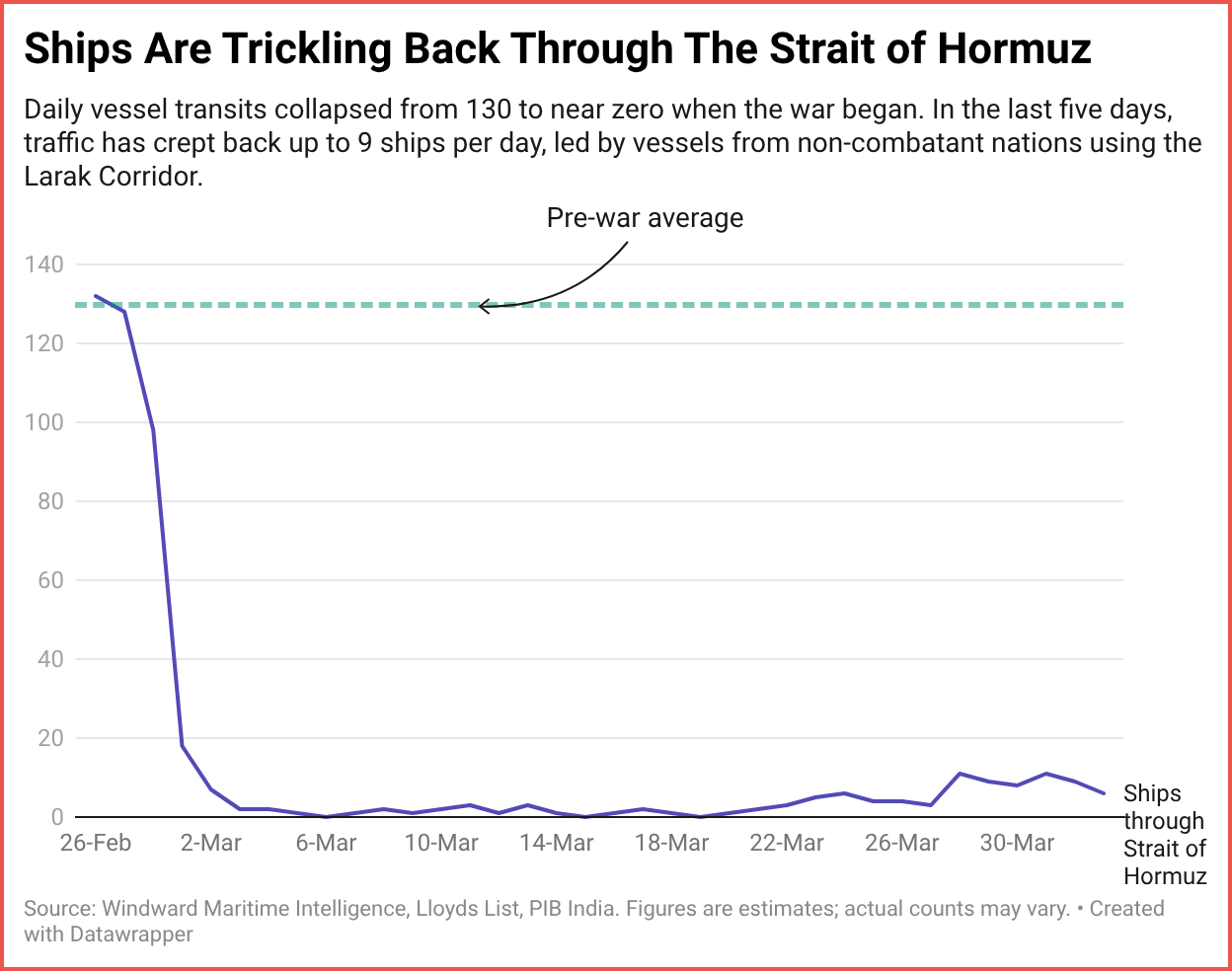
TIPP Insights analysis of daily shipping data shows a cautious recovery in the Strait of Hormuz. Before the war, around 130 ships passed through daily. By March 6, that number hit zero. For most of March, traffic hovered between 0 and 3 vessels per day. But in the last five days, an average of 9 ships per day have made the transit, including 11 on March 28 and March 31. The increase reflects the opening of the "Larak Corridor" for vessels from non-combatant nations including China, India, and Russia. It's a trickle, not a recovery. But it's the first sustained uptick since the war began.
editor-tippinsights@technometrica.com