Why are the Democrats always the last to know? Or at least the last to go public?
As California Congressman Eric Swalwell resigned in disgrace this week after a fifth woman came forward with sexual assault allegations, many of his Democratic colleagues chose silence. Strange, considering this is the same party that ran Minnesota Senator Al Franken out of town in a matter of days.
In Franken’s case, Democratic senators rushed to the microphones. They competed to take the strongest position, demanding accountability and casting themselves as defenders of standards and protectors of women. Franken was pushed out quickly, decisively, and very publicly over a groping photo and a series of allegations that were still being debated. He was not even serving in Congress when the photograph that triggered the outrage was taken.
Now compare that to Swalwell.
Five women came forward. The allegations were more numerous and more serious than anything Franken faced. But the same voices that once demanded immediate action went quiet. Nobody organized a response, nobody seemed to think it was urgent anymore, and nobody called a press conference to say standards had to be upheld.
What changed?
According to the New York Times, Senator Ruben Gallego of Arizona admitted that he had long heard rumors that Swalwell was “flirty” with women. 'Long heard' is a gentler way of saying the behavior was known and quietly tolerated.
Gallego acknowledged that his personal friendship with Swalwell kept him from acting. If friendship is enough to override judgment, then the standards applied to Franken were never real to begin with.
Over the weekend, former House Speaker Kevin McCarthy added another layer. He said he warned Nancy Pelosi in 2018 that Swalwell was unfit to serve on the House Intelligence Committee due to reports of a relationship with a Chinese spy, a serious national security concern.
For eight years, Swalwell remained a fixture of Democratic messaging. He was a reliable attack dog who went on national television and hammered President Donald Trump, repeated the party line without hesitation, and delivered exactly what leadership needed in the media.
And so the rules were bent for him.
He also had the support of Senator Adam Schiff, another California Democrat whose rise has been tied to his role as a leading Trump critic. Together, they became fixtures on television, shaping the narrative and reinforcing the Party’s message. The same party that claimed moral clarity during the Franken episode suddenly found reasons to wait and see when one of its own was still politically useful.
This pattern extends beyond Swalwell.
The Democrats were silent as President Joe Biden declined in front of the country. His speeches got harder to follow, his responses slowed, and his clarity faded. By the State of the Union in January 2024, anyone watching could see it.
Yet the response from Democratic leadership and their allies in the media was praise.
In the months that followed, Biden’s team insisted that he was “healthy and vigorous.” The claim was repeated with confidence, unchallenged by any major Democratic figure, even as many already knew better. Instead, Biden moved forward, won primaries, and secured delegates. By early June, he had locked up the nomination.
Barack Obama, Nancy Pelosi, Kamala Harris, and Chuck Schumer all understood the stakes. They had firsthand access to the reality that voters were beginning to understand. They knew Biden was not their strongest candidate. But they said nothing.
Instead, they tried to manage the situation. The decision to hold an early debate with Trump was part of that effort, timed before peak political attention. A strong performance could stabilize the campaign; a weak one might go unnoticed.
That calculation failed.
On the debate stage in Atlanta, Biden’s performance confirmed every concern. CNN moderators Jake Tapper and Dana Bash conducted the debate with professionalism and restraint. And under those conditions, Biden collapsed.
The fallout was immediate. Panic spread, donors reacted, and voters began to question the campaign’s direction. Only then did Democratic leadership act. They forced Biden out, skipped any open process, and moved quickly to install Kamala Harris as the nominee.
She did not earn the nomination through a contested primary. She was “selected.” And all the while, the same party continues to hold “No Kings” rallies, speaking about democracy, fairness, and accountability.
The contradiction is clear.
When it suited them, Democrats moved swiftly to remove Al Franken and claim the moral high ground. When it did not, they delayed, ignored, and stayed silent in the case of Eric Swalwell. When the issue involved Joe Biden, they denied reality until denial became impossible.
The Democratic Party, consumed by its loathing of Trump, now operates on a simple rule: standards apply when convenient, silence holds when it helps, and action comes only when nothing else is left.
The question is no longer whether Democrats are the last to know. The real question is whether they choose to know only when it benefits them.
A party that operates this way has no business being in charge.
👉 Show & Tell 🔥 The Signals
I. Climbing The Wall Of Worry
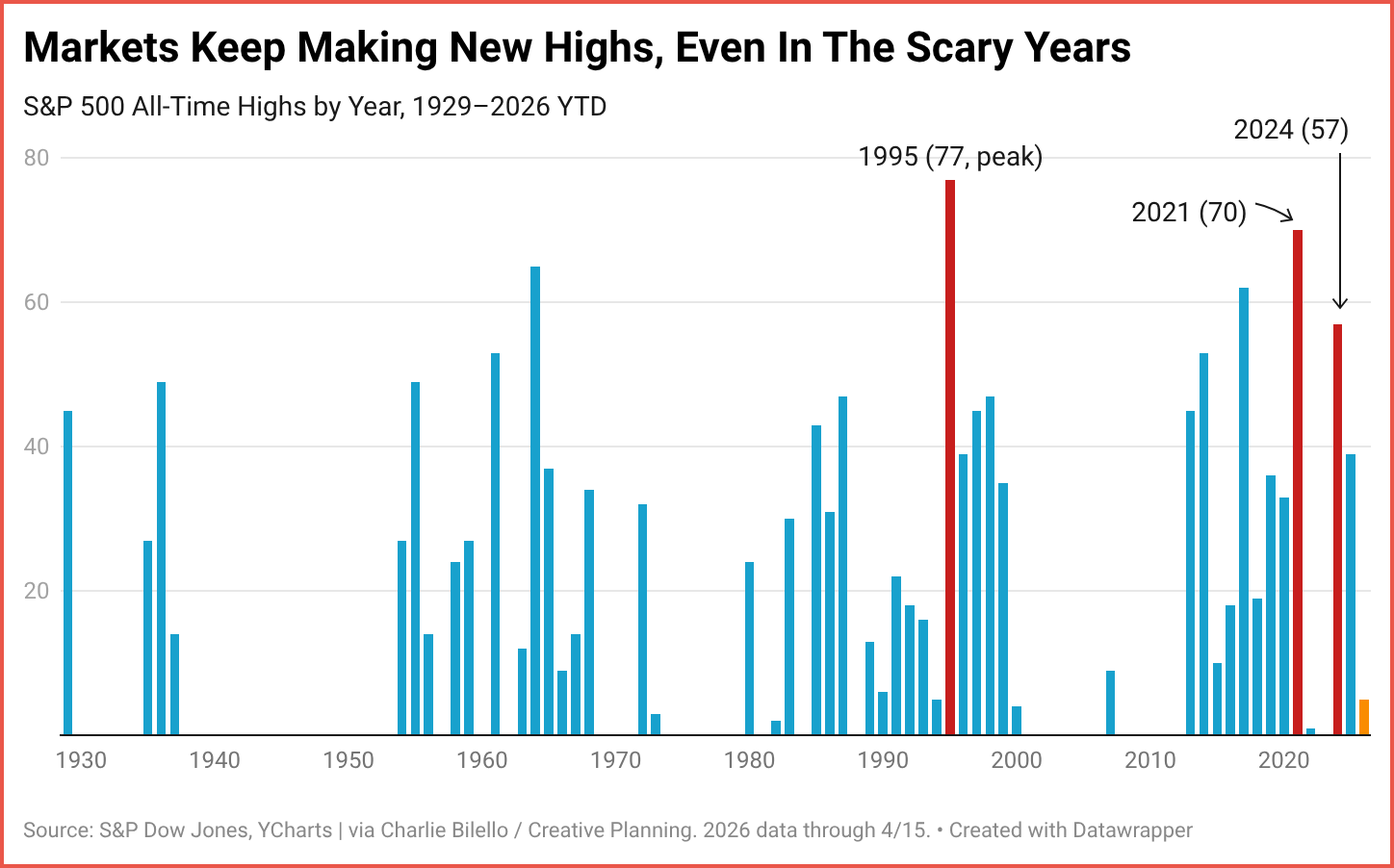
The S&P 500 closed at a record 7,022.93 on Wednesday — its first all-time high since January — even as the US naval blockade of the Strait of Hormuz entered its second week. It's a pattern that shows up again and again in the data. The index has posted new highs in 50 of the last 98 years, often in the years investors remember as the scariest: 33 during the 2020 pandemic, 57 during the 2024 election, 77 in 1995 after a brutal bond rout. Markets, as the saying goes, climb a wall of worry.
📊 Market Mood — Thursday, April 16, 2026
🟩 Markets Rise as Peace Talk Momentum Builds
U.S. futures climbed on growing optimism around renewed U.S.-Iran negotiations.
🟧 Oil Holds Below $100 Despite Lingering Risks
Crude stayed contained as diplomacy hopes offset ongoing supply disruptions.
🟦 Earnings Strength Reinforces Market Resilience
Solid bank commentary and upbeat tech results supported confidence in the economy.
🟨 China Growth and AI Demand Add Tailwinds
Stronger Chinese data and robust semiconductor earnings underscored global demand momentum.
🗓️ Key Economic Events — Thursday, April 16, 2026
🟧 08:30 ET — Philadelphia Fed Manufacturing Index (Apr)
Expected at 10.3 (vs. 18.1 prior), offering a read on regional manufacturing momentum.
🟧 08:30 ET — Initial Jobless Claims
Expected at 213K (vs. 219K prior), providing a timely snapshot of labor market conditions.
editor-tippinsights@technometrica.com