Incoming New York City Mayor, Zohran Mamdani, just quietly and almost invisibly crossed a line that has never before been crossed in American politics: he defined a group of American civilians as “war criminals.” This time, the Mayor-elect targeted Jewish New Yorkers: their “war crime” was attending a talk at Manhattan’s Park East synagogue to discuss (not surprisingly) the possibility of leaving. Yet now that a line has been crossed with no apparent consequences, no religion or minority group will be safe.p
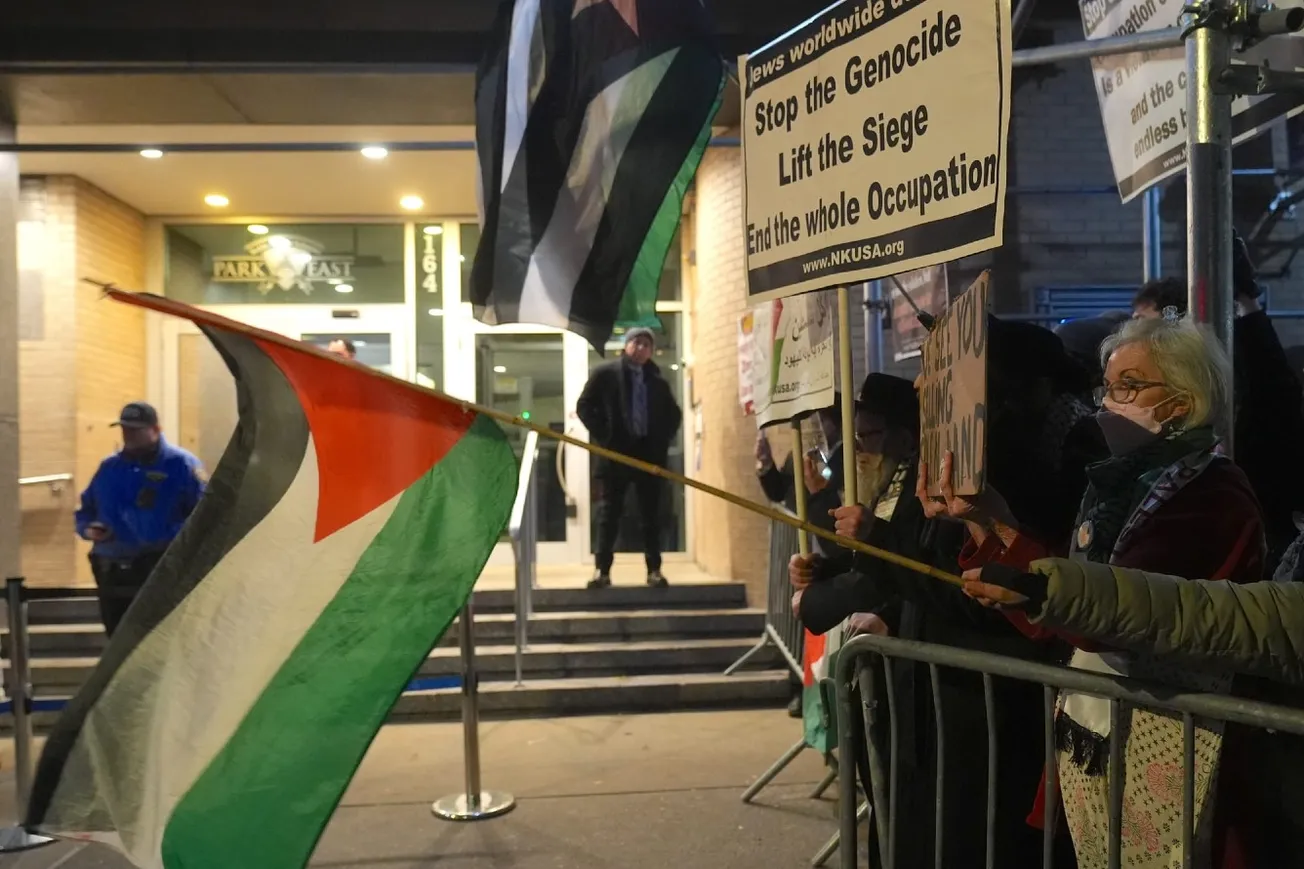
The November 19 talk at New York City’s Park East Synagogue covered matters of American Jewish interest, including immigration to Israel. Outside, a crowd of pro-Palestinian protesters raged against the event’s Jewish participants, including cries of “we need to make them scared,” “f—king Jewish pricks,” and “globalize the intifada” (a phrase the United States Congress officially recognizes as a call for violence against the Jewish people).
Some blandly criticized Mayor-elect Zohran Mamdani’s response as “ambivalent” or “hollow.” Yet Mamdani’s statement was nothing of the sort: it was unprecedented in American history, and outright terrifying. According to a spokesperson:
“The Mayor-elect has discouraged the language used at last night’s protest and will continue to do so…he believes every New Yorker should be free to enter a house of worship without intimidation, and that these sacred spaces should not be used to promote activities in violation of international law.”
(Emphasis added)
International law?
A lecture at a synagogue violated international law?
In diplomatic circles, “violations of international law” are widely understood to be major offenses: such as genocide, mass murder and other crimes against humanity – the kind of horrors associated with Hitler, Stalin or Milošević. This is the sort of stigma the incoming mayor is leveling upon New York’s Jewish community - for attending a lecture at a local synagogue.
To be clear, in addition to being absolutely protected by America’s First Amendment, a talk about Jewish emigration at a synagogue does not even remotely violate any international law, convention or treaty. Mandani has a long history of troubling rhetoric, including statements that many consider to be antisemitic – it’s therefore no wonder that much of New York’s Jewish community is seriously considering giving up the lives they’ve built in America to head for safer shores. To brand these New Yorkers as war criminals for doing so, merely confirms their very legitimate fears about the future of New York and about their own personal safety.
It is well known that the Mayor-elect promised to arrest Israeli Prime Minister Benjamin Netanyahu should he ever visit New York City, supposedly for reasons of “international law.” Ironically, doing so would actually violate both U.S. Federal law as well as several of the very international laws Mamdani claims to uphold - a legal topic we’ve previously discussed in depth.
Yet in this case, the soon-to-be Mayor of New York City was not accusing a foreign leader of war crimes: he was accusing Jews. American Jews. New York Jews. For attending a talk at a synagogue.
Mamdani’s accusation is reminiscent of Amsterdam, exactly one year earlier: the local Muslim population carried out an actual, modern day pogrom against visiting Israeli soccer fans, literally hunting them through the city streets. For hours, the Dutch police were nowhere to be found.
It is not a coincidence that this pogrom occurred in a city whose government speaks about Israel, and treats its local Jews, in a manner starkly similar to Mamdani.
Just one example: Amsterdam police have the right to refuse assignments on moral grounds. One of the assignments police frequently refuse is protecting Jewish sites, including Holland’s National Holocaust Museum. The irony is astonishing: refusing to protect a national Holocaust Museum on the grounds of “morality.”
The New York City police will soon be under the command of a mayor who now accuses American Jews of war crimes. In a city where violent antisemitic attacks have already reached shocking levels, the police are about to become unreliable at best, and perhaps even hostile.

Matters under the mayor’s direct authority, such as police protection, are only the beginning. Dozens of city agencies are next.
For example, Mamdani has promised to cut New York City’s relationship with Israel’s Technion University via New York’s Cornell University. The mayor does not directly control this decision, but he does have the power to appoint members of the board of management of the Roosevelt Island Operating Corporation, which can then force Cornell into decisions against the partnership.
In the coming years, NYC will see dozens of other political appointments, some visible and others subtle, and they will impact every aspect of the City’s culture, education and safety, for years to come.
This is not an isolated event.
At a 2001 conference in Durban, South Africa, the Palestinian Authority and its various allies (including Qatar and Iran) launched what later came to be known as the “Diplomatic Intifada” against Israel and the United States. The conference was characterized by rampant hate speech, including Nazi symbols, as well as discussion of specific plans. The primary “target market” was the generation just being born: today’s 18-24 year old cohort. The venues included news, education, entertainment and government. The timeframe was decades, and the budget was essentially unlimited.
Most of the apprehension around Mamdani’s candidacy related to his plans to impose socialism on New York City. Many fear this will not only reduce New York’s quality of life, but also destroy The City’s special status as a center of global commerce, and the heart of American capitalism. Yet we now understand that impending socialism is not the only concern for Americans and New Yorkers.
Last month we saw the results of the Diplomatic Intifada play out at a New York City synagogue, but eventually we will see the same in a church, a Buddhist or Hindu temple, a Bahai house of worship, or possibly even a mosque that the Mayor deems too moderate. The very American way of life is being put to the test in New York City, and it is not at all clear whether we, as a nation, will pass.
Daniel Pomerantz is the CEO of RealityCheck, a non-profit charitable organization dedicated to restoring public trust in information. An expert on the Middle East and international law, Daniel also serves as an adjunct professor at Israel’s Reichman University (the “IDC” in Herzliya). Daniel and RealityCheck can be found at www.realitycheckresearch.org or at contact@realitycheckresearch.org.
📊 Market Mood — Monday, December 8, 2025 (Pre-Market)
🟩 Futures Edge Higher Ahead of Fed Meeting
U.S. stock futures ticked up early Monday, extending last week’s gains as markets look to the Federal Reserve’s final policy decision of the year. A delayed September inflation report came in softer than expected, and Fed funds futures now price an 88% chance of a rate cut on Wednesday. With a quiet data calendar today, traders are focused on the Fed and major earnings later in the week.
🟧 Netflix–WBD Deal Faces Regulatory Firestorm
Netflix’s planned $72B acquisition of Warner Bros Discovery’s TV and film assets is set for fierce antitrust review in the U.S. and Europe. Industry unions warn of job losses and reduced theatrical output. President Trump said Sunday he will “be involved” in deciding whether the merger proceeds, adding political uncertainty to an already complex deal.
🟦 Japan’s GDP Contracts Sharply in Q3
Japan’s economy shrank 2.3% annualized in the third quarter—worse than initial estimates—marking the steepest decline since 2023. The weak data helps explain Tokyo’s recent large stimulus package, yet the Bank of Japan is still expected to raise rates at next week’s meeting, given inflation has held above 2% for more than three years.
🟪 China’s Trade Surplus Surges as Exports Rebound
China posted a $111.7B trade surplus in November, beating expectations as exports rose 5.9% year-on-year. Shipments to the U.S., however, plunged 29%, highlighting the impact of Trump’s tariffs. Exports to Europe, Australia, and Southeast Asia grew sharply as manufacturers deepen ties with non-U.S. markets.
🟫 Oil Holds Near Two-Week Highs
Crude prices inched higher, with Brent at $63.85 and WTI at $60.20. Expectations of a Fed rate cut are supporting demand outlooks, while G7 and EU discussions over a full maritime-services ban on Russian oil introduce new supply risks.
🗓️ Key Economic Events — Monday, December 8, 2025
No events scheduled
editor-tippinsights@technometrica.com