
On Tuesday night, President Trump will take the podium before a joint session of Congress to deliver his State of the Union address, outlining his agenda for the year ahead. But as he prepares to make his case to the nation, the latest nationwide TIPP Poll shows that Americans are already clear about what they want to hear from their president.
A year into his second term, the country is focused less on rhetoric and more on results. Americans’ top concerns center squarely on the cost of living and inflation, followed by the broader economy, immigration, and border security. Health care ranks next; trust in government, corruption, and transparency round out the top tier.
Voters across the political spectrum share a sense of urgency about economic strain and governance, even as they differ sharply on emphasis.
As the president outlines his priorities Tuesday night, these numbers provide a revealing benchmark of the public mood.
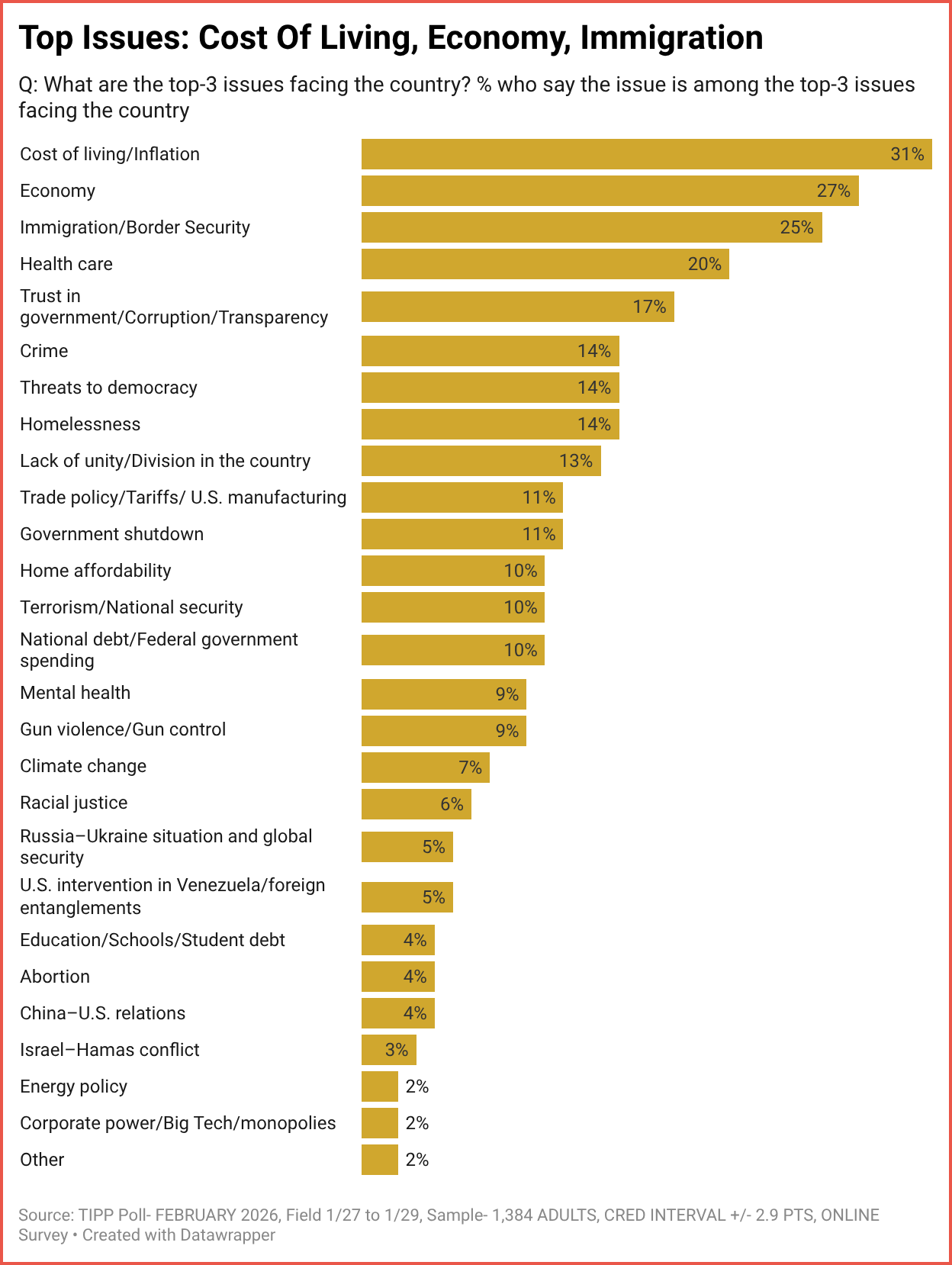
Cost of living and inflation dominate Americans’ concerns. Thirty-one percent of respondents say it is among the top three issues facing the country, making it the most prominent concern. The economy (27%) and health care (20%) rank second and fourth, respectively, while immigration and border security (25%) climbs to third, forming a distinct top tier. These findings are from the latest nationwide TIPP Poll, conducted in late January among 1,384 adults.
Beyond the top three, several issues continue to draw considerable attention. Trust in government, corruption, and transparency (17%) leads the next group, followed by crime (14%), threats to democracy (14%), and homelessness (14%). Lack of unity and division in the country (13%), trade policy, tariffs, and U.S. manufacturing (11%), and government shutdown (11%) also register at double-digit levels. Home affordability, terrorism and national security, and national debt and federal government spending each stand at 10%.
Mental health and gun violence/gun control each register at 9%. Lower on the priority list are climate change (7%), racial justice (6%), and the Russia–Ukraine situation and global security (5%), and U.S. intervention in Venezuela and foreign entanglements (5%). Issues such as education and student debt (4%), abortion (4%), China–U.S. relations (4%), and the Israel–Hamas conflict (3%) receive comparatively limited attention, while energy policy and corporate power and Big Tech each stand at 2%.
Priorities and concerns varied along party and ideological lines.
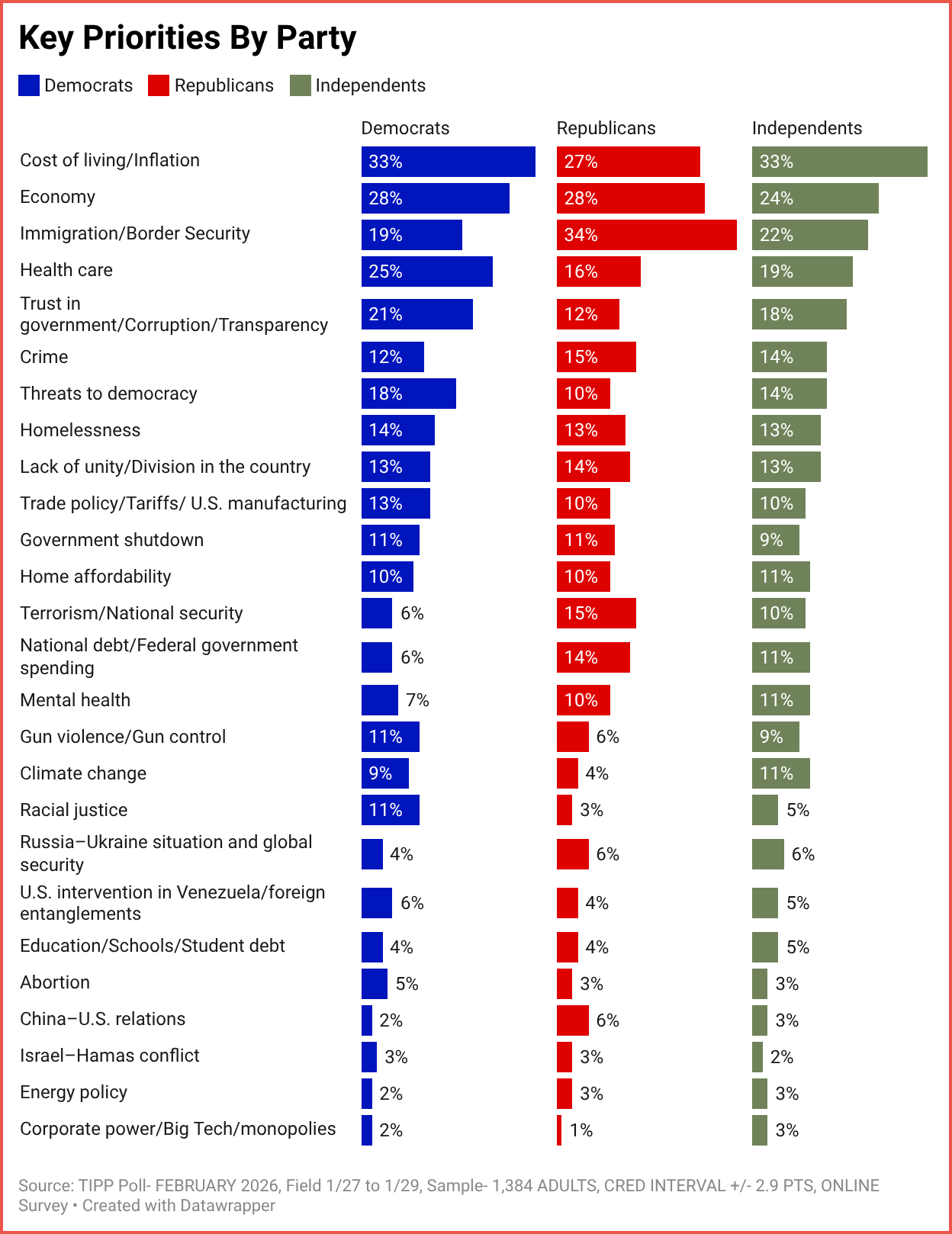
Democrats are most focused on the cost of living and inflation (33%) and the economy (28%), which clearly stand apart from other issues. Health care (25%) and trust in government, corruption, and transparency (21%) form a second tier of concern, followed by immigration and border security (19%). Issues such as threats to democracy (18%) and homelessness (14%) rank lower among Democratic respondents.
Republicans prioritize immigration and border security most strongly at 34%, followed by the economy (28%) and cost of living and inflation (27%). Secondary concerns include health care (16%), crime (15%), terrorism and national security (15%), and national debt and federal spending (14%), reflecting a broader focus on security and fiscal issues.
Independents closely track Democrats on economic stress, with cost of living and inflation (33%) and the economy (24%) topping their list. Immigration and border security (22%), health care (19%), and trust in government (18%) round out their leading concerns. Compared with partisans, independents show a wider focus across issues.
Top Economic Issues
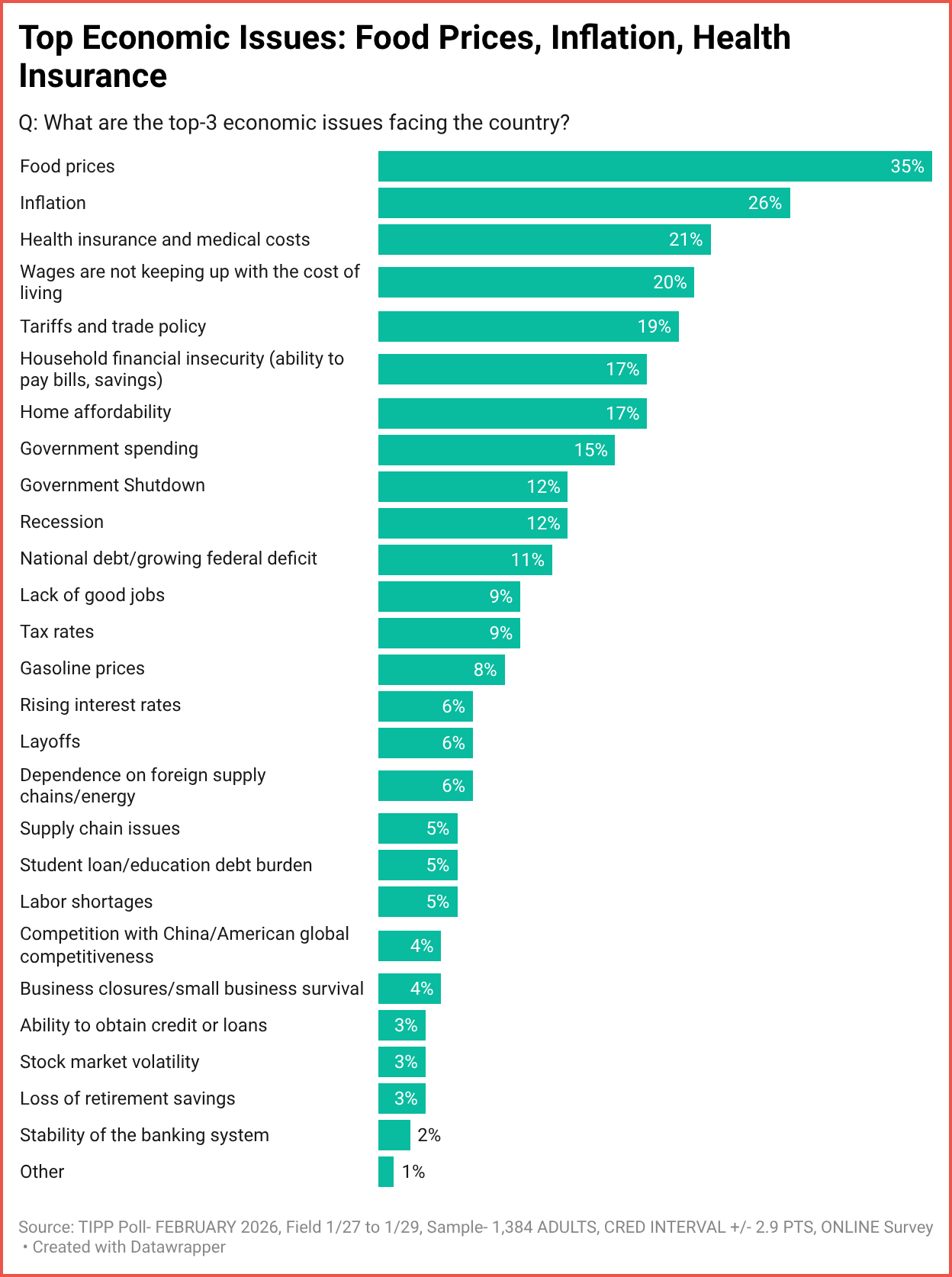
Responses to the question, “What are the top three economic issues facing the country?” reveal that Americans across the spectrum are facing the brunt of rising costs.
Food prices top Americans’ economic concerns - thirty-five percent of respondents cite food prices as one of the top three economic issues facing the country, followed by inflation (26%) and health insurance and medical costs (21%), forming a clear top tier.
Beyond the top three, cost pressures remain front and center. Wages not keeping up with the cost of living (20%) ranks next, followed by tariffs and trade policy (19%). Concerns about household stability are also prominent, including household financial insecurity—such as the ability to pay bills or maintain savings (17%) and home affordability (17%).
Fiscal and macroeconomic issues form a broad middle tier. Government spending (15%) draws notable attention, alongside a government shutdown (12%), fears of a recession (12%), and the national debt or growing federal deficit (11%). Labor-market concerns such as a lack of good jobs (9%), tax rates (9%), and gasoline prices (8%) also register.
Lower on the list are rising interest rates (6%), layoffs (6%), and dependence on foreign supply chains and energy (6%). Supply-chain disruptions, student loan and education debt burden, and labor shortages each stand at 5%. Issues such as competition with China (4%), small-business survival (4%), ability to obtain credit or loans (3%), stock-market volatility (3%), and loss of retirement savings (3%) receive limited attention, while banking system stability (2%) ranks near the bottom.
Direction Of Country
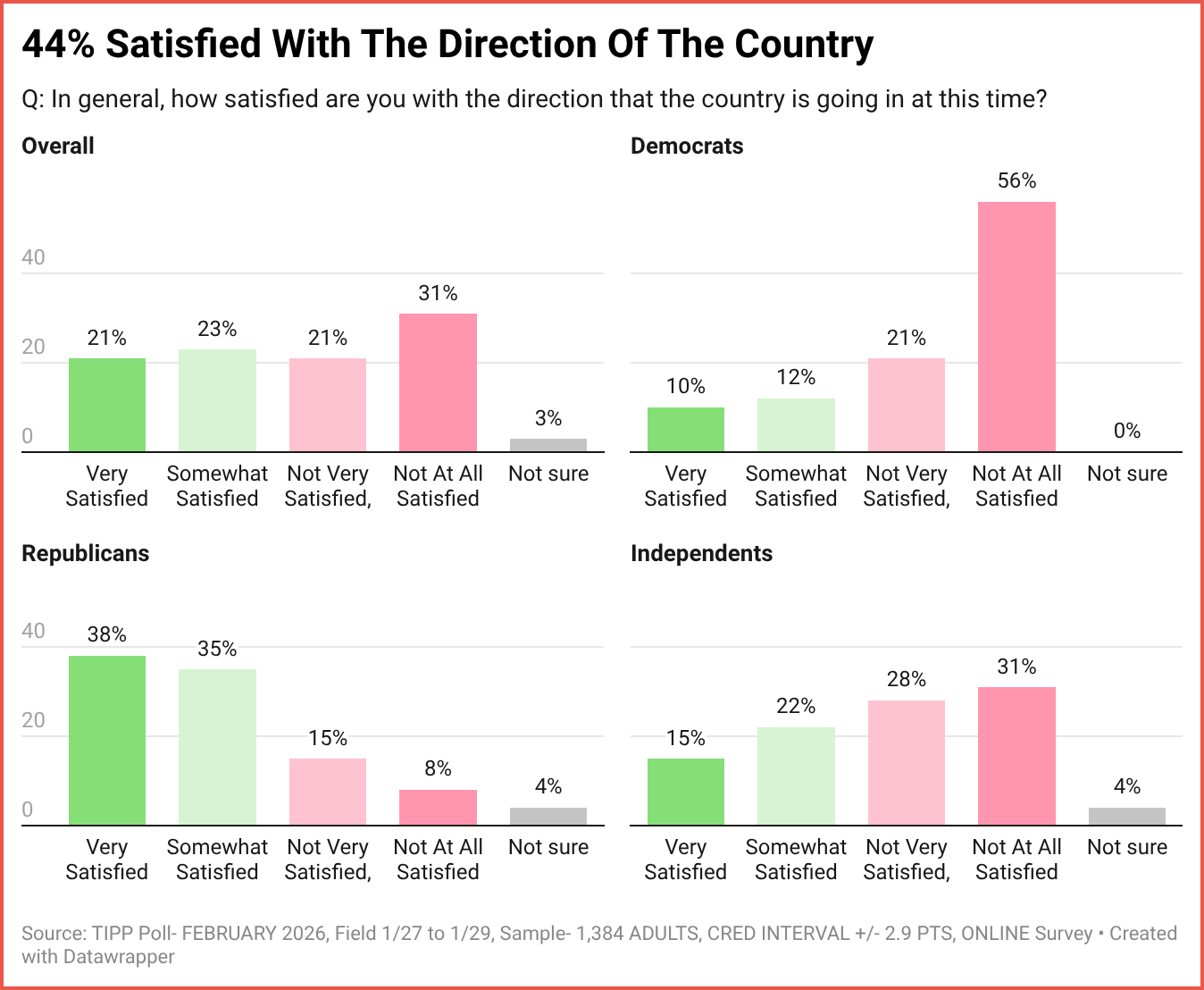
Each month, the TIPP Poll probes the general sentiment about the country’s direction using the survey question, "In general, how satisfied are you with the direction that the country is going in at this time?"
The latest poll shows that Americans have mixed feelings about the country’s direction. 44% of respondents are satisfied, while 52% are dissatisfied. Republicans are the most optimistic, with 73% expressing satisfaction, while Democrats are the least satisfied, with 77% dissatisfied. Among independents, 59% are dissatisfied while 37% are satisfied .
The survey also produces a compact index from responses to the above question. The Index ranges from 0 to 100. A score of 50 or above is positive, below 50 is negative, and 50 is neutral.
Overall, the Index slipped into negative territory in September 2021 and remained below 50 for 45 consecutive months through May 2025. It finally moved back into positive territory in June 2025, rising to 50.5, before falling again in the second half of the year. As of February 2026, the Index remains below the neutral mark at 45.1.
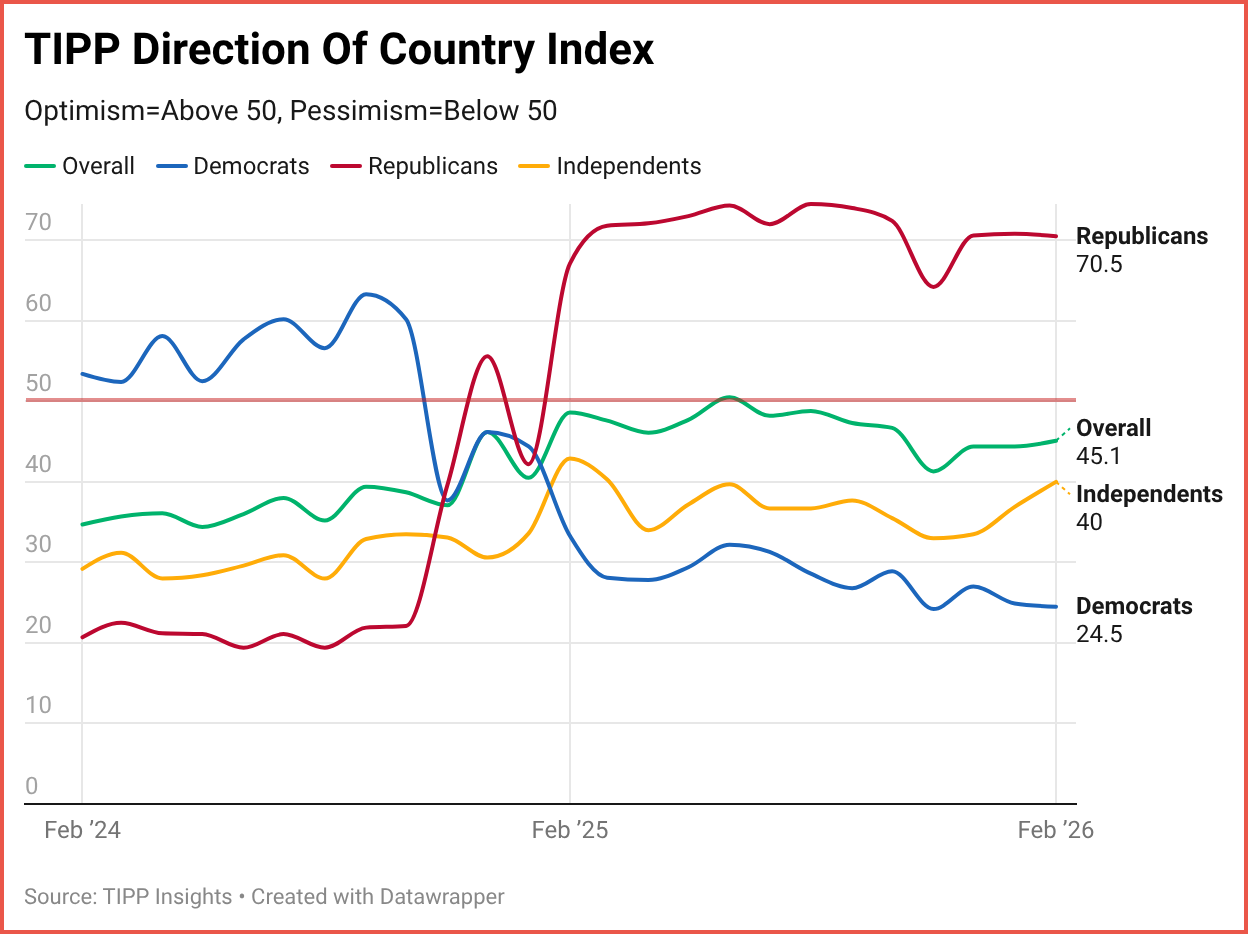
Republicans are the most optimistic, with a high score of 70.5. Democrats have the lowest optimism rating at 24.5, indicating extreme pessimism. Independents are in between at 40.
The sharp spike in optimism among Republicans and the steep decline among Democrats coincided with President Trump's election, marking a clear partisan shift in sentiment. The flip highlights the deep political divide prevalent in the country.
Taken together, the findings point to a country united more by shared economic pressure than by political agreement. While Americans differ sharply by party in how they rank specific issues, concerns about affordability, economic stability, and effective governance cut across ideological lines.
As President Trump delivers his State of the Union address, the public’s message is straightforward: focus on costs, stabilize the economy, and restore confidence in government. The address may set the tone in Washington, but the political landscape heading into the 2026 midterms will ultimately be shaped by whether voters feel tangible improvement in their everyday lives.
In that sense, Tuesday’s speech is not merely a ceremonial moment; it is a test against a clear and measurable public agenda.
👉 Show & Tell 🔥 The Signals
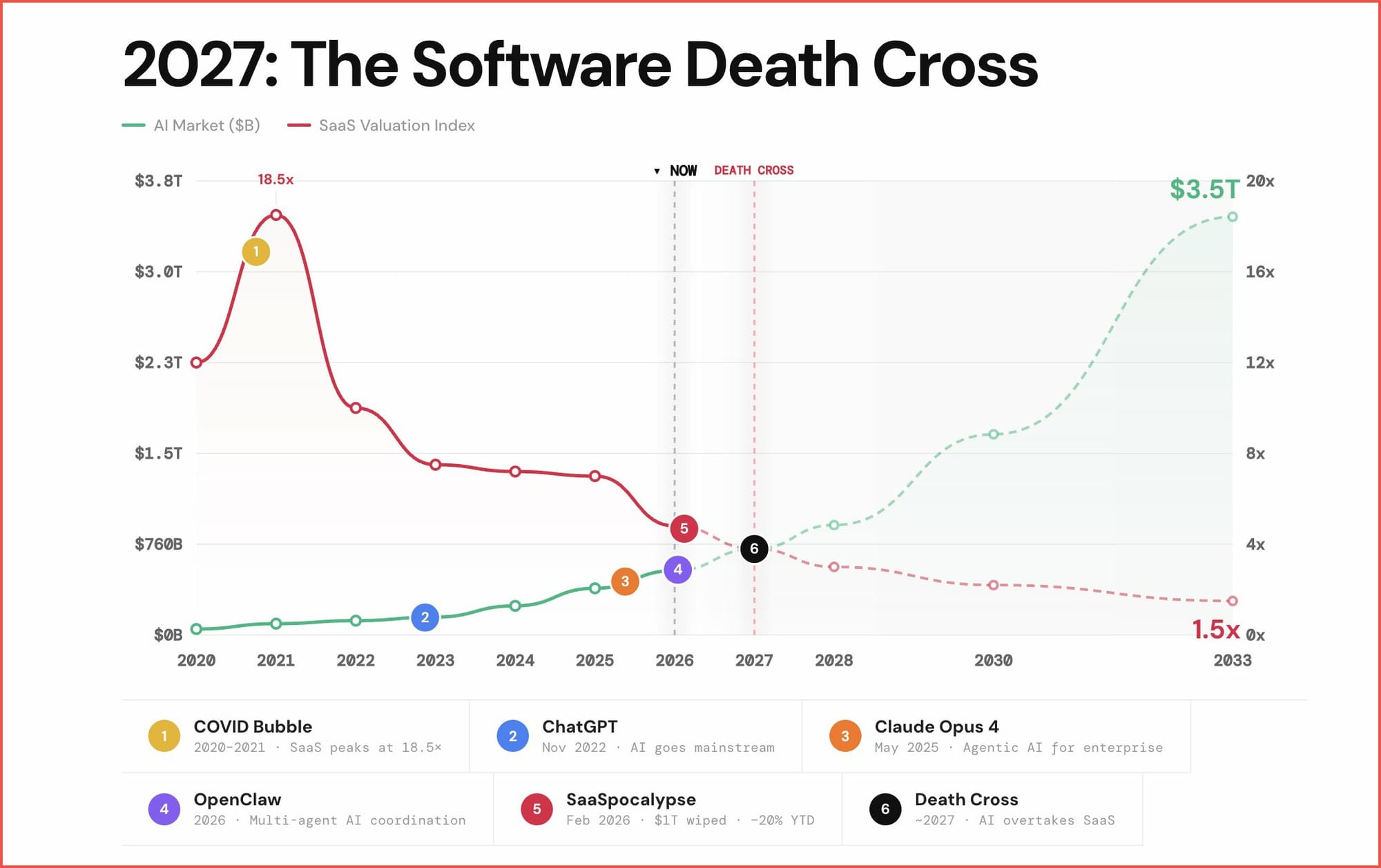
I. SaaS Valuations Collapse As AI Rises
Software-as-a-Service, or SaaS, refers to cloud-based subscription tools such as Salesforce for customer management, Zoom for video meetings, Shopify for online stores, and Slack for workplace messaging. These companies were once valued at extremely high revenue multiples during the pandemic boom. Today, those valuations have compressed sharply as growth slows and investors shift attention toward AI-native platforms. The re-pricing suggests a broader transition from traditional subscription software toward AI-driven systems.
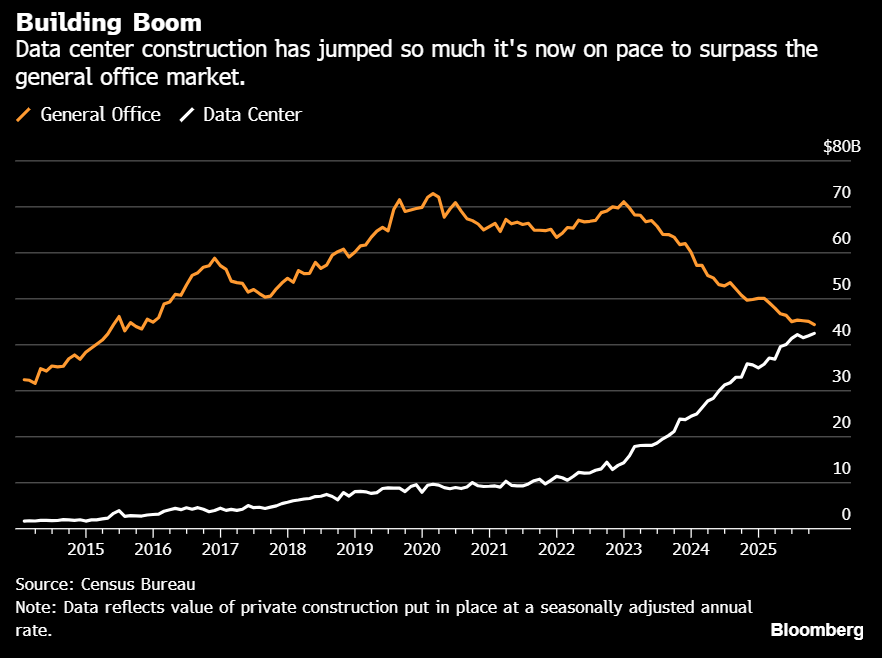
II. Data Center Spending Surges Past Office Construction
Private construction data show spending on data centers is rapidly catching up to, and poised to surpass, general office construction. The shift signals a reallocation of capital toward digital infrastructure over traditional workspace.
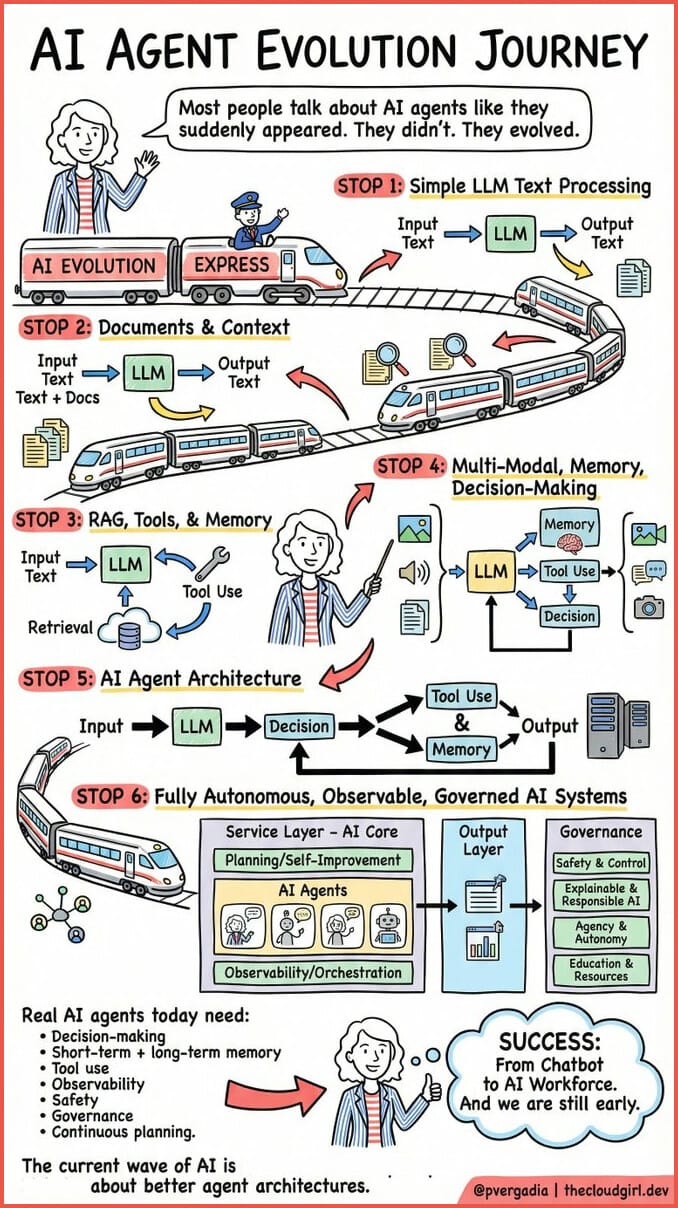
III. The Evolution Of AI Agents
AI systems have progressed from simple text generation to architectures that integrate memory, tools, retrieval, multimodal inputs, and decision loops. The latest phase emphasizes fully autonomous, observable, and governed systems designed to operate as digital workers rather than standalone chatbots.
📊 Market Mood — Monday, February 23, 2026
🟩 Futures Slide as Tariff Uncertainty Returns
U.S. futures fall after President Trump announces temporary 15% global tariffs following a Supreme Court setback.
🟧 Trade Policy Back in Flux
Markets grapple with the short-term nature of the tariffs and questions over refunds, extensions, and global trade deal stability.
🟦 Fed Watch: Waller Speech in Focus
Investors look to Governor Waller for clues on rate direction amid renewed tariff tensions and mixed inflation signals.
🟨 Oil Pulls Back Ahead of U.S.–Iran Talks
Crude retreats as prospects for further nuclear negotiations ease immediate supply disruption fears.
🗓️ Key Economic Events — Monday, February 23, 2026
No Events Scheduled
editor-tippinsights@technometrica.com