Editor’s Note: This commentary examines how China’s continued dominance in low-skill manufacturing is reshaping global trade. The authors argue that China’s policies, not just its economic efficiency, are limiting opportunities for developing countries with major implications for growth and global leadership.
By Shoumitro Chatterjee, Arvind Subramanian - Project Syndicate | October 20, 2025
China’s continued dominance in low-skill export sectors reflects not just efficiency, but deliberate policy choices that prevent poorer countries from climbing the development ladder. If it truly aspires to global leadership, it must stop tilting the playing field in its own favor.

WASHINGTON, DC – China’s rising trade surplus is once again causing unease in the United States and Europe. But the real casualties from this new “China Shock” will not be in the West. They will be in the developing world, where hundreds of millions of people still depend on manufacturing for jobs and upward mobility. China’s trade dominance not only threatens growth across the Global South; it also undermines China’s own claim to global leadership.
Influential work by David Autor and his co-authors documented how the first China Shock, from the mid-1990s to the late 2000s, wiped out manufacturing jobs and communities across the US. Yet much of that adjustment reflected deeper, long-term forces: technological progress and the steady reallocation of workers from factories to services – a shift that predated the China Shock, but was accelerated by it. As a result, advanced economies have largely vacated the low-skill sectors that China continues to dominate.
📘 TIPP’s Dragon Series
Explore China’s expanding reach and rising power through our exclusive editorial series:
- 🐉 The Dragon’s Image Problem
- 🐉 The Dragon’s Chokehold
- 🐉 The Dragon Learns To Fly
- 🐉 The Dragon’s Quest
- 🐉 Bear, Dragon, Eagle
- 🐉 Highway To The Danger Zone: The Dragon’s Gambit In The South China Sea
👉 Subscribe for $99/year to unlock the full Dragon Series and future deep-dive briefings from TIPP Insights.
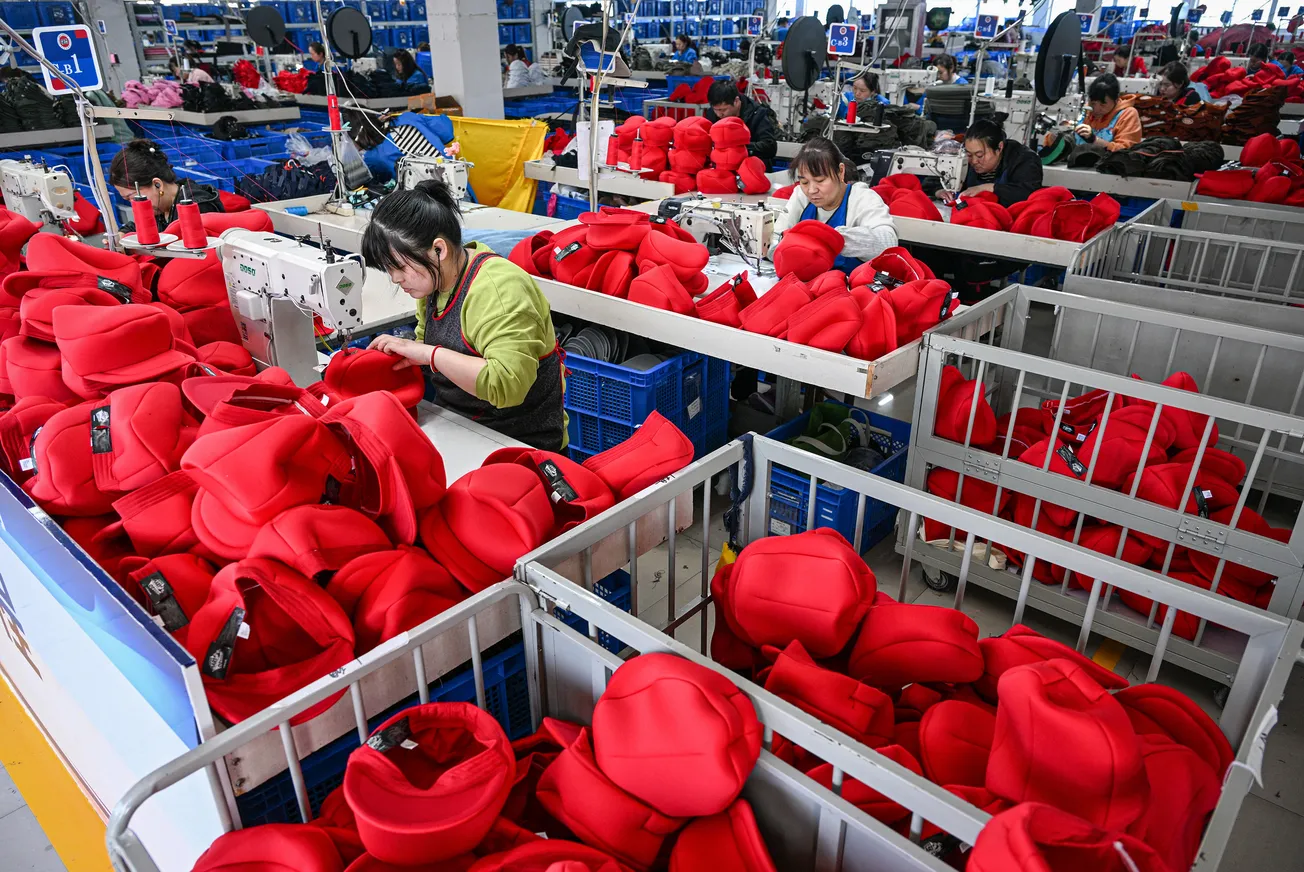
Today, China’s manufacturing trade surplus stands at roughly $2 trillion, about $1.4 trillion of which comes from low-skill goods. For the West, then, the new China Shock is narrower, concentrated in a few sectors such as electric vehicles and renewables, and in specific technologies where Chinese imports still account for about 1.5% of the West’s GDP.
The story is far more alarming for low- and middle-income countries (LMICs), which face a threat to the sectors where their comparative advantage lies – namely, low-skill manufacturing industries, which remain crucial for job creation and economic development. Accounting for almost 4% of LMICs’ combined GDP, the import shock from China represents a larger (and growing) share of their economies than imports of high-skill goods do in developed countries.
How serious is this threat? One benchmark is to compare China’s share of low-skill exports among LMICs to its share of the global workforce. China still accounts for more than half of global low-skill exports (see chart), and though its market share has declined slightly since peaking in 2015, the trend line should have been far steeper, given its shrinking labor force. The wedge between China’s export share and its labor-force share – roughly 28 percentage points – suggests that China continues to occupy “excess” export space that could otherwise support tens of millions of manufacturing jobs in poorer economies.

What makes this persistence even more striking is that China’s manufacturing wages are now far higher than those in LMICs – and still increasing. For example, in apparel, the canonical labor-intensive sector, the annual wage in China averages around $10,000, which is roughly five times higher than in Bangladesh and four times higher than in India.
Even with such wage differentials, China’s export strength might be less troubling if it stemmed purely from productivity gains and automation. In that case, one would still have to question China’s hegemonic legitimacy, because true hegemons accommodate rather than crowd out others, but it would not necessarily be unfair. Mounting evidence suggests that this is not the case, though. Instead, China shows signs of significant policy distortions. Industrial subsidies, undervalued exchange rates, and persistent excess capacity are all tilting the playing field in its favor. China’s continued dominance reflects not just efficiency, but deliberate policy choices that prevent poorer countries from climbing the development ladder.
History underscores how unfair China’s strategy is. Charles Kindleberger famously argued that hegemons provide global public goods, such as financing during crises, resources for long-term development, and support for open markets. When the US was the world’s economic hegemon after World War II, it created manufacturing and export space for others – first Japan, then the Asian Tigers, and eventually China itself. Its willingness to absorb imports and allow others to grow was an essential part of its global leadership. Yet today, as the Trump administration retreats from that role, China’s actions will determine whether it can credibly replace the US as a responsible provider of that critical global public good.
The pressure on LMICs is already evident in their growing trade actions against China. The recent unrest in Indonesia – a by-product of de-industrialization and exposure to Chinese competition – underscores what is at stake. To its credit, China has taken symbolic steps toward offering real leadership, including by voluntarily relinquishing its developing-country status at the World Trade Organization and granting duty-free access to poorer countries.
But these gestures will ring hollow unless China genuinely vacates the global manufacturing space. If China truly aspires to global leadership, it must internalize a simple truth: hegemons gain legitimacy not by dominating others, especially the poor, but by enabling their rise. The new China Shock is not just about economic consequences. It is also a test of whether China can serve as a fair steward of global prosperity, or remain a formidable practitioner of beggar-thy-neighbor mercantilism.
Shoumitro Chatterjee, Assistant Professor of International Economics at Johns Hopkins University, is a nonresident scholar at the Carnegie Endowment for International Peace.
Arvind Subramanian, former chief economic adviser to the Indian government, is a senior fellow at the Peterson Institute for International Economics and the author of Of Counsel: The Challenges of the Modi-Jaitley Economy (India Viking, 2018).
Copyright Project Syndicate
TIPP Takes
Geopolitics, Geoeconomics, And More
1. Zelensky Ready To Join Trump-Putin Talks After 'Frank' White House Meeting - BBC
Ukrainian President Volodymyr Zelensky has said he would be ready to join Donald Trump and Vladimir Putin at a proposed summit in Hungary if he were invited.

The US and Russian presidents announced after their phone call on Thursday that they planned to hold talks on the war in Ukraine in Budapest, possibly in the coming weeks.
On Monday, Zelensky told reporters: "If it is an invitation in a format where we meet as three or, as it's called, shuttle diplomacy... then in one format or another, we will agree".
2. US And Australia Sign Rare Earths Deal To Counter China's Dominance - BBC
The US and Australia have signed a deal intended to boost supplies of rare earths and other critical minerals, as the Trump administration looks for ways to counter China's dominance of the market.

Australian Prime Minister Anthony Albanese said the deal would support a pipeline of $8.5bn (£6.3bn) "ready-to-go" projects that would expand his country's mining and processing abilities.
It includes $1bn to be invested by the two countries in projects in the US and Australia over the next six months, a framework text says.
Related: The Dragon’s Chokehold
3. China’s Economy Shows Lopsided Growth - TIPP Insights
The world’s second-largest economy grew 4.8% in the third quarter, powered by strong exports and factory investment, while weak retail sales and slowing business investment reveal vulnerabilities.

4. Takaichi Set To Be Japan’s First Female Prime Minister - TIPP Insights
Sanae Takaichi is on track to become Japan's first female prime minister, after the right-wing Japan Innovation Party, known as Ishin, said it was ready to back her premiership.

5. Priceless Jewels Grabbed In Shocking Louvre Heist - TIPP Insights
A brazen robbery at the Louvre museum in Paris on Sunday – the most spectacular since the Mona Lisa was stolen last century – saw thieves make off with several items from the surviving French crown jewels.

📊 Market Pulse — October 20, 2025
📈 S&P 500 — 6,735.13 ▲ +1.07%
Stocks rallied to start the week as easing U.S.-China trade tensions and strong corporate earnings optimism lifted sentiment across Wall Street.
💵 10-Year Treasury — 3.98 ▼ -0.50%
Yields slipped as investors rotated back into equities and priced in higher odds of a Federal Reserve rate cut later this year.
🛢️ Crude Oil — $57.46 ▼ -0.14%
Oil edged lower amid cautious demand signals and ongoing uncertainty around global growth prospects.
💵 U.S. Dollar Index — 98.60 ▲ +0.06%
The dollar held steady as markets weighed geopolitical risks against dovish central bank expectations.
🪙 Bitcoin — $111,024.39 ▲ +3.71%
Bitcoin surged above $111K, extending its recent breakout on rising institutional demand and momentum-driven inflows.
🪙 Gold — $4,370.10 ▲ +3.72%
Gold climbed sharply, nearing record highs as safe-haven flows and expectations of easier monetary policy fueled renewed buying.