
American military attacks on boats in the Caribbean and Western Pacific carrying illicit drugs have created a furor in the media and within the Democratic Party. But that's about as far as the rage goes: Most Americans support the actions and, if they fail, back further action against the governments that support the drug cartels, the latest I&I/TIPP Poll shows.
The online nationwide poll, taken from Oct. 28 to Oct. 31 by 1,418 adults, has a +/- 2.8 percentage point margin of error.
I&I/TIPP asked respondents: "The U.S. military has been destroying boats in the Caribbean and Pacific carrying illegal drugs from Venezuela and Colombia that are blamed for many American deaths. Do you support or oppose these air strikes to stop shipments of illegal drugs, including fentanyl and similar narcotics?"
Support was strong across the board, with 60% favoring the policy "strongly" (37%) or "somewhat," while just 28% opposed it either "strongly" (16%) or "somewhat" (12%) and another 12% saying they weren't sure.
Republicans were strongest in backing the policy, with 82% saying they support it, and just 9% saying they oppose it. Independents and third-party members were also strongly behind the policy, with 50% supporting and 36% opposing.
But even the Democrats didn't oppose it. They split evenly, with 45% in support, and 45% in opposition.
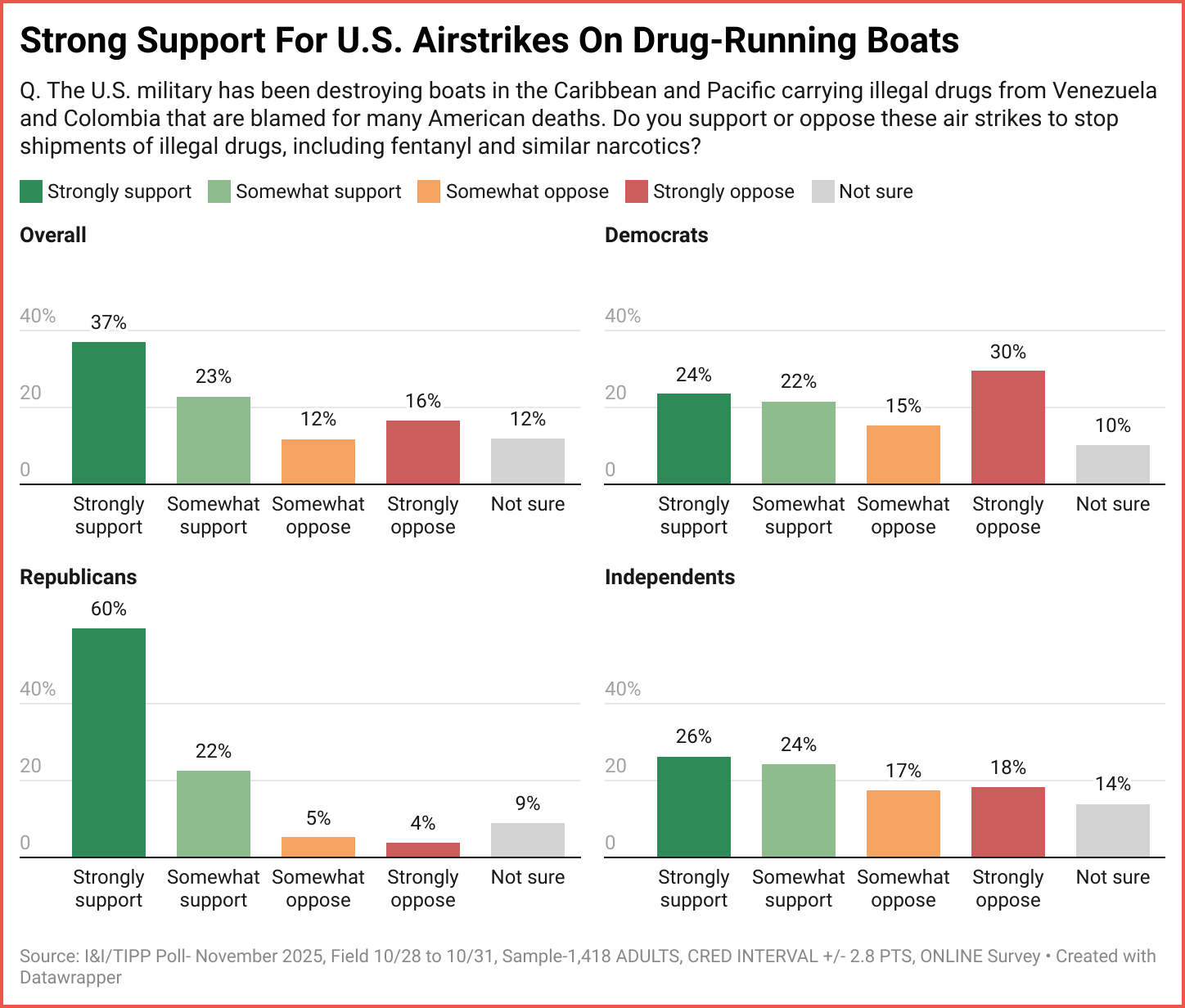
Indeed, among the 36 demographic groups that I&I/TIPP routinely queries, only one opposed the policy: Self-described liberals, at 53% oppose, 36% support. Self-described conservatives (79% support, 13% oppose) and moderates (58% support, 31% oppose) both solidly backed the military attacks on narco boats.
I&I/TIPP then asked a follow-on question about escalating the attacks: "If these air strikes do not stop the flow of drugs, would you support broader military action against the nations that allow drug and smuggling cartels to operate within their borders?"
Once again, support was solid, with 57% saying they would back such a move either "strongly" (33%) or "somewhat" (24%), compared to 27% who would oppose it either "somewhat" (12%) or "strongly" (15%). Another 16% weren't sure.
Once again, political leanings show that continuing action against both the cartels and the nations that support and coddle them is broadly supported.
A plurality of Democrats (45% support, 38% oppose) and independents (47% support, 35% oppose) back the plan to take further action. Among Republicans, it's a powerful majority that backs the idea: 77% support, just 11% oppose.
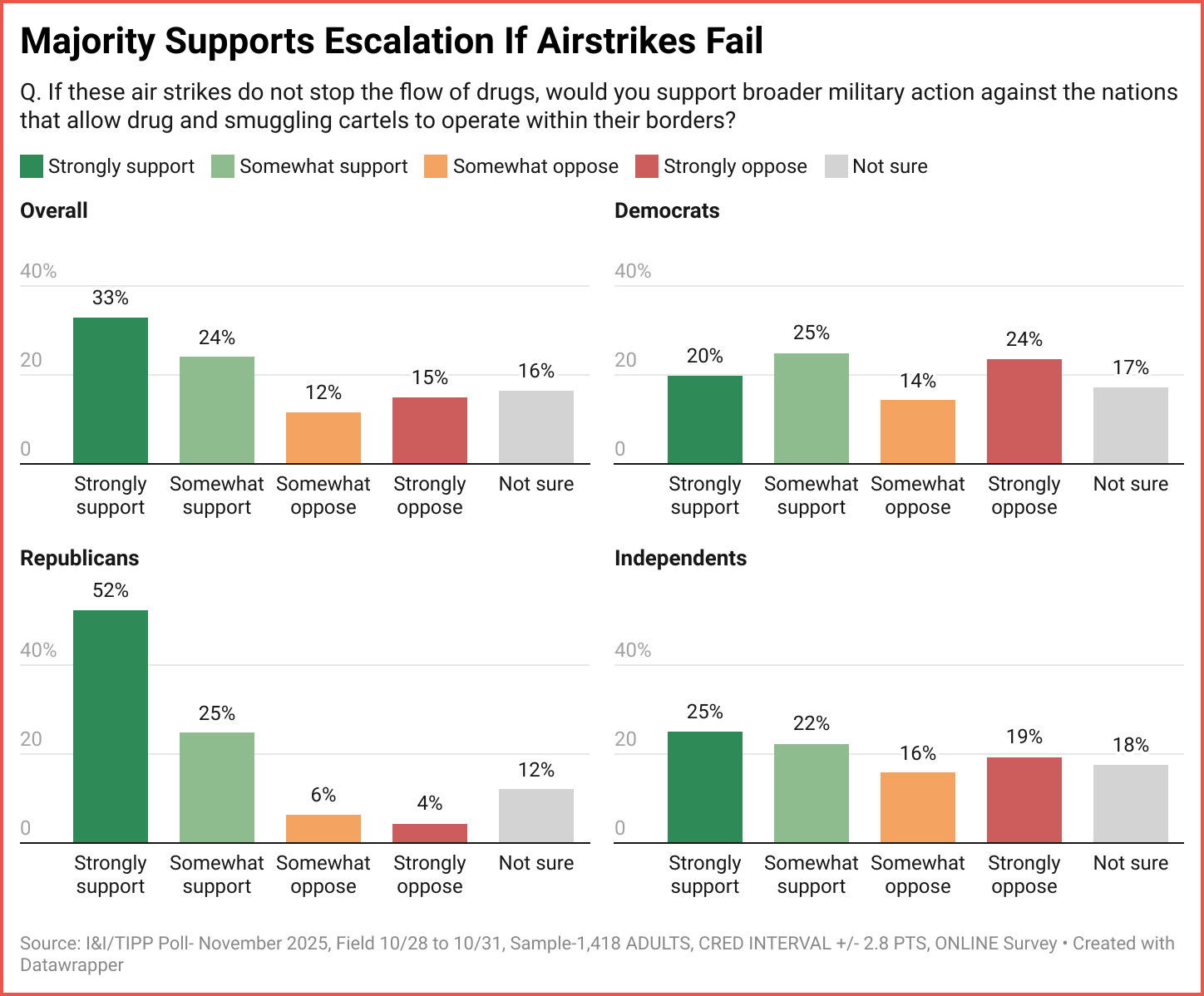
By another sensitive measure – race – the differences are not huge, but are notable. Black Americans (46% support, 33% oppose) back going beyond aerial attacks on narco-transshipment boats, but, perhaps surprisingly, a slim majority of Hispanics (51% support, 32% oppose) also do.
Meanwhile, white Americans (61% support, 24% oppose) are the bulwark of overall support.
What can be taken from this potentially violent situation?
That Americans are tired and angry with the status quo ante of looking the other way as cartels and the governments that support them transgress U.S. borders and, worse, kill thousands upon thousands of American citizens each year with their drugs.
None of this is merely hypothetical; it's being discussed at the highest levels of the U.S. government, starting with President Donald Trump.
As a recent New York Times piece noted in reference to Venezuela and its socialist narco-dictator Nicolas Maduro: "President Trump has yet to make a decision, but his advisers are pressing a range of objectives — from attacking drug cartels to seizing oil fields — to try to justify ousting Nicolás Maduro."
Trump has made clear his disgust not only with Maduro, but also with neighboring Colombia's Gustavo Petro, another extreme-left leader who has resisted U.S. requests to rein in his nation's drug cartels.
This is a huge issue in the U.S., perhaps with good reason.
According to the National Center for Drug Statistics, more than 1 million people have died from illicit drug overdoses since 1999. With just over half of the entire U.S. population over 12 having tried illegal drugs, that deadly trend shows no signs of ending.
In 2024, the federal government spent about $45 billion on drug control, but the overall cost of illicit drug use to the economy is staggering: The Council of Economic Advisors has estimated that opioid abuse alone cost Americans $2.7 trillion in 2023, or roughly 9.7% of U.S. GDP.
"Alarmingly, 93% of opioid deaths are caused by powerful synthetic opioids like fentanyl, which typically originate in China and are trafficked through Mexico," a White House release earlier this year noted.
That's one reason for the attacks on the drug boats in the Caribbean.
But would Trump actually be able to broaden his war against narco states such as Venezuela, Colombia and Mexico without Congress' permission?
Under the War Powers Act, enacted in 1973 in the waning years of the Vietnam War, a president cannot use U.S. troops in an overseas conflict without congressional approval. And the U.S. Constitution gives congress, not the president, the power to declare war on other nations.
Congress already tested this in October, but the Democrat-led effort to challenge Trump's actions in the Caribbean fell short of the required majority needed, 48-51, with votes made mostly along party lines.
Trump is already said to be prepared to strike military and cartel assets in Venezuela, an especially sensitive move after a Russian official recently claimed his government was sending air defense missiles to Venezuela, and might send offensive strike missiles as well.
Further complicating the picture is neighboring Mexico, which is a crucial nexus for drug trafficking to the U.S. Mexico's President Claudia Sheinbaum has clashed sharply with Trump on drug trafficking, calling his aggressive efforts "fascist."
"Returning to the war against the narco is not an option," Sheinbaum said earlier this month, "because it is outside the framework of the law. I said or have said on several occasions, it is permission to kill without any trial."
Trump may soon be testing that thesis. And if he does, he'll likely have the solid backing of most Americans, as the latest I&I/TIPP Poll shows.
I&I/TIPP publishes timely, unique, and informative data each month on topics of public interest. TIPP’s reputation for polling excellence comes from being the most accurate pollster for the past six presidential elections.
Terry Jones is an editor of Issues & Insights. His four decades of journalism experience include serving as national issues editor, economics editor, and editorial page editor for Investor’s Business Daily.
📊 Market Mood — Monday, November 17, 2025
🟩 Futures Rise Ahead of Data Restart
U.S. stock futures pointed higher to kick off a busy week featuring the return of official economic data and a marquee earnings release from Nvidia. Sentiment was helped by signs President Trump may ease certain tariffs, including cuts to levies on food items and a new deal with Switzerland lowering duties in exchange for a major U.S. investment commitment.
🟨 U.S. Data Flow Returns After Shutdown
With the government shutdown over, delayed economic releases resume this week.
A key one: September jobs report on Thursday, though officials warn October data may remain incomplete. Fresh figures will shape expectations for the Fed’s December meeting, where policymakers are split after two consecutive rate cuts but remain cautious amid weeks of missing data.
🟩 Nvidia Earnings Loom Large
Nvidia reports Wednesday after the close in what may be the most important corporate release of the week — potentially more influential than the jobs report itself. The stock is up roughly 1,000% since ChatGPT’s launch in late 2022, surpassing $5 trillion in market value. Given stretched AI valuations and concerns about circular industry deals, investors will be watching to see whether growth can justify the hype.
🟧 Japan’s Economy Contracts
Japan’s Q3 GDP fell 1.8% y/y, its first decline in six quarters, driven by tariff-hit exports and weak domestic demand. The drop was not as deep as expected, but the economy remains pressured by sticky inflation and high U.S. tariffs.
Focus now shifts to Prime Minister Sanae Takaichi’s fiscal stimulus plans.
🟥 Gold and Oil Slide
Gold extended losses as traders scaled back expectations for a December Fed rate cut and the dollar strengthened. Oil prices slipped as Russia’s Novorossiysk port resumed crude loadings, easing fears of a prolonged supply disruption after last week’s Ukraine-related shutdown.
🗓️ Key Economic Events — Monday, November 17, 2025
No Events Scheduled
Access our Featured Stocks and TIPP Top-20 archives — exclusive to paid subscribers. Subscribe now → $99/year.