By Philippe Aghion, Simon Bunel, Xavier Jaravel, Project Syndicate | October 28, 2025
While many commentators warn that AI will undermine employment and offer only modest productivity gains, empirical studies continue to suggest otherwise. With the right policies in place, the technology holds immense potential to drive both growth and employment.

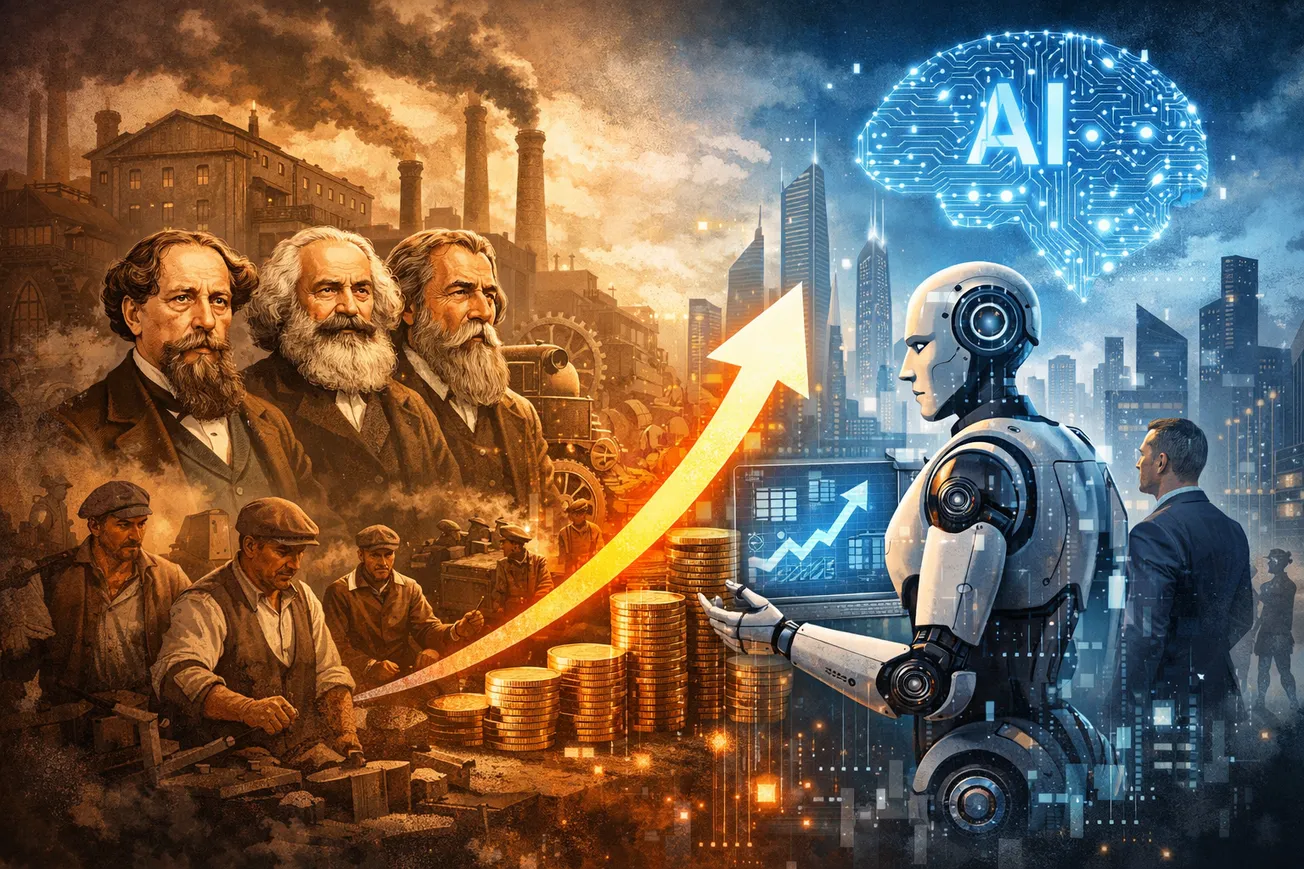
PARIS – As more businesses begin to experiment with AI and consider how it might improve their profitability, debates about the implications for workers have intensified. In the United States, the apparent disconnect between soaring stock-market valuations and falling total (non-farm) job openings has fueled media narratives about technologically driven job destruction.
Hardly a week goes by without new headlines about companies using AI to perform white-collar jobs, especially those typically filled by new graduates and those lower down the career ladder. According to a report issued by the US Senate Committee on Health, Education, Labor, and Pensions earlier this month, AI and automation could destroy nearly 100 million US jobs over the coming decade. Those voicing such fears can even point to prominent economists who argue that the AI revolution will have only moderate effects on productivity growth, but unambiguously negative effects on employment, owing to the automation of many tasks and jobs.
We disagree on both counts. Our own recent work shows that the situation is far more complicated, and not nearly as dire, as these pessimistic narratives suggest. When it comes to productivity growth, AI can operate through two distinct channels: automating tasks in the production of goods and services, and automating tasks in the production of new ideas.
Don’t just follow AI. Understand it.
Subscribe now for the best AI coverage, $99/year.
When Erik Brynjolfsson and his co-authors examined the impact of generative AI on customer-service agents at a US software firm, they found that productivity among workers with access to an AI assistant increased by almost 14% in the first month of use, then stabilized at a level approximately 25% higher after three months. Another study finds similarly strong productivity gains among a diverse group of knowledge workers, with lower-productivity workers experiencing the strongest initial effects, thus reducing inequality within firms.
Moving from the micro to the macro level, in a 2024 paper, we (Aghion and Bunel) considered two alternatives for estimating the impact of AI on potential growth over the next decade. The first approach exploits the parallel between the AI revolution and past technological revolutions, while the second follows Daron Acemoglu’s task-based framework, which we consider in light of the available data from existing empirical studies.
Based on the first approach, we estimate that the AI revolution should increase aggregate productivity growth by 0.8-1.3 percentage points per year over the next decade. Similarly, using Acemoglu’s task-based formula, but with our own reading of the recent empirical literature, we estimate that AI should increase aggregate productivity growth by between 0.07 and 1.24 percentage points per year, with a median estimate of 0.68. In comparison, Acemoglu projects an increase of only 0.07 percentage points.
Moreover, our estimated median should be seen as a lower bound, because it does not account for AI’s potential to automate the production of ideas. On the other hand, our estimates do not account for potential obstacles to growth, notably the lack of competition in various segments of the AI value chain, which are already controlled by the digital revolution’s superstarfirms.
What about AI’s implications for overall employment? In a study of French firm-level data collected between 2018 and 2020, we show that AI adoption is positively associated with an increase in total firm-level employment and sales. This finding is consistent with most recent studies of the firm-level effects of automation on labor demand, and it supports the view that AI adoption induces productivity gains by helping firms expand the scope of their business.
This productivity effect appears to be stronger than AI’s potential displacement effects (whereby AI takes over tasks associated with certain types of jobs and workers, thus reducing labor demand). We find that the impact of AI on labor demand is positive even for occupations that are often classified as vulnerable to automation, such as accounting, telemarketing, and secretarial work. To be sure, while certain uses of AI (such as for digital security) lead to employment growth, other uses (administrative processes) do tend to have small negative effects. But these differences appear to stem from different uses of AI, rather than from inherent characteristics of the affected occupations.
All told, the main risk for workers is that they will be displaced by workers at other firms using AI, rather than by AI directly. Slowing down the pace of AI adoption would likely be self-defeating for domestic employment, because many firms will be competing internationally with AI adopters.
While our interpretation of the data shows that AI could drive both growth and employment, realizing this potential will require suitable policy reforms. For example, competition policy must ensure that the superstar firms that dominate the upper segments of the value chain do not stifle entry by new innovators. Our own study finds that AI adopters are predominantly much larger and more productive than non-adopters, suggesting that those already on top are positioned to be the biggest winners of the AI revolution.
To avoid increased market concentration and entrenched market power, we must encourage AI adoption by smaller firms, which can be achieved through a combination of competition policy and suitable industrial policy that improves access to data and computing power. To enhance the employment potential of AI and minimize its negative effects on workers, broad-based access to high-quality education, together with training programs and active labor-market policies, will be crucial.
The next technological revolution is already underway. The future of entire countries and economies will hinge on their willingness and ability to adapt to it.
Philippe Aghion, a 2025 Nobel laureate in economics, is a professor at the College de France and the London School of Economics and an associate at the Centre for Economic Performance.
Simon Bunel is an economist at Banque de France.
Xavier Jaravel is Professor of Economics at the London School of Economics.
Copyright Project Syndicate
TIPP Takes
Geopolitics, Geoeconomics, And More
1. U.S., Japan Leaders Sign Rare Earths Deal - TIPP Insights
The U.S. and Japan signed an agreement for securing the supply of rare earths, as both countries seek to reduce China’s dominance of some areas of key electronic components.

2. China Pushes New Frontiers In Space And Deep Sea, Challenging U.S. Dominance - TIPP Insights
China is intensifying its technological race with the West, expanding its influence into new frontiers — the Arctic, deep sea, outer space, and cyberspace.

This week, Beijing announced a record-breaking Arctic Ocean expedition using its Tan Suo San Hao vessel, marking it as the only nation capable of continuous manned dives in dense Arctic sea ice, according to People’s Daily.
Western analysts warn Beijing’s growing footprint in space and polar research could threaten U.S. and European dominance. Beijing calls it peaceful progress, but Washington sees a mounting strategic challenge.
3. Taiwan Poll Reveals Declining Will To Fight China As U.S. Trust Wanes - TIPP Insights
A new My Formosa poll shows growing reluctance among Taiwanese citizens to risk their lives defending the island amid escalating tensions with mainland China.

About 52% said they were unwilling to make such a sacrifice, up 8.4 points from two years ago, while 41% were willing, down four points.
A majority of respondents—58%—favored restarting talks with Beijing to prevent war, while only 3% supported fully complying with President Donald Trump’s requests on defense and trade.
4. Netanyahu Orders ‘Immediate, Powerful’ Strikes On Gaza - TIPP Insights
Israeli Prime Minister Benjamin Netanyahu on Tuesday ordered the military to launch “immediate, powerful” strikes in Gaza, according to a statement from his office.

The directive followed a security consultation amid rising tensions with Hamas, which Israel accused of violating the Gaza ceasefire agreement.
Earlier, Netanyahu’s office said Hamas had returned remains to Israel that did not match any of the 13 hostages still unaccounted for, prompting the latest escalation.
5. U.S. Strikes Kill 14 In Pacific Anti-Drug Operation, Hegseth Confirms - TIPP Insights
The U.S. military conducted three airstrikes on four boats in the eastern Pacific Ocean allegedly carrying narcotics, Defense Secretary Pete Hegseth said Tuesday. Fourteen “narco-terrorists” were killed and one survivor was handed over to Mexican authorities.

This marks the 11th known U.S. strike on drug-smuggling vessels under the Trump administration, part of a broader campaign to dismantle transnational criminal networks.
6. Trump’s Truth Social To Launch Prediction Markets With Crypto.com - TIPP Insights
Truth Social is moving beyond political chatter into prediction markets. Trump Media & Technology Group (TMTG), parent of Truth Social, announced an exclusive partnership with Crypto.com’s Derivatives North America, a CFTC-registered exchange, to launch “Truth Predict.”

The new feature will let users trade event contracts tied to elections, interest rates, gold prices, and even sports championships—all directly on the platform. Prices will update in real time, turning social sentiment into tradable value.
7. U.S. Consumer Confidence Slips As Inflation, Jobs Worries Persist - TIPP Insights
The U.S. consumer confidence dipped modestly in October, reflecting growing unease about future financial prospects. The Conference Board’s index fell to 94.6 from 95.6 in September, marking a steady decline from last year’s 109.5.

Related: 50-Basis-Point Rate Cut Now - Editorial Board, TIPP Insights
8. PayPal Shares Jump As It Strikes AI Shopping Deal With OpenAI - TIPP Insights
PayPal announced a new partnership with OpenAI that allows ChatGPT users to make purchases using its digital wallet, boosting PayPal shares by 13% in premarket trading.

The deal integrates PayPal’s merchant network directly into ChatGPT, positioning the company at the forefront of the growing “AI shopping” trend—where digital assistants can research, compare, and buy products autonomously.
9. Musk Unveils Grokipedia, An AI-Powered Rival To Wikipedia - TIPP Insights
Elon Musk has launched Grokipedia, a new AI-driven encyclopedia he calls a truth-focused alternative to Wikipedia.

Modeled after Wikipedia’s minimalist layout, Grokipedia’s articles are written by Musk’s Grok AI and currently total about 800,000 entries, far fewer than Wikipedia’s seven million.
Market Pulse