The global elite, gathered in Davos, all agreed that President Trump was an enemy, and Canadian Prime Minister Mark Carney was not only a beloved friend but also a visionary.
Trump was attacked for everything. Trump was meandering; he complained a lot; he boasted too much; he was unprincipled, and was not pragmatic because he was tearing apart the culture of the rules-based international order.
Carney was the true opposite. His speech, entitled "Principled and Pragmatic: Canada's Path," attacked the United States because the post-Cold War rules-based international order—underpinned by American hegemony, open trade, and collective security—has undergone a fundamental rupture.
He described the current era as one of unconstrained great-power rivalry, economic coercion, and a "brutal reality" where geopolitics overrides norms, with no return to the old stability. His solution was for "middle powers" like Canada to unite, act decisively, and build resilience through shared values, diversified partnerships, and strengthened sovereignty—defined as the "ability to withstand pressure." Not surprisingly, Carney earned a standing ovation and sparked global discussion on adapting to a multipolar, transactional world.
Carney, as though to prove the benefits of diversified partnerships, had just returned from a state visit to China, where he agreed to lower tariffs on Chinese imports of electric vehicles in exchange for Beijing lowering tariffs on Canadian agricultural products.
Carney's move appeared to be a direct snub of President Trump, who has worked hard to bring auto manufacturing back to the United States while imposing stiff tariffs on Chinese vehicles. China is already the world's largest EV maker. If past performance is any indication, it would be more than willing to sell cars in Canada at prices so low as to decimate the Canadian auto industry. Not surprisingly, Trump threatened to impose a 100% tariff on Canadian exports to the United States if Carney went ahead with his move.
These post-Davos tit-for-tats aside, we interpret both speeches very differently from those gathered in Davos. Trump's speech was not so much America First; it was a legitimate attack on the global institutions that Carney so proudly promoted as the savior of the civilized world, because, in Trump's view, these have failed miserably.
Indeed, timed well with Davos, Washington announced (a year after Trump signed an Executive Order) that the United States was withdrawing from the World Health Organization –an institution created by the rules-based international order.
The WHO was established as a specialized agency of the United Nations to promote global health cooperation after World War II. On April 7, 1948, now celebrated as World Health Day, the WHO was officially launched when 26 nations ratified it, with headquarters in Geneva.
For the current cycle (2024–2025), the WHO's approved budget is US$6.83 billion, with only about 20% coming from its 196 member nations put together. The United States alone contributes about 18% of funding. Other key contributors include Germany, China, the UK, and private charities such as the Bill & Melinda Gates Foundation.
Of course, WHO has had some successes, such as helping eradicate smallpox, scaling up vaccination, and promoting community health centers. However, with a global staff of over 10,000 people, it is too mired in rules and rule-making and has also been caught up in controversies. The organization is a classic example of what happens when crucial decisions are made by committee, with an emphasis on consensus. The result is that not much gets done.
During the COVID-19 pandemic, the WHO delayed crucial declarations about the disease and deferred to China, where the virus originated. The organization even praised China's response early on while downplaying human-to-human transmission risks and delaying the Public Health Emergency of International Concern declaration until January 30, 2020, and the pandemic label until March 11, 2020, despite evidence of rapid global spread.
Acting in concert with elitist health care professionals like Dr. Anthony Fauci in America, the WHO issued contradictory guidance on masks (initially downplaying the need for healthy people), was slow to acknowledge airborne transmission and asymptomatic spread, and refused to challenge China's opacity regarding the origins of the outbreak.
The WHO was criticized for lacking authority, leadership, and agility, leading to poor coordination and vaccine inequities. If a global organization with a multi-billion-dollar budget couldn't see the pandemic coming and was late in issuing recommendations to combat the virus, why even have it at all?
The WHO's lousy performance eroded trust as more than 6 million people succumbed to the virus. The erosion of public trust in organizations is a critical reason President Trump is waging war on them.
Now, consider the United Nations. The veto power gridlock in the Security Council, insufficient political will among major powers, and limitations in enforcing resolutions or protecting civilians have rendered the world's most famous organization a paper tiger.
The UN failed to halt or effectively address the Syrian civil war. In Israel, the divisions between the Palestinians and the Israelis have continued since Yasser Arafat began his first car bomb attacks in the 1960s. The UN failed to avert the 2017 Myanmar military crackdown, which killed thousands and displaced over 700,000 Rohingya to Bangladesh amid widespread reports of ethnic cleansing and genocide. Untold civilian suffering, famine risks, and child malnutrition have persisted in Yemen despite UN-led peace efforts and appeals.
When a public corporation produces such a poor performance record, its board will demand quick action to turn things around; failing that, it will not hesitate to fire the management and usher in new leadership.
What reforms have taken place at the UN and with what result? The answers, unfortunately, are zero and zero.
When President Trump imposed tariffs during his Liberation Day announcement, the world cried foul. The World Trade Organization, another global behemoth established in 1995, has done nothing to address trade imbalances among countries. It has allowed China to dominate manufacturing to the point that its trade surplus last year exceeded $1.2 trillion. China continues to use its access to rare earths as a crucial weapon. Smaller and developing countries are at the mercy of the slow-moving bureaucracy of the rules-based WTO.
The legacy European powers and Carney want to cling to the formal structure of these failed global institutions, which are beyond reform. Instead of attempting to change a rules-based organization with even more rules, Trump has correctly focused on a large-scale reset.
👉 Show & Tell 🔥 The Signals
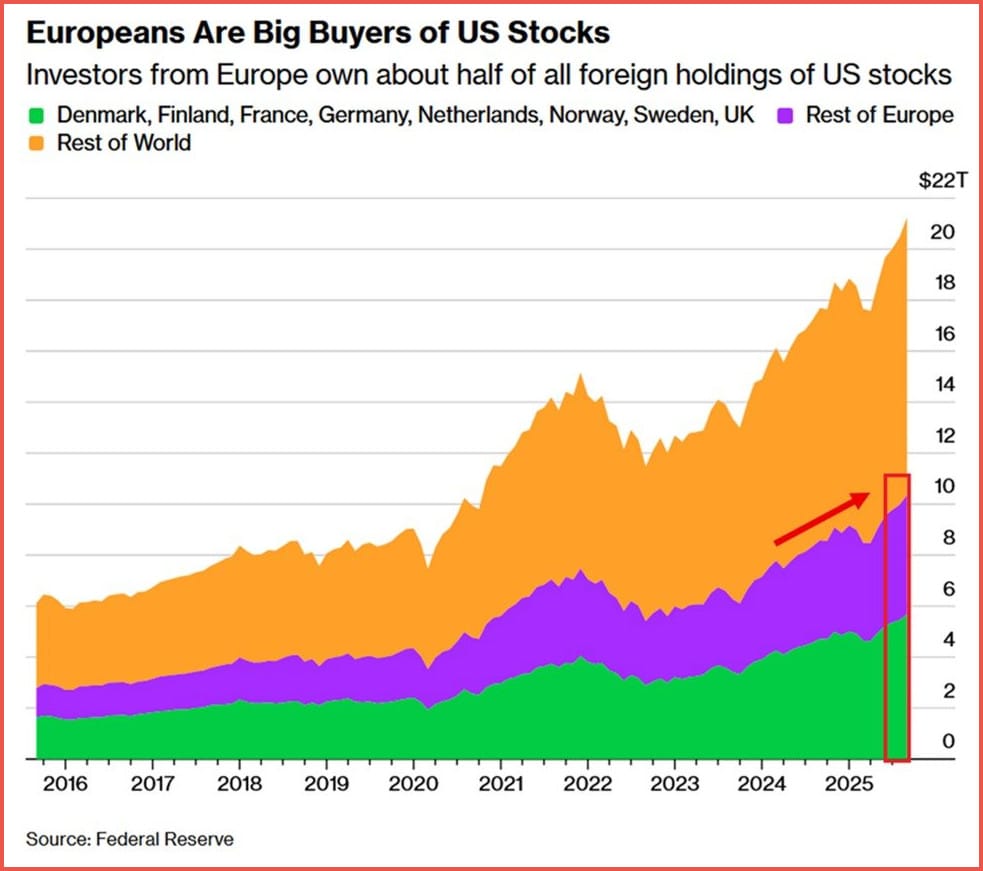
I. Europe Is Piling Into U.S. Stocks
European investors now hold a record $10.4 trillion in U.S. equities, nearly doubling (+91%) in three years. Major European countries account for about 55% of Europe’s U.S. equity holdings, meaning Europe represents roughly half of all foreign ownership of U.S. stocks. The surge underscores how U.S. markets continue to attract global capital—even amid trade tensions.
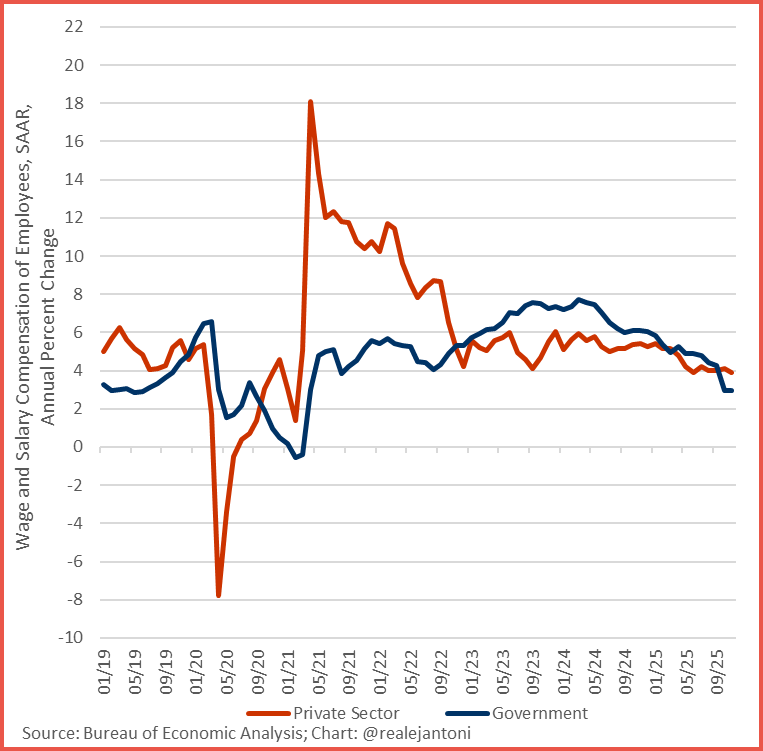
II. Private-Sector Wage Growth Is Pulling Ahead of Government Pay
The chart shows wage growth in the private sector once again outpacing that of government employees. After moving closely together in recent years, private-sector pay gains have edged ahead, pointing to stronger labor demand and compensation pressures outside government. The trend supports the idea that economic momentum is increasingly being driven by the private sector.
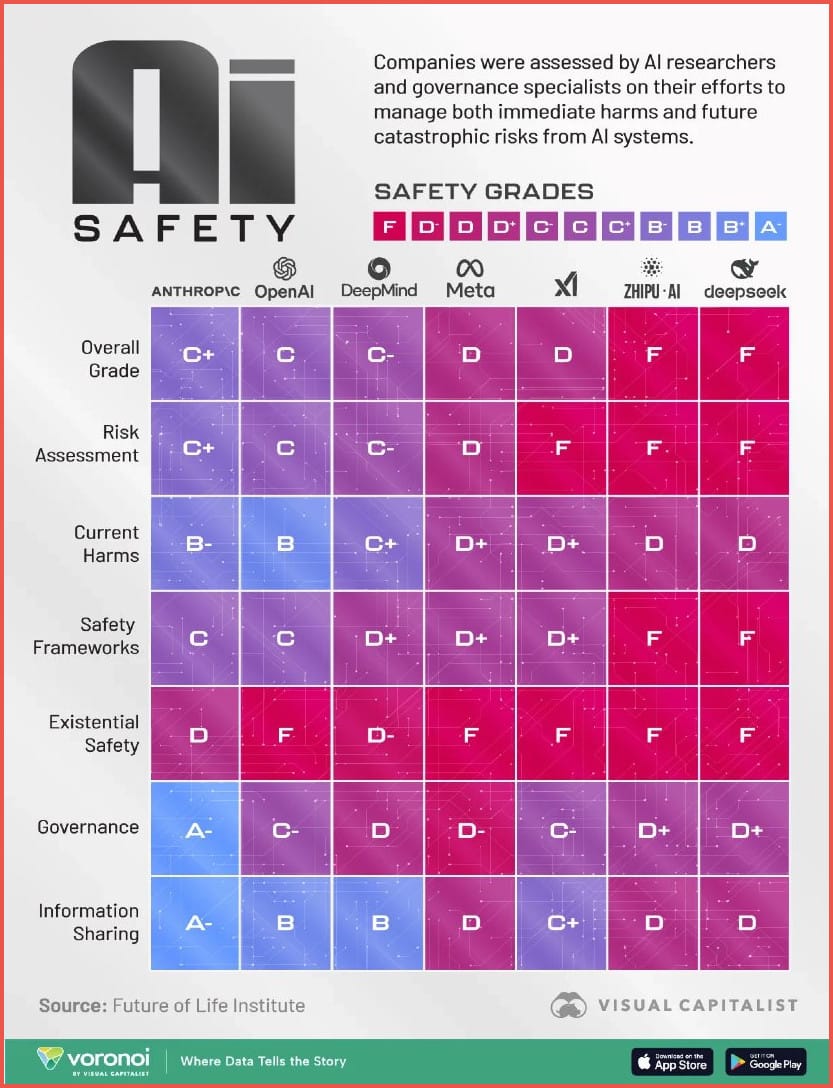
III. Most Big Tech Firms Score Poorly On AI Safety
An AI safety scorecard shows wide gaps in how leading tech companies manage risks from advanced AI systems. While a few firms score relatively better on governance and information sharing, most receive low marks on existential risk, safety frameworks, and oversight, highlighting how far industry practices lag behind the speed of AI deployment.
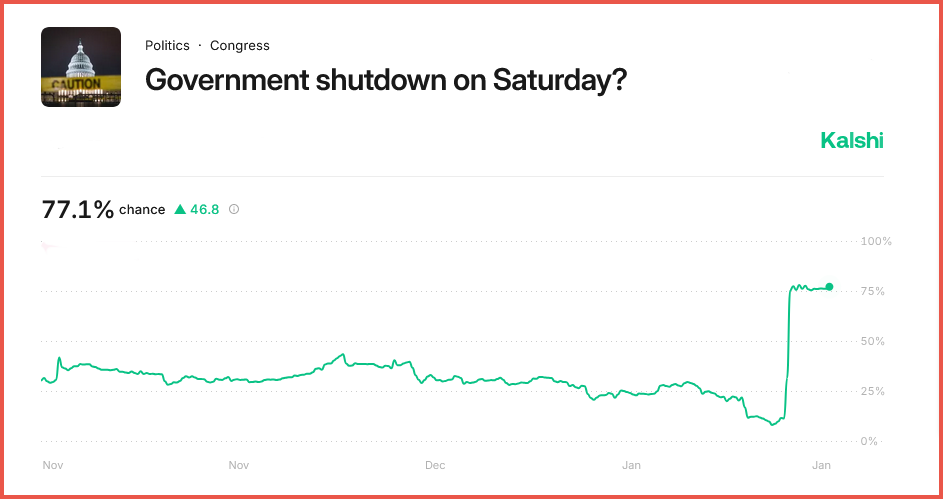
IV. Shutdown Odds Jump As Deadline Nears
Prediction markets have sharply raised the probability of a U.S. government shutdown, now putting the odds at around 77% as the deadline approaches. The late surge reflects growing skepticism that lawmakers will reach a funding deal in time—a familiar pattern in past shutdown standoffs.
📊 Market Mood — Tuesday, January 27, 2026
🟨 Futures Mixed Ahead of Fed & Earnings
U.S. futures search for direction as investors juggle a packed earnings slate and tomorrow’s Fed rate decision, with mega-cap tech providing modest support.
🟥 Shutdown Risk Back on the Radar
Renewed unrest in Minneapolis has reignited government shutdown concerns, though markets remain relatively calm as Washington works toward a last-minute compromise.
🟦 Earnings Season Takes Center Stage
Healthcare, aerospace, autos, and transport names report today, offering early clues on whether the economy’s emerging “K-shaped” divide is deepening in 2026.
🟧 Gold Near Records as Trade Tensions Simmer
Gold hovers near all-time highs as tariff threats, global trade realignments, and Fed uncertainty keep safe-haven demand elevated.
🟩 Oil Slips but Winter Storms Limit Downside
Crude pulls back modestly, though severe U.S. winter conditions and disrupted production are cushioning losses.
🗓️ Key Economic Events — Tuesday, January 27, 2026
🟩 10:00 AM — Consumer Confidence (Jan)
A key read on household sentiment and spending intentions, offering insight into the resilience of consumer demand amid political and economic uncertainty.
🟧 2:00 PM — President Trump Speaks
Markets will watch closely for signals on tariffs, the Fed, government funding, and foreign policy—any surprises could drive late-day volatility.
editor-tippinsights@technometrica.com