
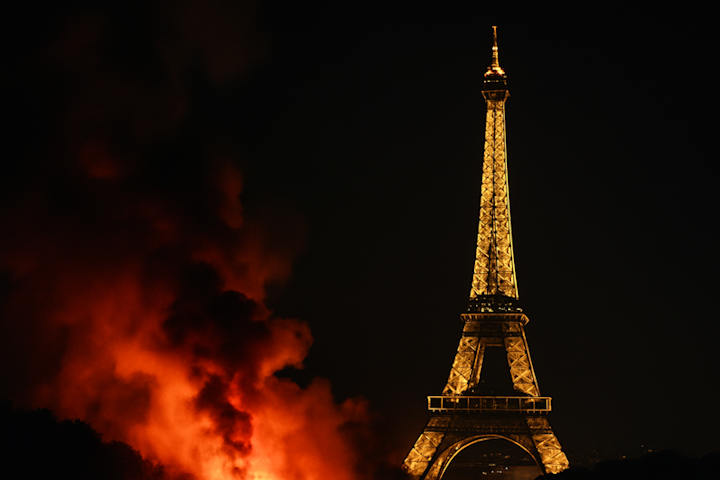
France, a significant economic and geopolitical player in Europe and a permanent member of the UN Security Council, is facing one of its most turbulent periods in nearly 75 years.
A beautiful and wealthy country, France has descended into a textbook definition of chaos as politicians in Paris have focused too much on grand goals, like human rights and freedom, while ignoring the bread-and-butter needs of the country's citizens. The Block-Everything (Bloquons Tout!) protests, a decentralized movement against French governance, demonstrate the widespread dissatisfaction of ordinary citizens with officialdom. The resistance is the result of generations of unsuccessful attempts by French political leaders to compete above their weight class on both the domestic and international stages.
As we have often remarked on these pages, the model of the Democratic Party in the United States since President Obama won in 2008 has been to chase higher levels of the Maslow pyramid of needs while ignoring more fundamental needs of the people. When leaders implement policies that cater to academics in elite college halls while neglecting the basic needs of ordinary citizens, such as food and protection from violent crime, the result is often a political revolt. President Trump won a resounding victory for common sense as the Biden-Harris administration had taken the feel-good ideas of governance too far to the left.
France is in the same boat. The country prides itself on being a democracy, which, by definition, is for the people, of the people, and by the people. The block-everything protests, which have already resulted in more than 500 arrests nationwide as people spar with more than 100,000 police officers around the country, are based on a simple truth. The vaunted principles of freedom and liberty that the French political class claims to uphold are only for the microphones and television cameras. On the ground, politicians are deeply invested in denying the voice of the voters, under the pretext that the political class knows better.
At the heart of this problem is the design of the French government. In 1958, President Charles de Gaulle championed an American-style presidency in France, having admired the leadership of Presidents Truman and Eisenhower during World War II. The Americans teamed up with British Prime Minister Winston Churchill to liberate France, which had then been under Nazi occupation, taking extraordinary risks. The Battle of Dunkirk and the D-Day landings in Normandy demonstrated to President de Gaulle the effectiveness of the executive state, where a single person had the power to implement the will of their administration unconstrained by the laborious process of votes in Parliament.
For nearly 70 years, France has been a beacon of leadership, setting the agenda for Europe at world bodies like the United Nations and the EU. All of this changed in 2016 when people across the English Channel voted for Britain to exit the EU, protesting against the so-called rules-based order in Brussels, a bureaucracy that France had warmly embraced. The Brexit vote was the transatlantic fuel that powered President Trump to an unlikely victory against the doyen of the Democratic Party establishment, Secretary Hillary Clinton, who had been a product of the rules-based order even when she was at Yale Law School. Ordinary citizens were tired of Washington and wanted their government to address immigration, crime, trade imbalances, and censorship of any viewpoint with which the deep state might disagree.
In France, the nationalist party of Marine Le Pen was making inroads to fundamentally change the architecture of the French government, which had become too large and too complacent in its decision-making. Budget deficits rose, and immigration became a flashpoint as France joined Germany in welcoming more than one and a half million refugees from Africa, people who fundamentally changed the social compact that the French government had with its citizens. Long known for its cradle-to-grave benefits, with people working only a 35-hour week and enjoying nearly six weeks of vacation every year, France began to struggle.
As a champion of democracy, France could have listened to Le Pen’s voters, as in the UK and the United States. But the French politicians chose not to do so. Using various parliamentary maneuvers and the court system, President Emmanuel Macron has consistently denied opposition forces the opportunity to take control of the French Parliament or the presidency itself.
The block-everything protests should have occurred in June 2024, at a time when Paris was preparing to host the Olympics. When President Macron's opposition parties won more seats in the EU election than his party, the writing was on the wall. The French people were voting against everything that the Macron administration was doing, including continuing the war in Ukraine, draining the French treasury, and imposing a huge tax on energy (President Macron championed cutting off cheap Russian oil and gas imports into the country).
From Parisian chaos to global shockwaves.
Get the context behind the turmoil—and what it means for markets, policy, and you.
$99/year for unmatched insight.
Rather than bend to the will of the people, President Macron called their bluff and announced parliamentary elections. He calculated that when the voters went to the polls, they would reject the policies promoted by the opposition led by Marine Le Pen. The voters proved President Macron wrong when, in the first round of voting, the conservative parties came in far ahead of his party. The president of France had a crucial choice to make: listen to the people or engage in parliamentary maneuvering to achieve his desired outcome.
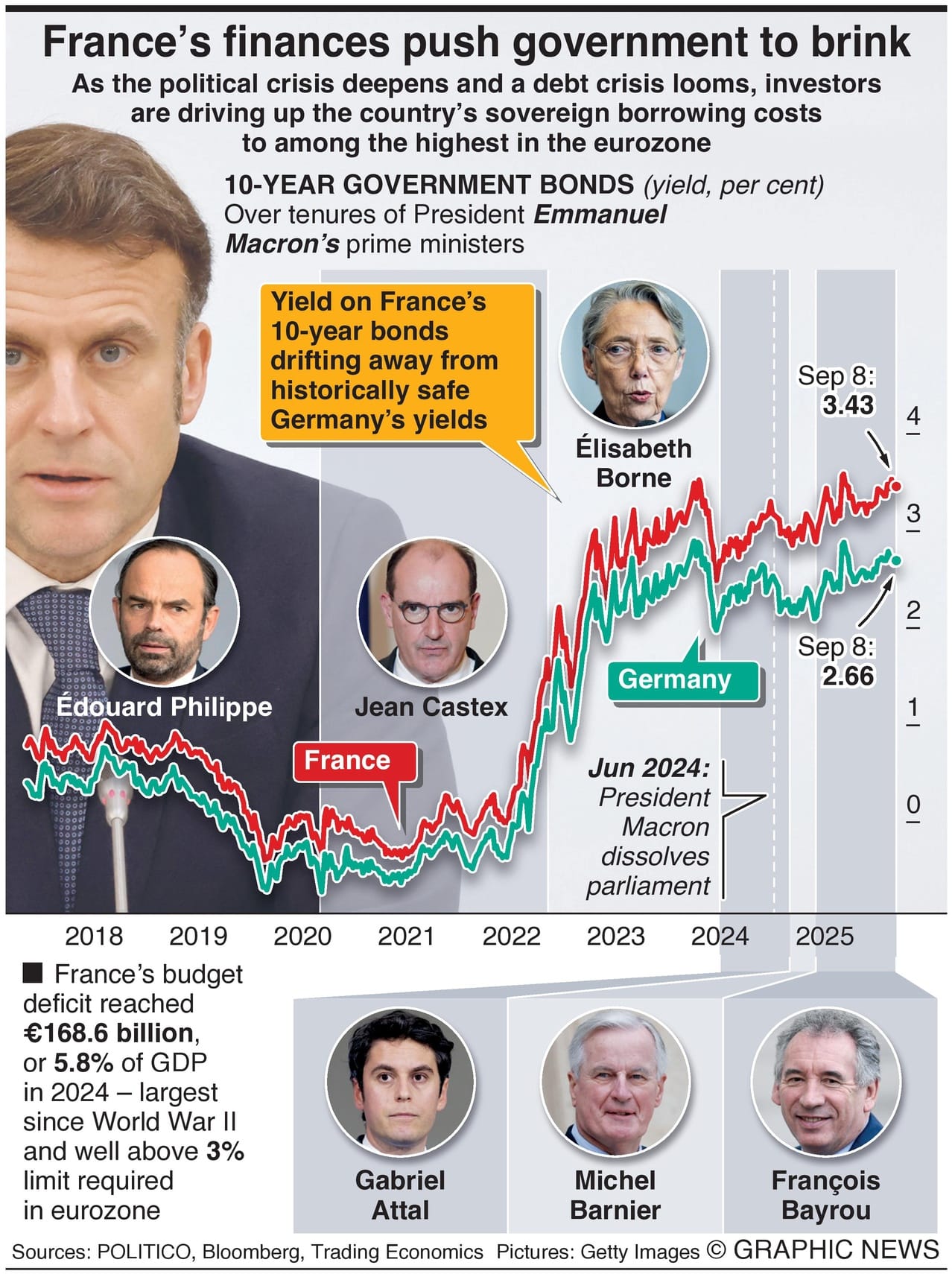
As expected, but completely undemocratically, he again chose the latter. He enabled a parliament made up of coalition parties to take power during the second round. His only condition was that the parties in power not adhere to "right-wing ideologies," even if the people wanted a conservative government. The result has been nothing short of a disaster. In just over a year, France has cycled through four prime ministers — and now a fifth, 39-year-old Sébastien Lecornu, a close confidant of President Macron has also served as the country’s defense minister. The last three and a half years have shown that French leadership in the war between Ukraine and Russia has been a disaster for the history books. Ukraine continues to lose territory, and the EU has inadvertently encouraged the United States to gradually withdraw from the conflict, placing even more responsibilities on the EU, which the union is unwilling and unable to shoulder.
⚖️ France in Political Freefall
Five prime ministers in just over a year:
- Élisabeth Borne (2022–Jan 2024)
- Gabriel Attal (Jan–mid 2024)
- Michel Barnier (mid 2024)
- François Bayrou (late 2024–early 2025)
- Sébastien Lecornu (2025–present)
📌 A revolving door at the top — a symbol of France’s deepening political turmoil
Meanwhile, the French government must address rising deficits, which, at approximately 5.6% of GDP, are nearly double the 3% limit allowed by the EU for its member nations. Any austerity measures — such as requiring the French to work two extra days per year by canceling public holidays — were met with vehement protests. The economy has stalled, and it is becoming more expensive for the French government to finance its debt, with interest costs becoming one of the most crucial budget line items. The war goes on, and people in the French hinterland feel impoverished.
President Macron is not eligible for reelection in 2027 when his term ends. By working with French courts, he has already engineered a solution that prevents the leader of the conservative party, Marine Le Pen, from running for office.
The only way for France to recover from its crisis is to listen to the will of the people at the voting booth. The French elites have shown that they will never do that. The block-everything protests might be forcibly controlled, but the French citizenry will continue to feel cheated by their political class.
📊 Market Mood — Friday, September 12, 2025
🟢 Futures Hold Steady: U.S. stock futures hover near flat after Thursday’s rally pushed all major indexes to record highs, with traders awaiting next week’s Fed decision.
🟡 Adobe Lifts Outlook: Adobe raised its FY25 revenue forecast to $23.65–$23.70 B and EPS to $20.80–$20.85, citing strong demand for its AI-driven creative tools like Firefly.
🟣 Consumer Sentiment Ahead: The University of Michigan’s September survey is due; August fell to 58.2, with inflation expectations still elevated at 4.8% short-term and 3.5% long-term. The RCM/TIPP Sentiment Index had plunged to 48.7, wiping out August’s fleeting rebound above 50.
🔵 Microsoft–OpenAI Deal: The two firms reached a non-binding pact on OpenAI’s for-profit transition; its nonprofit arm will receive $100 B (~20% of its $500 B valuation).
🟤 Oil Slides: Brent dipped to $65.91 (-0.7%) and WTI to $61.92 (-0.7%) on rising U.S. crude stocks and IEA forecasts for faster global supply growth.
Market round-up in 5 minutes. We bring you up to speed. Subscribe to TIPP Insights for $99/year.
📅 Key Events Today
🟨 Friday, September 12
None today