
The World Series is in full swing, and ads from Liberty Mutual featuring LiMu Emu and Doug invariably evoke laughter. All ads end the same way.
If you fast-forward one clip to the 25th second marker, the company’s storied tagline is displayed in its trademark colors: “Only pay for what you need.”
If Obamacare allowed you this simple luxury, all of the Affordable Care Act’s problems would be solved practically in an instant.
When the ACA was passed, former President Obama, former Speaker Nancy Pelosi, and other liberals resorted to a number of clever bait-and-switch tricks to obtain legislative success. Much like credit card companies offering 12 months of no interest payments on new cards, Obamacare sweeteners came first (2010-2013), while the bills came due later (2014 and beyond).
Among those early sweeteners are popular benefits that remain today, such as allowing young adults to stay on parents’ plans until age 26, free preventive services (such as mammograms and colon cancer screenings), protections for pre-existing conditions, and the elimination of lifetime coverage limits.
In their zeal to inch towards universal coverage, Obama and Pelosi also championed the inclusion of 10 categories of EHBs or “Essential Health Benefits” for every individual and small-group health plan. These benefits are mandated by federal law.
Obamacare’s EHB mandates force women who have passed childbearing age and men to pay for maternity and newborn care benefits. In an extreme example of Soviet-style authoritarianism, these enrollees have to pay for female contraception as part of their preventive care.
Couples without children have to pay for pediatric services, including oral and vision care. People who don’t indulge in the use of substances or have this behavior well controlled are forced to pay for disorder services. People who are otherwise physically fit, such as younger adults, have to pay for rehabilitative services and devices. They also have to pay for chronic disease management care.
So, far from “only paying for what you need,” Obamacare enrollees have to pay for things that they may never need.
The rationale behind these EHBs was to prevent what health policy experts called “a race to the bottom, with insurers cutting benefits to lower premiums,” and to establish “a standard” for what constitutes true health insurance.
In a 2017 editorial carried on the website of the National Institutes of Health, Charley Willison and Phillip Singer, then doctoral candidates in the Department of Health Management and Policy, University of Michigan School of Public Health, Ann Arbor, argued forcefully that eliminating EHBs would “revert markets to their pre-ACA state, riddled with low-value plans and limited consumer financial protections.”
Eight years later, we wonder how these experts would react to what is happening today.
According to Cynthia Cox of KFF, a leading health policy nonprofit formerly known as the Kaiser Family Foundation, ACA insurers are raising 2026 premiums by a whopping 26%, with most enrollees expected to be hit by even sharper increases. “In states that use Healthcare.gov, these premiums are rising an average of 30%,” she wrote on the KFF blog this week.
A marketplace with dramatically higher costs risks entering a death spiral, driving costs even higher. Insurers leave, leaving the burden on the few who remain, who can only do so by further raising prices, forcing even more people to exit the ACA.
The New York Times today quoted David Merritt, a spokesperson for the Blue Cross Blue Shield Association, which represents state Blue Cross plans. “The group that is most price sensitive are younger and healthier consumers who might think they don’t need coverage. That leaves older and sicker consumers in the marketplace, and that obviously complicates how they are covered and at what cost.”
Earlier this week, NPR’s Morning Edition featured the story of a healthy 31-year-old, Chloe Chalakani from Thomaston, Maine. “My premium is already $460 a month, and that is for the highest deductible plan that exists,” she said. “I don’t plan to get insurance next year. I’m just not going to do it — I’ll pay out of pocket.”
When the ACA was rolled out in 2010, the individual mandate, which forced everyone to buy into Obamacare or pay a penalty, ensured that death spirals wouldn’t happen. The mandate proved highly unpopular.
On December 22, 2017, President Trump signed the Tax Cuts and Jobs Act, which reduced the penalty to $0 starting January 1, 2019.
One carrot that held the marketplace somewhat together was federal subsidies. The idea here was to bribe healthier adults to stay in the ACA by offering premium discounts. However, a crucial reason the government has been shut down since October 1 is that the parties can’t reach an agreement on the so-called premium credits.
The choice for Congress is stark. Either pay exorbitant amounts to keep the Essential Health Benefits in place. Or eliminate them and embrace the Liberty Mutual model, which allows enrollees to pay only for what they need.
Comparing Obamacare to buying auto insurance is not unreasonable. Forty-eight states and Washington, D.C. require drivers to purchase minimum liability insurance (bodily injury + property damage). Two states, New Hampshire and Virginia, require proof of financial responsibility, such as a bond. In effect, drivers here could be “self-insured,” although most drivers buy insurance anyway.
Congress should think like a smartphone manufacturer. Apple currently sells three iPhone models: the iPhone 17, iPhone Air, and the entry-level iPhone 16e. Apple breaks the iPhone 17 into trim levels—such as the standard iPhone 17, the iPhone 17 Pro, and the iPhone 17 Pro Max—each with different performance and features. Americans are savvy, well-informed consumers, and know exactly what to get when they walk into an Apple store.
Allow them the same choice for healthcare.
More people will then sign up for the ACA. The death spirals will stop. Prices will drop. Subsidies can then be directed to the sick.
Doug and LiMu Emu would wholeheartedly agree.
Rajkamal Rao is a columnist and member of the TIPP Insights Editorial Board. An American entrepreneur, he previously wrote the WorldView column for The Hindu BusinessLine, India’s second-largest financial newspaper. Readers can follow his work and subscribe for free at Rajkamal Rao’s Substack.
TIPP Curated
Handpicked articles from TIPP Insights & beyond
1. Joe Biden Was The Real ‘King,’ Not Trump—Victor Davis Hanson, The Daily Signal
2. Do Californians Realize How Badly They’re Getting Ripped Off?—John Merline, The Daily Signal
3. House Oversight Panel Refers Biden ‘Cover-Up’ To DOJ For Investigation—Sarah Roderick-Fitch, The Daily Signal
4. House Report Concludes That Some Biden Autopen Executive Decisions Should Be ‘Void’—Jarrett Stepman, The Daily Signal
5. American Folklore Is More Than Just Scary Stories; It Carries A Value System—Salena Zito, The Daily Signal
6. What’s The Holdup On Russia Sanctions?—George Caldwell, The Daily Signal
7. France Unveils Bold Plan For State-Backed Bitcoin Strategic Reserve—TIPP Staff, TIPP Insights
8. Trump Admits Constitution Bars Him From Seeking Third Term—TIPP Staff, TIPP Insights
9. Free Speech In Britain—A Visitor’s Snapshot—Simon Hankinson, The Daily Signal
10. Meet Neo: The Humanoid Helper That Has Everyone Talking (And Worrying)—TIPP Staff, TIPP Insights
11. Trump-Xi Meeting Raises Hope For Nvidia’s Return To China Market—TIPP Staff, TIPP Insights
12. U.S. Intel: Putin More Entrenched Than Ever As Trump Pushes For Ukraine Peace—TIPP Staff, TIPP Insights
13. After Trump Pardon, Binance’s Changpeng Zhao Denies Being China’s 13th Richest Man—TIPP Staff, TIPP Insights
14. Which Issues Will Dominate Trump-Xi Talks: Taiwan, Trade, Or Tariffs?—TIPP Staff, TIPP Insights
15. ‘Go Out And Buy Toyota’: Trump Announces Japan’s Major Investment In US Industry—Elizabeth Troutman Mitchell, The Daily Signal
16. What Drove Nvidia To Become The World’s First $5 Trillion Company—TIPP Staff, TIPP Insights
17. Which Sectors Helped Norway’s $2 Trillion Fund Surge In Q3—TIPP Staff, TIPP Insights
18. Netanyahu Orders ‘Forceful Strikes’ In Gaza—Virginia Allen, The Daily Signal
19. Transgender Ideology Is On The Ballot In NJ, VA—Scott Hogenson, The Daily Signal
20. The Pennsylvania Elections That Could Affect Next Year’s Midterms—Jacob Adams, The Daily Signal
21. Two Admit Role In Daring Louvre Heist As Hunt For Missing Jewels Continues—TIPP Staff, TIPP Insights
22. MAGA Makes Allies Great Again—Daniel McCarthy, The Daily Signal
23. The DOJ’s Pharmacy Crusade Will Harm The Patients It’s Meant To Help—George Landrith, The Daily Signal
24. Fed Cuts Rates As Shutdown Hides Full Jobs Picture—TIPP Staff, TIPP Insights
25. DHS Responds To MSNBC Column Claiming ICE Lower Hiring Standards—Virginia Allen, The Daily Signal
26. Video Reports To Show Hamas Orchestrated Discovery Of Hostage Remains—Virginia Allen, The Daily Signal
27. Explosive Report By Virginia AG Exposes Failures Of Soros-Funded Prosecutor—Cully Stimson & Patrick McDonald, The Daily Signal
28. Just How Much Money Did Environmental Groups Pour Into Spanberger’s Campaign?—Tyler O'Neil, The Daily Signal
29, Virginia And New Jersey Candidates Join DNC Rally To Energize Supporters Ahead Of Elections—Virginia Grace McKinnon, The Daily Signal
30. Wisconsin Senator Backs Trump Admin’s Drug Boat Offensive—George Caldwell, The Daily Signal
31. The Real Problem With ‘Toxic Masculinity’—Mark Hancock, The Daily Signal
32. What’s Behind Virginia Democrats’ Push To Change Redistricting Rules Ahead Of Elections—Joe Thomas, The Daily Signal
33. Democrats’ Pervasive Racism And Their Delusion Of Moral Superiority—Stephanie Lundquist-Arora, The Daily Signal
34. Maryland’s Sole GOP Congressman Safe From Redistricting—George Caldwell, The Daily Signal
35. NY GOP Congresswoman Leads Incumbent Democrat For Governor, Poll Finds—Jacob Adams, The Daily Signal
36. Heritage Action President Exposes Democrat Senator’s Attempt to ‘Silence’ Those Who Challenge ‘Radical Climate Agenda’—Tyler O'Neil, The Daily Signal
37. Oh, SNAP: Republicans Try To Fund Food Stamps In Shutdown—George Caldwell, The Daily Signal
📊 Market Mood — Thursday, October 30, 2025
🟩 Futures Slip After Fed and Trade Talks
U.S. stock futures edged lower Thursday as investors digested the Fed’s latest rate cut and comments signaling caution about future easing. The Dow fell 0.2%, the S&P 500 was flat, while the Nasdaq gained 0.6% on Nvidia’s historic rise to a $5 trillion valuation.
🟦 Trump Meets Xi in South Korea
President Trump called his meeting with China’s Xi Jinping “amazing”, hinting a trade deal was near. The U.S. will cut fentanyl tariffs to 10%, while broader tariffs remain near 47%. Beijing will resume U.S. soybean purchases and maintain rare earth supply agreements.
🟨 Fed Flags Uncertainty Ahead
The Fed lowered rates to 3.75%–4.00%, its second straight cut, but Chair Jerome Powell warned it was “navigating in the fog.” Mixed signals on inflation and jobs cloud the outlook, with another December cut now “far from assured.”
🟪 Tech Earnings Drive Sentiment
Meta shares fell after pledging massive AI investments. Google’s profits jumped 33% on strong ad and cloud growth, while Microsoft reported robust AI demand and plans to double its data center capacity. Apple and Amazon report later today.
🟥 Crude Extends Monthly Losses
Oil prices eased, with WTI at $60.14 and Brent at $63.95, both down over 3% in October. Traders now eye the OPEC+ meeting on November 2, where another output hike is expected.
Market round-up in 5 minutes. We bring you up to speed. Subscribe to TIPP Insights for $99/year.
🟨 Key Economic Events — Thursday, October 30, 2025
🟧 8:30 AM — GDP (Q3)
The government releases its first estimate of third-quarter GDP growth, a key measure of overall economic activity. Investors watch this closely for signs of whether the economy is slowing or maintaining momentum after recent rate cuts.
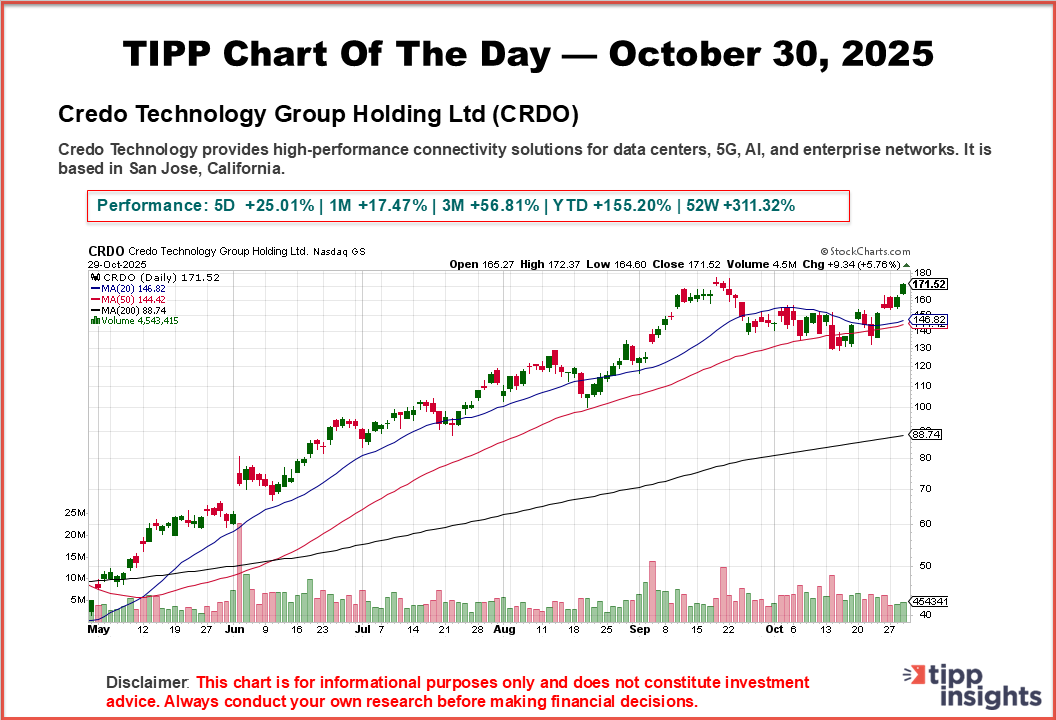
Access our Featured Stocks and TIPP Top-20 archives — exclusive to paid subscribers. Subscribe now → $99/year.