
The French government recently announced that its officials will soon be required to use "Visio," a French-made video conferencing platform, instead of Zoom. The move, framed as an effort to "regain digital independence," epitomizes Europe’s misguided approach to technology. Rather than leveraging global expertise and comparative advantage, France is choosing an expensive, inefficient path that will ultimately harm its own interests while delivering an inferior product to its citizens and officials.
The decision flies in the face of basic economic principles that have underpinned global prosperity for generations. The theory of comparative advantage holds that countries should specialize in what they do best, allowing international trade to flourish and benefiting all parties. Americans happily buy French wine because France excels at winemaking. The French eagerly purchase iPhones because American companies lead in technology innovation. This mutual exchange has created wealth and improved lives on both sides of the Atlantic.

For decades, this theory worked reasonably well in practice, at least on the surface. However, President Trump identified a fundamental flaw in the so-called rules-based international order: it systematically disadvantaged America. Europe enjoyed largely tariff-free access to U.S. markets while maintaining significant barriers to American exports. The European Union routinely levied massive fines against American tech companies and dragged them through protracted legal battles. American diplomacy offered carrots, but there was no stick to end the unfair treatment.
Trump's tariffs, characterized as both reciprocal and retaliatory, aimed to level the playing field and provide American officials leverage against EU actions. While the tariff regime has faced criticism and adjustment challenges, it has benefited the U.S. Treasury and created a more equitable trading relationship. The French government's response, developing its own technology products as a counter to American tariffs, is remarkably short-sighted and demonstrates a fundamental misunderstanding of both economics and technology.
Consider first the naming of France's video conferencing solution: "Visio." One wonders whether the French government bothered to consult Microsoft, which owns the Visio trademark, a diagramming and vector graphics application the company acquired years ago and integrated into its Office suite. This oversight alone suggests a lack of sophistication in the venture.
More significantly, the technological challenge France faces is immense. For all the years Zoom has been available, the platform has performed with remarkable reliability. It seamlessly scales from intimate two-person meetings to massive webinars with ten thousand participants, maintaining crystal-clear audio and video quality throughout. The engineering excellence required to achieve this level of performance represents years of iteration, billions of dollars in investment, and the collective expertise of some of the world's best software engineers.
What is the likelihood that France's Visio will match Zoom's technological excellence? About the same as an Oklahoma winery producing a world-class Chardonnay. It's technically possible, but the odds are vanishingly small, and the investment required would be enormous compared to simply purchasing the proven, existing product.
Then there's the critical issue of network effects. Technology platforms derive much of their value from widespread adoption. Zoom succeeded precisely because the world uses it. Colleagues, clients, friends, and family members across continents can connect effortlessly because they're all on the same platform. Given language barriers and limited governmental reach, Visio's adoption will likely be confined to government agencies in France and perhaps a handful of other Francophone countries. This limited user base means there's no compelling business case for continuous innovation and improvement. Zoom invests heavily in maintaining its technological leadership because its global dominance depends on it. No such incentive exists for France’s Visio, which will serve a captive, mandated user base with little competitive pressure.
The inefficiency multiplies when you consider that France isn't alone in this quixotic quest. If every country develops its own video conferencing platform, users will need multiple applications to communicate with different audiences. France is also considering replacing WhatsApp with its own messaging tool called Tchap. Imagine the absurdity: government officials would need one app to message French colleagues, another for European partners, a third for American contacts, and so on. The result would be chaos, reduced productivity, and frustrated users.
This fragmentation undermines the very purpose of digital communication tools: to connect people seamlessly across borders. We've already seen this problem play out in messaging platforms, where users juggle WhatsApp, Telegram, Signal, WeChat, and others. Extending this fragmentation to government-mandated platforms would create extraordinary inefficiencies and barriers to international cooperation.
The French are justifiably proud of their achievements in cuisine, fashion, culture, and many other domains. But even France cannot excel at everything. Someone needs to deliver this simple truth to the French government: building world-class technology platforms requires not just capital and will, but also the ecosystem, talent pool, and market dynamics that currently exist primarily in the United States and a few other tech hubs.
Rather than wasting taxpayer money on inferior domestic alternatives, France should focus its resources on areas where it genuinely excels. Let American companies provide the technology infrastructure while France invests in domains where it has true competitive advantages. This approach would better serve French citizens, strengthen the transatlantic alliance through mutual economic dependence, and demonstrate that France understands the economic principles it once championed.
Digital sovereignty is a worthy goal in data protection and privacy standards, areas where Europe has indeed led with initiatives such as the GDPR. But building inferior technology platforms in the name of independence is not sovereignty. It's folly dressed up as nationalism. The French government should reconsider this misguided path before it wastes billions on a vain, vanity project.
👉 Show & Tell 🔥 The Signals
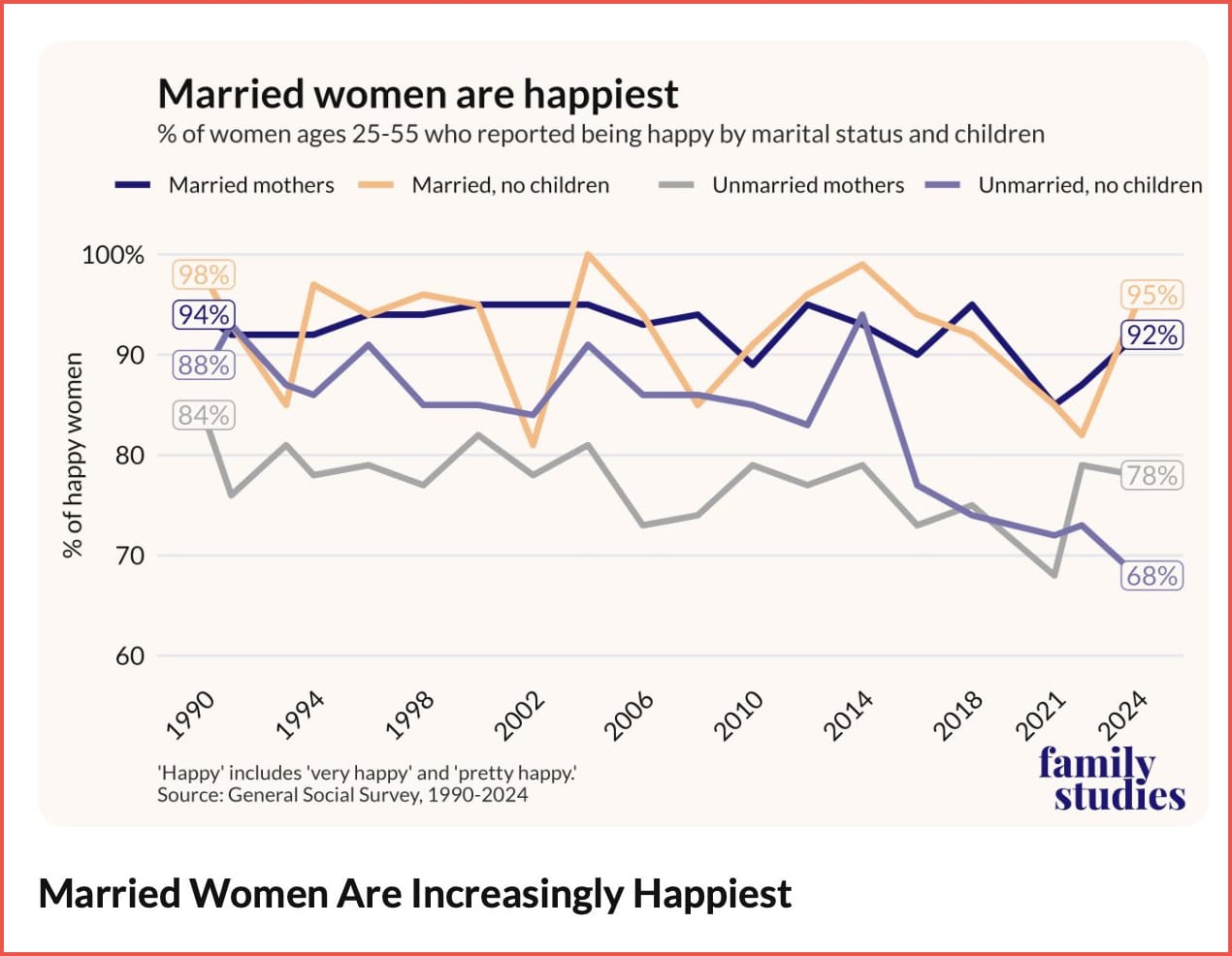
I. Married Women Report The Highest And Rising Happiness
Among women ages 25–55, those who are married consistently report higher happiness than unmarried peers, with the gap widening in recent years. The trend holds whether or not children are present, suggesting marital status—not parenthood alone—is strongly associated with reported well-being.
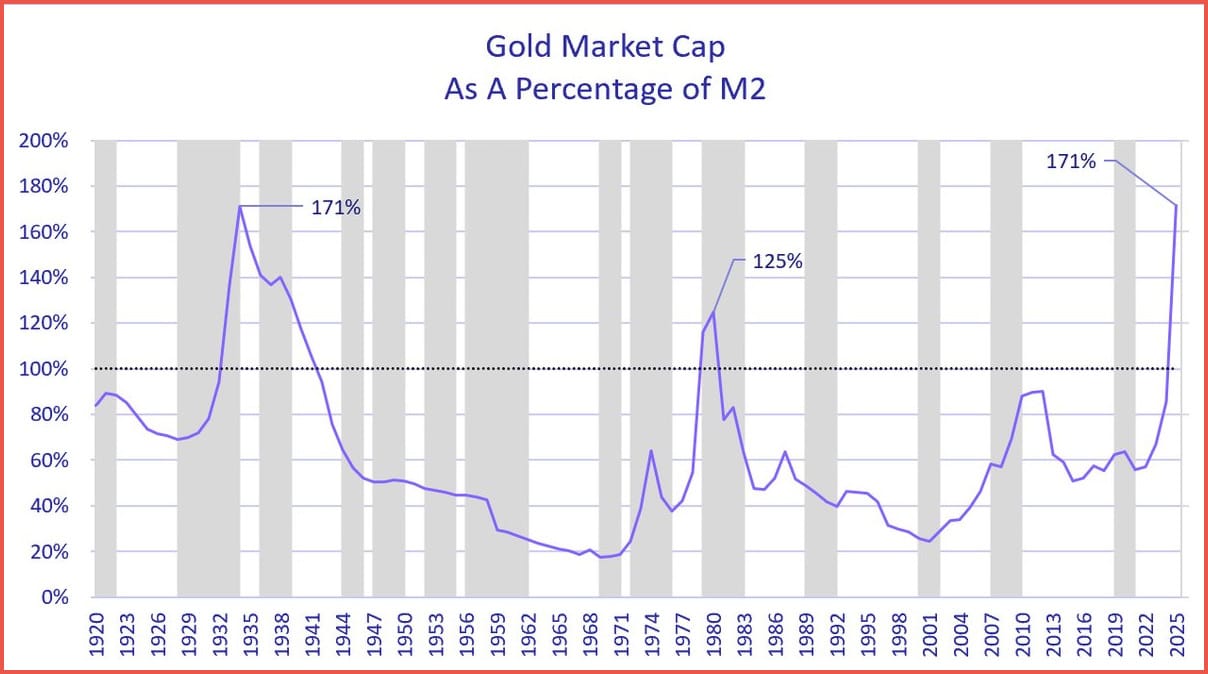
II. Gold Valuation Near Historic Extremes Versus Money Supply
This chart compares gold’s total market value to M2, a broad measure of money in the economy that includes cash, checking accounts, savings accounts, and money-market funds. When gold’s market cap rises sharply relative to M2, it suggests gold is absorbing an unusually large share of available liquidity. As Cathie Wood notes, the ratio has now reached an all-time high—above the peak seen in 1980 when inflation and interest rates surged—raising the odds that gold prices are nearing a turning point.
The TIPP Stack
Handpicked articles from TIPP Insights & beyond
1. Japan’s Crash Is Our Canary In the Coal Mine—Peter St. Onge & EJ Antoni, The Daily Signal
2. The Left’s Search For A New Cause—Ben Shapiro, The Daily Signal
3. Why Did A Judge Block The Arrest Of Don Lemon?—Tyler O'Neil, The Daily Signal
4. Minnesota Leftists Double Down On Anti-Church Protest As Feds Prepare For Arrests—Joshua Arnold, The Daily Signal
5. Johnson Says He’s Measuring GOP’s Success By The Strength Of The American Family—Virginia Grace McKinnon, The Daily Signal
6. Early Look At The House Anti-Sharia Law Caucus’ Priorities Ahead Of First Press Conference—Pedro Rodriguez, The Daily Signal
7. ‘Islamic Extremism Has No Place In Our State’: Texas Reps. Back Abbott As CAIR Plans To Sue—Pedro Rodriguez, The Daily Signal
8. HHS Axes Multimillion-Dollar Blue State Abortion Grant Program—Elizabeth Troutman Mitchell, The Daily Signal
9. Vance Tells Pro-Lifers To Be ‘Prudential’—Elizabeth Troutman Mitchell, The Daily Signal
10. Menger Versus Chartalism: Standards Of Empirical Evidence—Joshua Mawhorter, Mises Wire
11. On The Failure Of Constitutionalism Through The Ages: Norms, Emergencies, And The Administrative State—Joseph Solis-Mullen, Mises Wire
12. Virtuous Market Distribution Vs. Nefarious State Redistribution—Finn Andreen, Mises Wire
13. Using Carl Menger’s Insights To Understand Jew-Gentile Polarizations—Jorge Besada, Mises Wire
From TIPP Insights News Editor
14. Russia Using Starlink To Extend Drone Strikes Into Ukraine
15. What Saudi And Israeli Officials Are Discussing With Trump On Iran
16. China And Britain Signal Long-Term Partnership After Xi-Starmer Talks
17. Italy Pushes Back Against ICE Role At Winter Olympics
18. Why The Federal Reserve Paused Rate Cuts
19. Gold Demand Poised To Stay Strong In 2026, World Gold Council Says
20. Why China Is Moving To Curb AI Job Displacement Risks
21. AstraZeneca Commits $15 Billion To China In Major Expansion Plan
22. Shutdown Talks Intensify As White House, Senate Race Deadline
23. Washington Post White House Team Pushes Back On Planned Layoffs
24. Shutdown Risk Grows As Democrats Demand ICE Changes
25. Senate Democrats Demand Noem Testify Over ICE, CBP Killings
📊 Market Mood — Friday, January 30, 2026
🟥 Futures Slide on Fed Chair Uncertainty
U.S. futures retreat as markets brace for President Trump’s expected nomination of a new Fed chair, with Kevin Warsh emerging as the frontrunner and reviving rate-path uncertainty.
🟩 Apple Delivers, iPhone Demand Roars
Apple posts its strongest iPhone growth in four years and guides higher, signaling resilient consumer demand despite supply-chain constraints.
🟧 Fed Independence Back in Focus
Speculation around a Warsh appointment cools risk appetite, rekindling concerns over Fed independence after weeks of political pressure on Chair Powell.
🟦 Shutdown Averted, Tail Risk Removed
A last-minute deal in Washington avoids a government shutdown, easing one key macro overhang—at least temporarily.
🟨 Gold and Oil Pull Back from Extremes
Safe-haven trades unwind as gold and silver retreat from record highs, while oil slips modestly but remains on track for strong weekly gains amid Iran risks.
🗓️ Key Economic Events — Friday, January 30, 2026
🟧 08:30 AM — PPI (MoM) (Dec)
Wholesale inflation gauge that feeds into future consumer price pressures and shapes Fed expectations.
🟨 09:45 AM — Chicago PMI (Jan)
A regional manufacturing barometer offering an early read on U.S. factory activity and momentum.
editor-tippinsights@technometrica.com