
By Michael R. Strain, Project Syndicate | March 26, 2026
As AI advances, societies must consider how to strike a balance between the disruption caused by rapid productivity growth and its many benefits, including rising incomes and living standards. Fortunately, most advanced economies are well equipped to absorb the shocks associated with breakthrough technologies.
WASHINGTON, DC – Since OpenAI’s ChatGPT burst onto the scene in late 2022, economists and commentators have been discussing generative AI’s possible effects on productivity. But from a cultural and political perspective, it is useful to ask a normative question: How much productivity growth should society desire?
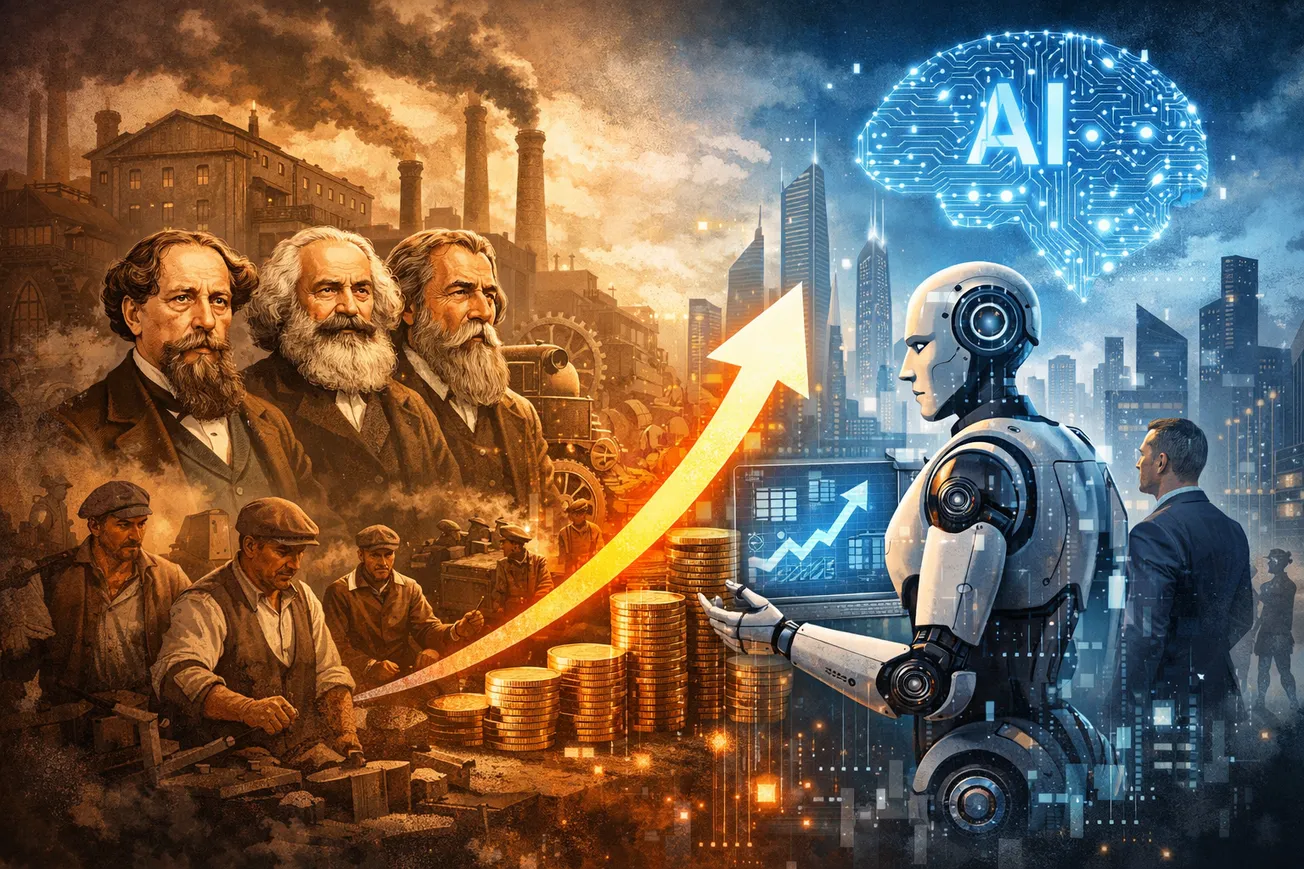
The economic disruption that accompanies rapid productivity growth can be wrenching. The British Industrial Revolution, for example, led to stagnant or declining average wages in at least the last two decades of the 18th century, with some economists arguing that it took several more decades for industrialization to raise typical workers’ living standards. Meanwhile, real wages plummeted in some occupations, and many laid-off workers struggled for years to find jobs. The social consequences were enormous. People flocked to crowded cities without clean water and adequate sanitation. Disease was rampant. Factory employment was hazardous. Workers were agitated.
It is no surprise that Oliver Twist and The Communist Manifesto were published a decade apart, during this period of upheaval. Charles Dickens was a great critic of Victorian London’s poverty, workhouses, and poor sanitation. Karl Marx schlepped through the streets of Dickens’s London, often studying in the reading room of the British Museum, directly observing how technology was shaking society to its core.
When Marx and Friedrich Engels wrote in 1848 that “constantly revolutionizing the instruments of production” caused changes in “the whole relations of society,” they were not theorizing; they were describing what they saw out their window. “All that is solid,” they wrote, “melts into air.”
At the same time, because output per worker is the key driver of long-term living standards, it is tempting to argue that we should want productivity to grow as rapidly as possible. Rising living standards mean new and better medicines, safer workplaces, longer lives, and more leisure time.
Know someone who should be reading TIPP Insights? Forward this email. Sponsor inquiries: editor-tippinsights@technometrica.com
Seemingly small changes to growth rates can have a huge economic impact. Productivity growth was around 3% at the peak of the 1990s digital revolution, compared to roughly 1.5% following the 2008 global financial crisis. The former rate would double Americans’ standard of living in 24 years, while the latter rate would double it in 47 years.
Finding the right balance between the damage from economic and social disruption and the benefits of rapidly rising productivity and living standards requires considering three key questions.
First, citizens and policymakers must decide their optimality criterion. Is the goal to make aggregate economic output grow as quickly as possible? Or is the aim to increase incomes at a rapid pace while preventing a jump in poverty or long-term unemployment? Or perhaps they want to pursue an entirely different approach, like attempting to forecast all possible outcomes and using economic policy to improve the worst one.
A second consideration is the living standard of future generations. Many people in the American Rust Belt would likely have preferred a slower rate of productivity growth over the past several decades, which would have blunted the impact of manufacturing-job losses.
At the same time, all of us alive today should be glad that our lives are much better than they would have been if our forebears had slammed on the brakes during, say, the Second Industrial Revolution beginning in the late 19th century, which introduced electrification, the telegraph, blast furnaces, and mass production.
The final consideration is the pace of technological advance: The faster it improves, the greater the social instability and the harder it is for laid-off workers to find new jobs. While 18th-century Britain was not ready for the rapid adoption of mechanized factory production, I would argue – controversially, to be sure – that the United States managed the pace of change during the late-20th-century information age relatively well. Will the AI revolution be more like the former or the latter?
Part of the reason the US handled technological change at the end of the last century better than Britain did in the late 1700s is that there were improvements in economic policy, including the development of the social safety net and expanded access to education. With these policies in place, the US, the United Kingdom, and other advanced economies are much better equipped to manage even extremely rapid technological change.
Given this, I hope that the AI revolution ushers in substantial increases in trend productivity growth. The benefits of productivity growth as rapid as 5% or 6% – much faster than the 3% pace of the internet boom – would clearly outweigh the costs, given our system’s ability to absorb and address the consequent disruption.
“Creative destruction” creates as well as destroys. While US politics is drenched in nostalgia for an imagined halcyon past, few people would actually turn back the clock to the 1970s if given the choice. And the same will be true of people one, two, and three decades from now – and beyond.
Michael R. Strain, Director of Economic Policy Studies at the American Enterprise Institute, is the author, most recently, of The American Dream Is Not Dead (But Populism Could Kill It) (Templeton Press, 2020).
Copyright Project Syndicate
Catch up on today’s highlights, handpicked by our News Editor at TIPP Insights.
1. Israeli Strike Eliminates Iranian Commander Linked To Hormuz Blockade
2. Iran Moves To Charge Ships For Strait Of Hormuz Passage
3. Gulf States Warn Iran, Signal Readiness For Self-Defense
4. Report Says Pentagon Considers Redirecting Ukraine Aid To Middle East
5. Trump Says Iran Allowed Oil Ships As ‘Present’ To U.S.
6. Global Growth At Risk If Oil Stays Above $100, EBRD Warns
7. What Is In The EU-U.S. Trade Deal Approved By European Parliament
8. Senate Bill Targets Ban On Prediction Markets Nationwide
9. Trump Administration Rejects Elon Musk Plan To Pay TSA Workers During Shutdown
10. What Does The Latest Jobless Data Say About U.S. Economy
editor-tippinsights@technometrica.com