Editor’s Note:
Pegah Banihashemi is a constitutional law scholar at the University of Chicago Law School whose work focuses on power structures and political change in the Middle East. Her analysis centers on how Iran’s legal and security institutions are holding up under sustained pressure. While she takes a skeptical view of U.S. strategy under Donald Trump, the piece is most valuable for what it reveals about conditions inside Iran.
By Pegah Banihashemi, Project Syndicate | April 3, 2026
The sustained US-Israeli attacks on Iranian infrastructure have left the country’s legal system without functional enforcement mechanisms. Regardless of whether the Islamic Republic collapses or endures, the country is likely to face a prolonged period of instability.
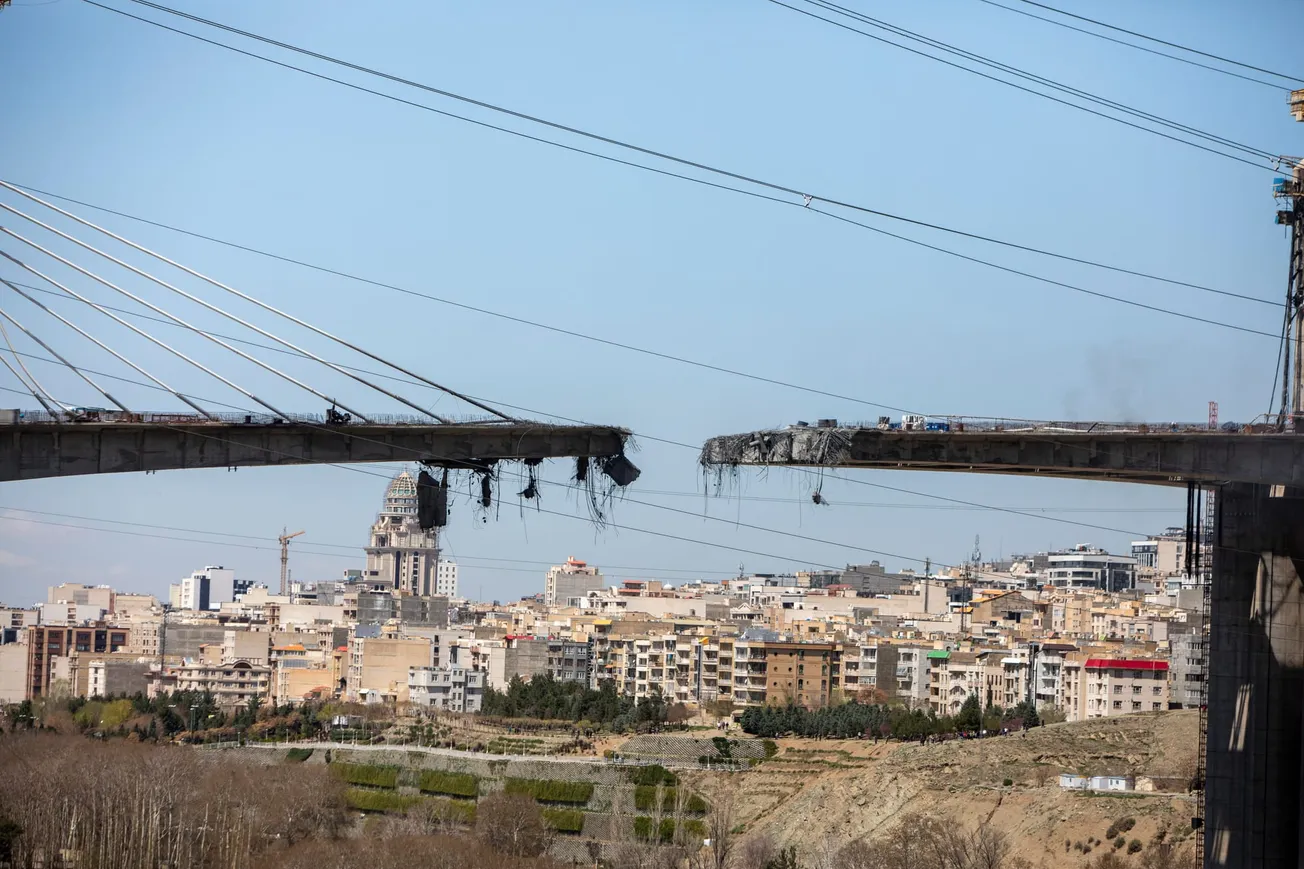
CHICAGO – More than one month has passed since the United States and Israel launched a joint war against Iran. While US President Donald Trump has been groping for an exit strategy, airstrikes on major cities and government, military, and infrastructure targets continue apace, and look set to escalate in the coming weeks.
The effects of this sustained assault have varied. Key Iranian officials have been killed. The status of the new supreme leader, Mojtaba Khamenei, is unknown, as he has not made any public appearances or statements in recent weeks. Other high-ranking leaders—such as Mohammad Bagher Ghalibaf, speaker of the Iranian parliament—appear to be playing a central role in managing the Islamic Republic’s affairs.
Despite extensive damage to police stations, courthouses, and other administrative buildings, the regime’s security apparatus, including the Islamic Revolutionary Guard Corps and the volunteer Basij forces, remains intact and in control over the country. In urban areas, they have established checkpoints across major streets. (Reports that they are recruiting children as young as 12 to assist with checkpoints and patrol duties raise serious legal and human-rights concerns.)
Moreover, political activists are still being arrested, and several individuals have been executed following convictions for charges related to espionage and national security. These developments suggest that even under wartime conditions, the government has continued to use coercion to preempt dissent.
In the same vein, the regime has severely restricted internet access from the war’s earliest days, leaving satellite links as the only reliable connection to the outside world. Security forces have also reportedly prohibited Iranians from photographing and documenting destruction. Government-affiliated individuals, on the other hand, appear to have privileged access to unfiltered communication tools through so-called “white SIM cards,” which allow them to disseminate official narratives on social media.
Know someone who should be reading TIPP Insights? Forward this email. Sponsor inquiries: editor-tippinsights@technometrica.com
Within Iranian society, a visible divide has emerged. Some citizens, fearing continued escalation, worry about the collapse of essential services such as electricity and water. Others, however, view the war as a potential pathway out of authoritarian rule and are willing to endure hardship for a chance at political change. There is, however, little indication that the Iranian leadership is preparing to retreat or relinquish power.
Perhaps most concerning is the condition of Iran’s legal and institutional frameworks. Over roughly the last two weeks of March, the country celebrated Nowruz, the Persian new year, a time when public offices and schools close (this year, many educational institutions were already shut or operating online because of the war). During this period, Israeli and US missiles rained down on civilian infrastructure, including universities.
Now that the holiday period has ended, Iranians must return to offices and classrooms. Courts, police, and public authorities must resume functioning. But many of these institutions no longer physically exist or have been severely damaged. While laws remain formally valid, the bodies responsible for enforcing them have been dramatically weakened. To be sure, many existing laws lack legitimacy among large segments of the population, particularly those opposed to the current political system. But meaningful legal reform is unlikely, so long as the regime survives.
The more likely outcome, assuming the continuation of the regime and an eventual move toward negotiations, is that these institutional weaknesses produce harsher internal policies. Historically, the Iranian state responds to periods of vulnerability with intensified repression. In this case, the authorities, lacking enforcement capacity, may try to reassert control through increased reliance on loyalist forces and expanded surveillance. This could further empower regime supporters while leaving civilians and dissenters increasingly exposed.
But if sustained external pressure leads to systemic collapse or severe dysfunction, the risks are equally significant. The breakdown of central authority would likely create an institutional and legal vacuum. As competing political actors fought for supremacy, police stations and courts could be abandoned or overtaken, creating an environment of near-total impunity. Until a new governing structure emerged, such a transition would almost surely cause disorder, fragmentation, and uncertainty.
In both scenarios, Iran is likely to face a prolonged period of instability, rather than an immediate transformation. Iran’s experience during its eight-year war with Iraq in the 1980s is a sobering precedent. The state demonstrated its capacity to impose brutal internal controls during wartime and to ramp up repression once it ended. This suggests that whatever the regime’s final status, Iranians face heightened coercion, if not institutional breakdown.
The question is not simply whether the regime will collapse or endure. Either way, Iran’s fragmentated society is staring down the barrel of a profoundly disrupted legal and institutional order that is now at risk of being weaponized or disappearing altogether.
Copyright Project Syndicate
Pegah Banihashemi is a constitutional law scholar at the University of Chicago Law School and a human rights law instructor whose work focuses on power structures and political change in the Middle East.
1. Trump Threatens Strikes On Iran Infrastructure
2. China And Europe Push For Iran War De-Escalation
3. U.S. F-15 Jet Crash: One Crew Saved, Search Continues For Other Pilot In Iran
4. Search Underway For American F-15 Downed In Iran
5. What Did Trump Say About Taking Iran’s Oil
6. Cuba Frees Over 2,000 Prisoners Amid U.S. Pressure
7. China Rocket Launch Fails After Flight Anomaly
8. Hegseth Eases Rules On Personal Guns For Troops
9. Trump Mail-In Ballot Order Sets Up Battle With States
10. What Is Included In Trump’s 2027 Budget Plan
11. Why Was The U.S. Army Chief Asked To Step Down
12. U.S. Jobs Rebound Strongly In March
13. AI Boom Drives China Semiconductor Growth
14. NASA-Artemis II Mission: Stunning Earth Photos Captured From Space
editor-tippinsights@technometrica.com