
Some of us are old enough to remember Matthew Lesko, the lanky, fast-talking late-night TV pitchman who promised people free government money to those who bought his books.
There are, Lesko said in one of his countless ads decades ago, “15,000 programs you can use to get a better job, get an education, or start your own business. Those who know about the programs are the ones who get the money!”
Lesko was right about how easy it is to get taxpayer money.
What Lesko didn’t say is that it’s easy to do even when it violates the law — especially if you live in a state run by Democrats.
Minnesota, of course, has been the epicenter of fraud stories these days, after the scale of the swindle became apparent. Not only did those committing fraud make off with billions, but fraudsters funneled at least some of that money into political campaigns to effectively buy lawmakers’ silence.
But Minnesota is hardly the only place where scammers have gone way beyond what Matthew Lesko promised in his books.
As Charles Silver and David Hyman note in the City Journal,
Frauds against government health-care programs are both common and costly. Fraudsters routinely scam (Medicare and Medicaid) for billions of dollars. States themselves run schemes of their own. COVID-related frauds, for example, exceeded $280 billion, with another $123 billion wasted or misspent. Obamacare enrollment fraud is pervasive, likely costing taxpayers $27 billion in 2025 and $21 billion in 2024.
California is under federal criminal investigation for wasting $37 billion to fight homelessness. It lost $20 billion in COVID-19-related federal unemployment money — the most of any state. Nearly half of the state’s increase in Medicaid spending went to pay for health care for illegal aliens. And it’s under investigation to see where the $4 billion in federal money for California’s never-ending bullet train project ended up.
Fox News reports that the Education Department found that “during a 12-month period between 2024 and 2025, scammers stole at least $10 million in federal financial aid from community colleges in California.”
Recently, three people in Brooklyn were found guilty of stealing $68 million from New York’s Medicaid program in a con that lasted seven years before they were caught.
The government routinely reports that Medicaid annually wastes 6% of benefits to errors and fraud, which works out to more than $37 billion. But that’s likely a vast understatement.
It’s worth noting that Medicaid fraud isn’t a universal problem – but one that tends to flourish in blue states. The Cato Institute’s Chris Edwards notes that “New York State spends two and a half times more on Medicaid than Florida, even though the latter has a larger population.”
Why is it so easy to steal from the federal government? Because, unlike a private business, nobody in government really cares if money is wasted. Who has lost their job after some major scam was uncovered?
Plus, as we pointed out in this space, fraud is good for big-government types because it creates new constituents and new sources of campaign cash.
The answer to this problem isn’t just to unleash armies of auditors and federal police. It’s to close the spigot entirely.
The federal government spends more than $3.6 trillion on what it calls “direct payments for individuals” and another $833 billion in grants to states that are supposed to end up in individual pockets.
That’s about two-thirds of the entire federal budget!
As long as there’s that much money flying around, fraudsters will flourish. And taxpayers will be bilked.
— Written by the I&I Editorial Board
Trump Warns Iran As U.S. Military Builds Up In Gulf
President Trump warns Iran that “time is running out” to strike a nuclear deal as the U.S. deploys what he calls a “massive armada” amid a tense standoff.
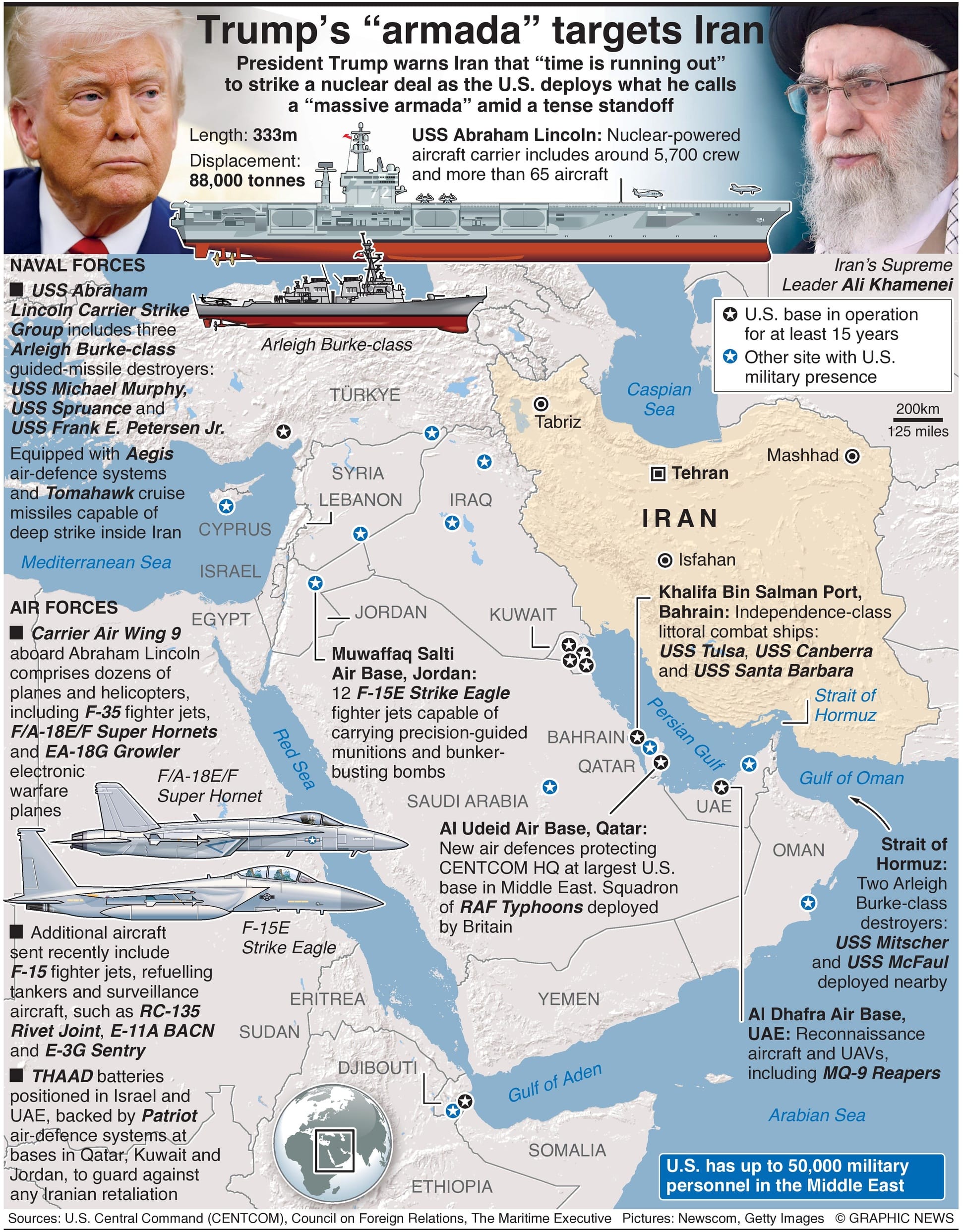
U.S. President Donald Trump has intensified his pressure on Iran’s leadership, warning that “time is running out” for Tehran to agree to a new nuclear deal and signaling that military action remains a possibility as a large U.S. naval force moves into the Middle East.
In a message posted on his Truth Social platform, Mr. Trump said a “massive armada,” led by the aircraft carrier USS Abraham Lincoln and accompanying warships, is en route toward Iran and could act swiftly and forcefully if necessary.
Iran’s government responded with defiance. Top Iranian officials have said they would retaliate “like never before” against any U.S. attack and reiterated that negotiations under the threat of force are unacceptable.
The standoff comes amid continued international concern over Iran’s nuclear ambitions and growing tensions following a violent crackdown on domestic protests.
Tight Budget Slows Russian Military Spending
Russia’s defense industry will slow dramatically in 2026, with military spending to be reined in as the economy feels the effects of the four-year war with Ukraine and falling oil revenues.
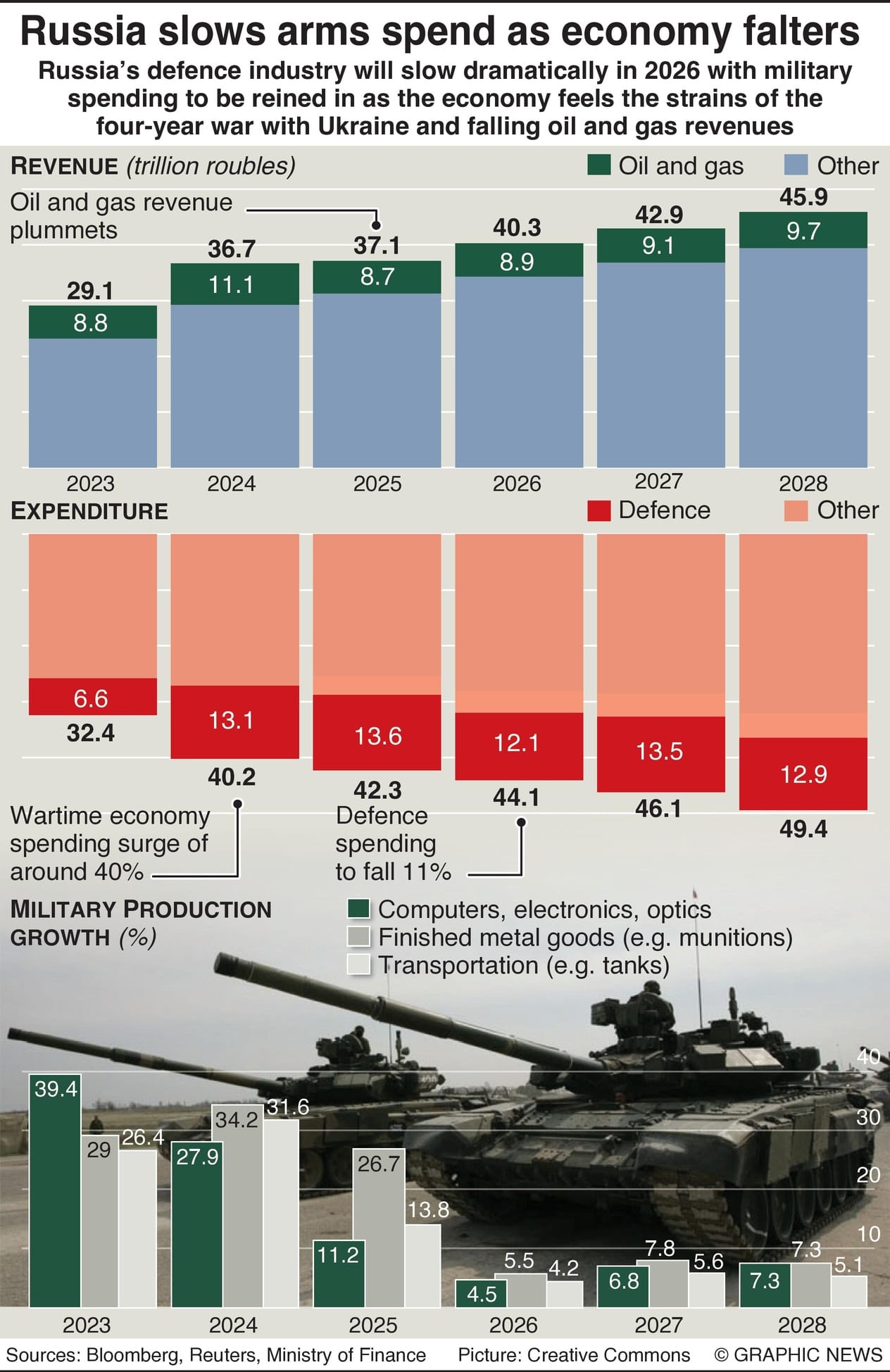
Russia's revenues from its oil and gas industry fell to a five-year low in 2025 as oil prices slumped, gas exports declined, and energy sanctions against Russia took effect. The country pulled in 8.48 trillion rubles in oil and gas taxes last year, 24% less than in 2024 and the lowest since the start of the decade.
In 2025, Russian defense spending amounted to 7.3% of GDP, including 6.2% for “national defense” and 1.8% to “national security”. While overall expenditure is expected to rise in line with inflation, military spending, driven by the war in Ukraine, is set to fall this year by almost 11% after a surge in 2022.
Catch up on today’s highlights, handpicked by our News Editor at TIPP Insights.
1. Russia Using Starlink To Extend Drone Strikes Into Ukraine
2. What Saudi And Israeli Officials Are Discussing With Trump On Iran
3. China And Britain Signal Long-Term Partnership After Xi-Starmer Talks
4. Italy Pushes Back Against ICE Role At Winter Olympics
5. Why The Federal Reserve Paused Rate Cuts
6. Gold Demand Poised To Stay Strong In 2026, World Gold Council Says
7. Why China Is Moving To Curb AI Job Displacement Risks
8. AstraZeneca Commits $15 Billion To China In Major Expansion Plan
9. Shutdown Talks Intensify As White House, Senate Race Deadline
10. Washington Post White House Team Pushes Back On Planned Layoffs
11. Shutdown Risk Grows As Democrats Demand ICE Changes
12. Senate Democrats Demand Noem Testify Over ICE, CBP Killings
editor-tippinsights@technometrica.com