Editor’s Note:
TIPP Insights highlighted the strategic importance of the Suwałki corridor in a 2022 editorial, warning that this narrow land link between Poland and Lithuania is NATO’s most vulnerable access point to the Baltic states. The following article revisits why this corridor remains central to Europe’s security debate, as Lithuania now moves to strengthen defenses in the region.
By Agnia Grigas, Project Syndicate | Feb 12, 2026
If NATO is serious about managing the Russian threat identified in its own strategy documents, it must focus its efforts where deterrence is most fragile. Lithuania's plans for a new training ground near the Suwałki corridor are thus a test case for assessing US and European resolve.
VILNIUS – In response to intensifying Russian activity along NATO’s eastern flank, the US Congress recently approved $200 million in security assistance for Estonia, Latvia, and Lithuania. By preserving the US Baltic Security Initiative despite earlier efforts within the Pentagon to eliminate it, the new measure (signed into law on February 3) underscores congressional concern about NATO’s eastern border. But appropriations alone do not guarantee deterrence. The question now is how the renewed commitment will be implemented on the ground, particularly in places where the alliance is most exposed.
Few regions will test NATO’s resolve more severely than southern Lithuania, along the narrow land corridor connecting Poland to the Baltic states. Lithuania’s decision to build a new military training polygon near Kapčiamiestis – close to the Suwałki corridor between Belarus and Russia’s Baltic Sea exclave – offers a timely test of whether US support and European statements add up to genuine readiness along NATO’s eastern flank.
As a security analyst who has written about these risks for more than a decade – and now lives in Vilnius, the Lithuanian capital – this debate is not merely theoretical for me. It is about whether NATO is taking deterrence seriously in the place where it will be tested first.
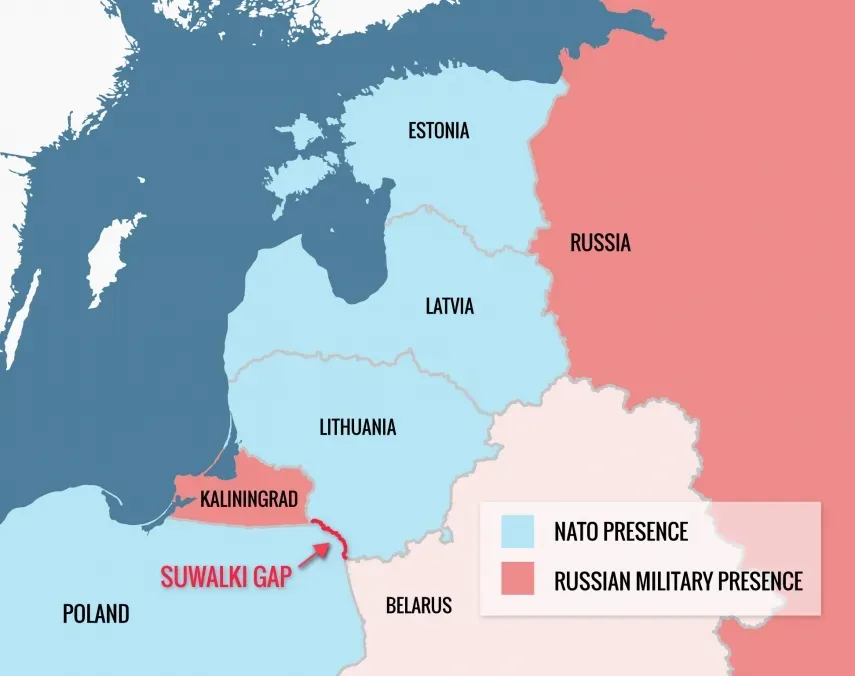
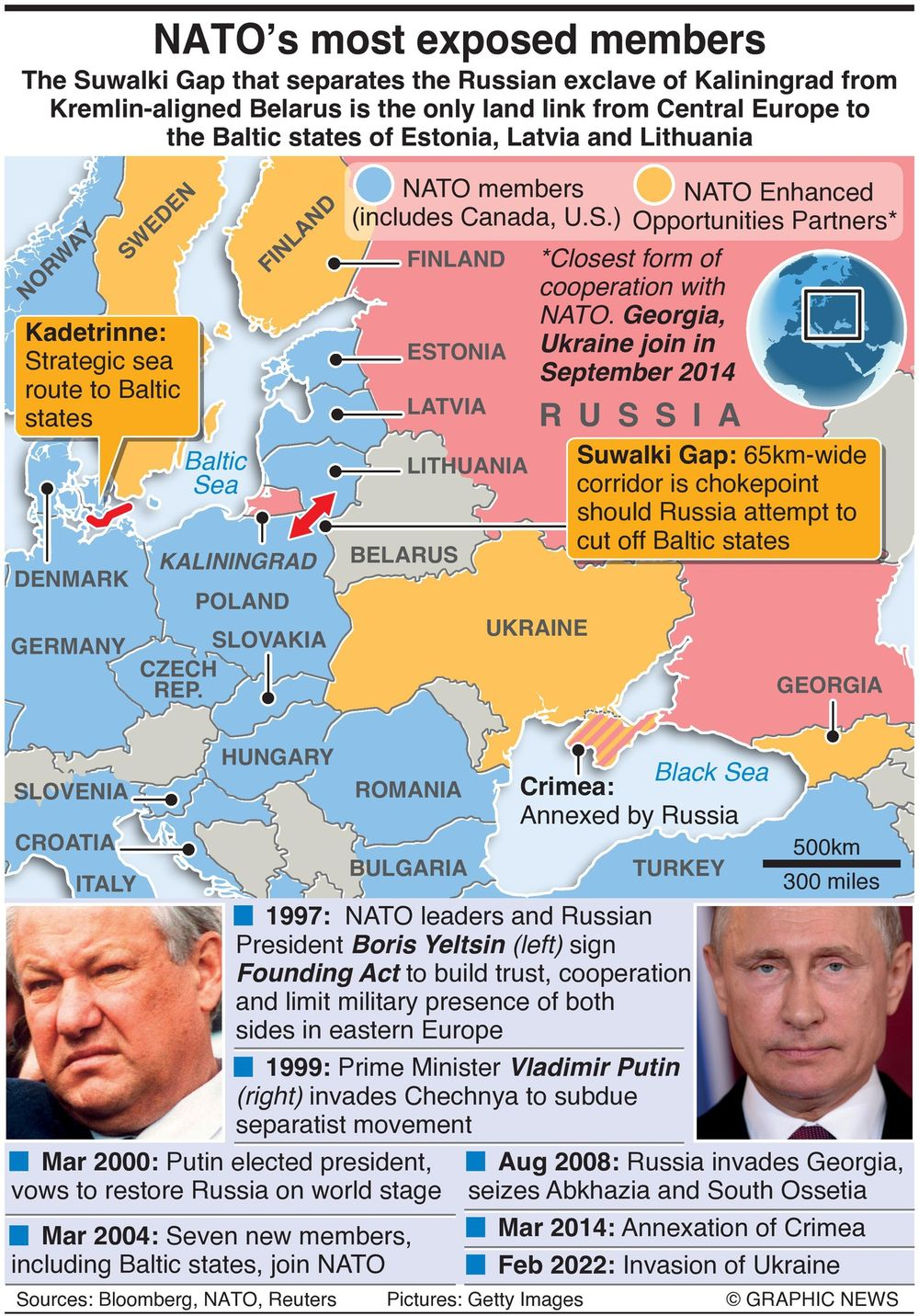
The Suwałki corridor is NATO’s only land route linking Poland to Lithuania, Latvia, and Estonia. Roughly 40 miles wide, it sits between Russia’s heavily militarized Kaliningrad Oblast and Belarus, which, since Russia’s full-scale invasion of Ukraine, has become a de facto forward-operating platform for the Russian military. In a crisis, control of the corridor would determine whether NATO could reinforce the Baltic states by land, or whether these allies would be cut off. For years, it has featured prominently in alliance planning precisely because it combines strategic importance with geographic vulnerability.
Lithuania’s planned training site near Kapčiamiestis reflects this reality. The country’s other two main training areas – Pabradė, which regularly hosts rotational US Army units, and Gaižiūnai, near Rukla, the home to Germany’s forward-deployed brigade – are used intensively but are geographically distant from the Suwałki region. By contrast, Kapčiamiestis allows for battalion- and brigade-level maneuvers, live-fire drills, and reinforcement training on terrain that mirrors where NATO would face its most direct challenge. Hence, Polish defense officials have also expressed an interest in training there, reflecting Poland’s broader push to strengthen deterrence along NATO’s eastern flank.
The military pressures on the corridor are no longer hypothetical. Kaliningrad hosts elements of Russia’s Baltic Fleet, advanced air-defense systems, and nuclear-capable Iskander missiles. To the southeast, Belarus has hosted Russian troops, aircraft, and missile systems since 2022. Together, these positions compress NATO’s room for maneuver at precisely the point where the alliance’s land connectivity is most fragile.
Of course, Lithuania’s decision has sparked debate at home – as expected in a democratic society. Local communities have raised concerns about land use, the environmental impact, and disruptions to daily life. These worries deserve attention, but they also must be weighed against the fact that delays are costly in this security environment. As Lithuania’s chief of defense, Raimundas Vaikšnoras, acknowledged, “we live in a liberal society where people have different opinions, but the security situation means this polygon is inevitable – the question is no longer whether it will be built, but when.”
This tension between democratic processes and strategic urgency is not unique to Lithuania. Whereas Russia makes its military plans on the basis of terrain and timelines, democracies must plan with an eye toward maintaining legitimacy and alliance cohesion. The challenge, then, is to ensure that openness and debate do not become vulnerabilities that adversaries can exploit.
In this context, allied recognition may matter as much as allied resources. Visible NATO engagement – particularly a US acknowledgment of the site’s strategic importance – would reinforce deterrence, signal unity, and help situate the project within a broader alliance framework. Lithuania is not asking others to defend it alone. It is leading the investment in its own defense, consistent with the burden-sharing demands that the United States has made in recent years. Even the most recent US National Defense Strategy states plainly that “Russia will remain a persistent but manageable threat to NATO’s eastern members for the foreseeable future,” placing greater responsibility on European allies.
The greatest risk along NATO’s eastern flank is ambiguity. Deterrence does not erode when defenses are visible, but when preparation lags behind threat recognition, and when political resolve appears uncertain. Training gaps, untested reinforcement routes, and ambiguous signaling create openings that adversaries can exploit without crossing the threshold of open conflict.
The implications are clear. If NATO is serious about managing the Russian threat identified in its own strategy documents – and highlighted repeatedly in reporting on Europe’s security – it must focus its efforts where deterrence is most fragile. The Kapčiamiestis polygon is not merely a local training ground. It is a measure of whether the alliance can turn commitments into capability, and align strategy with geography, before a crisis forces its hand.
Agnia Grigas, a senior fellow at the Atlantic Council, is the author of Beyond Crimea: The New Russian Empire (Yale University Press, 2016) and The Politics of Energy and Memory Between the Baltic States and Russia (Routledge, 2014), and has written on NATO’s eastern flank for more than a decade.
Copyright Project Syndicate
Catch up on today’s highlights, handpicked by our News Editor at TIPP Insights.
1. Ukraine-Russia Peace Talks Resume As War Nears Fifth Year
2. U.S. Boosts Naval Presence Amid Iran Nuclear Dispute
3. Fishing Boat Seizure Sparks New China Japan Standoff
4. China Growth Outlook Dims As Provinces Slash Revenue Plans
5. CIA Latest Outreach Campaign Looks To Recruit Chinese Officers
6. Why Analysts Are Flagging Political Bias In Chinese AI Systems
7. Kim Jong Un Chooses Teen Daughter As Heir
8. Trump Administration Ends Qatar Route For Venezuela Oil Funds
9. Homicide Rates Fall In Many Major U.S. Cities
10. U.S. Customs Duty Revenue Hits Record $288 Billion
11. Gen Z Redefining Winter Olympics
12. Small Business Tax Burden Varies Widely By State
13. NASA Sends Astronauts To Reinforce Understaffed Space Station
14. Inflation Cools As CPI Rises 2.4 Percent
15. Senate Report Says Some Trump Deportations Cost Over $1 Million Per Migrant
16. What The New Trump Lawsuit Against Harvard Is About
17. Why Chocolate Prices Are Spiking This Valentine’s Day
editor-tippinsights@technometrica.com