

By Yi Fuxian, Project Syndicate
The logic behind China’s family-planning policies was always suspect, as were the data that convinced officials to keep them in place long after it should have been clear that they had failed. The history of the 35-year one-child policy highlights a fatal flaw in Chinese governance, for which the country is paying a steep price.
MADISON – January 1 marked a decade since China repealed its one-child policy. Just ten days before, Peng Peiyun, who long oversaw the often-brutal enforcement of China’s family-planning rules, died at the age of 96, having never been held accountable for her actions. Some obituaries praised Peng for being “reform-minded,” even though, in practice, she only perpetuated an utterly inhumane policy, whose consequences have barely begun to materialize.
It was Vice Premier Chen Muhua who first proposed the one-child policy in 1979, with the endorsement of China’s then-top leaders, Chen Yun and Deng Xiaoping, as a means of avoiding the grain shortages they wrongly believed loomed. But it was not until the following year, after missile scientist Song Jian and economist Tian Xueyuan warned that China’s population was on track to reach 4.26 billion by 2080, that they decided to implement it.
Given the skepticism of some senior leaders toward the proposal, it was announced and introduced not through legislation, but through an “open letter.” A two-child policy was also piloted in multiple regions starting in 1985.
Get unmatched China analysis. Subscribe to TIPP Insights for $99/year.
After the 1989 Tiananmen Square protests, Song, who had by then been promoted to State Councilor, convinced China’s newly appointed president, Jiang Zemin, to strengthen the one-child policy. Within two years, the fertility rate fell below replacement level (2.1 births per woman). But far from ending the policy, Peng, in her capacity as head of the National Population and Family Planning Commission, expanded the “one-vote veto” system, which directly tied officials’ career prospects to family-planning outcomes.
This motivated authorities throughout China to embrace increasingly brutal tactics. When Shandong province carried out its ruthless “Hundred Childless Days” campaign in 1991, rounding up women and subjecting them to forced abortions or induced labor, Peng praised its efforts and urged others to emulate them. Within her tenure (1988-98), 110 million women received intrauterine devices, 41 million were sterilized, and 110 million underwent abortions – often coerced. Overall fertility dropped from 2.3 births per woman in 1990 to 1.22 in 2000, at which point there were only 40% as many six-year-olds as ten-year-olds in Shandong province.
Peng continued to receive promotions. In 1998, she became Vice Chairperson of the National People’s Congress and Chair of the All-China Women’s Federation, whose local cadres assisted with family-planning enforcement. In 2001, together with Jiang Zhenghua, another Vice Chairperson of the National People’s Congress, she persuaded President Jiang to enact the Family Planning Law in 2001, ending the “illegal” status of the policy. (Before 2001, not only the one-child policy but the entire family-planning policy, including the two-child and three-child policies of the 1970s, were “illegal.”)

Crucially, Peng also served as President of the China Population Association from 1994 to 2007, and Honorary President in 2007-18 – a position that enabled her to ensure that China’s demographic research was ideologically correct, rather than factually accurate. For example, though the 2000 census showed a fertility rate of only 1.22, the figure was revised upward to 1.8. After all, as Yu Xuejun, the spokesman for the National Population and Family Planning Commission, pointed out in 2007, a fertility rate of 1.2 would render family-planning policies unnecessary.
When observers credit Peng as a reformer, they typically refer to the proposal on loosening the one-child policy that she submitted in 2004 on behalf of official demographers. But the proposal called for the gradual rollout of a two-child policy, not an accelerated rollback of family-planning rules. It defended this position with dubious figures: the authors added over 26 million people to the population determined by the 2000 census, revised the fertility rate upward (from 1.2 to 1.6), and warned that a universal two-child policy would push China’s population beyond the “alert line” (1.6 billion).
This assessment contrasted sharply with mine. In 2000-07, I published a series of articles, reports, and a book predicting that even if family-planning controls were abolished, fertility would not reach the replacement level before beginning to fall again, reaching 1.47 births per woman in 2023. China’s population, moreover, would peak below 1.4 billion. But far from heeding my warnings, decision-makers banned my book.
Predictably, fertility rates continued to decline, and officials continued to revise them upward. For example, the rate of 1.18 births per woman shown by the 2010 census was later revised to 1.63. Meanwhile, senior family-planning officials such as Yu Xuejun and Zhai Zhenwu recommended that the Politburo “earnestly maintain a low birth rate.”
But my projections proved prescient, so in 2012, the government invited me to publish a 50,000-word report that would be circulated only among China’s top leaders. Again, however, my estimates clashed with the inflated forecasts of official demographers, 17 of whom asserted, inexplicably, that allowing two births per household nationwide would cause the fertility rate to surge beyond 4.4 births per woman. The government went with their assessment, implementing the two-child policy selectively in 2014.
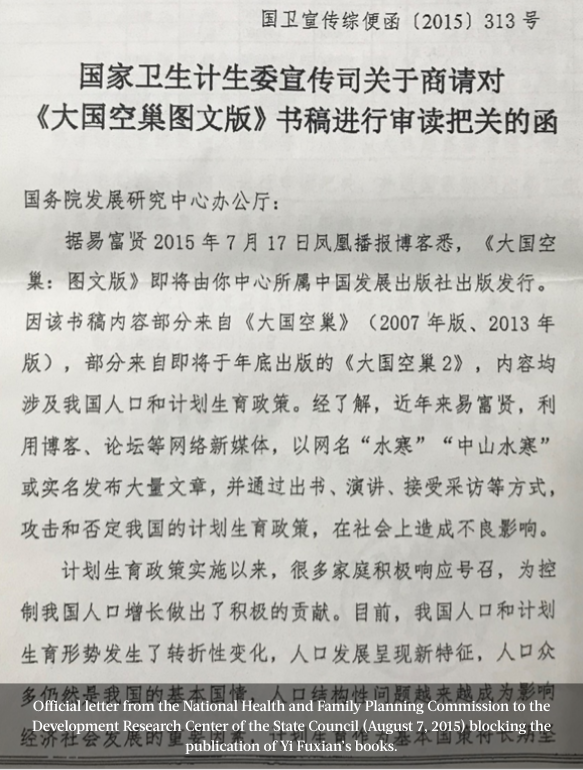
Once that policy, too, proved a failure, a publisher under the Chinese State Council scheduled to publish a new edition of my book, and a “Special Forum on Population Policy,” focusing on my findings, was planned. But the National Health and Family Planning Commission was not having it and sent an official letter to block the book’s release. It was only in 2016 – when official forecasts predicted that fertility would stabilize at 1.8 births per woman through 2030 before the population began to decline – that the two-child policy was implemented across the country.
While Peng did engage in some self-reflection in her later years, even inviting me to meet with her (I declined), the damage was done. Officials now acknowledge that the population began shrinking in 2022, and the 2025 fertility rate probably amounted to just 0.9 births per woman. Demographic collapse is a distinct possibility.
This saga exemplifies a fatal flaw in Chinese governance: the failure of policies backed by high-level officials can be obscured for far too long, not least through wrong or manipulated data. It stands in stark contrast to the experience of democratic India, where Prime Minister Indira Gandhi imposed coercive family-planning measures in 1975, only to be voted out – with the policy quickly abolished – two years later.
Yi Fuxian, a senior scientist at the University of Wisconsin-Madison, spearheaded the movement against China’s one-child policy. His book Big Country with an Empty Nest (China Development Press, 2013), initially banned, now ranks first in China Publishing Today’s 100 Best Books of 2013 in China.
👉 Quick Reads
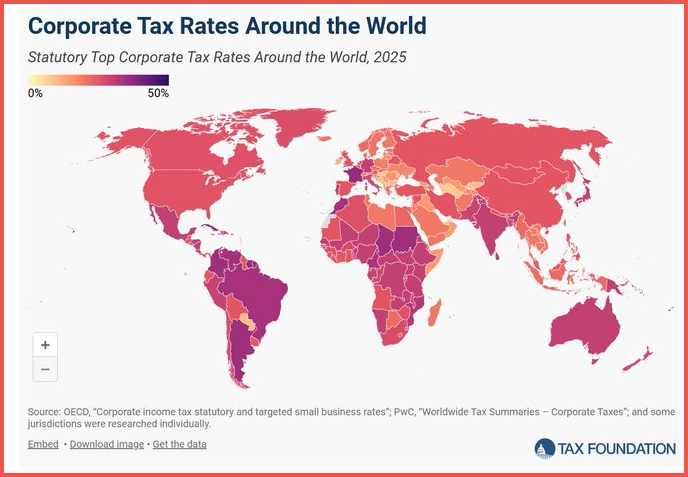
I. Global Corporate Tax Lines Are Hardening
The world is splitting into clear tax camps. Ireland and Hungary continue to court capital with ultra-low rates, the U.S. and Switzerland sit in a competitive middle ground, while France, Germany, Brazil, and Colombia anchor a growing high-tax bloc that increasingly tests investment tolerance.
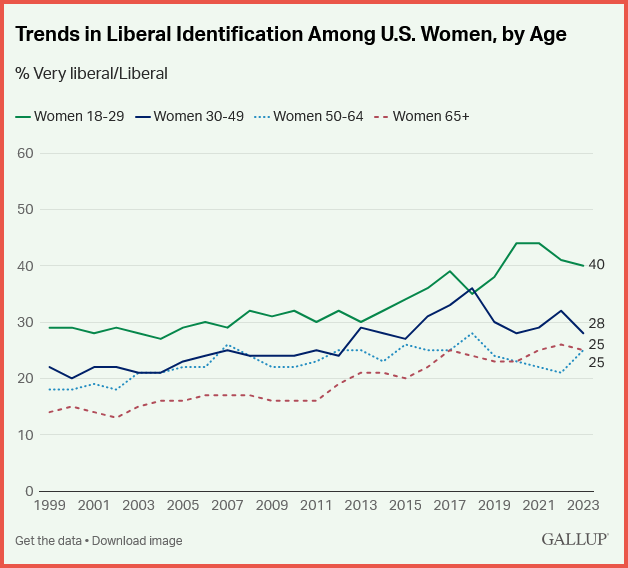
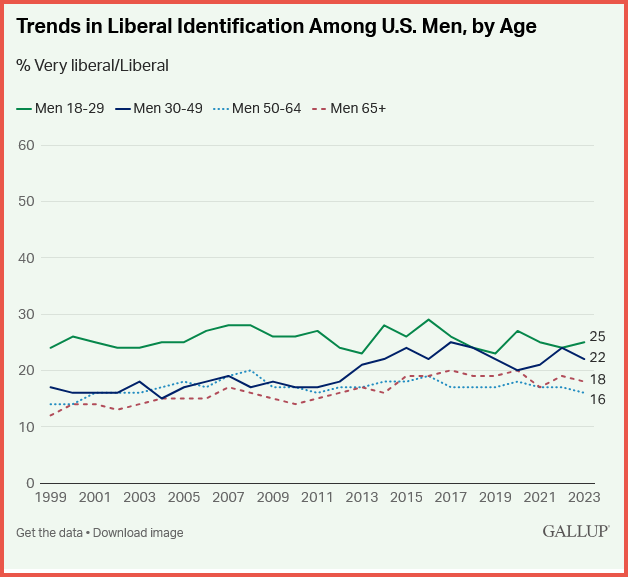
II. America’s Liberal Shift Is Being Driven By Young And Senior Women
The charts below show that liberal identification has surged among women at both ends of the age spectrum. Since 1999, women aged 18 to 29 and women 65 and older have each become 11 points more likely to call themselves liberal, while men in the same age groups have changed little, making women the primary engine behind the nation’s long-term ideological drift. More here.
The TIPP Stack
Handpicked articles from TIPP Insights & beyond
1. If The Old Guard Destroys Bari Weiss, Legacy Media May Finally Die—Mike Gonzalez, The Daily Signal
2. Socialism Versus Capitalism—John Stossel, The Daily Signal
3. The Monroe Doctrine In An Era Of China And Russia—Editorial Board, TIPP Insights
4. The Day The Monroe Doctrine Went Kinetic—Larry Kudlow, TIPP Insights
5. The Trump Doctrine In Venezuela—Richard Haass, Project Syndicate
6. Lack Of Trust In Media Continues As Perceived Bias, Ideology Divide Readers: I&I/TIPP Poll—Terry Jones, TIPP Insights
From TIPP Insights News Editor
7. U.S. Moves To Seize Venezuela-Linked Oil Tanker: Report
8. U.S. Military Captures Russian-Flagged Venezuelan Oil Vessel
9. Trump Says U.S. To Take 30-50 Million Barrels Of Oil From Venezuela Under New Plan
10. China Weighs Next Move After Trump’s Venezuela Operation
11. Venezuelans Fear What Comes Next After Maduro Capture
12. Venezuelan Migrants In U.S. Face Deportation Uncertainty After Maduro Capture
13. Taiwan's Opposition Party Warns Venezuela Precedent Aids China
14. Energy Secretary Signals Path To Expanded Venezuelan Oil Output
15. GOP Sen. Rand Paul Pushes Back On Greenland Military Option
16. Denmark, Greenland Seek Urgent Talks With Rubio Over Trump Remarks
17. Global Trust In U.S. Dollar Tested After Venezuela Action
18. Warner Bros. Discovery Says No To Paramount Bid
19. Private Sector Added 41,000 Jobs In December 2025: ADP Report
20. Explicit Grok Images Expose Legal Gaps In AI Accountability
📊 Market Mood — Thursday, January 8, 2026
🟩 Futures Slip Ahead of Jobs Data
U.S. futures edge lower as investors brace for Friday’s nonfarm payrolls report.
🟧 Policy Shockwaves Linger
Trump’s housing and defense mandates weigh on sentiment, highlighting a more interventionist White House.
🟦 Samsung Lights Up AI Chips
Samsung forecasts a blowout quarter as AI-driven memory shortages send profits surging.
🟪 China Chips Catch a Bid
Chinese semiconductor stocks rally on reports Beijing may pause Nvidia H200 orders.
🟫 Bitcoin Breaks Below $91K
Crypto slips as geopolitical risks and jobs data keep traders on the sidelines.
🗓️ Key Economic Events — Thursday, January 8, 2026
🟧 8:30 AM ET — Initial Jobless Claims
A weekly snapshot of labor-market conditions ahead of Friday’s closely watched nonfarm payrolls report.
editor-tippinsights@technometrica.com