
Editor's Note
Since this survey was completed, President Trump has announced a two-week ceasefire with Iran tied to reopening the Strait of Hormuz. The pause may ease immediate tensions, but it does not resolve the divide captured in this poll
As President Trump gears up to put even more pressure on what remains of Iran’s regime, do Americans support the Iran war? According to the latest I&I/TIPP Poll, nearly half of all Americans do, but an equal share don’t, with political affiliation seemingly the deciding factor in whether one supports or opposes the conflict.
I&I/TIPP’s national online poll of 1,464 voters was taken from March 31 to April 2, and has a margin of error of +/-2.7 percentage points.
The public opinion survey asked participants three questions about the Iran war, which has now lasted just over a month. The first question: “Do you support or oppose the United States military action against Iran?”
Overall, opinion was sharply and evenly divided, with 45% saying they either support it “strongly” (25%) or “somewhat” (21%), while 45% also said they opposed it either “strongly” (29%) or “somewhat” (16%). Another 10% were unsure.
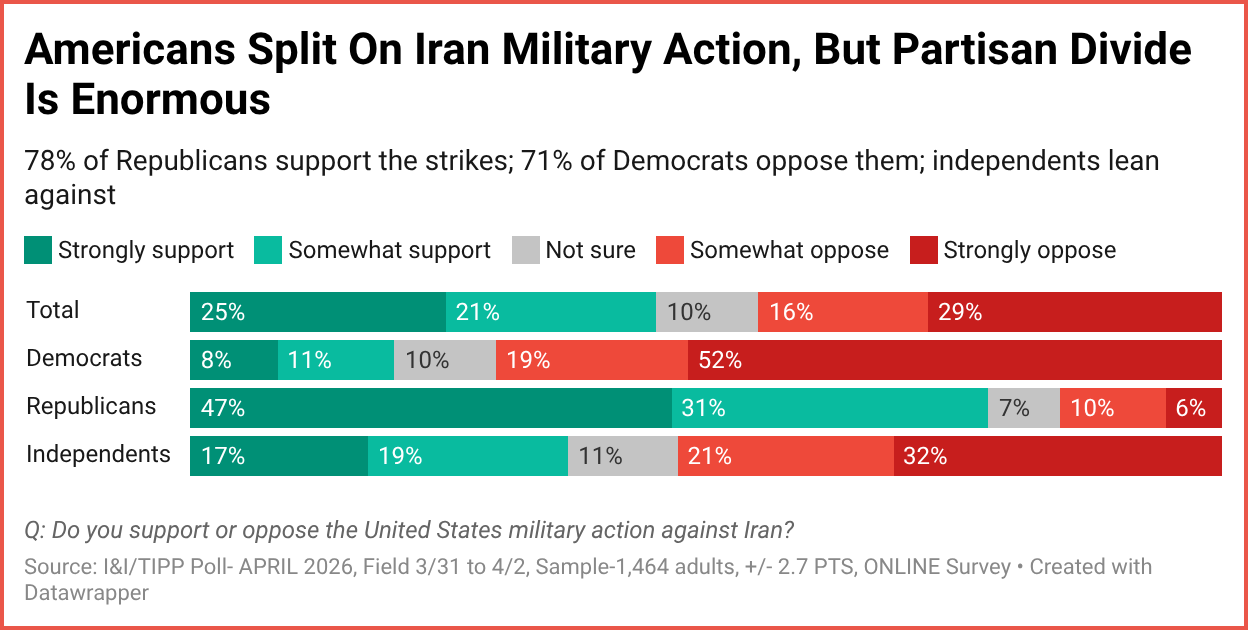
But the numbers change based on which political group is asked the question.
For instance, those who support the war are overwhelmingly Republican in political affiliation: 78% support, 16% oppose.
But Democrats are nearly a mirror image in opposition to the war: 71% oppose, 19% support. Independents fall somewhere in the broad middle, at 36% support, 53% oppose.
So the war is neither popular nor supported by a wide swath of the political spectrum.
But the demographic breakdowns are also telling. For instance, men (48% support, 43% oppose) are more likely to back the Iran war effort than women (41% support, 47% oppose).
How about race or ethnicity? White voters (48% support, 43% oppose) are nearly a third more likely to support the Iran war than black voters (33% support, 50% oppose). But Hispanic voters are the most likely of all the major groups in the survey to back Trump on Iran: 50% support, 42% oppose.
I&I/TIPP asked a second question of those taking the poll: “Would you support or oppose the United States sending ground troops into Iran?”
Overall, a 53% majority said they opposed such a move, while just 37% supported it.
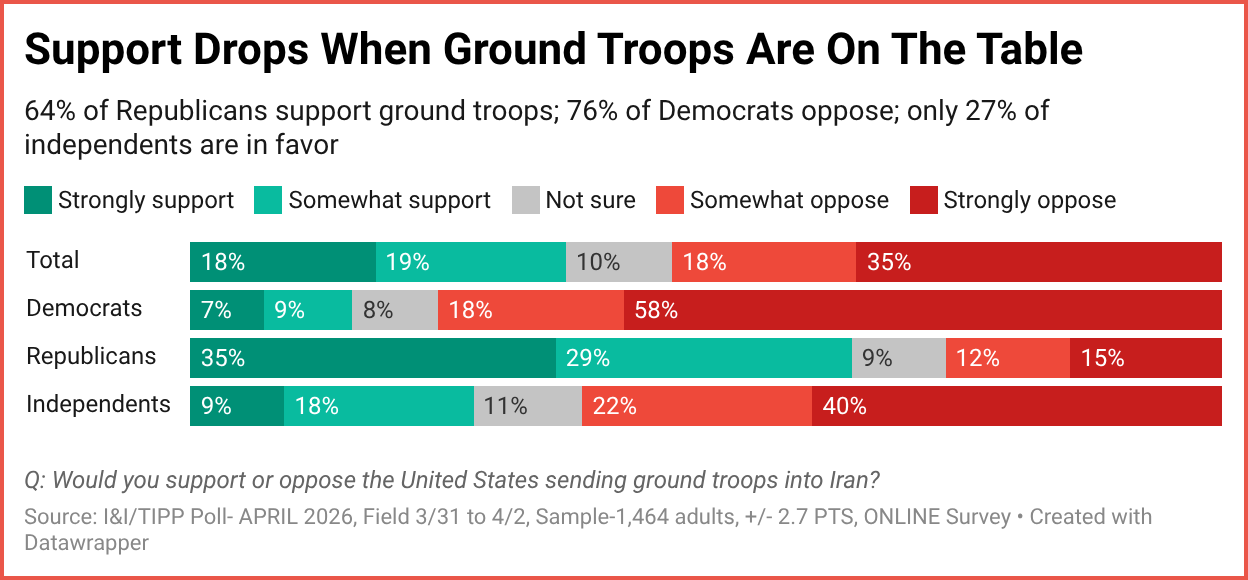
And once again, the response was largely shaped by political affiliations. Democrats (16% support, 76% oppose) were the least supportive of boots on the ground, followed by independents (27% support, 62% oppose).
But a solid majority of GOP members (64% support, 27% oppose) backed sending troops in, if necessary.
The only others among the 36 demographic groups I&I/TIPP regularly follows that solidly supported boots on the ground: Self-described conservatives (58% support, 31% oppose), parents (51% support, 42% oppose), and those aged 25-44 years (48% support, 43% oppose).
So who would support sending troops into Iran to finish the fight?
It’s very hard to find large groups that back more troops into Iran, in particular, given the vivid memories of President Joe Biden’s ignominious withdrawal from Afghanistan in August of 2021. Biden’s decision led to the deaths of 13 U.S. service members, abandoned our Afghan allies, and left billions of dollars of sophisticated U.S. military equipment for the Taliban to use.
A third and final question broadened the theme a little: “How concerned are you that the conflict with Iran could expand into a wider regional or global war?”
On this question, the answer was a significant majority of 77% said they were either “very” (44%) or “somewhat” (32%) concerned, while just 19% responded they were “not too” concerned (14%) or “not at all” concerned (5%).
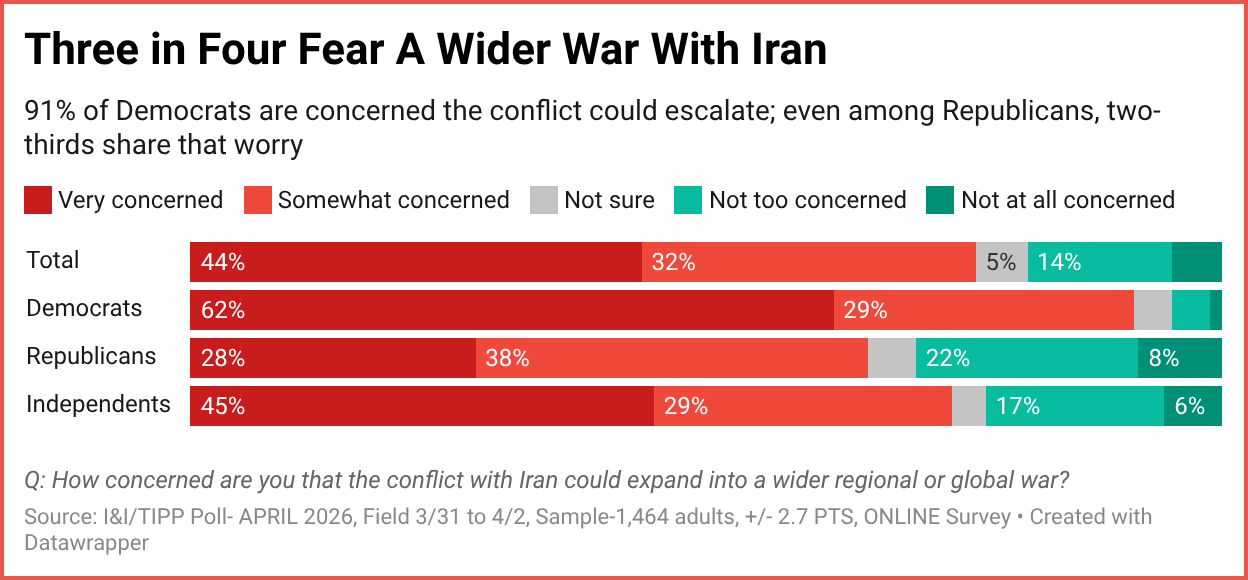
All major political persuasions showed majorities of concern that the war would widen.
Unfortunately, the war has already widened, at least somewhat.
Saudi Arabia and the United Arab Emirates are said to be urging the U.S. and Israel on to finish the job against Iran. They fear a nuclear Iran with its oil riches and large army would eventually become a Mideast regional bully, dictating regional politics and setting Mideast oil policy to the detriment of its neighbors.
As for boots on the ground, the daring rescue in Iran of a crashed U.S. flier on Easter morning has grabbed the world’s attention. That’s especially the case since the U.S. set up a forward operating air and military base inside Iran to search for and ultimately rescue the U.S. soldier.
So, in a manner of speaking, the U.S. already has boots on Iran’s ground. But that doesn’t mean more troops will follow.
As of Sunday, President Trump was on Truth Social warning Iran about the consequences for not surrendering, threatening to bomb both power plants and bridges next, but told ABC News that the war should end in “days, not weeks.”
If that happens, what will he have achieved? Early on, Trump set out five goals he expected from taking action against Iran’s theocratic dictatorship:
- completely degrading Iranian missile capability,
- destroying Iran’s defense industrial base,
- eliminating their navy and air force,
- never allowing Iran to get even close to nuclear capability, and
- protecting our Middle Eastern allies.
So far, so good.
Even so, as constitutional law scholar and Middle East expert Pegah Banihashemi of the University of Chicago wrote recently in TIPP Insights:
Despite extensive damage to police stations, courthouses, and other administrative buildings, the regime’s security apparatus, including the Islamic Revolutionary Guard Corps and the volunteer Basij forces, remains intact and in control over the country. In urban areas, they have established checkpoints across major streets. (Reports that they are recruiting children as young as 12 to assist with checkpoints and patrol duties raise serious legal and human-rights concerns.)
Moreover, political activists are still being arrested, and several individuals have been executed following convictions for charges related to espionage and national security. These developments suggest that even under wartime conditions, the government has continued to use coercion to preempt dissent.”
So while U.S. officials hope to wrap things up soon, it’s not clear what kind of Iran will remain:
A modern state, capable of managing its own affairs and protecting its citizens’ rights without menacing its neighbors?
Or, after the U.S. departs, will the old murderous, dictatorial regime that oppresses its own people and terrorizes its neighbors regain control?
It’s not yet entirely clear. But, as the I&I/TIPP Poll shows, almost half of Americans support the military action against Iran, a number that might grow considerably if Trump manages to finish the war without sending troops in to do the job.
I&I/TIPP publishes timely, unique, and informative data each month on topics of public interest. TIPP’s reputation for polling excellence comes from being the most accurate pollster for the past six presidential elections.
Terry Jones is an editor of Issues & Insights. His four decades of journalism experience include serving as national issues editor, economics editor, and editorial page editor for Investor’s Business Daily.
For more polling insights, explore our TIPP archive. Subscribe to TIPP Insights for $99/year.
The TIPP Stack
Handpicked articles from TIPP Insights & beyond
1. A Bad Deal Today Means A Bigger War Tomorrow—Mohammed Al Dhaheri, Rikard Jalkebro, Project Syndicate
2. Trump Issues Chilling Threat To Iran: ‘A Whole Civilization Will Die’—Elizabeth Troutman Mitchell, The Daily Signal
3. Trump’s Easter Ultimatum: Open The (Expletive) Strait Or Else— Kurt Nimmo, The Ron Paul Institute for Peace and Prosperity
4. Trump Celebrates Stunning Rescue Of Downed US Pilot In Iran—Elizabeth Troutman Mitchell, The Daily Signal
5. Supreme Court Clears Way For Dismissal Of Case Against Trump Ally Steve Bannon—John Kruzel, The Daily Signal
6. Radical Tax Hikes Will Accelerate PA’s Outmigration—Nathan Benefield, The Daily Signal
7. Why Largest Protestant Denomination Opposes Trump’s Surgeon General Pick—Elizabeth Troutman Mitchell, The Daily Signal
8. Price Inflation And The Price Of Oil— Frank Shostak, Mises Wire
9. A GOP Senator’s Fight For Life Continues On Capitol Hill—Virginia Grace McKinnon, The Daily Signal
10. GOP Rising Star Backs Paxton’s Senate Bid— Pedro Rodriguez, The Daily Signal
11. Inside The Massive Advocacy Blitz To Set AI Regulations—Elizabeth Troutman Mitchell, The Daily Signal
12. NIH Faces Blowback Over Controversial Dog Research—Fred Lucas, The Daily Signal
13. SCOTUS Decides Challenge To Public Transit Gun Ban—Andrew Rice, The Daily Signal
📊 Market Mood — Wednesday, April 8, 2026
🟩 Markets Surge on Iran Ceasefire Breakthrough
U.S. futures jumped sharply as a temporary ceasefire eased geopolitical tensions.
🟧 Oil Plunges as Hormuz Reopens to Shipping
Crude fell below $100 as safe passage through the Strait of Hormuz reduced supply fears.
🟦 Rate Cut Hopes Return as Inflation Risks Ease
Lower energy prices revived expectations for Fed easing after weeks of inflation concerns.
🟨 Gold Rallies as Dollar Weakens on Risk Shift
Bullion climbed alongside a softer dollar as investors rotated out of crisis positioning.
🗓️ Key Economic Events — Wednesday, April 8, 2026
🟧 10:30 ET — Crude Oil Inventories
Weekly U.S. stockpile data provides insight into supply trends and energy price direction.
🟧 13:00 ET — 10-Year Treasury Note Auction
Investor demand for long-term government debt offers signals on interest rate expectations.
🟧 14:00 ET — FOMC Meeting Minutes
Detailed record of the Fed’s latest meeting gives insight into policy thinking and future rate path.
editor-tippinsights@technometrica.com