
By Roberta Lajous, Project Syndicate | March 11, 2026
US President Donald Trump’s effective oil blockade of Cuba has plunged the country into crisis. In such a weakened state, the Cuban regime could be motivated to launch a transition to a market-based economy if offered a chance to integrate economically with the US, Canada, and Mexico.
MEXICO CITY – Ever since Fidel Castro’s forces overthrew Fulgencio Batista’s regime in 1959, Cuba has served as a revolutionary paradigm for Latin American leftists – and America’s Achilles’ heel in the region. While the regime’s oft-predicted demise has failed to materialize, that may change now that US President Donald Trump has seized control of Venezuela’s fossil-fuel industry, enabling his administration to establish an effective oil blockade of Cuba.
Although Trump recently eased restrictions on private oil sales to Cuba, his pressure campaign has plunged the country into crisis, resulting in dire humanitarian conditions and significantly increasing the risk of uncontrolled migration by boat to the United States and Mexico.
Florida, the closest US state to Cuba, could probably handle an exodus on a scale larger than that of the 1980 Mariel boatlift, when around 125,000 Cubans reached Miami after Castro briefly lifted the ban on emigration. But this might cause a political uproar, especially given Trump’s anti-immigrant agenda. Mexico’s Yucatán peninsula, another major destination for Cuban migrants, lacks the resources to receive and care for those fleeing the island, as has become evident in recent years.
To alleviate Cubans’ suffering and prevent a new migrant crisis, urgent and innovative measures are required. Instead of threatening a “friendly takeover,” the US government should position itself as a potential trade partner. This would require lifting the trade embargo, which former US President Barack Obama tried to do, though partisan divisions doomed the effort.
The timing is right for such an approach. With a mandatory joint review of the US-Mexico-Canada Agreement (USMCA) scheduled for later this year, its members should consider inviting Cuba to join. Tourism is the island’s main source of revenue, and more than half of its annual visitors come from these three countries. Moreover, Cuban leaders have indicated their eagerness for investment. These factors, coupled with the risk of societal breakdown, might be enough to compel Cuba to launch a transition to a market-based economy with a predictable legal framework.
Such a shift is not unheard of. Consider, for example, the European Union’s successful integration of post-communist countries. The prospect of EU membership created huge incentives for internal change. Market liberalization, of course, triggered shocks, but most of these countries are now far better off for taking the reform medicine, with Poland emerging as one of the EU’s best-performing economies in recent years. Expansion was beneficial not only for the European market but also for regional security.
Compared to Europe, North America shares stronger cultural affinities, including three primary languages (English, Spanish, and French) and, despite the wars fought in the 19th century, a common sense of belonging to a new world that had shaken off the shackles of colonialism.
Moreover, the implementation in 1994 of the North American Free Trade Agreement strengthened cohesion and improved lives in all three countries. Trump, who sought to terminate NAFTA in his first term before realizing that doing so would be political suicide, replaced it in 2020 with the USMCA, which tightened the rules of origin for merchandise trade.
As a result, Mexico became the top US trading partner, with Canada close behind, and the three countries are even more integrated today than before Trump first took office, putting them in a stronger position to compete with China. This remains the case despite Trump’s belligerent rhetoric against America’s neighbors and imposition of high import tariffs in his second term. In fact, Mexico and Canada have fared relatively well following the introduction of tariffs, because USMCA-compliant goods are exempt.
The Trump administration is currently facing several challenges. Prices remain high ahead of the midterm elections, and the US-Israeli war in Iran threatens to exacerbate the electorate’s affordability concerns. Adding Cuba to the USMCA would create a larger market, improve access to critical minerals, which are already being mined in Cuba by Canadian companies, and secure Cuba’s transition to a market economy without resorting to force.
Just as US President Richard Nixon’s strident anti-communist views gave him political cover to open relations with the People’s Republic of China, Trump’s far-right credentials make him well placed to risk a reconciliation with Cuba. As the son of Cuban immigrants and a hardliner, US Secretary of State Marco Rubio is also uniquely positioned to achieve this outcome.
But Trump and Rubio must choose the most effective and least painful route: regional integration. Cubans have endured enough suffering, including the pain of exile and family separation. It might seem improbable, but a new and peaceful Cuban revolution is possible.
Roberta Lajous, a career Mexican diplomat, is a former Mexican ambassador to Cuba (2002-05) and the author of Historia mínima de las relaciones exteriores de México (El Colegio de México, 2012) and La política exterior del porfiriato (1876-1911) (El Colegio de México, 2010).
Protecting Shipping In The Strait Of Hormuz
The U.S. is analyzing how to protect shipping in the Strait of Hormuz, through which around 20% of the world’s oil and gas travel, after three cargo vessels were hit by missiles and 16 Iranian minelayers were destroyed.
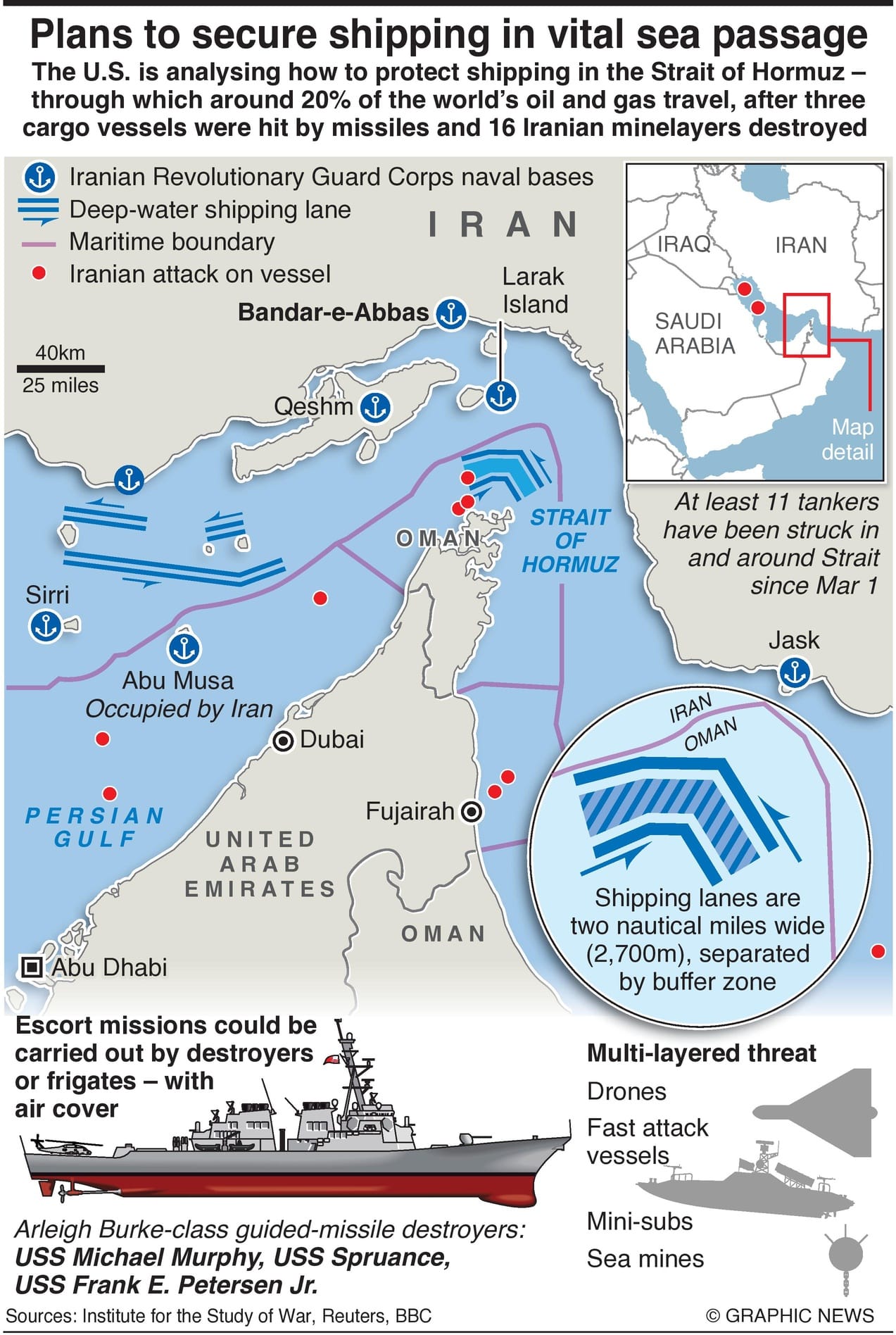
The U.S. is analyzing how to protect shipping in the Strait of Hormuz, through which around 20% of the world’s oil and gas travel, after three cargo vessels were hit by missiles and 16 Iranian minelayers were destroyed.
At least 11 tankers have been attacked by Iranian projectiles in and around the Strait since March 1, forcing traffic to a virtual standstill with a 97% drop-off since the U.S.-Israeli war on Iran began. Tehran has warned that it would "set fire" to any vessels attempting to pass through the strategic choke point.
The Strait is under 50km wide at its entrance, and barely 33km at the narrowest point, but deep enough for the world’s largest tankers to traverse. However, it is overlooked by mountainous terrain and islands on the Iranian side, making it very difficult to defend. Moreover, the Iranian threat is multi-layered with drones and missiles from the air, fast-attack vessels on the surface – despite the near destruction of most of the Iranian navy – and mini-submarines and mines below the water.
Catch up on today’s highlights, handpicked by our News Editor at TIPP Insights.
1. Russia Shares Drone Warfare Tactics With Iran, Intelligence Says
2. U.S. Destroys 16 Iranian Mine Ships Near Strait Of Hormuz
3. Why Iran Is Still Sending Oil To China Through The Strait Of Hormuz
4. Three Cargo Ships Hit By Projectiles Near Strait Of Hormuz, UK Says
5. Chubb Named Lead Insurer For Tankers In War Threatened Hormuz Route
6. Iran Holds Funeral For Military Commanders Killed In War With U.S. And Israel
7. Trump Tells FIFA Iran Can Compete In World Cup Despite War: Officials
8. Energy Shock From Iran War Puts Asian Economies Under Pressure
9. 400 Million Barrels Of Oil To Be Released Amid Iran War Crisis, Says IEA
10. Auto Industry Faces New Supply Risks From Iran Conflict
11. Speculation Grows Over Fate Of Iran’s Esmail Qaani—TIPP Quick Takes
12. DHS Restores Global Entry Program Amid Ongoing Funding Standoff
13. How Google Could Gain In AI Race As OpenAI And Anthropic Clash
14. FBI Server With Epstein Files Breached By Foreign Hacker In 2023: Report
15. Consumer Prices Rise 2.4 Percent Annually As Inflation Stays Stable
16. What JPMorgan’s Move Against Software Loans Reveals About Market Risks Amid AI Disruption
17. Treasury Markets React To Inflation Data And Rising Oil Prices
18. Congress Probes Epstein Finances As Accountant Faces Deposition
19. Meta Introduces New AI Chips Amid Massive Data Center Expansion
20. U.S. Budget Deficit Tops $1 Trillion As Tariff Revenue Surges
editor-tippinsights@technometrica.com