By Jeremy Portnoy, RealClearInvestigations | October 23, 2026
The old saw that money is the mother’s milk of politics is a bipartisan truism universally recognized on both sides of the aisle. Anyone who wants to become a political princess or prince must be able to play the pauper, incessantly shaking the tin can in desperate appeals for the cash that, would-be leaders proclaim, spells the difference between victory and defeat.
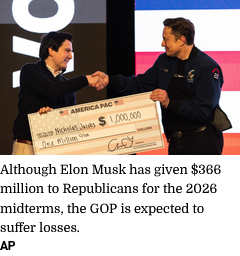
This year’s crop of candidates appear to have mastered the role of beggar. AdImpact projects that $11.6 billion will be spent on political ads this cycle, the most ever for a midterm election and even more than the 2024 presidential election. Super PACs and other interest groups have nearly doubled their spending since the 2022 midterms, while billionaires including Elon Musk and Michael Bloomberg have made headlines for their gargantuan contributions.
A RealClearInvestigations analysis of campaign spending in federal races since 2012, however, challenges the bedrock assumption that superior fundraising buys victory. Although a majority of the candidates who raised the most money won their races, most of them likely would have won anyway thanks to the power of incumbency or the safety secured by gerrymandering. In the relatively small number of truly competitive races, the advantage of a bigger war chest was almost negligible.
Political scientists have found that politicians only need a certain threshold of money to run a viable campaign. After that, other factors – the candidate’s incumbency and charisma, the prevailing political winds and the state of the economy – are more important.
“To the extent people believe it’s an automatic, ‘If you’ve got more money you’re gonna win,’ that is clearly not true,” said Bradley Smith, founder of the Institute for Free Speech (IFS) and former chairman of the Federal Election Commission. “What spending does is it allows you to get your message out to voters, and from there you’ve got to have an attractive message or personality or total political package to win.”
Election experts told RCI the overemphasis on fundraising is affecting the nation’s politics. It leads candidates to spend a lot of time seeking money to pay for often misleading attack ads, instead of sharpening their message. It leads media outlets to devote resources to covering the fundraising instead of the issues. And it instills cynicism among voters: Three out of four Americans agree there is too much money in politics, and almost half believe that wealthy people or organizations can outright “buy” election victories.
Cause or effect?
FEC filings show that since 2012, the candidate who raised the most money won nine out of 10 federal elections. RCI found that wide fundraising gaps had a strong statistical correlation with landslide victories.
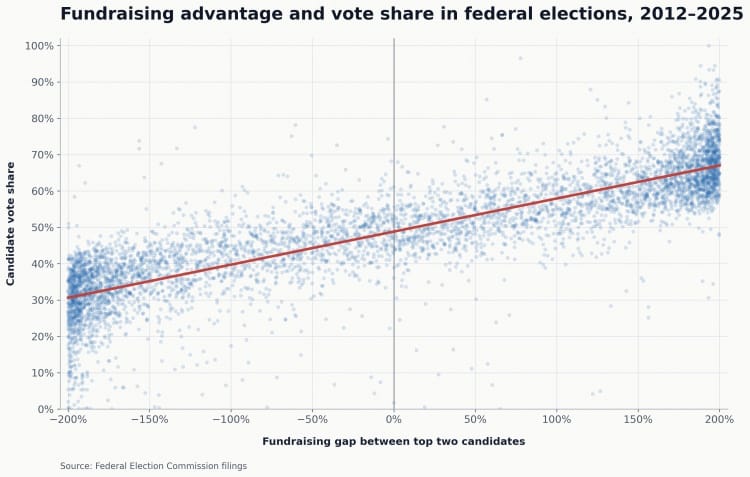
However, those statistics include scores of races where the outcome was all but predetermined. Rep. Nancy Pelosi outraised her opponent $10.2 million to $207,000 in 2024 and won easily – but her victory was hardly dependent on fundraising. There was little chance her San Francisco district – where Democrats outnumber Republicans more than five to one – would ever elect a Republican. She won with 80% of the vote, which is not rare in our highly gerrymandered country. Research shows that more than 90% of House incumbents like Pelosi who have stood for re-election, and 86% of incumbent U.S. senators, have won their races since the mid-1960s.
That makes it difficult to decipher whether money actually causes election victories. Candidates with the political prowess to win a seat in Congress are usually the ones donors are excited to give to. “Political scientists have been skeptical of the causal impact of money, because those who raise the most money are often expected to be the most likely to win. It’s really hard to untangle how much of it is material,” said Dr. Danielle Thomsen, professor of political science at the University of California, Irvine, and author of “The Money Signal: How Fundraising Matters in American Politics.”
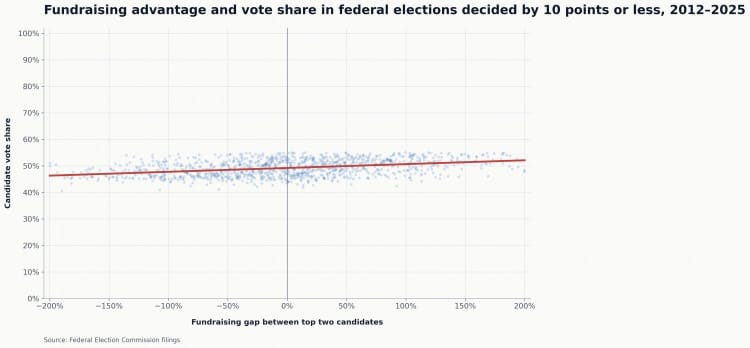
The picture changes significantly when the focus is narrowed to competitive races – those where the victor wins by 10% or less. RCI’s analysis found that large fundraising gaps only had a weak correlation with the candidate’s margin of victory. Supporters of both Hillary Clinton and Kamala Harris, for example, vastly outspent those of Donald Trump in their losing 2016 and 2024 campaigns, respectively. But because spending statistically has less impact in tight races, Trump was still able to win the presidency.
In Michigan’s 2024 Senate race, Elissa Slotkin and PACs supporting her outspent Mike Rogers $91 million to $44 million. She barely eked out a victory. In Pennsylvania’s 2024 Senate race, incumbent Bob Casey outraised his challenger $58 million to $36 million but still lost to Dave McCormick.
Overall, there were 555 competitive federal elections from 2012 to 2025. The top fundraiser only won 63% of them.
“Candidates are mindful of being seriously outspent by their competitors. But at some point, when both candidates spend so much, races are just saturated with information, and spending an additional ‘x’ number of dollars isn’t likely to yield the same rewards,” Thomsen said.
Data can also be skewed by panic spending. IFS’s Smith said that incumbents who realize they are likely to lose will spend extreme amounts of money in a last-gasp effort to recapture popularity. Rarely does the infusion do much to offset whatever the nation’s prevailing sentiment toward Democrats and Republicans happens to be that year.
“If you’re an incumbent, you’ve already got your name known. Spending doesn’t do as much for you as it does for a challenger,” said Smith. “I don’t think that spending more money actually causes candidates to lose, but it’s indicative that the candidate is likely to lose. The candidate’s losing, and they don’t know what else to do besides spend money.”
Early money matters
The time and place where campaign fundraising does make a notable difference is early in the primary cycle. Fundraising success tells donors and voters that a candidate has the support needed to win a general election. Since 2012, the top fundraiser has won 80% of primaries, not including uncontested races.
Thomsen’s research found that primary voters often view a candidate more favorably simply because they raised lots of money. She gave politically engaged voters a list of fictional candidates and found those who raised the most money were more likely to attract votes, regardless of the candidates’ political views or platform.
“Early money matters in all of these ways long before the primary election in shaping how candidates are perceived, which competitors are seen as formidable, and which candidates are covered by journalists,” Thomsen said.
Thomsen found the average primary winner in the 1980s and 1990s raised roughly $100,000 during their first three months after announcing their candidacy, adjusted for inflation. Today, it’s closer to $400,000. That’s partly why winners like New York City Mayor Zohran Mamdani and even President Trump, who won elections despite huge fundraising disadvantages, are becoming increasingly rare exceptions to the norm. It’s harder than ever to pull off a victory without early donor support.
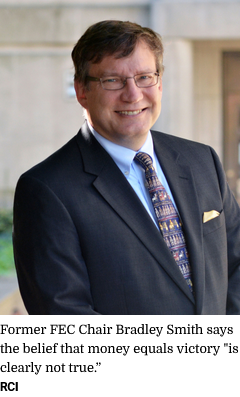
“Imagine you had a really good idea for a soft drink,” said Smith. “But if you want to go out and compete with Coke and Pepsi, you’ve got to go on ‘Shark Tank’ and get somebody to give you some real money. You can’t just do a public offering and hope people will buy stock in your company that they never heard of. You need that champion. Politics can be the same.”
Safe seats
While most incumbents do not need hordes of cash to win re-election, money empowers them in other ways, and they often end up being some of the top fundraisers. Rep. Alexandria Ocasio-Cortez of New York could likely win reelection this year without spending a single penny, yet she has outraised every House candidate in the country.
Candidates in safe seats still need to fundraise as a deterrent to potential challengers, both Smith and Thomsen said. Ocasio-Cortez’s seat is completely safe in part because her challenger, Diamant Hysenaj, has no political experience and little name recognition. If Ocasio-Cortez’s funds were depleted, perhaps a Republican or primary opponent would have made a more serious attempt to unseat the popular progressive.
“If a challenger sees that you’re not raising any money, and you’re just assuming you’re gonna win reelection, somebody might say, ‘I think that candidate actually has some vulnerability,’” said Smith. “But if you’ve got a huge war chest, that challenger might go, ‘There’s no way I’m gonna beat that incumbent,’ and they don’t even try.”
Well-known candidates also have the easiest time currying donations, and their committees often serve as a fundraising nexus for their entire party. Rep. Brett Guthrie, running for a safe seat in Kentucky in 2024, transferred the majority of his funds to the National Republican Congressional Committee. It was then disbursed to candidates with less name recognition who may have struggled to fundraise on their own.
Incumbents “have longevity, seniority, and a long list of donors, so it’s easier for them to raise money,” Smith said. “So the party presses them, ‘You need to raise money and then give it to other candidates running for the House, because you want to be the majority, don’t you?’”
Unsurprisingly, incumbents rarely acknowledge the fact that money is rarely crucial for them to retain their seat. In an Aug. 31 email blast, Ocasio-Cortez told Democrats she needs their money to “re-elect AOC, defeat our Republican opponent, and show the world what we can do.” In a tacit acknowledgment of her surplus, she gave $1 million to support Abdul El-Sayed’s U.S. Senate run in Michigan.
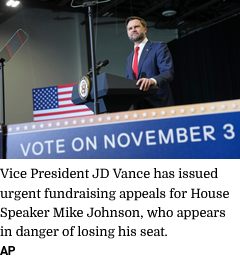
Likewise, Vice President JD Vance emailed supporters to let them know “The Democrats are pouring everything they have into stopping” House Speaker Mike Johnson from winning reelection. Johnson’s top challenger has raised only $1.2 million and has virtually no chance of victory, but such messaging is more effective than asking donors to give Johnson money so he can transfer it to other committees and PACs.
Even though money is not determinative in many races, grassroots fundraising continues to grow because writing a check is an easy way for average citizens to feel they are participating in democracy. Yet most donors already know their money is unlikely to sway the race. A 2017 study by the Bipartisan Policy Center found that “overwhelmingly donors are not giving because they think the race is close or they think they could affect the outcome.” Instead, most donors felt it was their “civic duty” to donate, and nearly all said they were “advancing the common good.”
Mega-donors and dark money
More recently, the rise of dark money groups has added more fuel to the fundraising fire. These organizations are legally unaffiliated with candidates and do not disclose the sources of their funding, which are widely believed to come from wealthy donors. These groups spent a record $1.9 billion in 2024, and the Brennan Center for Justice predicts the record will be broken again in 2026.
Political scientists say while there is no evidence that this money influences election outcomes any more than other contributions, its impact may be more corrosive. It highlights the motivations of rich donors who, presumably, are more aware of the limits of their large checks in affecting outcomes, raising questions about whether they are trying to buy access to leaders. In addition, dark money groups often use their funds to run attack ads, which can be misleading, deepening cynicism.
There are various reasons donors may hide their identities, including protecting their social and business prospects.
Of course, this year’s largest donor is not secret. Elon Musk gave $366 million to Republican candidates, the largest political donation in U.S. history. The Brennan Center writes, “We have not had a major election where one party’s spending so dwarfs the other’s in at least a half century, likely since the 1972 election that brought us Watergate.”
Yet Democrats are still projected to win control of both chambers of Congress as of Oct. 14, and to win the Texas Senate race, where Musk has concentrated most of his spending. If Democrats do walk out of Election Day with a sweeping victory, it could serve as further evidence that no amount of spending can mitigate factors like the president’s low job approval rating.
Loved it, hated it, or somewhere in between — tell us. Grade this article here and help shape what lands in your inbox next.
Original article link: RealClearInvestigations
Trump Derangement Syndrome: What Does the First National Survey Reveal?
Join Dr. Carole Lieberman and a distinguished panel of journalists and commentators for an exclusive briefing on new TIPP Poll findings and their implications for families, society, and American politics.
October 28 | 1 PM ET | National Press Club, Washington, DC
Letters to the editor email: editor-tippinsights@technometrica.com
Subscribe Today And Make A Difference. Consider supporting Independent Journalism by upgrading to a paid subscription or making a donation. Your support helps tippinsights thrive as a reader-supported publication. Contact us to discuss your research or polling needs.
Reach our audience. For sponsorship and advertising opportunities, visit our Partner With Us page.