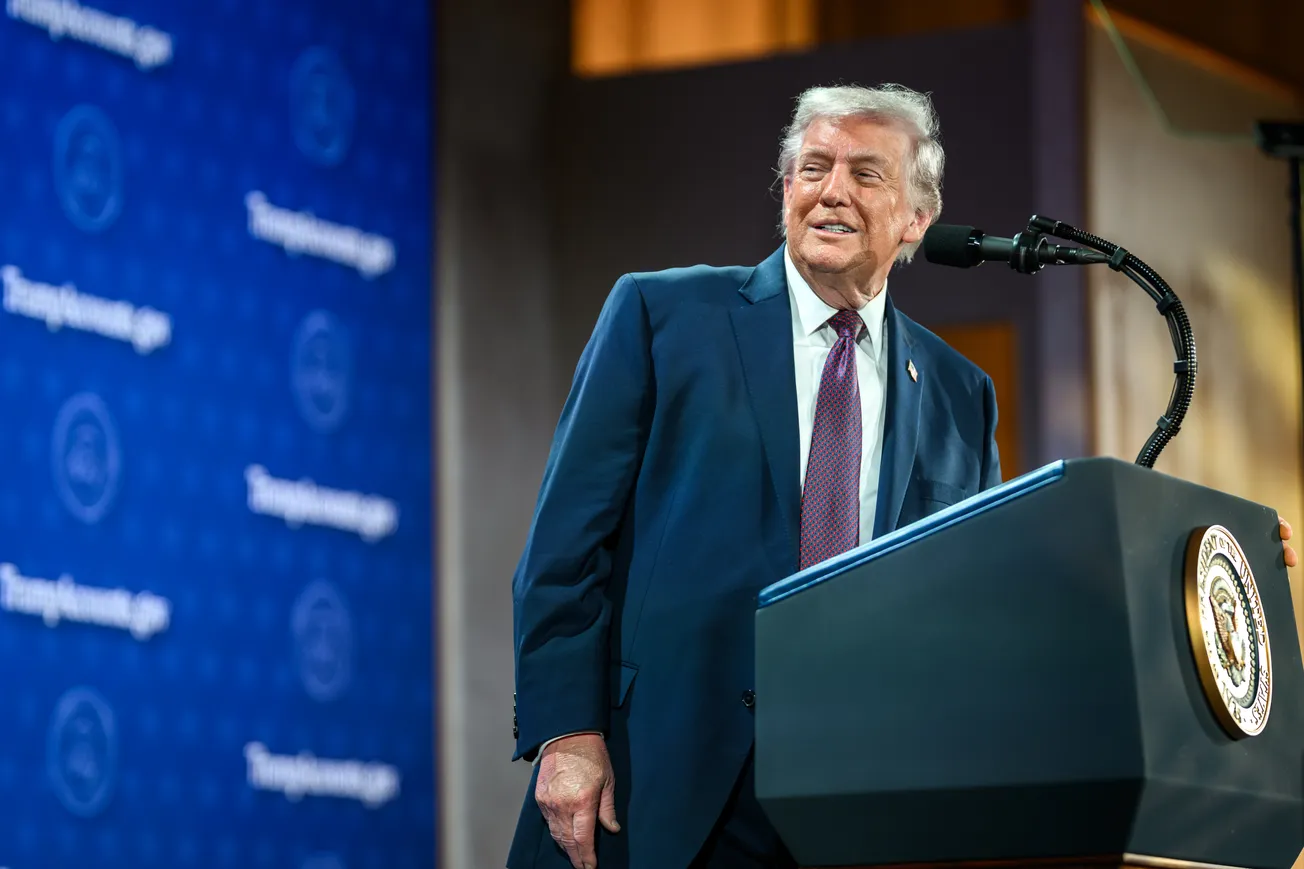
On February 24, President Donald Trump gave what many, including some critics, thought was one of the most effective presidential State of the Union speeches of recent decades, if not ever. But it barely moved the needle when it comes to his presidential favorability ratings, the latest I&I/TIPP Poll shows.
In the March online national I&I/TIPP Poll, taken from Feb. 24 to Feb. 27 by 1,456 adults, Trump showed only slight improvement on the lead presidential leadership question: "Overall, is your opinion of Donald Trump generally favorable, generally unfavorable, or are you not familiar enough to say one way or the other?"
Among those responding to the poll, which has a margin of error of +/-3.0 percentage points, 42% gave Trump a "favorable" rating, while 49% gave him an "unfavorable" score, for a net minus-7 percentage points.
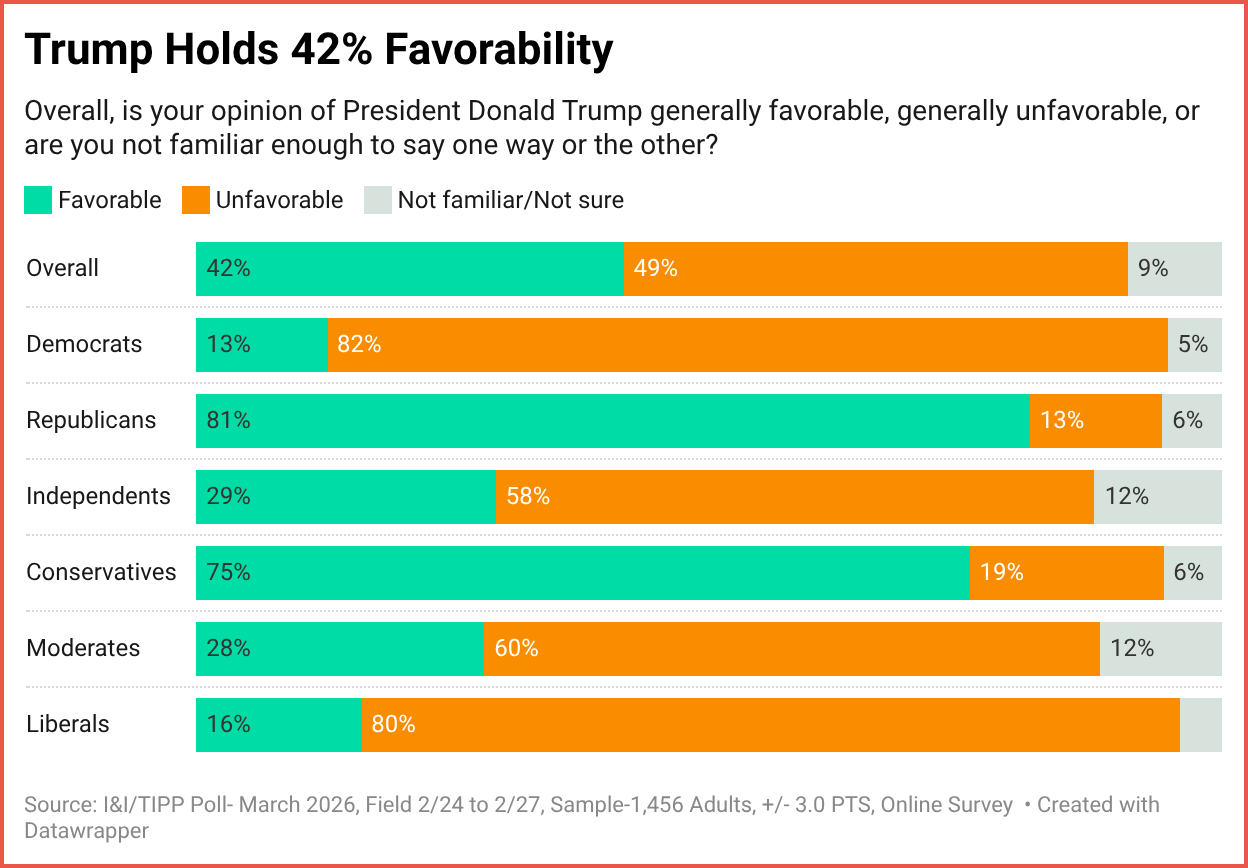
That's only marginally better than February's 41% favorable, 50% unfavorable rating, with a net of minus-9 percentage points.
A look at the breakdown by political affiliation shows clear erosion in one area: independents.
Among Republicans, Trump's favorability rating stood at 82%, up from 77% a month earlier, while the GOP "unfavorable" score fell to 13% in March, down from 17% a month before. That's a swing to a plus-68 percentage point reading, up eight points from February's 60.
Democrats? They showed little change in March. They gave Trump a 13% favorable rating and an 82% unfavorable number, a slight improvement on February's 10% favorable and 82% unfavorable score.
But, as noted, Trump lost some favorability among independents. In March, indie voters gave Trump a 29% favorable score, down five percentage points from 34% a month earlier. Unfavorable reached 58%, a big gain from February's 52%.
One possible explanation: There has been a trend toward lower average TV viewership for the State of the Union over the past 30 years, largely due to . So even a good speech will be heard by fewer people.
Trump's speech attracted 32.6 million viewers this year, according to Nielsen. That's marginally better than the 31.2 million average during Biden's four years. During Trump's first term, he averaged 44.3 million viewers.
As noted, the trend has been down since the early 1990s. That may mean that the SOTU speech is losing its power to affect a president's favorability with the public.
"Trump has relied heavily on television to get his message out and is especially popular on Fox News, which also bolstered his ratings in the past," according to Statista.
"Yet, there is a general downward trend in these ratings as TV is becoming less important as a medium. For perspective: President Barack Obama’s first SOTU was viewed by 52.4 million people in 2009, President Bill Clinton’s by 66.9 million in 1993. Only 47.7 million watched Trump’s first address to the Joint Session of Congress in 2017."
For the second question, I&I/TIPP each month asks the following about presidential performance, namely: "In general, do you approve or disapprove of the way Donald Trump is handling his job as president, or are you not familiar enough to say one way or the other?"
This month, there was no overall change at all from February: 40% gave Trump "approve," versus 51% "disapprove." But again, the similarity masks change among the three major political affiliations.
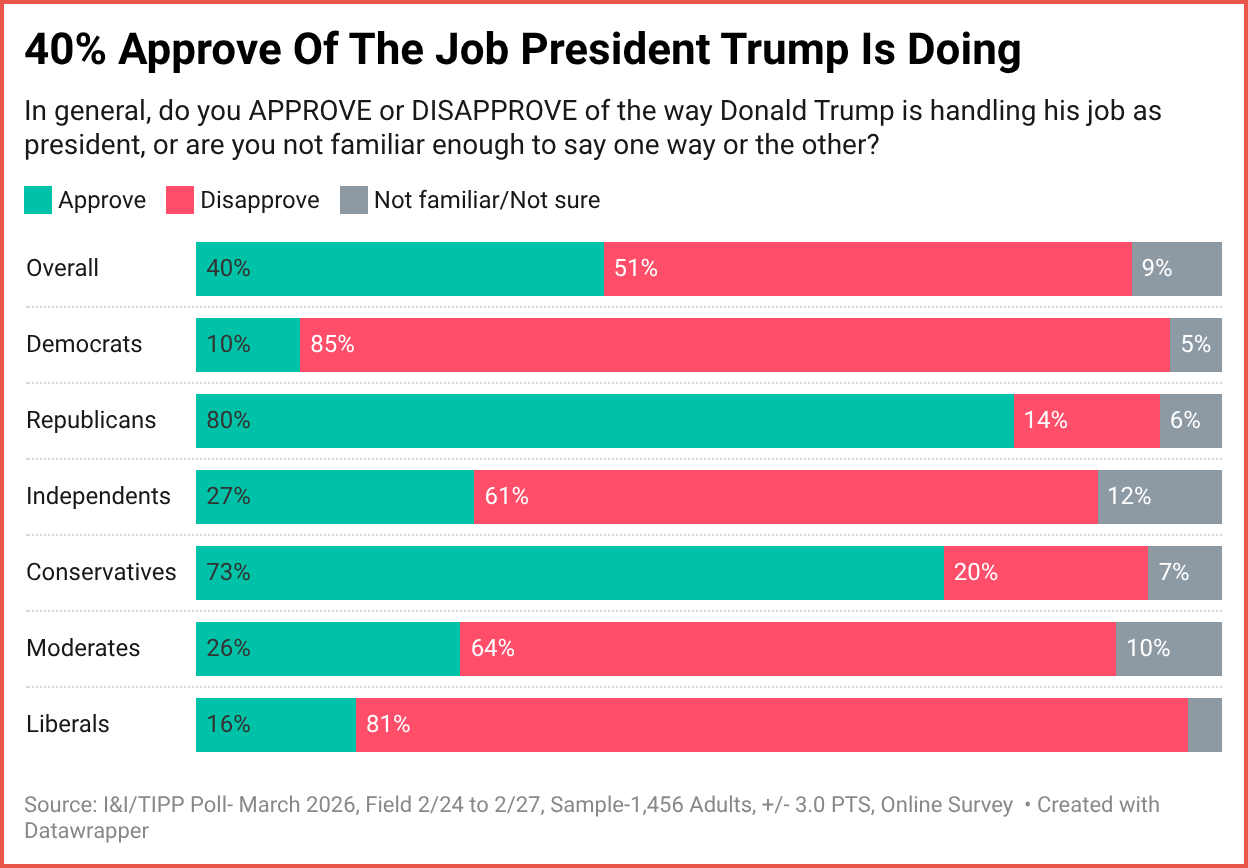
Republicans once again increased their grade for Trump in March, to 80% approve and 14% disapprove, an improvement from the 77% approval and 16% disapproval in February.
Just as the Republicans, Democrats were statistically unchanged in March: 10% approval, 85% disapproval, statistically virtually identical to February's 86% approval and 10% disapproval.
But once again, slippage was seen among independents. In March, 27% approved of Trump's performance, while 61% disapproved; that's significantly lower than the 34% approval and 54% disapproval in February's reading.
So independents' high hopes for Trump after four years of President Joe Biden don't seem to have been met by Trump's performance so far.
However, Trump shows some clear improvement when it comes to leadership.
Each month, I&I/TIPP poses this question: "How would you describe the leadership that President Trump is providing for the country?"
Overall, Trump's doing better in March with 55% calling his leadership either "very strong" (26%), "strong" (15%) or "moderate" (14%). But 41% called his leadership either "weak" (10%) or "very weak" (31%).
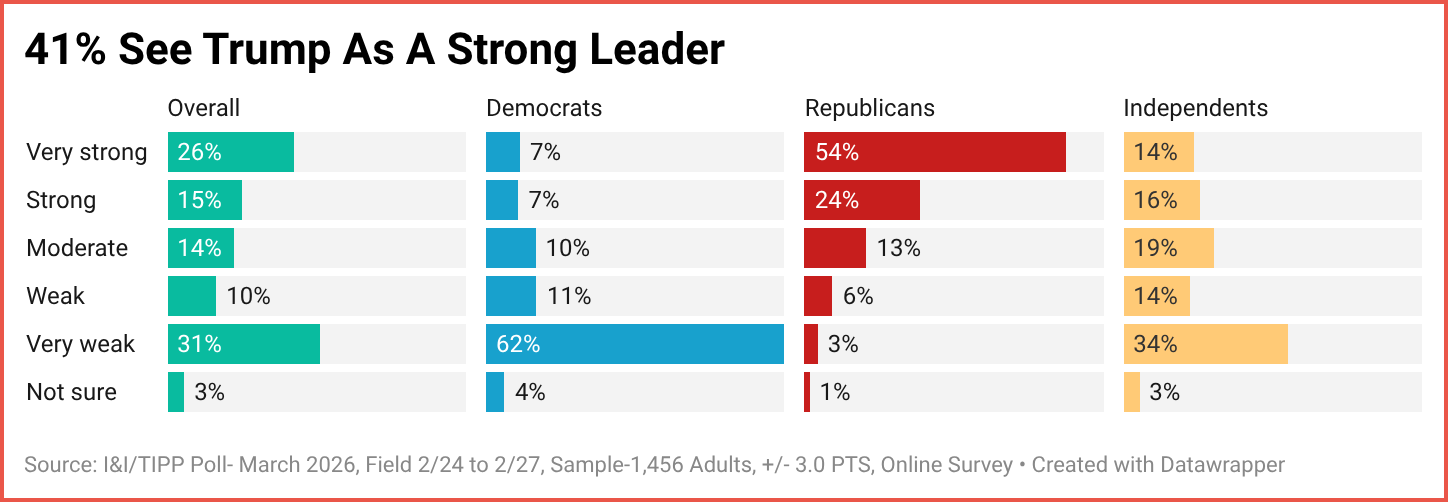
That compares with 54% in February who called Trump's leadership "very strong" (26%), "strong" (14%), or "moderate" (14%). And once again, independents held the overall average down, as Trump gained among Republicans and Democrats, but declined among indie voters.
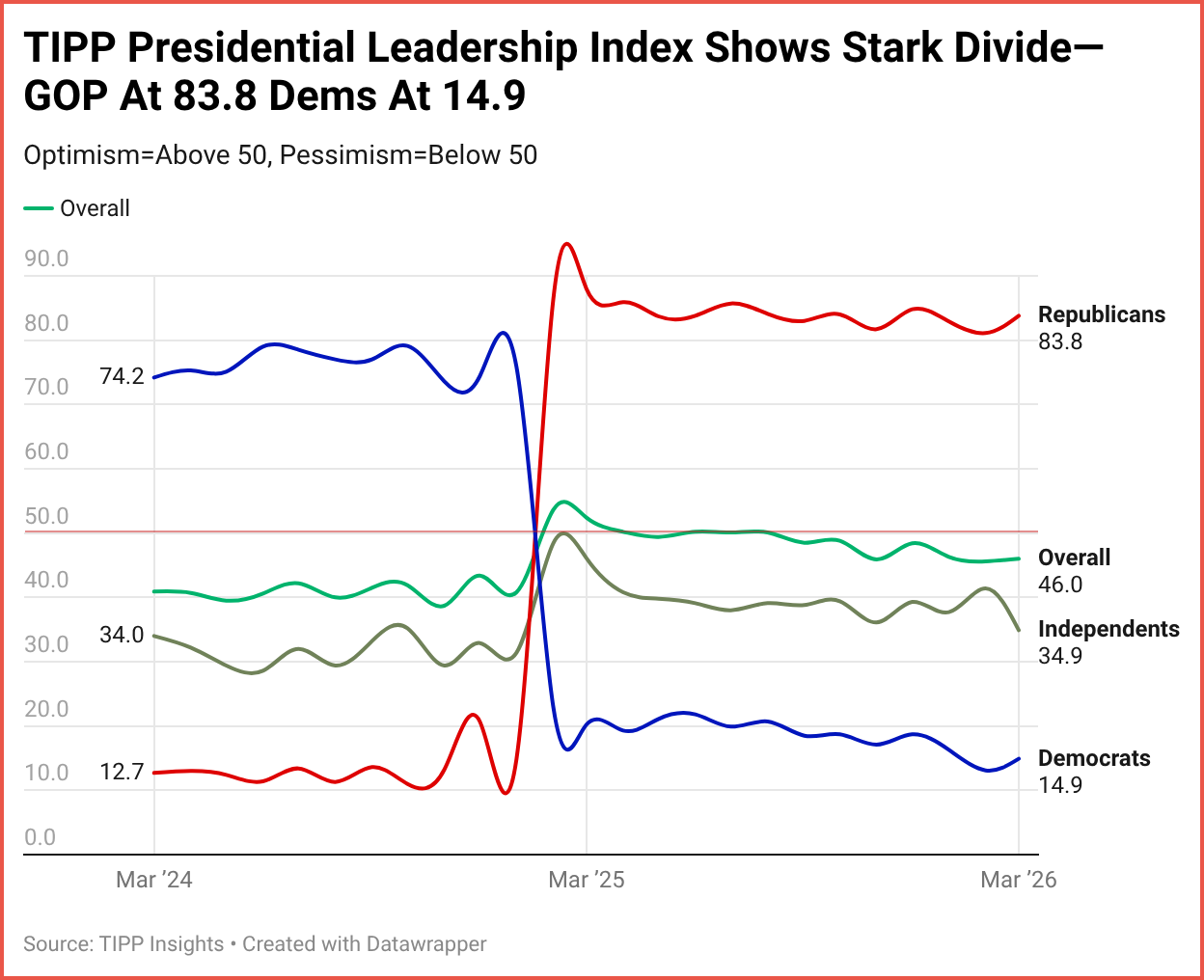
(Below: The TIPP Presidential Leadership Index measures public sentiment over time by combining three components: favorability, job approval, and presidential leadership. The index ranges from 0 to 100, with readings above 50 indicating optimism and below 50 signaling pessimism. In March, the overall index stood at 46.0 (Feb=45.6, Jan=46.3, Dec=48.4), with Republicans most optimistic at 83.8 (Feb=81.1, Jan=82.9, Dec=84.8), Democrats least at 14.9 (Feb=13.1, Jan=16.3, Dec 18.7), and independents in between at 34.9 (Feb=41.4, Jan=37.7, Dec=39.3).
But, when asked to give Trump A and B grades for how he's handling individual issues? Yes, in fact, his overall grade remains unchanged in March: 38% give him either As or Bs.
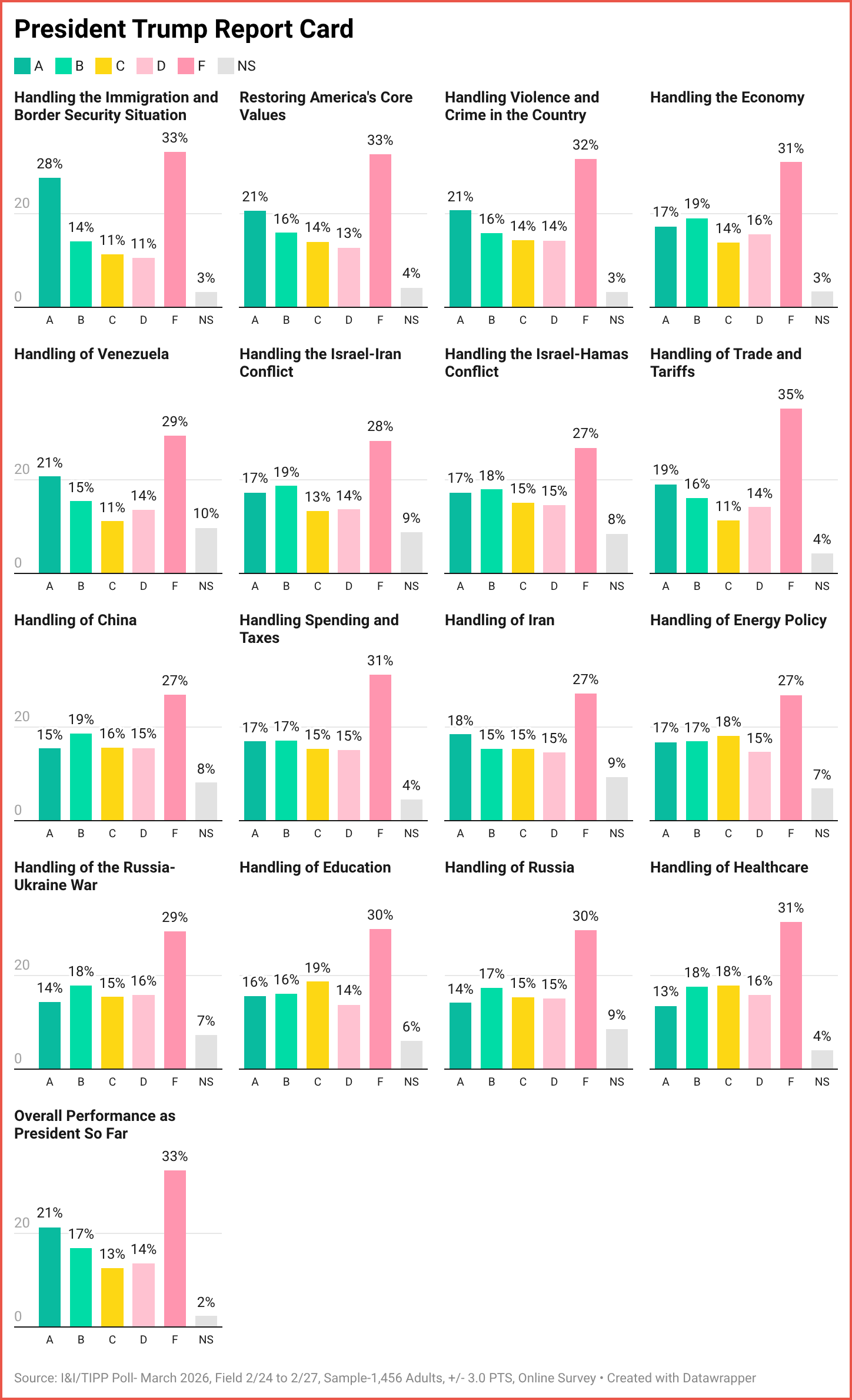
Not surprisingly, the breakdown by party affiliation is sharply skewed, with Democrats giving just 12% As and Bs for Trump's performance overall, compared to 21% As and Bs from independents and 61% of Republicans, a large majority.
His highest score: 42% for "Handling the immigration, border security situation," followed by a number of 36% A and B scores for "Handling the economy," "Handling the Israel-Iran conflict," "Handling of Venezuela," "Handling violence and crime in the country," and "Restoring America's Core Values."
Lowest scores of 31% went to handling of "Russia" and "Healthcare," followed by 32% for "Education" and "the Russia-Ukraine war." All other issues came somewhere between the two extremes.
As noted above, Trump's two-hour stemwinder State of the Union speech didn't have much apparent impact on public opinion. That may be because out of a population now estimated at about 350 million, only a little over 7% watched the speech.
But while Trump's notable speech didn't move the needle, something he did later in the week might just do that: That is, the attack against Iran's Islamist regime, which for decades has backed terrorism and sowed violence across the Mideast and Europe.
This is not mere rhetoric: Since 1979, Iran has been involved -- either through funding, training or more directly -- in at least 45 terrorist attacks leading to the deaths of American citizens both here in the U.S. and abroad.
Yet, in the I&I/TIPP tally of policy grades given by voters to President Trump, "Handling of Iran" got a below-average score of 34. Americans have not been overly impressed, despite Trump's move to destroy Iran's illicit nuclear weapons program.
But the Trump administration's overseas wins against longtime foes are adding up.
Following the deposing of Venezuelan dictator Nicolas Maduro, the U.S. attack on Iran's dictatorial regime, along with the possible dissolution of Cuba's collapsing communist government, will Trump's ratings rise?
An I&I/TIPP Poll in November found that "Voters Back ‘Military Action’ Against Drug Boats, Leftist Narco Regimes." Will this mark a turnaround in how Americans view Trump, especially on foreign-policy issues?
Or will bread-and-butter domestic issues, a far more typical pattern among American voters, continue to hold sway?
I&I/TIPP publishes timely, unique, and informative data each month on topics of public interest. TIPP’s reputation for polling excellence comes from being the most accurate pollster for the past six presidential elections.
Terry Jones is an editor of Issues & Insights. His four decades of journalism experience include serving as national issues editor, economics editor, and editorial page editor for Investor’s Business Daily.
👉 Show & Tell 🔥 The Signals
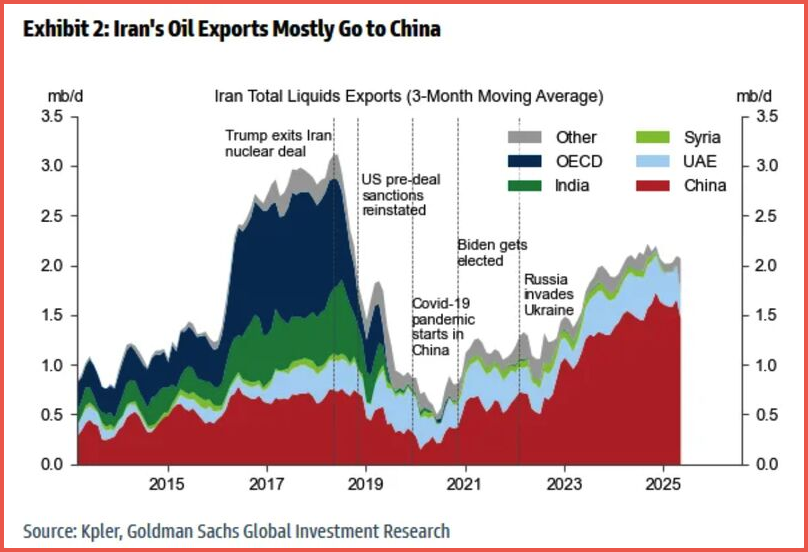
I. China Buys Most Of Iran’s Oil At A Discount
About 90% of Iran’s oil exports now go to China, often at discounts of $8 to $10 per barrel. That equals roughly 1.5 million barrels per day and represents a significant share of global seaborne crude. The discounted supply helps China lower import costs, but it also creates risk. Any disruption to Iranian exports or shipping through the Strait of Hormuz could tighten global markets and hit China’s energy supply first.
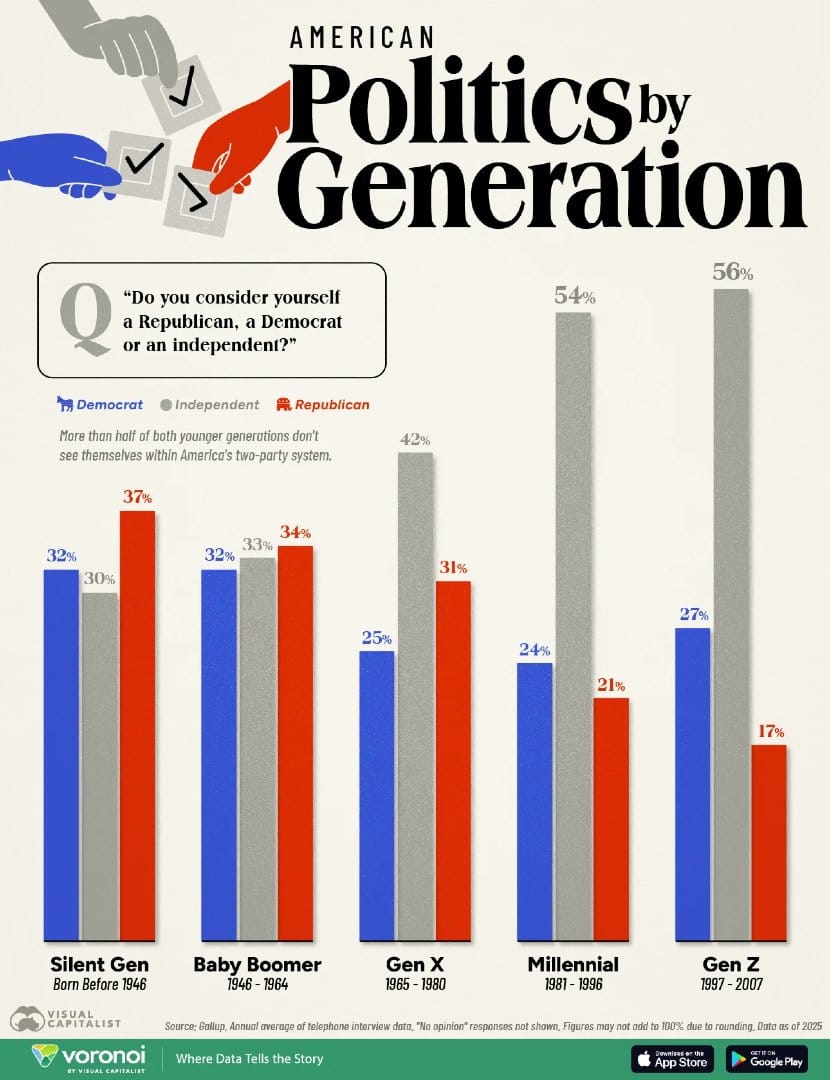
II. Political Affiliation Varies Sharply By Generation
Survey data show clear generational divides in party identification. Older generations lean more Republican, Millennials tilt Democratic, and Gen Z shows a high share identifying as independent. The differences highlight how age cohorts may shape future political coalitions.
📊 Market Mood — Monday, March 2, 2026
🟥 Futures Plunge as Mideast Conflict Escalates
U.S. stock futures tumble sharply after joint U.S.–Israel airstrikes on Iran trigger fears of a broader regional war.
🟧 Oil Spikes on Strait of Hormuz Risk
Crude surges nearly 10% as traders brace for potential supply disruptions through a key global energy chokepoint.
🟨 Gold Jumps in Flight to Safety
Investors rush into safe-haven assets, sending gold sharply higher amid rising geopolitical and inflation risks.
🟦 Global Stocks Slide as Risk Appetite Fades
Asian equities fall and tech remains under pressure as markets pivot decisively away from risk.
🗓️ Key Economic Events — Monday, March 2, 2026
🟧 9:45 AM — S&P Global Manufacturing PMI (February)
Early gauge of factory activity, signaling momentum in the manufacturing sector.
🟧 10:00 AM — ISM Manufacturing PMI (February)
Widely watched indicator of U.S. factory conditions and overall economic strength.
🟧 10:00 AM — ISM Manufacturing Prices (February)
Measures input cost pressures for manufacturers, offering insight into inflation trends.
editor-tippinsights@technometrica.com