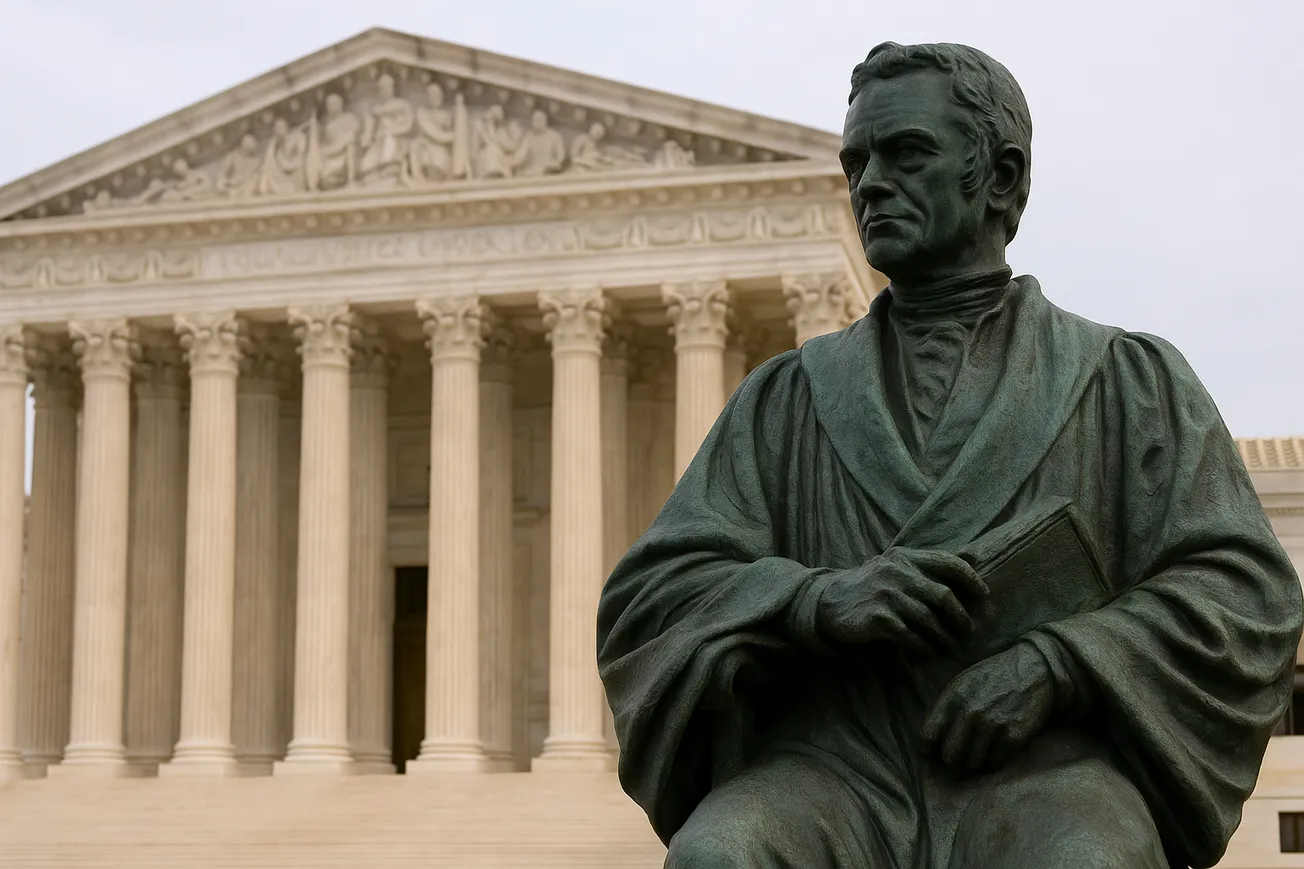
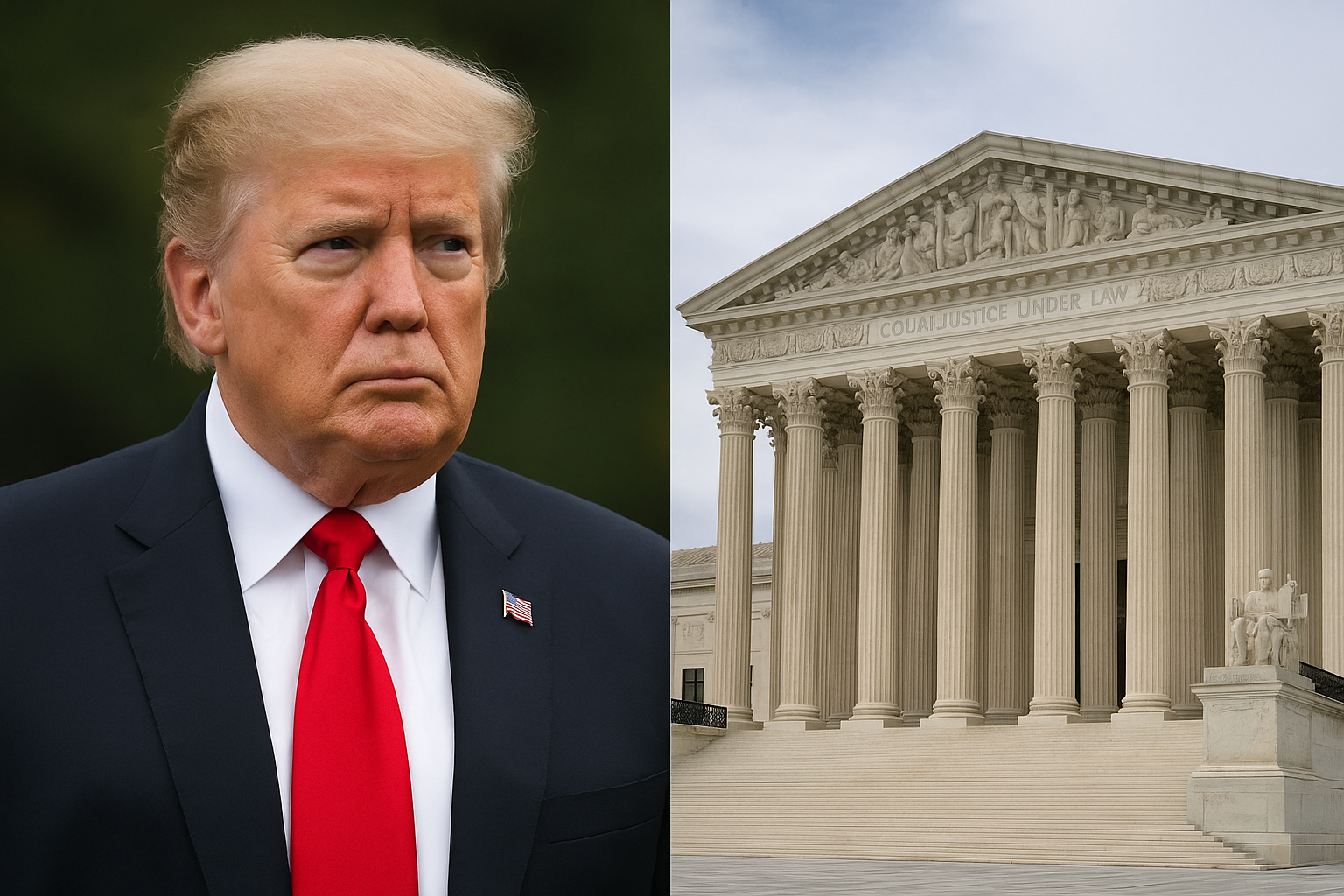
In 1803, the Supreme Court’s Marbury v. Madison ruling gave the justices the power to strike down laws or actions that broke the Constitution. That principle, known as judicial review, made the Court the final referee in America’s system of checks and balances. More than two centuries later, with cases on birthright citizenship and tariffs, the echoes of 1803 now collide with the realities of 2025.
As President Trump continues to govern through Executive Orders, several policies have played a key role in fundamentally transforming the nation. While several of his orders have been blocked, the Supreme Court has upheld some.
Two incredibly consequential cases will be heard when the Supreme Court begins its session this month. The birthright citizenship class action case has suspended Trump's executive order in all the states, and newborns continue to receive United States citizenship at birth, regardless of the immigrant or citizenship status of the parents. The Supreme Court has never ruled on the constitutional aspects of granting automatic citizenship at birth, although most countries in the Western world, including close allies of the United States, impose some requirement (the lineage of parents, their immigrant status, and the length of stay of the parents) before a newborn is granted citizenship in that country. The Trump administration faces a challenging task in convincing five justices to rule in favor of the executive order. The influx of migrants over the last four years occurred largely because they knew that even if their asylum requests were denied, they could remain in the country if they could anchor their lives to a child born here after their arrival.
Under our Constitution, the judiciary was set up as an institution that is the freest from political interference. In fact, the well-defined powers under Article III make it very difficult for Congress or the executive branch to force the judiciary to act in a manner they prefer. Once a judge is nominated by the President and confirmed by the United States Senate, that person can serve for life. Even if the judge decides to retire early, that judge's compensation remains intact. Judges can excuse themselves from hearing cases. The United States Marshals Service protects them, and judges wield enormous power in interpreting the laws of the United States and adjudicating cases between parties. Few cases are overturned on appeal, and fewer still make it to the Supreme Court.
However, the federal judiciary is not exempt from political influence. Universal injunctions issued by single-district federal judges were used so frequently and so persistently that the United States Supreme Court put an end to the practice, leaving aside a loophole for class action lawsuits. Judges are human beings, and before they attract the attention of a President for nomination, many were prominent members of the President's political party. It is unwise to assume that the moment a judge dons the revered black gown for the first time, the person will automatically shed all political bias.
Enjoying our gold-standard analysis? Support independent journalism with a $99 annual subscription.
The second most important case that the Supreme Court will hear in October is the Trump administration's appeal of the judgment of the federal appeals court in Washington, D.C. Last week, the court upheld a lower court ruling that held the Trump tariffs unconstitutional because Congress did not authorize them. In particular, the federal appeals court affirmed a lower court ruling, which stated that Trump had exceeded his executive authority in interpreting a 1970s law regarding trade. The law, one judge noted, did not even contain the word "tariff."
While the legal arguments against the Trump tariffs may be strong, the Supreme Court should not decide this case based only on the underlying law.
Here is where the justices must do what is politically expedient: push through a policy that could benefit the country, even if the benefits of doing so are not immediately apparent. Recall that the Roberts Court let Obamacare stand, although the legal arguments against it were powerful. At the time, the policy argument was that many Americans were dying because of a lack of healthcare, and a marketplace solution could do the trick. The Roberts Court issued a series of legal decisions to help save Obamacare, although in retrospect, the Affordable Care Act has proven to be a significant policy failure. Premiums have never been higher, deductibles are unaffordable for most families, and the quality of care in America's healthcare system is no longer what it was before the law was passed.
The Trump tariff executive order, on the other hand, suffers from none of the pie-in-the-sky promises that President Obama made when trying to sell his plan to Congress, such as insisting that patients could keep whichever doctor they wanted. Dozens of countries have already signed on to the Trump tariff regime, with many promising to invest trillions of dollars in the United States in exchange for tariff exemptions.
On inflation, when many liberal economists predicted that the new tariffs would severely hurt household pocketbooks, second-quarter government data for both GDP and inflation show a vibrant economy. Indeed, two members of the Federal Reserve Board's Open Market Committee voted against the other five members during the July meeting, stating that current interest rates are too high and need to be lowered. It was the first such dissent in more than 32 years.
Even antagonists of the Trump tariffs were pleasantly surprised when customs and import duties provided a new revenue stream for the federal government. In June, the country experienced its first-ever monthly surplus in over 25 years.
Liberal arguments that the tariffs have been passed on to consumers and have thus become an indirect consumption tax are also unfounded. While it is too early to tell, most of the tariffs have been absorbed either by the exporter or the importer, but the additional costs have not been passed on to customers. We refer to our analysis of three different scenarios to demonstrate this point.
The Trump tariff policy, bizarre as it may seem sometimes — when the Trump administration imposed a 25% secondary sanction tariff on India for purchasing Russian oil, but did not impose similar duties on Europe, which continues to buy Russian natural gas, or China, which buys much more Russian oil — has become the administration’s primary tool in solving international disputes without using the Pentagon. For the record, we have consistently opposed the idea of secondary sanctions.
Finally, unlike Obamacare, which is practically impossible to reverse given that Congress would never vote to repeal the law, Trump can change tariff rates and policies overnight. Indeed, he has done precisely this ever since the Liberation Day announcement, keeping countries guessing and forcing deals to be signed.
Supreme Court justices must consider all these practical policy matters when they hear the Trump appeals on the birthright citizenship class action order and the tariff judgment. By ruling in his favor, the Court could establish long-term policies to address some of the most intractable problems of our time, including illegal immigration, federal deficits, trade imbalances, and a lack of investment in American manufacturing. By ruling against him, it may limit the presidency for generations. Either way, this is more than Trump’s fight — it is America’s new Marbury v. Madison showdown.
📈 Market Mood – Tuesday, September 2, 2025
🔵 Futures Slip: U.S. futures edge lower after the Labor Day break, with Dow -0.3%, S&P 500 -0.2%, Nasdaq 100 -0.3%, as traders return to a data-heavy week.
🟢 Manufacturing in Focus: ISM Manufacturing PMI due today, expected at 49.0 vs. 48.0 prior, still signaling contraction but watched closely for Fed policy implications.
🟣 Nestlé Shake-Up: Shares fall 3% after CEO Laurent Freixe is ousted over code-of-conduct violations; Philipp Navratil steps in as successor.
🟡 Gold at Record High: Spot gold hits $3,508/oz, futures touch $3,578/oz, boosted by rate-cut bets, tariff uncertainty, and safe-haven demand.
🟠 Oil Pushes Higher: Brent +0.9% to $68.74, WTI +1.0% to $65.24, as Russia-Ukraine tensions offset OPEC+ output growth and supply glut concerns.
Market round-up in 5 minutes. We bring you up to speed. Subscribe to TIPP Insights for $99/year.
📅 Key Events Today
🟦 Tuesday, September 2
09:45 – S&P Global Manufacturing PMI (Aug)
Monthly gauge of U.S. factory sector.
10:00 – ISM Manufacturing PMI (Aug)
Broader measure of U.S. manufacturing activity.
10:00 – ISM Manufacturing Prices (Aug)
Input cost pressures in manufacturing.
14:00 – U.S. President Trump Speaks
Remarks on economy and policy outlook.