

Unlike its adversaries’ long-range hypersonic missile arsenals, the U.S. has unveiled a lean, medium-range hypersonic missile that is capable of mass production and can be launched from a plane or even from space.
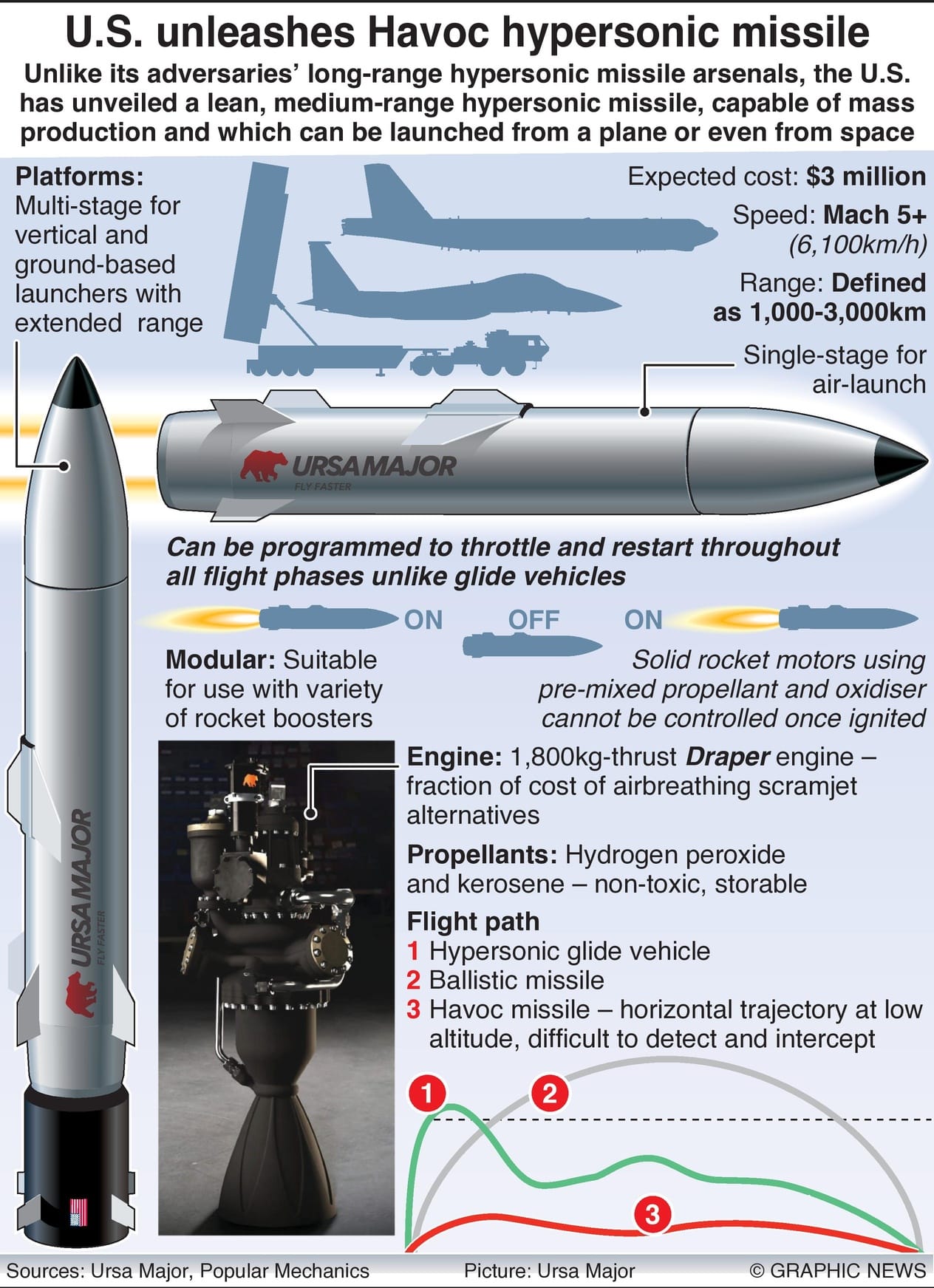
The Ursa Major HAVOC missile system is powered by the company’s Draper engine - a safe, storable tactical liquid rocket engine. Costing a fraction of the cost of airbreathing scramjet alternatives, the Draper engine can also be programmed to throttle and restart throughout all flight phases, unlike glide vehicles or solid rocket motors, which cannot be controlled once ignited. The modular design allows integration with various solid rocket motor boosters, enabling air- or ground-launch capability, extended range options, or even launch from outside the atmosphere.
The U.S. new HAVOC missile is much leaner than anything in Chinese and Russian hypersonic arsenals, which are typically designed to be capable of carrying nuclear warheads. Although U.S. hypersonic missile could also be made nuclear-capable, as a policy this is not usually the case.
U.S. Military Aircraft Leave Second UK Base Over Iran Threat
The U.S. has evacuated military aircraft from a second British air base after a threat from Iran weeks after the Pentagon pulled all its bombers from another RAF base over a suspected Iran-linked plot.
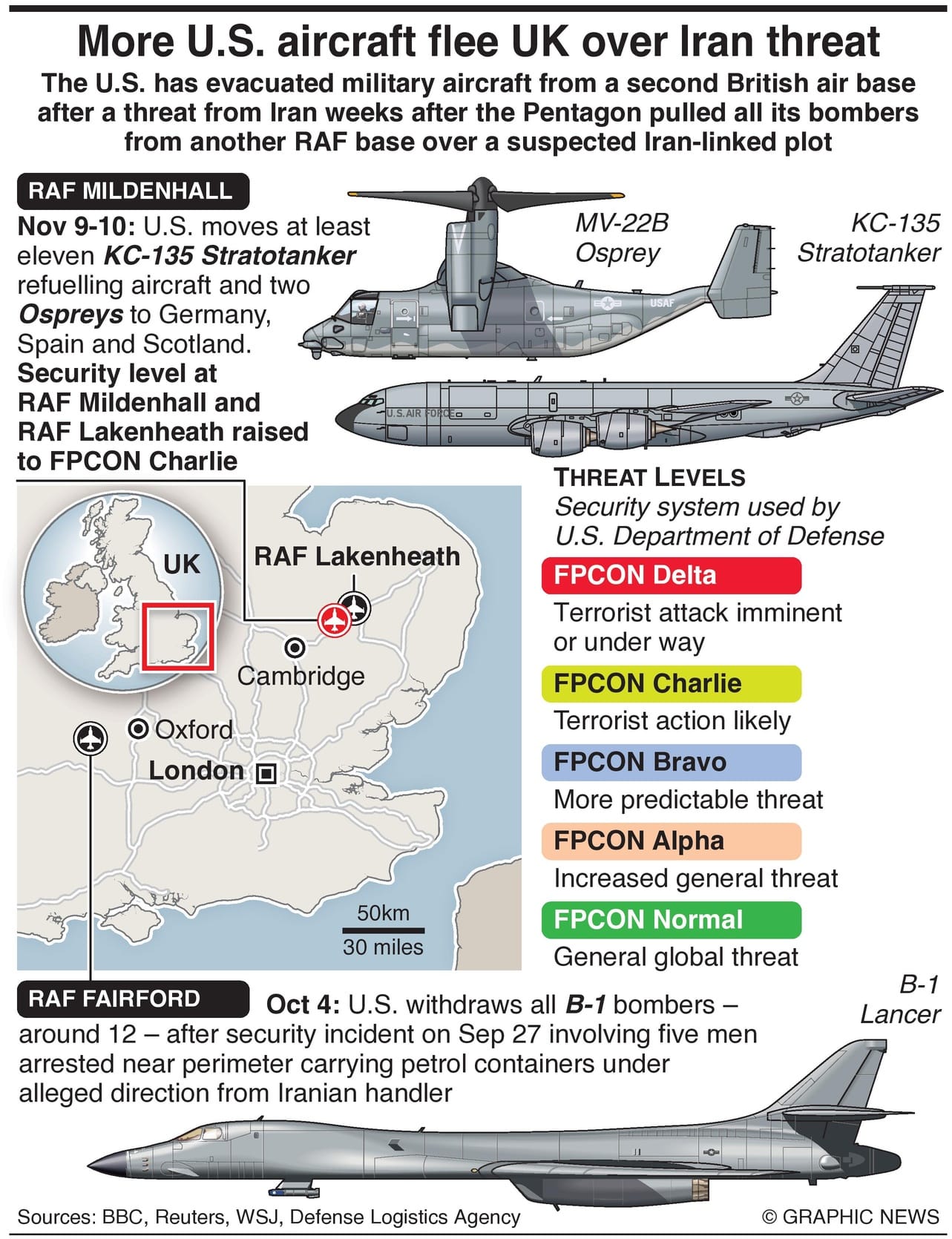
Between Nov 9 and 10, the U.S. has moved at least 11 KC-135 Stratotanker refueling aircraft and 2 Ospreys from RAF Mildenhall to Germany, Spain, and Scotland, according to news media reports.
Security at Mildenhall and nearby RAF Lakenheath was raised to FPCON Charlie, the second-highest level in the Pentagon’s force protection system, indicating a terrorist action is likely.
It is the second British base the U.S. has cleared of aircraft in recent weeks. On Oct 4, about a dozen of its B-1 bombers left RAF Fairford in Gloucestershire. The withdrawal followed the arrest on Sep 27 of five men near the base, where police found petrol in vans but no explosives. Prime Minister Andy Burnham later told parliament the plot was highly likely coordinated in Iran and almost certainly directed by its Revolutionary Guard. Iran denies involvement.
In July, the Guard named Fairford, which the U.S. has used to launch strikes on Iran, among bases it considers legitimate targets.
Pete Hegseth Survives Impeachment Push, For Now
An effort to impeach U.S. Defense Secretary Pete Hegseth has failed in Congress, but Democrats, who won control of both chambers, can revive the push when the new Congress convenes on January 3.

The House voted 211-204 to refer the resolution to committee, which prevents the articles from advancing to the Senate.
Republican Congressman Thomas Massie of Kentucky introduced the resolution, with eight articles of impeachment. He and other lawmakers accuse Hegseth of defying Congress by continuing the war in Iran despite legislative efforts to shut it down.
Three of the articles accuse Hegseth of violating congressional war powers in Iran. The others allege misconduct involving civilian casualties, strikes on suspected drug boats, retaliation against Senator Mark Kelly, the capture of Nicolás Maduro and military operations in Yemen.
Hegseth has dismissed the effort as a “farce” and a “stunt”, and President Donald Trump has said he intends to keep him in the job.
Massie has said the resolution is a “much gentler version” of what Democrats will do once they control Congress. The measure could now serve as the basis for a new impeachment push in January.
🌍 Global Affairs
The world's flashpoints, in motion.
🟥 Divided On The War, Open To A Deal – Editorial Board, TIPP Insights
🟥 Kushner And Witkoff Head To Moscow For Talks With Putin – TIPP News
🟥 Zelenskyy Rejects Territorial Concessions As Ukraine-Russia Peace Talks Stall – TIPP News
🟥 Watch: Zelenskyy Applauds U.S. Shift On Ukraine Peace Strategy – TIPP Video
🟥 Russian Ambassador To US Alexander Darchiev Dies At 66 – TIPP News
🟥 Saudi Arabia Thwarts Fresh Houthi Missile Attack On Capital – TIPP News
🟥 Watch: El Salvador Military Helicopters Strike 400 Mawozo Gang Stronghold In Haiti – TIPP Video
🟥 Watch: Pro-Palestinian Protesters Heckle Joe Biden During Surprise Ireland Visit – TIPP Video
🟥 Watch: 57 Injured In South Korea After Bus Rams Into 32 Vehicles During Rush Hour – TIPP Video
🏛️ National Affairs
The fights shaping America right now.
🟫GOP facing uphill battle in Texas for years to come after Latinos vote for blue surges – Robert Bryce, New York Post
🟫Dems May Have Found a Way Around the Electoral College –James Sieja, RealClearPolitics
🟫Hegseth impeachment vote was never an attack on the troops – Chris Brennan, USA Today
🟫 GOP Lawmakers Shield Trump’s Defense Secretary From Impeachment – TIPP News
🟫 Watch: House GOP Selects Rep. Jim Jordan As Minority Leader – TIPP Video
🟫 Who Is The US Army Officer Arrested In A Russia-Linked Espionage Probe – TIPP News
🟫 Why Was Treasury Secretary Scott Bessent Moved To A Military Base – TIPP News
🟫 Kennedy Family Joins Legal Battle Against Trump's Proposed Washington Arch – TIPP News
🟫 How Did A United Airlines Flight Passenger Trigger A Suspected Hijacking Alert – TIPP News
🟫An Ode to Harmeet Dhillon – Christopher Tremoglie, Washington Examiner
💼 Markets & Business
The deals and tickers making moves.
🟧 What Is Driving The Growing Financial Crisis In The AI Industry – TIPP News
Letters to the editor email: editor-tippinsights@technometrica.com
Subscribe Today And Make A Difference. Consider supporting Independent Journalism by upgrading to a paid subscription or making a donation. Your support helps tippinsights thrive as a reader-supported publication. Contact us to discuss your research or polling needs.
Reach our audience. For sponsorship and advertising opportunities, visit our Partner With Us page.