By S. Alex Yang, Angela Huyue Zhang, Project Syndicate | November 24, 2026
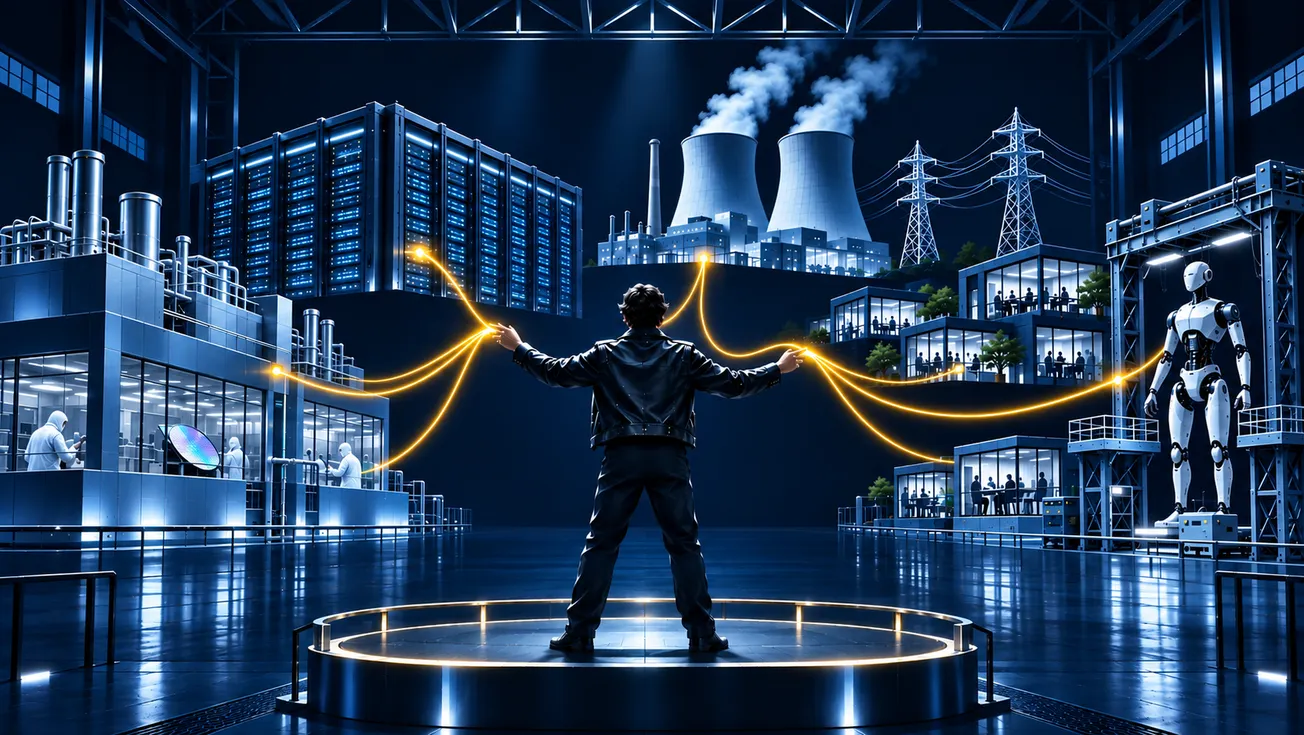
Developing AI requires tremendous coordination across firms and sectors, from the AI labs themselves to energy and computing infrastructure, as well as long-term vision and patience. Whereas much of this coordination and planning is led by the government in China, in the US, it has been driven largely by one CEO.
LONDON/LOS ANGELES—The US–China AI race has often been viewed as a contest between two fundamentally different systems: one driven by a bottom-up market economy, and the other shaped by top-down state planning. But the fallout from Nvidia’s ousting of co-founder and longtime CEO Jensen Huang, and his shock reinstatement within the month, suggests how superficial this distinction can be.
Developing AI requires tremendous coordination across firms and sectors, from the AI labs themselves to energy and computing infrastructure. It also requires long-term vision and patience. In China, much of this coordination and planning is led by the government. In the United States, it has been driven largely by an audacious entrepreneur: Huang.
As our recent research shows, China’s government has borrowed the playbook of commercial platforms to organize its innovation ecosystem. Rather than simply picking winners, it encourages broad entry into the ecosystem and exerts control through shared interfaces, scaling the innovation ecosystem before capturing its gains. This “platform state” model enables the Chinese state to draw on considerable entrepreneurial dynamism while retaining the power to steer innovation toward its strategic goals.
In the US, the private sector has functioned almost as an industrial planner, encouraging different players across the AI supply chain to invest together in the emerging AI economy. No one has been more important to this process than Huang.
Consider the semiconductor supply chain. Chip suppliers are generally very cautious about investing ahead of demand, not only because expanding production is slow and expensive, but also because they fear that the “bullwhip effect”—when small fluctuations in customer demand produce much larger swings in upstream orders—could lead to overcorrection. To conquer hesitation, Huang spent years cultivating relationships with Nvidia’s manufacturing partners, making frequent visits to Taiwan and South Korea and forging close personal ties with top executives at leading suppliers such as TSMC and SK Group.
These suppliers came to trust that Nvidia could generate enough demand to use their expanded capacity. As Huang remarked in an interview, “Nvidia and TSMC don’t have a legal contract.” Likewise, customers trusted that Nvidia would deliver enough supply to meet their needs. Their confidence strengthened that of the suppliers, and vice versa.
Of course, Huang’s powers of persuasion would have quickly waned had he not delivered. So, beyond convincing suppliers to expand production ahead of demand, Nvidia actively cultivated that demand. Perhaps the most famous example of this happened in 2016: Huang personally delivered Nvidia’s first DGX-1 AI supercomputer to what was, at the time, a little-known AI research lab called OpenAI. Today, Nvidia uses its Inception Program to support startups that might become the next OpenAI, offering technical support, discounts on selected chips, cloud credits, and investor connections.
Nvidia has also provided substantial financing support to its customers, helping them to purchase its chips and expand the infrastructure needed to run them. For example, last year, it committed to provide a backstop for CoreWeave, purchasing computing capacity that the cloud provider could not sell to other customers. Nvidia has also offered conditional credit guarantees of up to $105 billion to support a massive data-center development involving OpenAI and SB Energy in Ohio.
These arrangements have attracted considerable criticism as examples of circular financing, raising legitimate concerns about an AI investment bubble. But they can also make economic sense. By sharing risks across complementary businesses, Nvidia can help its customers overcome financing bottlenecks that might otherwise delay AI development.
More broadly, as our research shows, identifying and supporting promising customers can, under certain conditions, accelerate innovation and improve supply-chain efficiency. This can generate positive spillovers across the industry, benefiting competing suppliers as new markets emerge. In a race between innovation ecosystems, these spillovers can become an important source of competitive advantage for the US.
Ultimately, cultivating an innovation ecosystem requires long-term vision and a willingness to invest in technologies whose commercial prospects might not be clear for years or even decades. This kind of patience is unusual, especially for a publicly listed company facing constant pressure to deliver results to shareholders. But under Huang’s leadership, Nvidia has consistently shown it.
For example, in 2006, Nvidia introduced the Compute Unified Device Architecture, a parallel-computing platform that enabled programmers to harness GPUs for general-purpose computing, rather than just graphics processing. CUDA was initially seen as a highly risky bet, requiring years of investment before its commercial prospects became clear. But the gamble paid off, and CUDA has since become one of Nvidia’s most important competitive moats, which strengthens the wider AI ecosystem.
Huang is now playing a similar long game with physical AI, particularly robotics. Nvidia has invested heavily in Omniverse, a platform for developing simulation applications, as well as its Isaac robotics tools and AI models. It is also working with robotics companies to assemble the technological foundations for a nascent industry.
Against this backdrop, it is no wonder that Nvidia’s stock plunged after Huang announced his resignation. Nor is it surprising that those who have pinned their economic fortunes on the success of the company, and the AI sector more broadly, wanted him back at the helm of the company. But it would be a mistake to focus solely on the financial implications of Huang’s return. He is the ultimate architect of America’s AI industrial policy, and with his reinstatement, the US is effectively charting the future course of its innovation strategy.
S. Alex Yang is Professor of Management Science and Operations at London Business School.
Angela Huyue Zhang, Professor of Law at the University of Southern California, is the author of High Wire: How China Regulates Big Tech and Governs Its Economy (Oxford University Press, 2024) and Chinese Antitrust Exceptionalism: How the Rise of China Challenges Global Regulation (Oxford University Press, 2021).
Loved it, hated it, or somewhere in between — tell us. Grade this article here and help shape what lands in your inbox next.
🧭 Power & Capital · November 24, 2026
Where state power meets the boardroom.
🔷 Jensen Huang And The Price Of Losing Genius – TIPP Editorial Board
🔷 Why Are Republicans Opposing Jensen Huang’s Return As Nvidia CEO – TIPP Staff
🔷 Watch: Did Trump's Pressure Force Jensen Huang's Return To Nvidia? – TIPP Staff
🌍 Global Affairs
The world's flashpoints, in motion.
🟥 Report Estimates Over 720,000 Russian Soldiers Killed In Ukraine War – TIPP Staff
🟥 China Sentences Government Official To Death For Spying For Foreign Agent – TIPP Staff
🟥 Watch: Dramatic Scenes As Swimmer Passes Burning Ships In Hormuz – TIPP Staff
🟥 Watch: Bodycam Footage Reveals Dramatic Cartel Kingpin Arrest In Mexico – TIPP Staff
🟥 Watch: Finding Cyprus’s Missing Is Now A Race Against Construction – TIPP Staff
🟥 UK Police Investigate Break-In At Prince William And Kate’s Country Home – TIPP Staff
🟥 Watch: How An Alzheimer’s Patient Was Found Alive In Amazon Rainforest – TIPP Staff
🏛️ National Affairs
The fights shaping America right now.
🟫 Ted Cruz Launches Saving Texas To Rebuild GOP After Democrat Wins – TIPP Staff
🟫 Youngest Member Of Congress Says GOP Must Stop Being ‘Party Of No’ – Virginia Grace McKinnon, The Daily Signal
🟫 Court Clears US Army Plan To Destroy Five Tons Of Unstable Explosives – TIPP Staff
📈 Economy
Prices, policy, and the pressure on your wallet.
🟩 Federal Reserve Official Says More Action Needed To Bring Inflation Down – TIPP Staff
💼 Markets & Business
The deals and tickers making moves.
🟧 Elon Musk’s Tesla And SpaceX Move Forward With Merger Discussions – TIPP Staff
🟧 Sanofi Acquires Insmed In Major Push To Strengthen Respiratory Drug Portfolio – TIPP Staff
🟧 Anthropic Shares Fall Below $83 IPO Price Despite Wall Street Optimism – TIPP Staff
Letters to the editor email: editor-tippinsights@technometrica.com
Subscribe Today And Make A Difference. Consider supporting Independent Journalism by upgrading to a paid subscription or making a donation. Your support helps tippinsights thrive as a reader-supported publication. Contact us to discuss your research or polling needs.
Reach our audience. For sponsorship and advertising opportunities, visit our Partner With Us page.