China’s response to the Iran war has been revealing. Beijing has been careful not to anger Tehran, but even more careful not to provoke Washington.
Iran has long been one of Beijing’s closest partners in the Middle East. China condemned the U.S.–Israeli strikes that killed Ali Khamenei as a violation of Iran’s sovereignty and called for an immediate ceasefire. But its language has remained measured and carefully balanced.
That caution became even more evident when his son, Mojtaba Khamenei, emerged as Iran’s new leader. Beijing offered formal condolences through a lower-level official but stopped well short of any strong endorsement. In strong contrast, Russia moved quickly to signal support.
The tone has remained the same in the weeks since Mojtaba Khamenei’s appointment. On March 9, Foreign Ministry spokesperson Guo Jiakun described the succession simply as “a decision by the Iranian side based on its constitution.” Beijing reiterated its opposition to outside interference and called for respect for Iran’s sovereignty and territorial integrity. At the same time, it avoided any enthusiastic congratulations or political embrace of the new leadership.
There is a reason for the overt restraint.
China’s economic stakes across the Middle East extend far beyond Iran. Beijing’s relationships with Saudi Arabia, the United Arab Emirates, and other Gulf states are far more significant economically than its ties with Iran. China imports vast quantities of oil from these countries and has invested heavily in infrastructure and trade through its Belt and Road Initiative.
The war has put those interests at risk. Iranian retaliation has struck Gulf infrastructure and energy facilities, threatening shipping, oil flows, and regional stability. Chinese officials have responded by emphasizing respect for the sovereignty and security of all states in the region and condemning attacks on civilians and non-military targets without directly blaming anyone.
In a region where instability could disrupt China’s energy supplies, investments, and expatriate communities, Beijing has little incentive to appear one-sidedly aligned with any stakeholder.
But there is another reason for China’s caution. It lies thousands of miles away in Washington.
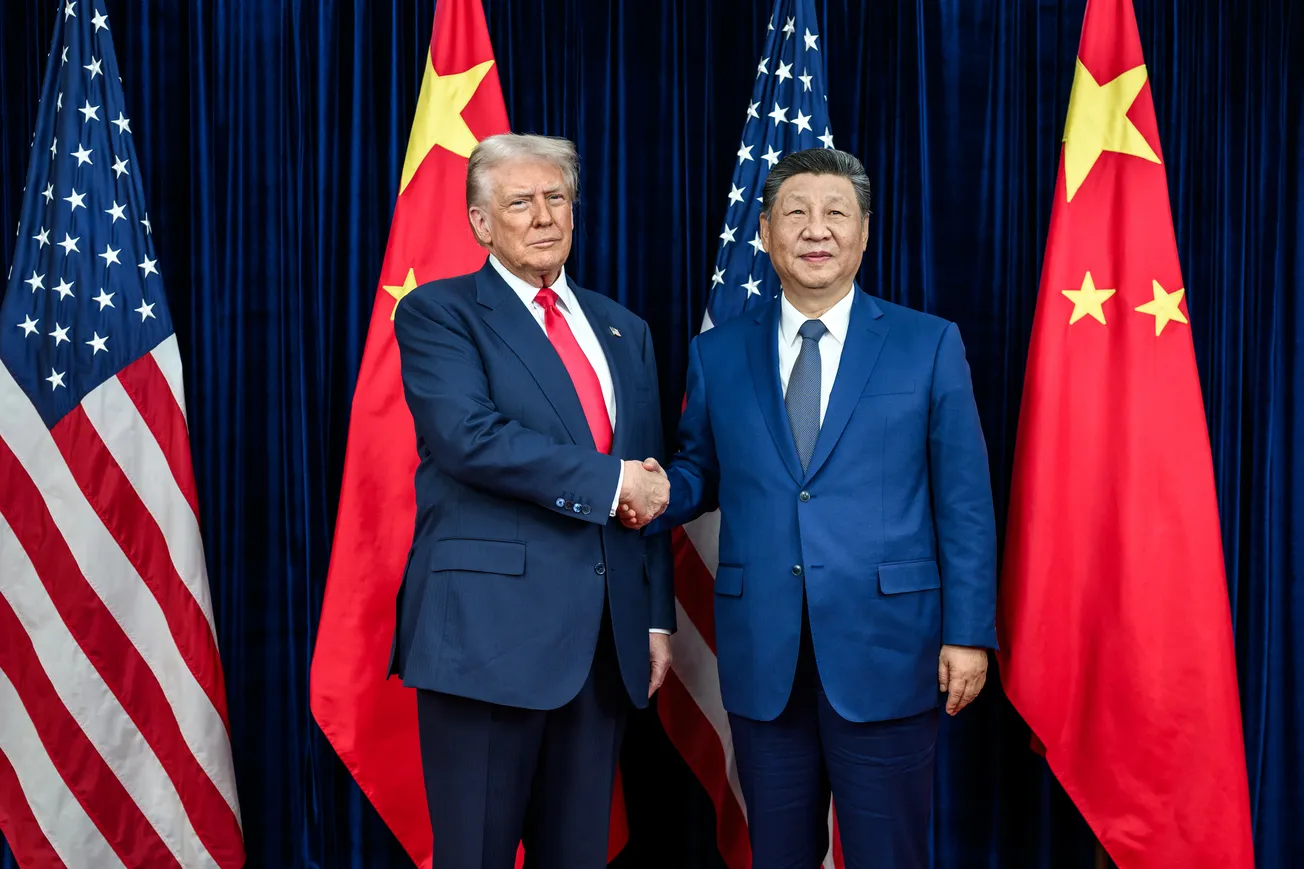
As reported in Nikkei’s “China Up Close” column, President Xi Jinping has been focused on another event: the planned visit of Donald Trump to Beijing later this month. The summit, scheduled for March 31 to April 2, comes at a delicate moment. Trade tensions between the two countries remain fragile, and the war in the Middle East has injected fresh uncertainty into global energy markets and the broader economy.
For Xi, ensuring that the visit proceeds smoothly is far more important than publicly embracing Iran’s new leadership. A strong show of support for Tehran could inflame tensions with Washington and complicate a summit Beijing views as essential for stabilizing relations.
This episode highlights the limits of what is often described as a China–Iran “axis.”
Relations between the two countries are undeniably close. Since the 1980s, China has supplied Iran with military equipment, dual-use technology, and industrial materials, while Iran has sold large volumes of crude oil to Chinese buyers. In 2021, the two governments signed a 25-year cooperation agreement to expand economic ties.
China has continued to deepen its practical ties with Tehran. Analysts believe military and technical assistance has continued during the conflict, and Iran has gained access to China's BeiDou satellite navigation system, reducing its reliance on Western-controlled GPS. As SpecialEurasia has argued, confrontations involving Chinese-supplied systems give Beijing a chance to observe how its technology performs against U.S. capabilities, valuable insights that could be relevant to the scenario China worries about most: a future crisis over Taiwan.
None of this contradicts Beijing’s diplomatic caution. If anything, it helps explain it. China appears to be pursuing a familiar strategy: providing enough quiet support to preserve its relationship with Iran while avoiding the kind of overt alignment that could provoke Washington and jeopardize the upcoming Trump–Xi summit.
But the China-Iran partnership has always been transactional rather than strategic. China has never offered Iran security guarantees. Nor does it share a military alliance with Tehran. The relationship rests primarily on trade, mutual convenience, and a shared opposition to Washington.
The contrast with Russia’s behavior during the crisis is telling. Russian President Vladimir Putin quickly offered condolences and congratulations after the change in Iran’s leadership.
China’s priorities help explain why. Beijing is navigating a difficult economic environment at home, marked by slowing growth and mounting pressure to stabilize trade and investment.
Under these circumstances, maintaining a manageable relationship with the United States remains a central objective of Chinese foreign policy. Iran may be an important partner, but the U.S. relationship is vastly more consequential for China’s long-term economic and strategic interests.
The crisis in the Middle East has therefore revealed something important about the hierarchy of Beijing’s priorities.
Despite decades of cooperation with Iran, China has little interest in being drawn too deeply into the conflict. Its statements emphasize restraint and diplomacy and call for a ceasefire rather than aligning with Tehran.
China will not abandon Iran. The two countries will continue trading oil and cooperating where their interests overlap. But the war has made clear that the relationship has its limits.
When forced to balance between solidarity with Tehran and stability with Washington, Beijing has chosen caution.
Editor’s note:
This article is Part III of a series examining China’s position in the Iran war. Part I, “The Dragon’s Fragility,” and Part II, “What’s Behind Beijing’s Restraint?” explore the geopolitical and economic forces shaping Beijing’s cautious response.
👉 Show & Tell 🔥 The Signals
I. Minneapolis Office Values Collapse As Vacancies Soar
Commercial office prices in Minneapolis have plunged as demand for downtown space weakens.
- Ameriprise Financial Center: $6.25M vs $200M in 2016 (↓97%)
- Wells Fargo Center: $85M vs $314M in 2019 (↓73%)
- Forum: $6.5M vs $73.7M in 2019 (↓91%)
- Kickernick Building: $3.79M vs $19.15M in 2017 (↓80%)
- Lumber Exchange: $1M vs $24.3M in 2019 (↓99%+)
Vacancy rates remain extremely high across the metro area, particularly in the central business district (CBD), the downtown office core.
- Minneapolis–St. Paul vacancy: 22.2%
- Minneapolis CBD: 32.6%
- St. Paul CBD: 33.1%
Source: Cushman & Wakefield | Via: @FCNightingale on X
II. U.S. Interest Payments Now Rival Defense Spending
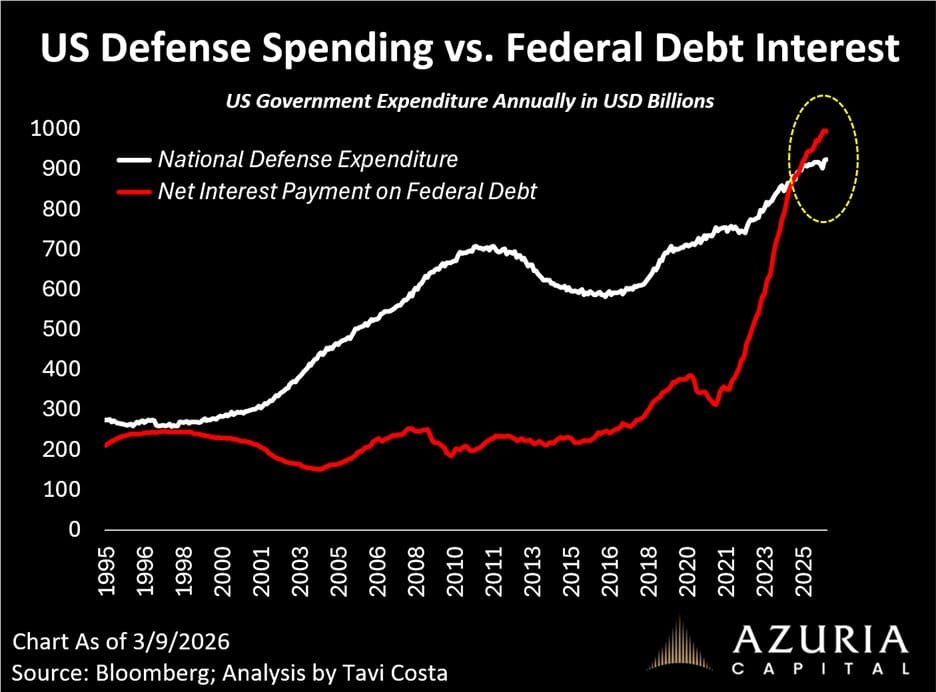
America’s rising debt burden is driving a surge in interest costs. Net interest payments on the federal debt are now approaching the size of the entire U.S. defense budget, highlighting how higher interest rates are rapidly increasing the government’s financing costs.
If borrowing costs remain elevated, interest payments could become one of the largest items in the federal budget, limiting fiscal flexibility for other priorities.
The TIPP Stack
Handpicked articles from TIPP Insights & beyond
1. A MAGA Split Over Iran? What MAGA Split?—Victor Davis Hanson, The Daily Signal
2. Choke Point: The Global Economic Consequences Of The Persian Gulf Shutdown—Larry C. Johnson, Ron Paul Institute for Peace and Prosperity
3. War On Iran – Oil Prices Lag Supply Deficit – Arab’s Won’t Fight Iran – Khamenei Son Succeeds Father— Moon of Alabama, Ron Paul Institute for Peace and Prosperity
4. What If Iran Says No?— Ashes of Pompeii, Ron Paul Institute for Peace and Prosperity
5. Gangster Foreign Policy— George D. O’Neill, Jr., Ron Paul Institute for Peace and Prosperity
6. ‘We’ve Obliterated Their Missiles’— Gerry Nolan, Ron Paul Institute for Peace and Prosperity
7. As Congress Looks On, President Trump Rules By Decree— Adam Dick, Ron Paul Institute for Peace and Prosperity
8. Republicans Prefer War To The US Constitution And To Truth— Paul Craig Roberts, Ron Paul Institute for Peace and Prosperity
9. Uncle Bibi’s War — And America’s Bill—Brian D. O’Leary, Ron Paul Institute for Peace and Prosperity
10. Who Owns The Middle East?— Vincent Cook, Mises Wire
11. Launching A War On Iran Was No Act Of Courage— Connor O'Keeffe, Mises Wire
12. Hegseth: Iran’s Leader ‘Wounded And Likely Disfigured’—George Caldwell, The Daily Signal
13. Silent Attacks On Personal Freedom—Andrew P. Napolitano, Ron Paul Institute for Peace and Prosperity
14. The Duke Lacrosse Case 20 Years Later: How Durham Law Enforcement Promoted A Criminal Conspiracy—William L. Anderson, Mises Wire
15. Rothbard’s Defense Of Border Control —David Gordon & Wanjiru Njoya, Mises Wire
16. Will Aliens Trigger The Next Financial Crisis?— George Pickering, Mises Wire
17. The Robot Won’t Take Your Job. The Government Might—Attila Rebak,Mises Wire
18. The Madness Of King Trump: War Games, War Crimes And A Wrecking Ball Presidency—John W. And Nisha Whitehead, Ron Paul Institute for Peace and Prosperity
19. Iran’s New Supreme Leader Issues First Statement— Virginia Allen, The Daily Signal
20. End the Harmful Time Change Ritual—Jeff Crouere, The Daily Signal
21. Only Power Can Check Power—Ryan McMaken, Mises Wire
22. Appeals Court Hands Trump Major Win In High-Stakes Deportation Fight—Fred Lucas, The Daily Signal
23. Trump Says High Oil Prices Will Make US ‘A Lot Of Money’—Elizabeth Troutman Mitchell, The Daily Signal
24. Mace Leads American Rescue Effort In Israel Amid Iran War—Pedro Rodriguez, The Daily Signal
25. GOP Senator Fights For Life On Capitol Hill—Virginia Grace McKinnon, The Daily Signal
26. US Sues California Over Zero-Emission Vehicle, Greenhouse Gas Rules—David Shepardson, The Daily Signal
27. ‘RIPPING US OFF’: Tim Burchett Blames Oil Companies’ ‘Greed’ For Higher Prices—Pedro Rodriguez, The Daily Signal
28. Republicans Work On Megabill Game Plan—George Caldwell, The Daily Signal
29. Deportation Showdown Escalates After Court Halts Block On Trump Policy— Fred Lucas, The Daily Signal
30. Suspect Dead In Detroit-Area Synagogue Shooting, No Other Casualties Reported— Daily Signal Staff, The Daily Signal
31. No Other News Network Can Catch Fox News Right Now—Rob Bluey, The Daily Signal
32. Inside CSWF: Pro-Family Conference Offers Alternative To UN’s Women’s Agenda—Reagan Campbell, The Daily Signal
33. Florida Passes Voter ID Bill As National SAVE Act Stalls—Pedro Rodriguez, The Daily Signal
34. ‘URGENT’: Chip Roy Demands Probe Into Leftist Activist Groups After Their Leaders Meet With Cuban Communist Politburo—Tyler O'Neil, The Daily Signal
35. Deleting The State: Skoble’s Deleter—David Gordon, Mises Wire
36. Super PAC Launches $100 Million Strategy To Bolster MAHA Candidates In Midterms— Elizabeth Troutman Mitchell, The Daily Signal
37. Revisiting Colonial Massachusetts And Mises’s Taxonomy Of Money—Joshua Mawhorter, Mises Wire
editor-tippinsights@technometrica.com