Editor's Note
The United States has entered a consequential new phase in its long confrontation with Iran. Supporters see a decisive move against a regime that has destabilized the Middle East for decades. Critics warn that regime change through military force carries historic risks. In moments of high consequence, serious debate matters. Below, two experienced observers offer sharply different assessments of what this moment may bring.
Trump’s Risky War Of Choice In Iran
By Richard Haass, Project Syndicate | March 1, 2026
Once again, the US has opted to make a massive strategic commitment in the Middle East. But while it takes only one side to begin a war, it takes two to end it – and Iran now has a vote in how big this conflict becomes and how long it continues.
NEW YORK – There is much that can be said about the United States’ decision to attack Iran – and about what could result from the joint US and Israeli strikes against military and political targets throughout the country. Unfortunately, little of it is reassuring.
First and foremost, this is a war of choice. The US had other policy options available. Diplomacy appeared to hold promise as a means to prevent Iran from developing nuclear weapons. Increased economic pressure had the potential over time to precipitate regime change.
Moreover, this is a preventive war, not a preemptive one. Iran posed no imminent threat to vital US interests. Iran was not on the verge of becoming a nuclear weapons state or using what weapons it did have against the US. At most, the threat posed by Iran was a gathering one.
This distinction is important. A world in which countries believed they have the right to undertake preventive strikes against those they judge to be threats would be a world of frequent conflict. That is why such actions have no standing under international law.
US President Donald Trump has chosen an objective – regime change – that is political rather than military. But while military force can destroy and kill, on its own, it cannot bring about regime change, which requires the regime to collapse. It is possible that the US attack will trigger defections from Iran’s political leadership and armed forces, but this cannot be counted on. Hamas and Gaza are a reminder that regimes can absorb incredible punishment yet cling to power. And even if the clerics fall from power – Supreme Leader Ayatollah Ali Khamenei has been killed – the security forces are arguably best positioned to take their place.
In any case, using military force to kill select leaders as a means of triggering regime change – a tactic often called decapitation – is unlikely to succeed in Iran, where the leadership has institutionalized itself since taking power nearly a half-century ago. Moreover, the leadership has had time to improve succession planning over the past few weeks as the possibility of war increased.
During its January incursion into Venezuela, the Trump administration limited itself to replacing one leader (all but ignoring the internal opposition), while in much of the world, it has avoided pressing for democracy. In the case of Iran, though, Trump has called for regime change – but without preparing the ground for it. The political opposition is not united or functioning as a government in waiting, which means that it is unable to accept defections, much less provide security.
History suggests that regime change requires a physical, on-the-ground presence. This is the lesson of Germany and Japan after World War II, and Panama, Iraq, and Afghanistan more recently. And even with a ground presence, such efforts often come up short. In Iran, occupation is inconceivable, given the country’s size and ability to resist.
All of which is to say that the Trump administration has chosen to accomplish the most ambitious of foreign-policy goals with limited means. It seems to have rejected a war of choice with narrower goals, such as degrading known Iranian nuclear and ballistic missile capabilities, even though it could credibly claim to have achieved these ends. If there is a recent parallel to what is taking place in Iran, it is Libya, where just over a decade ago Western forces ousted the leadership using air power but then withdrew, leaving the country in chaos.
In the Iranian case, it appears that assembling a massive military presence – what Trump called an armada – ended up putting pressure on the administration to act, because US forces could not be maintained in a high state of readiness on location indefinitely. As a result, the means of policy (military force) may well have played a large role in determining the ends of policy, namely, the decision to attack. This is obviously the reverse of how policy should be decided.
Taking a step back, the US has opted yet again to make a massive strategic commitment in the Middle East. This is at odds with the Trump administration’s own National Security Strategy and with the reality that the greatest challenges to US interests are to be found in Europe and the Indo-Pacific. Here, the parallel is to the 2003 Iraq War, another preventive war of choice in the region that cost the US enormously.
The American people are unprepared for this war. Nor is Trump’s political base, as it will unsettle markets, cause a spike in energy prices, and could go on for some time. America’s allies are unhappy as well, as Iran has already attacked several neighboring countries and could take steps that damage their economies. Trump did not use his State of the Union speech Tuesday night to make the case for attacking Iran, and much of his statement in the immediate aftermath of Saturday’s attack emphasized past actions by Iran rather than new or emerging threats.
It is possible that last year’s cost-free bombing of three Iranian nuclear sites and the more recent intervention in Venezuela made Trump and those around him highly confident that they could achieve ambitious ends with limited means at a low cost. He may also have been tempted to achieve something historic in Iran – regime change – that eluded his predecessors. He may still succeed. But as a rule, regime change is easier called for than successfully carried out. While it takes only one side to begin a war, it takes two to end it. Iran now has a vote in how big this conflict becomes and how long it continues.
Richard Haass, President Emeritus of the Council on Foreign Relations, senior counselor at Centerview Partners, and Distinguished University Scholar at New York University, previously served as Director of Policy Planning for the US State Department (2001-03), and was President George W. Bush's special envoy to Northern Ireland and Coordinator for the Future of Afghanistan. He is the author of The Bill of Obligations: The Ten Habits of Good Citizens (Penguin Press, 2023) and the weekly Substack newsletter Home & Away.
The Case For Decisive Action In Iran
By Larry Kudlow, Fox News | March 2, 2026
‘America is backing you with overwhelming strength and devastating force,’ President Trump tells Iranians.
President Trump’s unleashing of “Operation Epic Fury” on Iran will change the course of history.
He has done what no president in the last 50 years was willing to do: go after the despotic, terrorist enemy of Western Civilization, namely Iran and their Mullah regime.
And by doing so, with our military might, working with our great friend Israel, Mr. Trump can rid the world of one of the most evil regimes in history.
And he can bring peace and freedom and prosperity, not only to the Middle East, but to the entire Western World.
Mr. Trump’s brave and courageous move is likely to bring results similar to the Berlin Wall coming down. A move unleashed by Ronald Reagan’s crusade against Soviet Communism.
At that time, all of the Iron Curtain countries were liberated and freed from Russia’s tyranny. People blinked and communism was gone.
With Mr. Trump’s determination to see it through, in four or five weeks the old evil Iranian empire will be gone.
Now there are many, many reasons to end the Iranian regime — taking out their nuclear capability, take out their missile building, their terror financing, their entire military — but at the end of the day, I believe Mr. Trump’s “Epic Fury” is about restoring civilized value and civilized behavior in the Middle East.
My friend Conrad Black, writing in the New York Sun, puts it this way: “The world’s foremost terrorism-sponsoring state is about to cease to exist, and the war on terror that was unofficially launched on September 11, 2001, in the ashes of the World Trade Center, will substantially be won.”
And this is no forever war, as Trump critics keep complaining.
Yet the scale and scope of geopolitical change because of Mr. Trump’s courage is almost intellectually immeasurable. While all of the gulf states are behind him, and even the large European nations reluctantly supporting, we have heard nary a peep from China or Russia. They are the big losers in America’s epic fury. Communist China will lose its cheap discounted oil.
Russia will lose its Iranian-made drones. Both countries will have lost all of their Middle East influence.
Meanwhile, a very similar story of Sino-Russian lost influence is occurring in South America with Mr. Trump’s pathbreaking move in Venezuela. And after watching the use of America’s military might, I would think China will surely be thinking twice or maybe five times more about invading Taiwan.
Finally, Mr. Trump issued a clear message to the people of Iran, that a historic moment of freedom is there if they can seize it: “Finally, to the great, proud people of Iran, I say tonight that the hour of your freedom is at hand.”
He added: “America is backing you with overwhelming strength and devastating force. Now is the time to seize control of your destiny and to unleash the prosperous and glorious future that is close within your reach. This is the moment for action. Do not let it pass”
Yes indeed, the battle is always about freedom and liberty for mankind; there is nothing more important. Bravo President Trump.
Lawrence Kudlow is a Fox News Media contributor and host of both “Kudlow” on weekdays and the nationally syndicated “Larry Kudlow Show” each Saturday. This column is adapted from his monologues on “Kudlow.”
👉 Show & Tell 🔥 The Signals
I. U.S.-Israel War On Iran Spreading Across Region
The U.S.-Israeli air campaign against Iran has intensified, with the conflict expanding to Lebanon as Israel responds to strikes by Hezbollah, while Tehran fires missiles and drones at Israel, Gulf states, and a British air base in distant Cyprus.
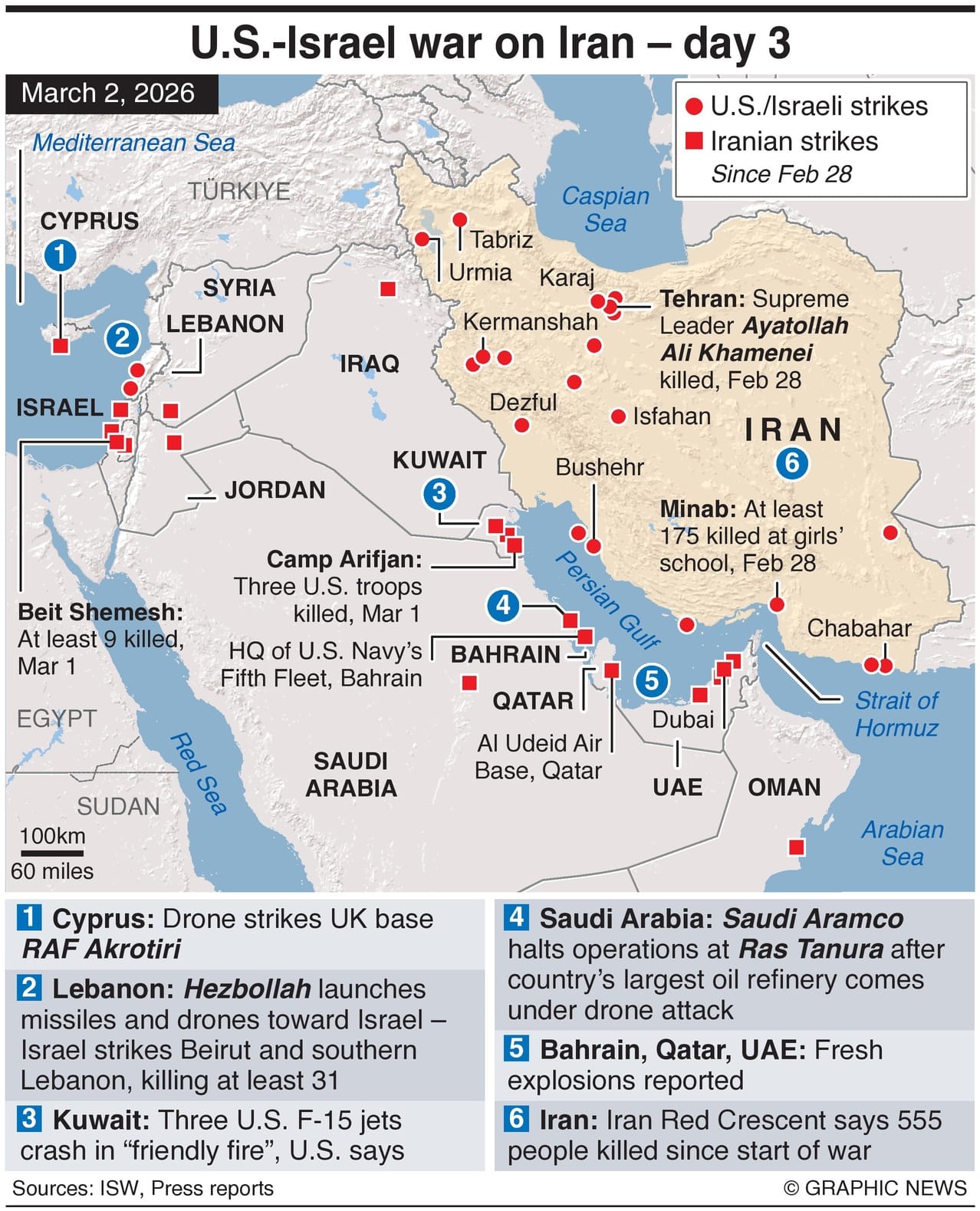
In Saudi Arabia, an oil refinery was hit, but officials report that the resulting fire is now under control.
The U.S. Central Command confirmed a separate incident in Kuwait, where three F-15 jets flying in support of Operation Epic Fury, the U.S. operation against Iran, went down due to an apparent friendly fire incident. All six crew members ejected safely and have been recovered.
The Iran Red Crescent has reported that the war has so far claimed 555 lives since its outbreak.
The conflict shows no signs of abating, as multiple fronts across the Middle East continue to escalate, drawing in regional powers and raising fears of a wider confrontation.
II. Energy Prices Spike With Strait Of Hormuz At Standstill
International shipping has come to a standstill at the Strait of Hormuz,the critical waterway through which some 20% of the world’s oil and gas is transported, pushing oil prices up 10% while gas has soared by 40%
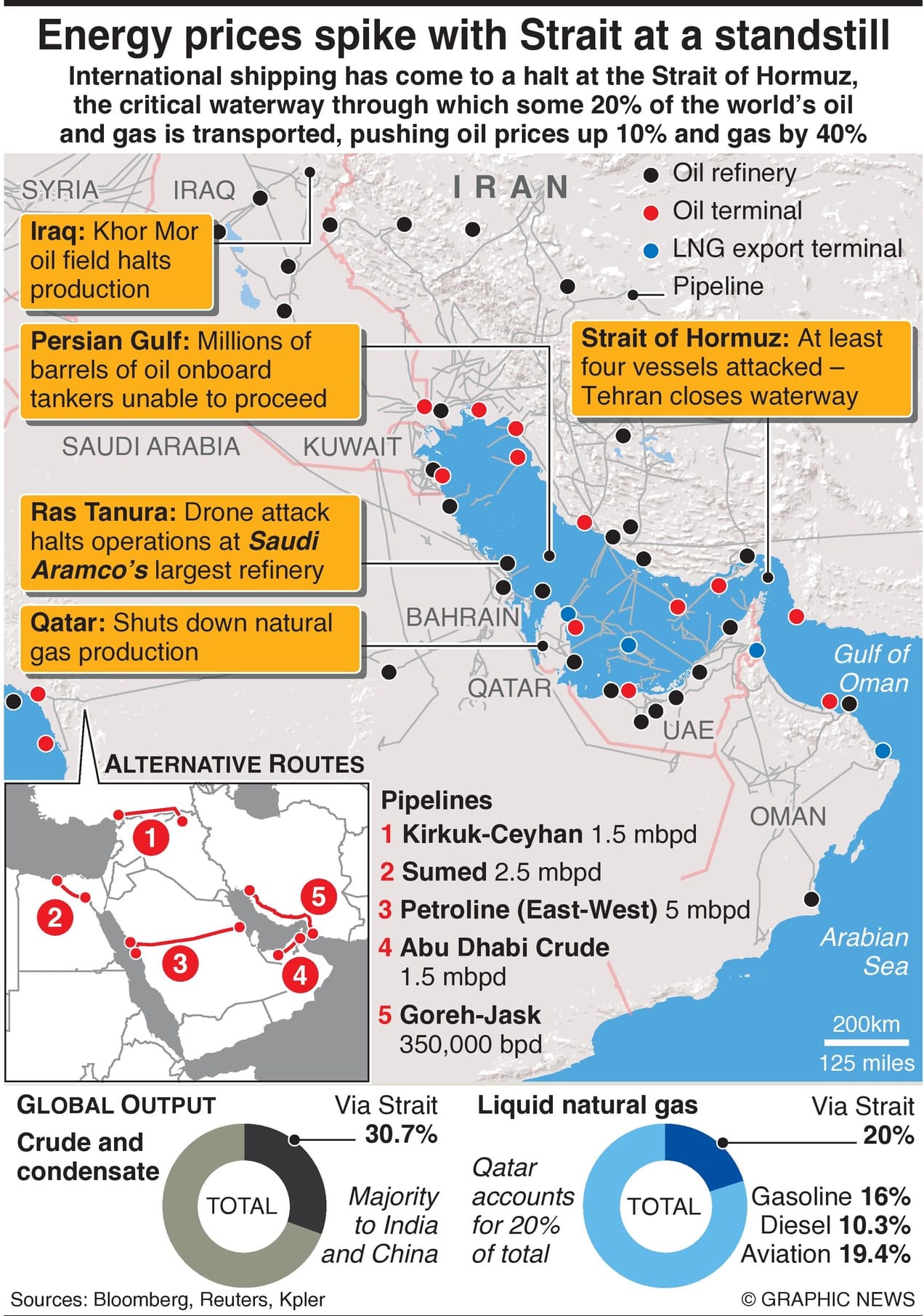
At least four vessels have been attacked, and while a formal closure has not yet been announced, Tehran has warned shipping not to attempt pass through the Strait.
The passageway is vital to global energy markets, carrying about a fifth of the world’s total oil consumption, with more than 20 million barrels a day of crude, condensate and refined fuels transiting the passage on average in 2025, according to the EIA.
Some 30% of crude and condensate passed through the Strait, 16% of gasoline, 10.3% of diesel, 19.4% of aviation fuel and some 20% of liquid natural gas. Qatar, which accounts for about a fifth of the world natural gas, all of which is transported via the Strait, has shut down production. Ras Tanura, Saudi Arabia’s largest oil refinery has also ceased operation following a drone attack.
The TIPP Stack
Handpicked articles from TIPP Insights & beyond
1. Israel Declares State Of Emergency As Iran Fires Missiles—Alexander Cornwell, The Daily Signal
2. Hegseth Pronounces ‘Weakness’ And ‘Wokeness’ Dead In US Military—Virginia Allen, The Daily Signal
4. ‘Spiral Of Violence’: Pope Calls For Diplomacy After Iran Strikes— Fred Lucas, The Daily Signal
5. Rubio Demands UN Reckoning As US Reasserts Sovereignty—Rachana Chhin, The Daily Signal
6. Trump Says Khamenei Is Dead. What Happens Now In Iran?— Virginia Allen, The Daily Signal
7. What Is ‘Operation Epic Fury’—And How Far Will The Iran Operation Go?—Jasper Ward, The Daily Signal
8. Bloodshed And Bluster: US Confirms Casualties As Iran And Trump Trade Threats— Fred Lucas, The Daily Signal
9. Ignore The Rich, Don’t Loot Them—Gary Galles, Mises Wire
10. Spanberger And Dems Lie About Gerrymandering Scheme—Rep. Ben Cline, The Daily Signal
11. Minnesota Church Invasion Leader Slapped With Ethics Complaint— Tyler O'Neil, The Daily Signal
12. Trump Reminds Americans That All Policy Is Family Policy—Delano Squires, The Daily Signal
13. Exposing The Hidden Bias In Political And Historical Questions— Wanjiru Njoya, Mises Wire
14. What Clinton Told House Panel About Trump In Epstein Testimony—Fred Lucas, The Daily Signal
15. The Psychological Walls To Freedom—Christopher Day, Mises Wire
16. Gavin Newsom’s Toddler Tax Will Raid Kids’ Trump Accounts— Rachel Loren, The Daily Signal
17. Russia Operating ‘Systematic Child Abduction Operation,’ EU Ambassador Says— Virginia Allen, The Daily Signal
18. Congress Reacts To Iran Attack: Fetterman Praises, Jeffries Cautions— Daily Signal Staff, The Daily Signal
19. ‘The Hour Of Your Freedom Is At Hand’: President Trump’s Statement On Iran— Daily Signal Staff, The Daily Signal
20. Dozens More Arrested In Cities Church Invasion Case—Tyler O'Neil, The Daily Signal
21. The State of Our Journalism Is Viciously Anti-Trump— Tim Graham, The Daily Signal
22. How The Heartland Is Reacting To Trump’s State Of The Union—Rebecca Downs, The Daily Signal
23. Amid Shutdown, 5 Major Homeland Security Responsibilities Are Unfunded—George Caldwell, The Daily Signal
24. Spanberger’s Subtext: What The Governor’s Rebuttal Really Reveals—Joe Thomas, The Daily Signal
25. Virginia School Board Settles With Boys Punished Over Locker Room Dispute—Fred Lucas, The Daily Signal
26. Trump Spoke For Nearly 2 Hours, But Who Was Really Watching?— Katherine Matt, The Daily Signal
27. Georgia Voters Support SAVE America Act—Even As State’s Democrat Senators Oppose It— Reagan Campbell, The Daily Signal
28. House Republicans Slam Senate For Dog Parade— George Caldwell, The Daily Signal
29. Britain’s Fragile Vote—risten Ziccarelli, The Daily Signal
📊 Market Mood — Tuesday, March 3, 2026
🟥 Futures Tumble as Mideast Conflict Widens
U.S. futures drop sharply after Iranian retaliation expands regional tensions, heightening global growth fears.
🟧 Oil Surges on Strait of Hormuz Threats
Crude jumps over 7% as threats to Gulf shipping lanes raise fresh supply disruption risks.
🟨 Inflation Shock Clouds Rate Outlook
Rising energy prices fuel concerns that central banks, including the Fed, may delay rate cuts.
🟦 Target Earnings to Test Consumer Resilience
Retail results today will offer insight into spending trends as households grapple with higher costs.
🗓️ Key Economic Events — Tuesday, March 3, 2026
No Events Scheduled
editor-tippinsights@technometrica.com