

Everywhere one looks these days - and certainly after the New York mayoral election - the term ‘affordability’ has become ubiquitous.
The liberal media, which ignored the horrors of Biden's inflation and the extremely irresponsible statements of officials like then-Treasury Secretary Janet Yellen, who said that "inflation was transitory," has launched a 24/7 campaign against the Trump administration on affordability.
The country is barreling towards a Dec 31 deadline, with Congress and the Trump administration still at odds over a reprieve on tax credits, without which the cost of Obamacare could explode. In such a context, a new study by Posh Peanut, a children's clothing brand, shows that in most of America, the cost of raising children is dramatically outpacing family incomes, fundamentally altering the economic calculus of parenthood and forcing ordinary families to make impossible choices.
The research analyzed the cost of raising a young child in 2025 versus 2015, including childcare, housing, food, healthcare, and transportation. Each category represents a fundamental necessity. Yet when combined, these essential expenses increasingly devour family paychecks, leaving little room for the unexpected car repair, the medical emergency, or the simple dignity of modest savings. Using price and household income figures from both periods, the study measured how much of the family's paychecks go toward baby expenses. States where these costs now take up a larger portion of income ranked highest, highlighting where affordability has worsened most for parents.
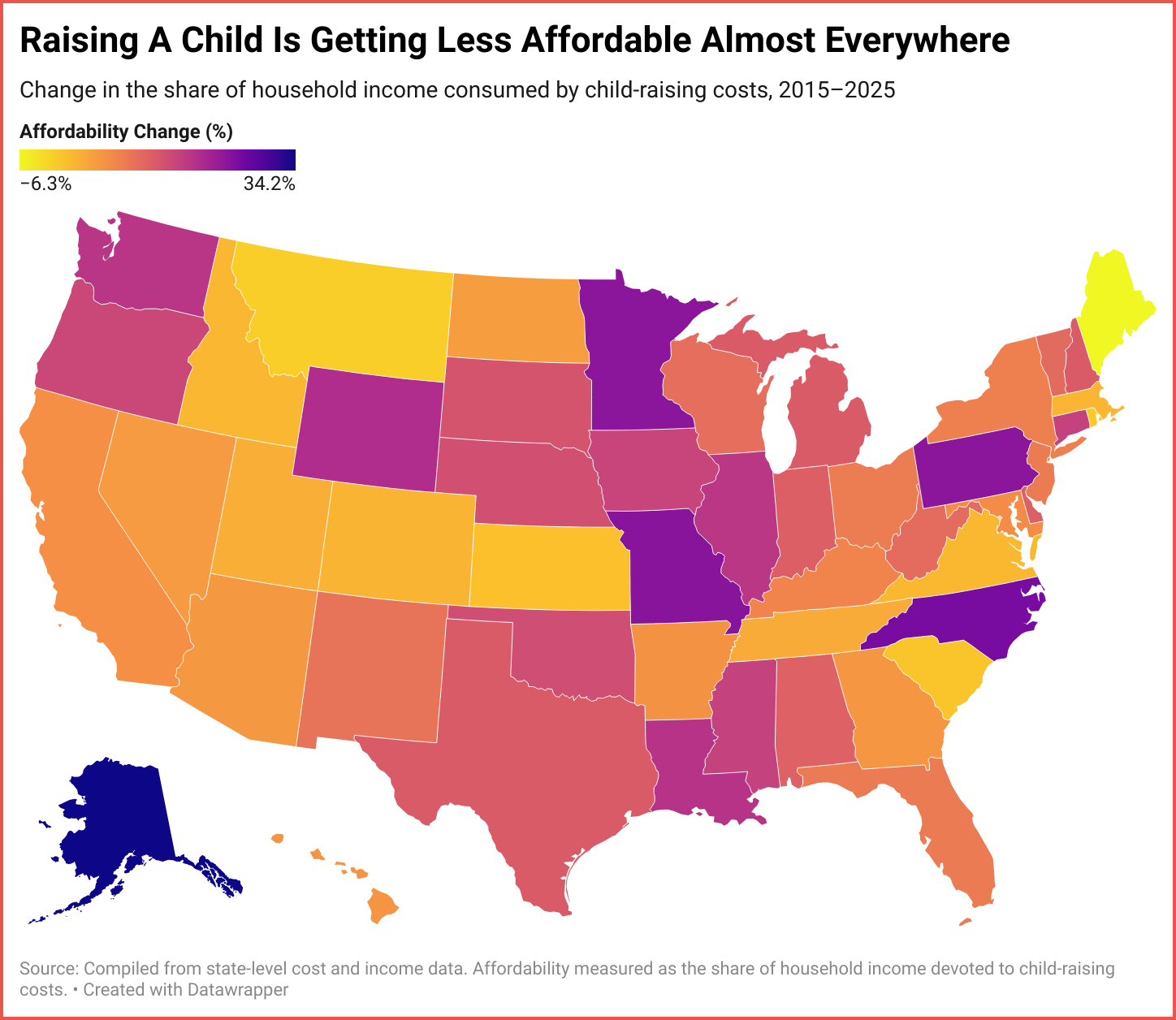
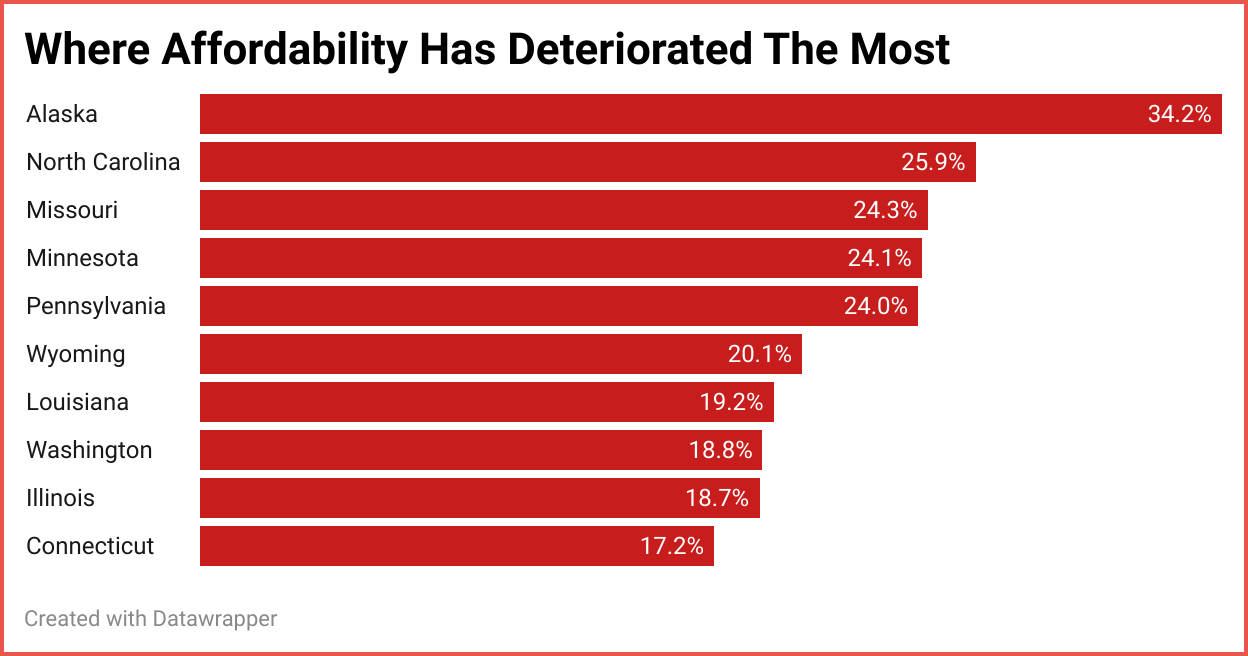
Alaska, North Carolina, Missouri, Minnesota, Pennsylvania, and Wyoming top the list of states where raising a child is 20% more expensive than it was 10 years ago. Alaskan families struggle the most, with children's expenses now consuming a staggering 34% more of household income than a decade ago. In South Carolina, Rhode Island, Montana, and Maine, it is actually more affordable today to raise children than it was ten years ago. The full 50-state ranking is here.
The American dream once promised that each generation would do better than the last, that hard work would secure a comfortable life, and that raising a family was an achievable aspiration for the middle class.
Childcare alone has become prohibitively expensive across much of the nation, often rivaling or exceeding college tuition costs. Working parents need employment to afford their children, but childcare costs often consume an entire paycheck, making it economically irrational for one parent to hold a job.
Housing costs compound the pressure. Young families need space, safe neighborhoods, and access to decent schools. Yet in most markets, these basic requirements command premium prices that have skyrocketed over the past decade. Food prices have similarly surged, and healthcare costs—always America's unique burden—continue their relentless climb, with pediatric care and family insurance premiums stretching budgets to the breaking point.
When we layer these escalating costs atop stagnant or barely growing wages, we create an economic environment fundamentally hostile to family formation. The data doesn't lie: young Americans are delaying parenthood, having fewer children, or foregoing parenthood entirely—not because they don't want families, but because the mathematics of modern American life make it financially unaffordable.

It is little wonder that fertility rates have declined to historic lows. An aging population requires younger workers to sustain social programs and economic growth.
America faces a choice. We can continue the current trajectory, watching affordability deteriorate further, birth rates decline, and families struggle under impossible financial pressure. Behind every percentage point are real families making heartbreaking calculations about whether they can afford another child, whether both parents can work, and whether they can provide their children with opportunities they themselves once took for granted.
The Democratic Party's way has been to throw money at the problem, money that we don't have, and money that we must borrow.
A more innovative approach is to implement policy changes at every level of government to reduce long-term structural costs. President Trump must be congratulated for his vision here.
Consider transportation costs, a key component of a family's budget. President Trump has made impressive gains in bringing down the cost of owning a vehicle. His recent instructions to his transportation department to end EV subsidies and impossible CAFE standards will rescue automakers from a decade of government overreach.
Energy costs drive most other bills at the kitchen table, including home heating, electricity prices, and grocery prices. By relentlessly pursuing more drilling, opening more federal lands to leasing, and approving pipelines, gas prices at the pump are now among the lowest in over 5 years.
But Trump cannot do it all alone.
We return to the issue of spiraling healthcare costs and lower enrollee participation in Obamacare. The debate in Congress last week centered on the same old tried methods - of extending tax credits (Democrats) or making a $1,500 contribution to Healthcare Savings Accounts (Republicans). Both are band-aid solutions that will cost the Treasury billions of dollars but will not make a dent in affordability.
As our columnist and an Editorial Board member wrote recently, we need to eliminate the mandated benefits that Obamacare guarantees for everyone.
Obamacare's mandates force women who have passed childbearing age and men to pay for maternity and newborn care benefits. Couples without children have to pay for pediatric services, including oral and vision care. People who don't indulge in the use of substances or have this behavior well controlled are forced to pay for disorder services. People who are otherwise physically fit, such as younger adults, have to pay for rehabilitative services and devices. They also have to pay for chronic disease management care.
The above rules are nonsensical when families are facing ever-increasing healthcare costs. If Congress passed this simple Obamacare fix - of allowing enrollees to only pay for what they need - the Affordable Care Act would truly live up to its name and make raising children more affordable.
👉 Quick Reads
I. How Vladimir Putin Is Causing Chaos All Over Europe
According to a tally from the Associated Press, Western officials accuse Russia and its proxies of orchestrating around 140 attacks and other incidents across Europe since the invasion of Ukraine began.

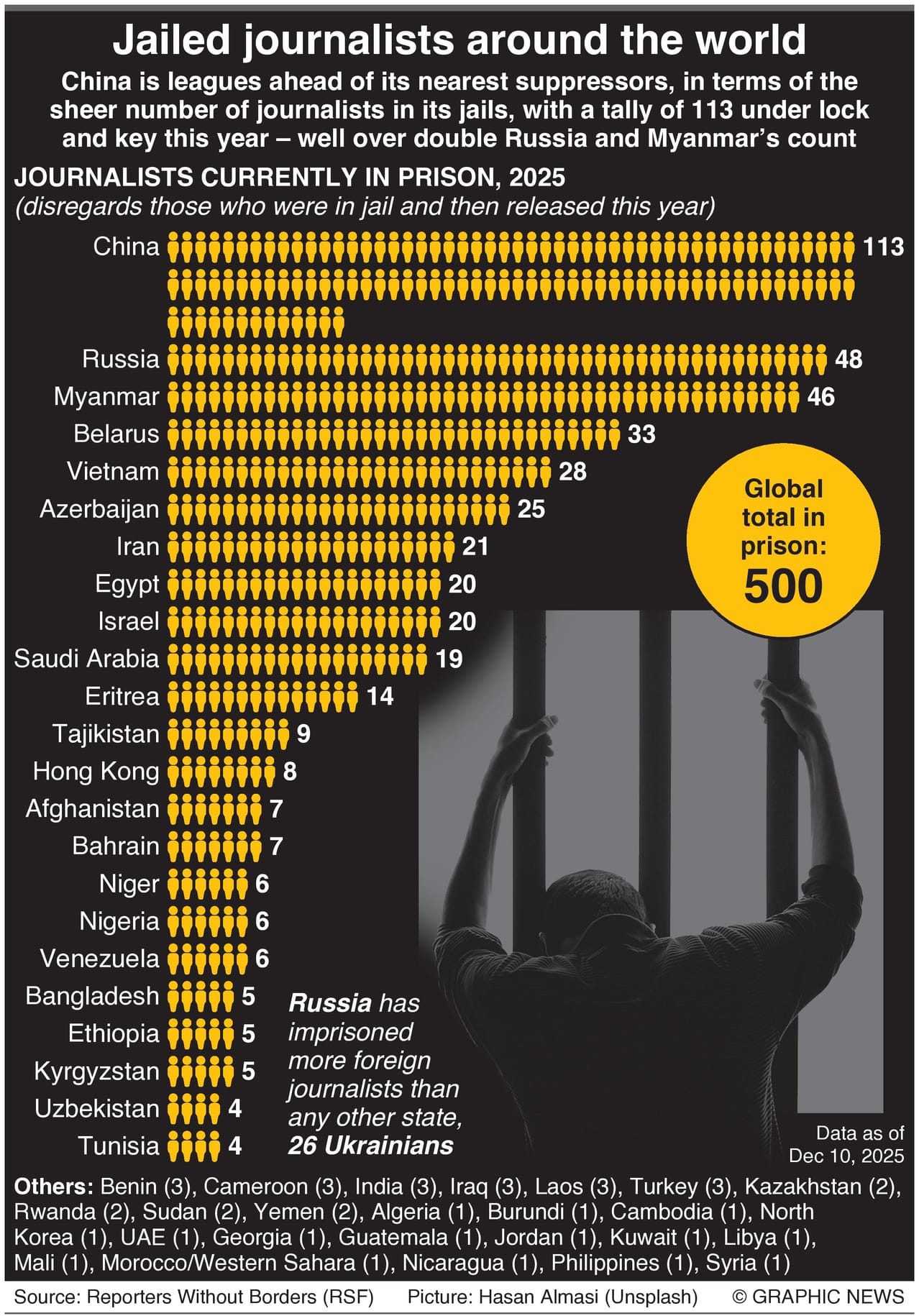
II. China Has Well Over 100 Journalists Incarcerated This Year
China is leagues ahead of its nearest suppressors, in terms of the sheer number of journalists in its jails, with a tally of 113 under lock and key this year – well over double Russia and Myanmar’s count.
editor-tippinsights@technometrica.com