
Across Latin America, the populist Right earned an impressive series of electoral wins this year, including Honduras, Costa Rica, and Chile. In fact, like-minded conservative leaders now govern from the southern tip of South America at Tierra del Fuego in Argentina, up through El Salvador, and, of course, into the United States.
As I’ve been profiling for months, this trend to Make the AMERICAS Great Again now looks for another win in the politically troubled nation of Peru. Current polling reveals a very volatile situation, unfortunately, on brand for Peru. After all, this country has impeached and removed presidents like the changing of the seasons in recent years.
As the final days of the race approach—the first round of voting is Sunday, April 12—some public polling shows former Lima Mayor Rafael López Aliaga still leading the race. But other polling shows effectively a competitive three-way race, with Aliaga alongside Keiko Fujimori and Carlos Alvarez.
In my own extensive poll of Peru, taken one month ago, Aliaga led by +10 percent for the first round of voting. But other recent polls point to gains for rival candidates. In any case, it seems highly improbable that any candidate can command a decisive 50 percent margin in the first round with such a crowded field. As such, in a runoff ballot vs. Keiko Fujimori, Aliaga then soars to a landslide win by +27 percent, 45–18 percent, with 28 percent saying “neither” and 9 percent undecided.
Most of the recent gains for Aliaga’s rivals have come from voters in and around the sprawling capital of Lima. On decision day, if these voters are reminded of his strong leadership regarding the “Rutas” issue, then he should recover that Lima support. The “routes of Lima” are toll roads serving many of the working poor and blue-collar citizens of greater Lima. The concessions for those tolls were sold to foreign private equity interests in deals that most Peruvians regard as corrupt.
But as mayor, Aliaga canceled those tolls and insists that dirty deals consummated with compromised Peruvian politicians will no longer shrink the paychecks of hard-working Peruvians. By a whopping +50 percent margin, Peruvians approve of Aliaga’s decision, 73–23 percent.
In addition to those domestic issues, looking at the broader strategic scene, Peruvians increasingly align with their neighbors in Colombia, who turned to the populist Right after flirting with the dangerous policies of Latin Marxists.
For example, 72 percent of Peruvians approve of the recent U.S. capture and removal of Venezuelan dictator Nicolás Maduro, with only 17 percent disapproval. Along that theme, 47 percent of Peruvians want close relations with the U.S., while 37 percent say relations should “stay the same,” and only 9 percent want a “more distant” approach to America.
On this key issue, clearly, voters in Peru prefer Aliaga, who has repeatedly shown great alignment with the patriotic populist movement in the United States. Moreover, Aliaga consistently looks to counter the increasingly aggressive moves by the Chinese Communist Party to spread influence across Latin America and, specifically, Peru.
Right now, China exerts very controversial control over Peru’s valuable Chancay deepwater port, one of the shipping jewels of Latin America, able to accommodate the largest ocean vessels traversing the Pacific between China and South America. Many Peruvians understandably bristle at surrendering majority control of such a strategic asset, especially to the Beijing dictatorship.
Not surprisingly, Washington objects as well and has issued a scathing public statement about Chinese state-owned enterprise Cosco controlling much of the port. The U.S. State Department warned that “Peru could be powerless to oversee Chancay . . . which is under the jurisdiction of predatory Chinese owners.”
Thankfully, Aliaga has been clear and consistent in seeking a closer Peruvian relationship with America rather than China. Aliaga, widely known by his nickname “Porky,” recognizes that the vast natural resources of Peru form a perfect counter to China. America’s exploding digital economy badly needs the critical minerals found in Peru. By partnering with Peru, the U.S. simultaneously decouples from China while also checking China’s influence in Latin America.
So, this upcoming election promises to advance a trend gaining support across Latin America. A tide rises to lift prosperity, from Argentina to El Salvador. This tide is also decidedly pro-U.S. Voters across the region choose leaders who believe their future lies alongside the United States in building a hemisphere of prosperity and security.
Steve Cortes is president of the League of American Workers and advisor to CatholicVote. He directs political campaigns on media, polling, and Hispanic outreach, including Trump 2016/2020 and Vance 2022 U.S. Senate. He is a former broadcaster for Fox News and CNN.
Original article: American Greatness
Poll Cross-tabs: League of American Workers Survey — Peru
Iran Reveals Safe Route Through Strait Of Hormuz
Iran’s Revolutionary Guards (IRGC) has provided alternative safe routes for shipping through the Strait of Hormuz during the two-week ceasefire with the U.S. and Israel, to avoid “possible collisions with sea mines”.
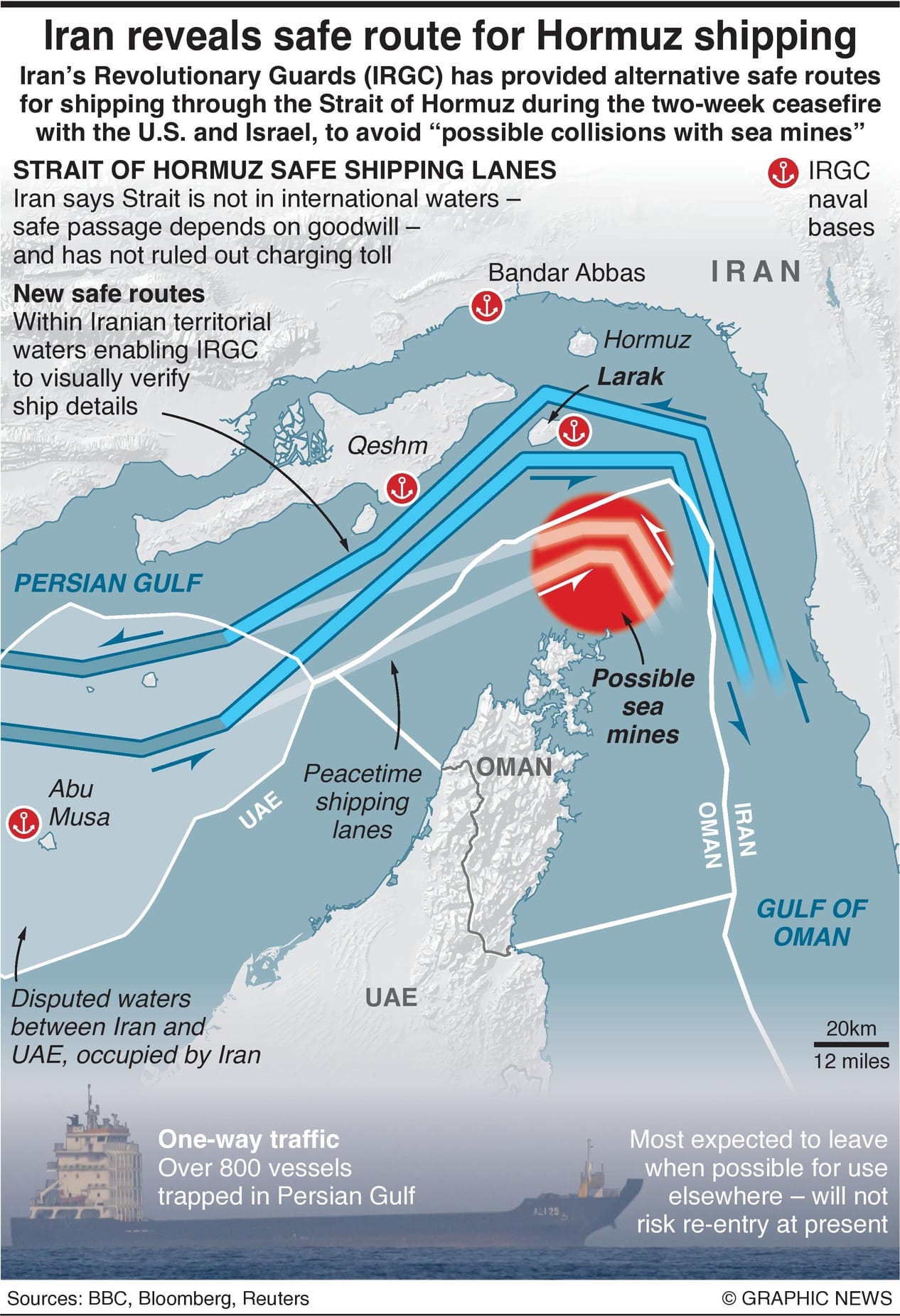
Some 800 vessels remain trapped in the Persian Gulf by Iran’s closure of the Strait, and despite the terms of the ceasefire requiring it to be reopened, passage remains subject to logistical and safety considerations according to the IRGC.
Iran says that the Strait is not in international waters and, therefore, safe passage requires the goodwill of Iran and Oman. The new safe routes are within Iranian territorial waters, enabling the IRGC to visually verify ship details. Iran has not ruled out charging a toll.
With the status of the ceasefire still unclear, shipping companies are likely to exit the Persian Gulf only when it is safe to do so, in order to use their vessels elsewhere in the world, and are unlikely to return while the likelihood of the ceasefire breaking down remains high, meaning supply disruptions are likely to continue for some time.
1. Why Is Trump Threatening 'Bigger Strikes' On Iran?
2. U.S. Push Drives Israel Toward Lebanon Talks
3. Pentagon Faces Scrutiny Over Kuwait Attack
4. Hormuz Shipping Recovery May Take Months, Say Experts
5. North Korea Tests Cluster-Bomb Missiles
6. Why Did UK And Norway Track Russian Submarines?
7. How Will Trump’s Iran Moves Impact China Talks?
8. Oil Prices Spike Again As Iran Controls Hormuz
9. Iran War May Push U.S. Inflation Higher, Warn Economists
10. How Will NASA’s Artemis II Astronauts Return To Earth?
11. What Is Holding Back OpenAI’s UK Expansion?
12. What Is Behind Disney’s Latest Layoffs?
13. USPS Halts Pension Payments, Warns Of Looming Cash Shortage
editor-tippinsights@technometrica.com