
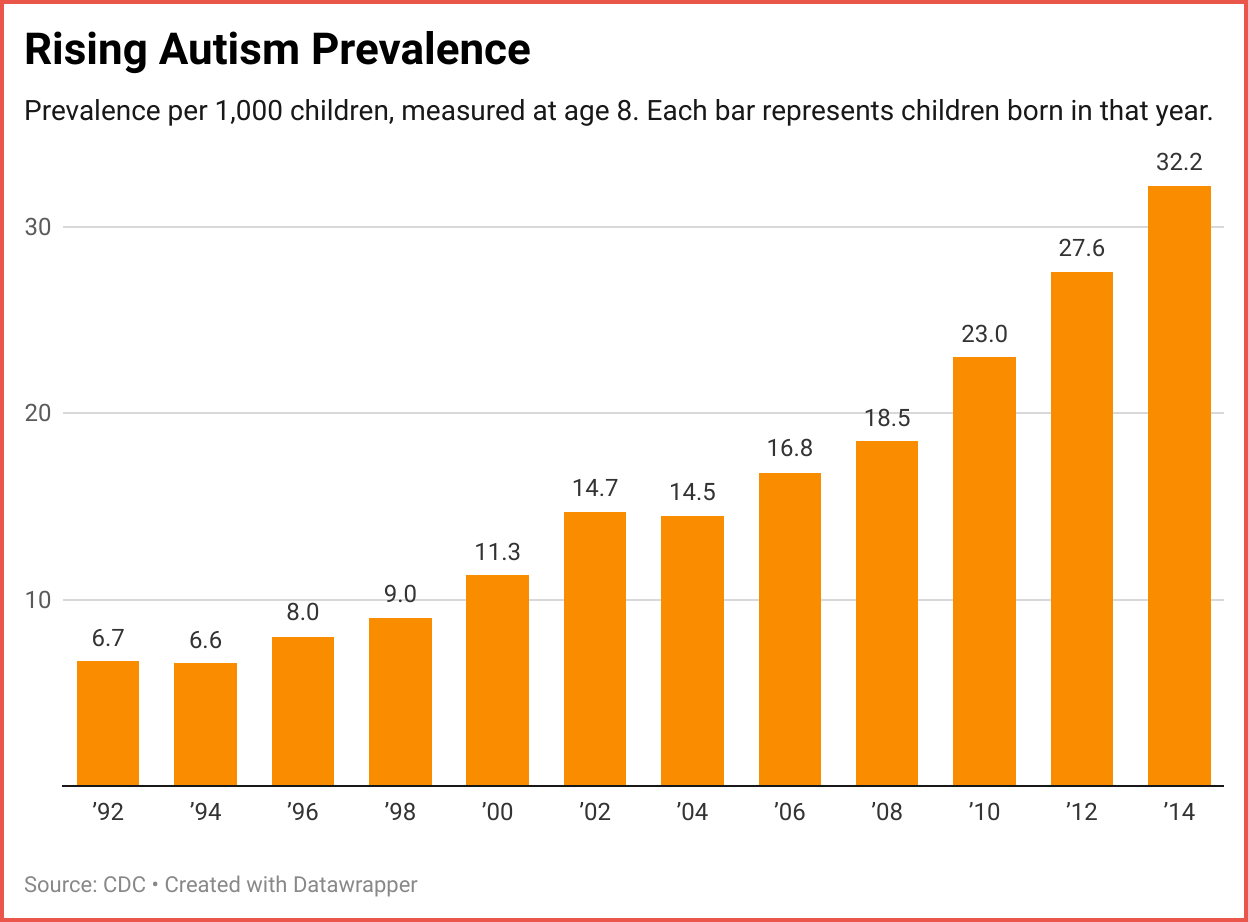
Autism diagnoses have risen sharply in recent decades. The CDC’s most recent estimate, for children born in 2014 and assessed in 2022, puts the figure at about 1 in 31, continuing a decades-long upward trend. By contrast, among those born in 1994, the figure was just 1 in 150. In simple terms, that’s a fivefold increase.
Some of the rise in cases can be attributed to broader definitions and increased awareness of the condition. Yet many parents and researchers believe environmental factors and other inputs may also be contributing to the increase in numbers.
One candidate under scrutiny is acetaminophen, a common pain reliever better known as Tylenol. Researchers speculate that acetaminophen might influence fetal development through oxidative stress or folate pathways, although no mechanism has been demonstrated. Acetaminophen readily crosses the placenta, meaning the medicine a mother takes can also reach her unborn child.
📌 Tylenol at a Glance
- First introduced: 1955 (as a prescription drug by McNeil Laboratories).
- Over-the-counter since: 1960.
- Years on the market: 70 years (1955–2025).
- Parent company: Now owned by Kenvue (spun off from Johnson & Johnson in 2023).
- Annual sales: Kenvue reported $15.4 billion in net sales in 2023 across its portfolio, with Tylenol among its top brands.
- Market share: Analysts estimate Tylenol contributes roughly 10% of Kenvue’s revenue.
Several large cohort studies and systematic reviews have reported a statistical association between frequent or prolonged use of acetaminophen in pregnancy and higher rates of autism or ADHD in children. The associations appear stronger with heavier use, though the studies are not conclusive.
However, in scientific studies, association is not the same as causation. To put it in plain terms: ice cream sales and drowning deaths both rise in the summer, but one does not cause the other. The real factor is the heat. Similarly, expectant mothers may reach for acetaminophen because of fevers or infections, and those conditions themselves could be part of the explanation.
Only rigorous science and thorough scientific inquiries can settle questions of causation. Until then, the association is a call for prudence, not panic. The government signaled its seriousness by bringing the President himself to a press conference, a rare step for a single medication. His presence underscored how quickly emerging science can move from journals to policy. The administration’s message was simple: acetaminophen should not be treated casually in pregnancy.
We witnessed a similar situation a few years ago. In 2020, when hydroxychloroquine and ivermectin were floated as possible COVID-19 treatments, debate was fueled as much by politics as by science. Some voices dismissed them outright, and others embraced them too quickly. The lesson is clear: when evidence is mixed, it is best to keep an open mind, call for study, and proceed with caution.
That is the spirit of what we might call Responsible Acetaminophen. It means different things for different groups:
For mothers: Use acetaminophen only when needed. Do not self-medicate, and always consult a physician. Avoid routine or prolonged use, but do not feel guilty if medicine is necessary for your health or your child’s.
For doctors: Counsel patients with balance. Be honest about the uncertainties, but also reassure them that occasional, necessary use remains appropriate. Clarity matters, and so does compassion.
For policymakers: Encourage more research, support transparent labeling, and above all, communicate in a way that informs without alarming.
📌 Responsible Acetaminophen: What We Know and Don’t Know
Know
- Autism diagnoses are rising.
- Acetaminophen crosses the placenta.
- Some studies show an association with autism/ADHD.
Don’t Know
- Whether acetaminophen causes autism.
- The biological mechanism.
- If other factors (fever, infection) are the real drivers.
Key Takeaway
Until science is conclusive, Responsible Acetaminophen is the prudent path. Handle with care.
Note to the Media
The anti-Trump press rushed to politicize yesterday’s announcement, quick to talk down both the HHS Secretary and the President. In doing so, they added noise when clarity was needed. The media must hold its judgment, not stoke confusion and panic.
Autism is too complex, and mothers too important, for us to rush to conclusions. Science must do its work. Until science is conclusive, Responsible Acetaminophen is the prudent path. Handle with care.
📊 Market Mood — Tuesday, September 23, 2025
🟢 Micron Earnings in Spotlight
Futures were flat as investors awaited Micron’s results, with bullish sentiment tied to robust AI-driven demand for its memory chips.
🟡 Fed Messaging and Powell Ahead
Treasury yields edged higher after cautious Fed remarks; Powell’s upcoming speech may clarify the debate over further 2025 rate cuts.
🟣 Flash PMIs and Oil Weakness
U.S. flash PMIs are expected to confirm steady growth, while oil slid on oversupply concerns after Iraq struck a deal to resume pipeline exports.
Market round-up in 5 minutes. We bring you up to speed. Subscribe to TIPP Insights for $99/year.
📅 Key Events Today
🟧 Tuesday, September 23
09:45 – S&P Global Manufacturing PMI (Sep)
Survey of manufacturing business conditions.
09:45 – S&P Global Services PMI (Sep)
Survey of services sector activity.
12:35 – Fed Chair Powell Speaks
Remarks on monetary policy and the economy.