
By David W. Brady, Michael Spence - Project Syndicate | February 11, 2026
US voters may well embrace the Democratic Party in this year’s midterm elections. But neither that outcome nor the 2028 election is likely to lead to a realignment of US politics that delivers a government capable of sustaining policies long enough to address the problems the country faces.
STANFORD/MILAN – With political turmoil roiling the United States, talk about this year’s midterm congressional elections in November is already picking up steam. In last year’s key elections, the Democrats racked up a string of victories, including in gubernatorial votes in New Jersey and Virginia, special elections to Virginia’s General Assembly, and mayoral races in Miami and New York City. While this bodes well for the Democrats in the coming midterms, US politics is likely to remain dysfunctional for a long time to come.
In the 2024 presidential election, Donald Trump and his opponent, former Vice President Kamala Harris, each won over 90% of their respective parties’ votes. But an expansive YouGov survey project showed that among the votes Harris lost to Trump were those of Democrats who identified inflation as the most important issue (12%). Among Independents who felt that inflation, the economy, and immigration were the three most important issues (20%, 15%, and 12%, respectively), Trump beat Harris by more than 40 points.
Last year’s Democratic victories reflect the same economic concerns, but with different results. As of the end of 2025, US voters viewed inflation (24%) and jobs and the economy (16%), together with health care (11%), as the most important issues, according to an Economist/YouGov poll. But, unlike in 2024, Democrats were viewed as better equipped to address them. Even Republicans who list these among their high-priority issues are 10-15% less likely to say they will vote for the party in the 2026 midterms than Republicans who do not cite these issues.
The bigger problem for Republicans are Independents, more than two-thirds of whom now disapprove of Trump’s handling of the economy and inflation. When asked whether they would vote Democrat or Republican in the midterms, they gave Democrats a 16% lead. Since the Democrats have to flip only five seats to gain a majority in the House of Representatives, their chances of success appear strong.
But while Democratic control of the House would put a damper on some of the Trump administration’s policies, it would not herald a significant shift in the US political landscape. Instead, America’s two main political parties will continue to hand power back and forth, as has been the case for the last few decades.
To be sure, the Democrats enjoyed 48 years of dominance beginning in 1932, at the peak of the Great Depression. But since Republican candidate Ronald Reagan won the 1980 presidential election, leadership has constantly changed hands. Reagan secured a second term in 1984, but Republicans lost the Senate two years later. The GOP’s George H.W. Bush won the presidency in 1988, but Democrat Bill Clinton denied him a second term in 1992.
In the 1994 midterms, Republicans won the House for the first time in 40 years. While Clinton secured re-election in 1996, he was succeeded by Republican President George W. Bush, who not only served two consecutive terms but also benefited from six years of GOP control of Congress.
Democratic President Barack Obama was elected in 2008, but in the 2010 midterms, Republicans picked up a whopping 64 House seats. While Obama won again in 2012, he was succeeded by Trump. Again, however, Republicans lost control of the House in the 2018 midterms. In the 2020 election, Trump was defeated by Obama’s former vice president, Joe Biden.
Whatever elation the Democrats felt was tempered in the 2022 midterms, when they lost the House, and snuffed out when Trump won a second presidency in 2024. The impending midterms are likely again to shift the balance – but only just. America’s political pendulum will continue to oscillate.
A key reason for this is that governments and leaders often lose their shine once they are in office – and not just in the US. France’s government has an approval rating of just 16%, according to a December 2025 YouGov poll. The British government is not doing much better, at 17%. Approval ratings are slightly higher in Germany (25%), and in Denmark, Italy, and Spain – all above 30% – but even in these countries, majorities disapprove of their leaders.
Citizens complain that their leaders have failed to address major challenges, such as slow growth, inflation, a lack of affordable housing, inequality, and climate change. More than half of people in the US and Europe consider public pensions to be too low, and a significant share of young people believe that the pension system will not be working or solvent when they are ready to retire.
But many of these problems are very hard to solve, especially before the next election arrives, and the public rarely trusts their leaders enough to give them more time. So, when an incumbent fails to deliver results, voters often decide to give the opposition a chance. These constant reversals make it difficult to sustain policies long enough to make a difference, and the resulting policy uncertainty can discourage long-term investment. Meanwhile, the lack of progress reinforces mistrust in elected officials, potentially leading voters to turn on the “establishment” altogether and embrace populist “disruptors” who compound the uncertainty.
In the US, frustration with powerful elites is one of the few sentiments that spans the political spectrum. The last Economist/YouGov poll of 2025 showed that 91% of Democrats, 75% of Republicans, and 83% of Independents think political institutions have been “captured by the rich and powerful.” Moreover, 80% of Democrats, 70% of Republicans, and 80% of Independents agree that important political decisions are largely made behind closed doors, without public accountability.
US voters may well embrace the Democratic Party in this year’s midterms. But neither this year’s midterm election nor the presidential election in 2028 is likely to lead to a significant realignment of US politics or deliver a government capable of sustaining policies long enough to address the problems the country faces. In the coming years, we can expect more political paralysis than policy progress.
David W. Brady is Professor of Political Science and Leadership Values at Stanford University and Senior Fellow at the Hoover Institution.
Michael Spence, a Nobel laureate in economics, is Professor Emeritus of Economics and a former dean of the Graduate School of Business at Stanford University. He is Senior Fellow at the Hoover Institution, Senior Adviser to General Atlantic, and Chairman of the firm’s Global Growth Institute. He is Chair of the Advisory Board of the Asia Global Institute and serves on the Academic Committee at Luohan Academy. He is a former chair of the Commission on Growth and Development and a co-author (with Mohamed A. El-Erian, Gordon Brown, and Reid Lidow) of Permacrisis: A Plan to Fix a Fractured World (Simon & Schuster, 2023).
Copyright Project Syndicate
Losses Mount In Ukraine As War Marks Fourth Anniversary
As the full-scale conflict in Ukraine nears the four-year mark, human casualties have reached staggering levels, with combined Russian and Ukrainian losses approaching two million.

Despite claims of battlefield momentum in Ukraine, the data show that Russia is paying an extraordinary price for minimal gains and is in decline as a major power.
Since February 2022, Russian forces have suffered nearly 1.2 million casualties, more losses than any major power in any war since World War II. At current rates, combined Russian and Ukrainian casualties could reach two million by the spring of 2026.
After seizing the initiative in 2024, Russian forces have advanced at an average rate of 15-70 meters per day in their most prominent offensives, slower than almost any major offensive campaign in the last century. Meanwhile, Russia’s war economy is under mounting strain, with manufacturing declining, growth slowing to 0.6% in 2025, and no globally competitive technology firms to drive long-term productivity, according to an analysis by CSIS.
In terms of military equipment, the two sides have lost a combined total of 28,000 weapon platforms, according to open-source data.
This includes almost 6,000 tanks, more than 13,000 armored vehicles, and over 3,000 artillery pieces.
Actual equipment losses are likely to be significantly higher, since the analysis by Oryx – an open-source intelligence website – only includes captured and destroyed vehicles and equipment for which photo or videographic evidence is available.
Britney Spears Sells Music Catalogue For $200 Million
Pop superstar Britney Spears sold the rights to her entire music catalogue to independent music publisher Primary Wave for around $200m in late December 2025, according to showbiz website TMZ.
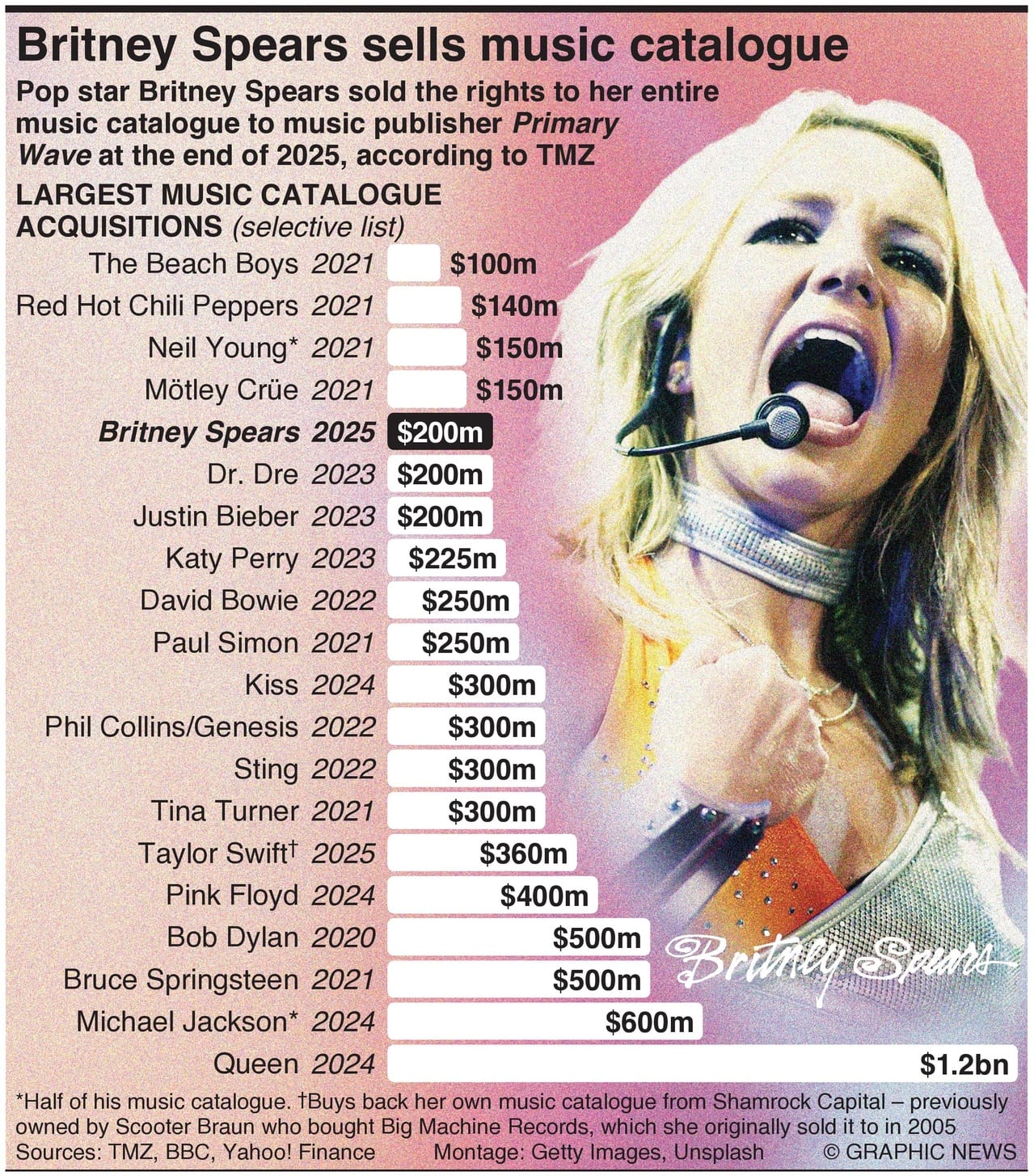
Details of the sale and the exact price of Spears’ catalogue have not been made public, and neither Spears nor Primary Wave has responded to BBC requests for comment.
Spears, one of the world’s best-selling female artists with more than 150 million records sold, is the latest in a long line of high-profile artists to sell their music catalogues for huge sums of money.
In January 2024, Spears said she would “never return to the music industry” – her last song being a duet with Elton John, released in 2022.
Catch up on today’s highlights, handpicked by our News Editor at TIPP Insights.
1. Ukraine Says No Elections While Martial Law Remains
2. Russia Moves To Restrict Messaging Platform 'Telegram' Access Nationwide
3. Moscow Signals Nuclear Restraint After Treaty Expiration
4. As U.S.-Russia Nuke Deal Expires, 2/3 Of U.S. Voters ‘Concerned’ About Nuclear War: I&I/TIPP Poll
5. Beijing Rejects Allegation It Conducted Secret Nuclear Test In 2020
6. U.S. Troops To Train Nigerian Forces, Not Enter Combat
7. Hormuz Looms Large In U.S.-Iran Showdown
8. What Happened In Canada’s Deadliest School Shooting In Decades
9. Memory Chip Prices Surge 600% In Just Six Months
10. How Medicaid Work Requirements May Shrink Coverage By Millions
11. Pam Bondi To Face House Grilling Over Epstein Files And Election Probe
12. El Paso Flights Grounded After Surprise National Defense Order
13. New Data Shows Major Decline In Murders And Robberies Across Large U.S. Cities
14. Bitcoin Falls Below $67,000 As Rally Loses Steam
15. U.S. Adds 130,000 Jobs In January As Unemployment Dips To 4.3%
16. Markets Rise On Solid Labor Data And Falling Jobless Rate
editor-tippinsights@technometrica.com