The U.S. has arrested Venezuela’s former leader and appears on the verge of toppling Cuba’s regime through stiff economic sanctions. Are Americans tired of this? No. In fact, a majority want the U.S. to either maintain its level of activity in the Western Hemisphere or to expand it, the latest I&I/TIPP Poll shows.
The national online poll, taken from Jan. 27 to Jan. 29 by 1,384 adult voters, has a margin of error of +/-2.9 percentage points. The poll’s main message: If Americans are tired of President Donald Trump’s activist foreign policy in the Western Hemisphere — jokingly called by some the “Donroe Doctrine” — they aren’t showing it.
I&I/TIPP asked voters: “Should the United States take a more active role in addressing problems in the Western Hemisphere, or reduce its involvement?”
The answer: 56% said the U.S. should either “take a more active role” (34%) or “keep current level of involvement” (22%). Of the rest, only 23% said “reduce involvement” while 21% said “not sure.”
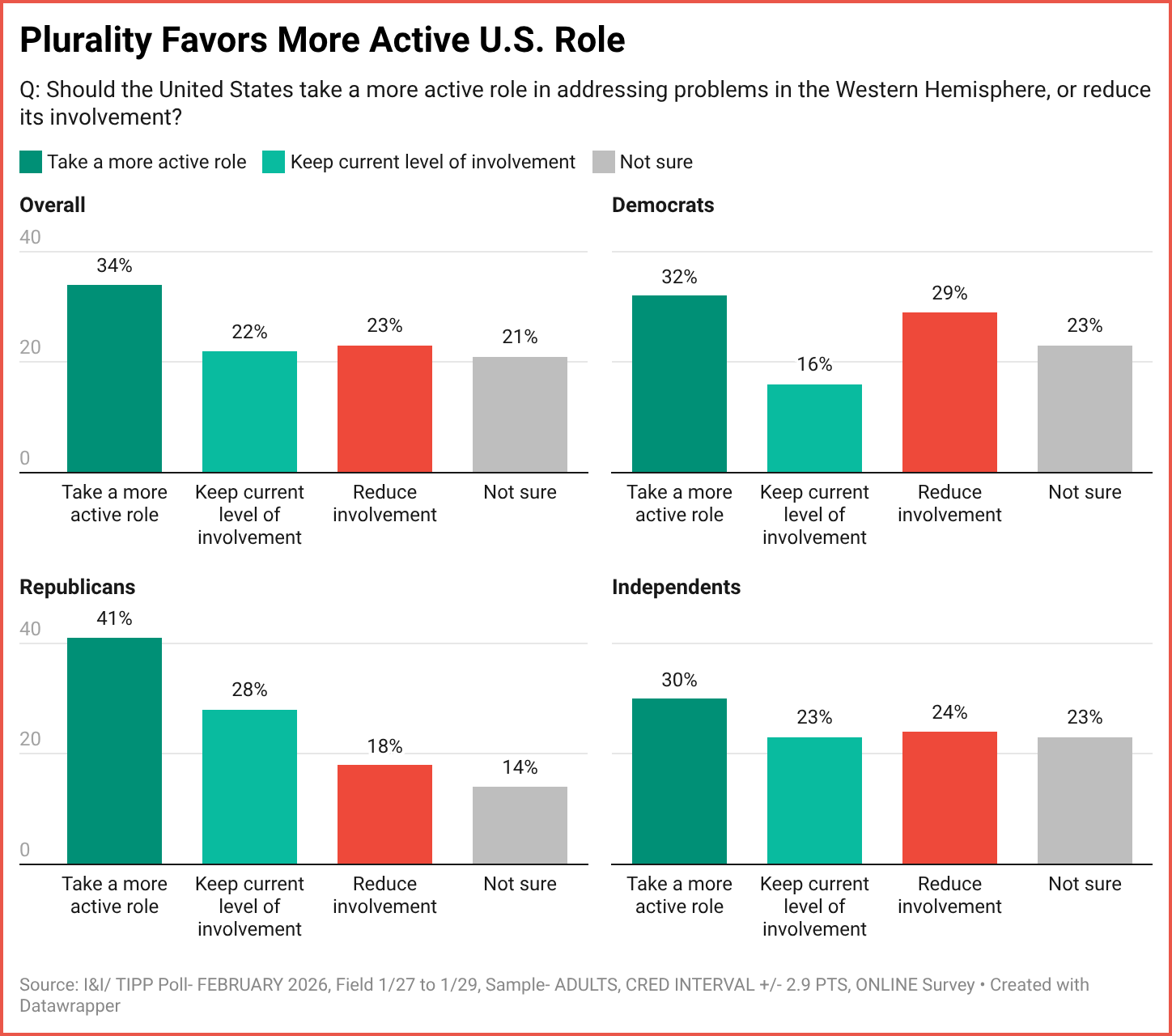
Perhaps a bit surprisingly, political affiliation doesn’t have an enormous impact on how voters respond, though there are some differences.
Answers by Democrats (32% “more active,” 29% “reduce involvement,” 16% “keep current level”), weren’t radically different from those of Republicans (41% “more active,” 18% “reduce involvement,” 28% “keep current level”) or independents (30% “more active,” 24% “reduce involvement,” 23% “keep current level”).
In short, all show either majorities or pluralities for maintaining the status quo or taking an even more active role in the region.
But just what should the U.S. be emphasizing? I&I/TIPP asked respondents the following: “Which of the following poses the greatest threat to the United States from the Western Hemisphere today?”
The response: 24% said “economic instability,” 19% “illegal immigration,” 15% “authoritarian governments,” 15% “drug trafficking and cartels,” and 12% “Chinese influence in the region.” Another 14% answered “not sure.”
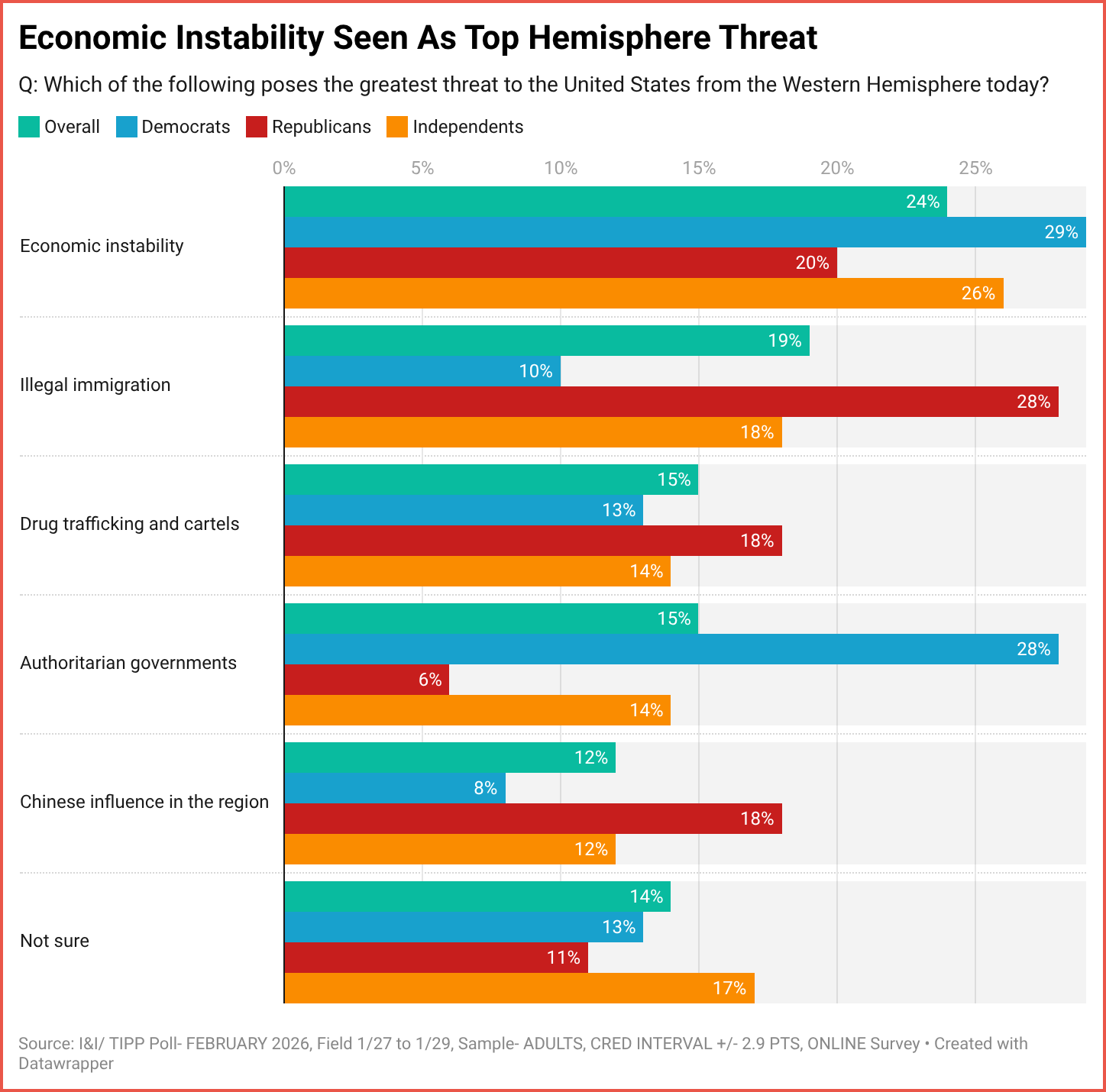
Among the different political parties and factions, differences emerged. For instance, only 10% of Democrats called illegal immigration the most serious threat, while 28% of Republicans and 18% of independents did.
“Authoritarian governments” flipped the script: 28% of Democrats called this the greatest threat, versus only 6% of Republicans and 14% of independents.
Only one possible answer got 20% or more from all three groups: “Economic instability,” with Dems (29%), GOP (20%), and indie voters (26%) all pretty much singing in tune.
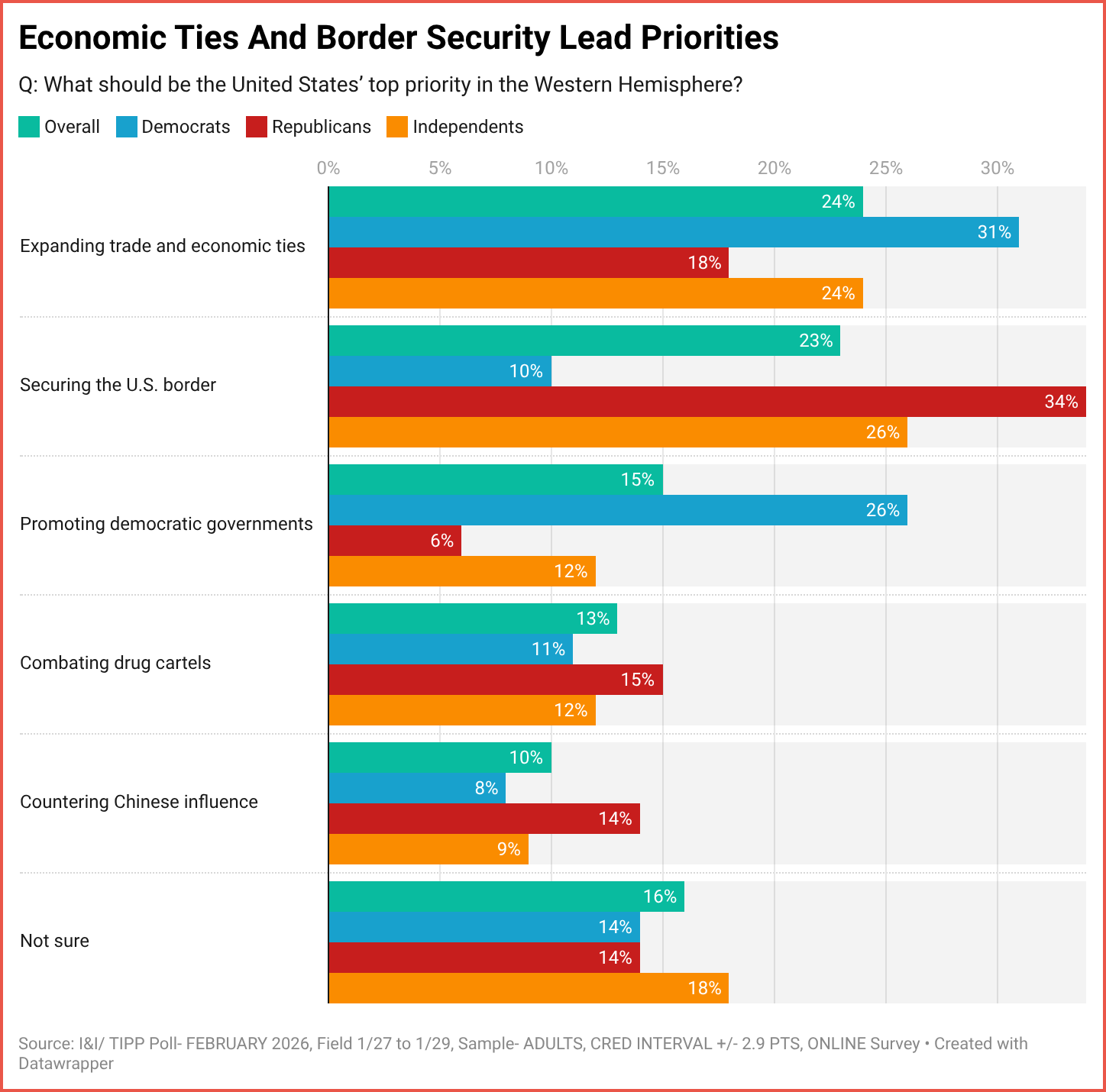
The final question simply asked: “What should be the United States’ top priority in the Western Hemisphere?”
Two answers scored highest overall: “Expanding trade and economic ties” (24%) and “Securing the U.S. border” (23%), a statistical tie. They were followed by “Promoting democratic governments” (15%), “Combating drug cartels” (13%), and “Countering Chinese influence” (10%). Once again, “not sure” was one of the largest responses at 16%.
Related
Make The Americas Great Again: Colombia Embraces Trump & The U.S. — Steve Cortes, TIPP Insights
These questions are in play even as you read this. President Trump and Secretary of State Marco Rubio have made clear that hemispheric politics are now a major White House concern.
It should be no surprise. A new group of centrist and conservative leaders has come to power in the region in the last year or so, creating a far more friendly environment for U.S. policymakers.
The most recent was conservative candidate Laura Fernandez in Costa Rica, who won that nation’s presidential election in a “landslide” earlier this month.
She follows Javier Milei in Argentina, El Salvador’s Nayib Bukele, and a handful of others (hat tip to the Unleash Prosperity website) who are reshaping the region’s political landscape. They include:
- Ecuador: President Daniel Noboa won reelection in April of last year, defeating leftist Luisa Gonzalez with 56% of the vote.
- Bolivia: In August, the socialist MAS party that had been In power for 20 years was repudiated with the victory of conservative Rodrigo Paz.
- Honduras: Conservative Nasry Asfura won November’s election in part due to an explicit endorsement from President Trump.
- Chile: December saw free-market candidate José Antonio Kast win a landslide 58% victory, turning a left-wing government out of office.
So for the first time in decades, the political backdrop in the Western Hemisphere is highly favorable for positive free-market policies and realistic democratic political change.
Equally important is Trump’s new emphasis on the region. It’s not just lip service, unlike recent past presidents, who have uttered fine-sounding speeches but largely ignored the festering troubles in Latin America.
Trump stunned many by quarantining Venezuela’s energy sector late last year, virtually crippling its government, and then following up in January by arresting Venezuela’s Marxist dictator, Nicolas Maduro.
Trump increased the pressure by economically isolating the illegitimate Cuban regime — a regime that systematically destroyed Cuba’s once-vibrant economy through decades of communist misrule and mismanagement.
Given Cuba’s cratering economy, it seems highly likely that the Communist Castroite regime that has ruled Cuba since New Year’s Day in 1959 and is responsible for the deaths of an estimated 70,000 or more of its own citizens will soon collapse.
Cuban health workers and security troops who protected Venezuela’s Maduro in exchange for oil have now returned home, another major loss for Cuba’s heavily oil-dependent economy.
Meanwhile, the Trump-Rubio maneuvering appears to be pushing both China and Russia to the margins in this hemisphere. After the U.S. took back control of the ports on either side of the Panama Canal, China has abandoned several strategic infrastructure investments in that nation.
At the same time, Russia has found its “ghost tankers” blocked from entering Venezuelan ports to break the embargo, and is now evacuating its advisers and families of diplomats there.
As for our nearest neighbor to the south, Mexico, illegal immigration from and through that country has slowed to a bare trickle, while deportations of criminal illegal aliens have surged, a radical shift in the immigration dynamic.
Mexico’s leftist President Claudia Sheinbaum continues to make critical speeches ripping the Trump administration for interfering with her country’s sales of oil to Cuba and imposing tariffs on the slumping Mexican economy. But she has also quietly begun cooperating on security issues, short of allowing U.S. troops to operate inside Mexico.
Canada is part of the picture, as well. Right now, it’s in a growth slump, one that “out of nowhere” shockingly finds its per capita GDP now below that of Alabama. Canada faces a secessionist threat from its own restive western provinces, and opposes Trump’s efforts to take over Greenland.
What does it all mean? After being largely ignored for years, if not decades, the nations of the Western Hemisphere are suddenly relevant to the U.S. again, like it or not. This poses enormous challenges for Trump and the U.S. Even so, as the I&I/TIPP Poll shows, most Americans want Trump, Rubio, and company to get moving.
I&I/TIPP publishes timely, unique, and informative data each month on topics of public interest. TIPP’s reputation for polling excellence comes from being the most accurate pollster for the past six presidential elections.
Terry Jones is an editor of Issues & Insights. His four decades of journalism experience include serving as national issues editor, economics editor, and editorial page editor for Investor’s Business Daily.
👉 Show & Tell 🔥 The Signals
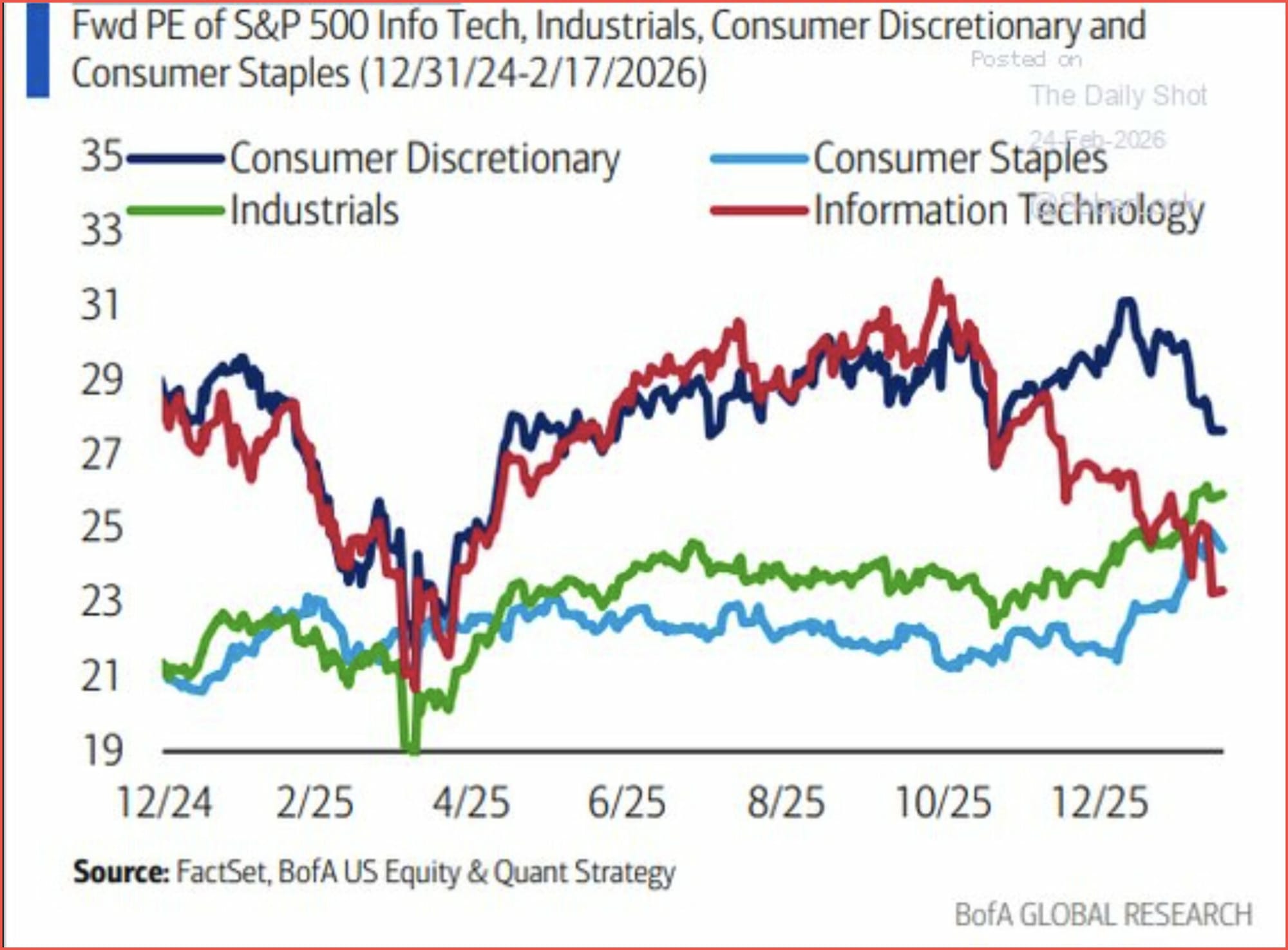
I. Tech Stocks Now Cheaper Than Staples
Investors often compare companies using something called a “price-to-earnings ratio,” which shows how expensive a stock is relative to its profits. Right now, big technology companies are trading at lower valuations than consumer staples like food and household goods, and even lower than retail and industrial companies. That is unusual because tech stocks have historically traded at a premium. It suggests investors are cooling on tech growth expectations, at least for now.
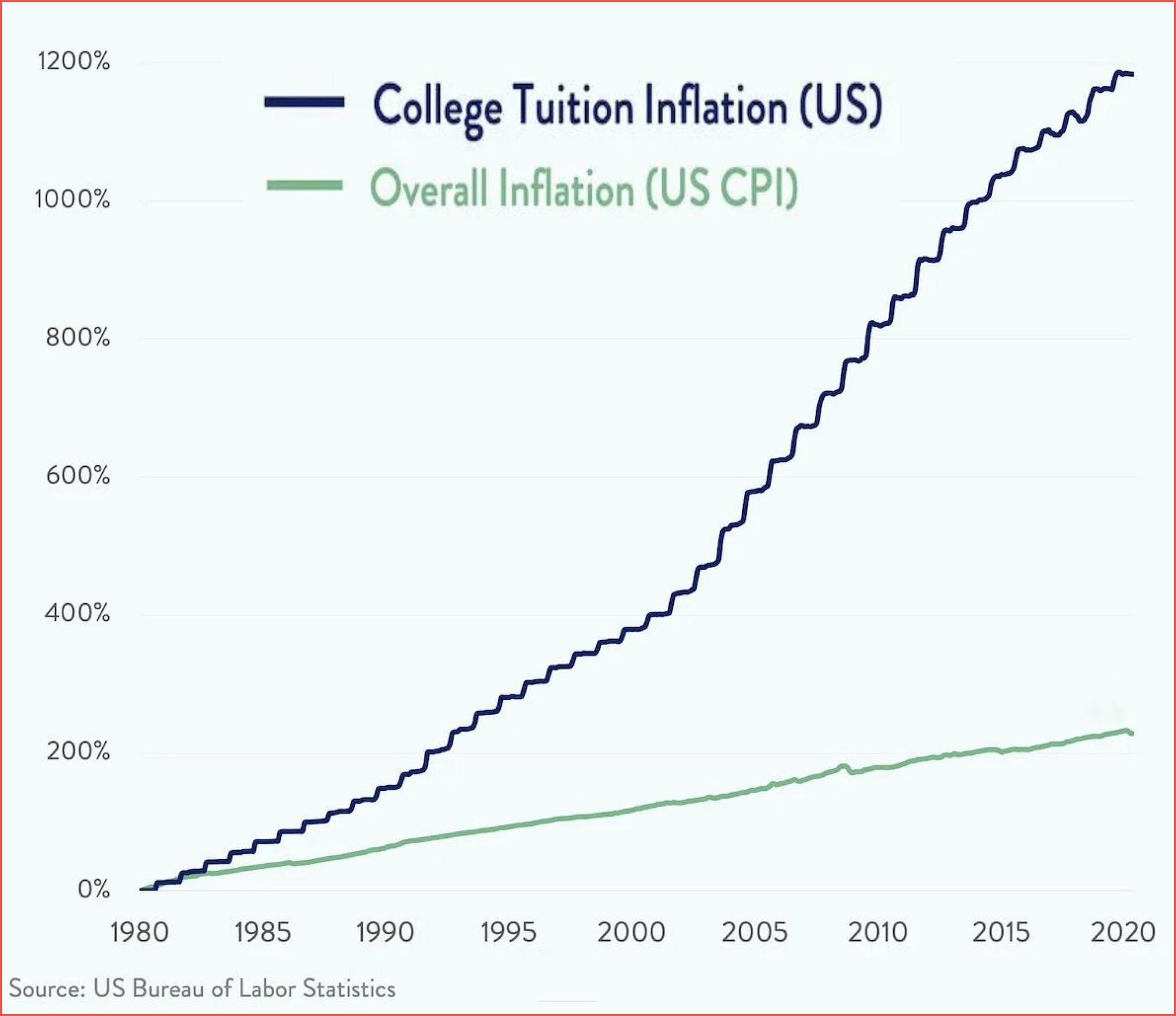
II. College Tuition Up 5x Faster Than Inflation
Since 1980, college tuition has increased more than 1,000%, while overall consumer prices have risen only about 200% over the same period. In simple terms, the cost of college has grown many times faster than normal inflation. This helps explain why student debt has ballooned and why families feel squeezed when paying for higher education.
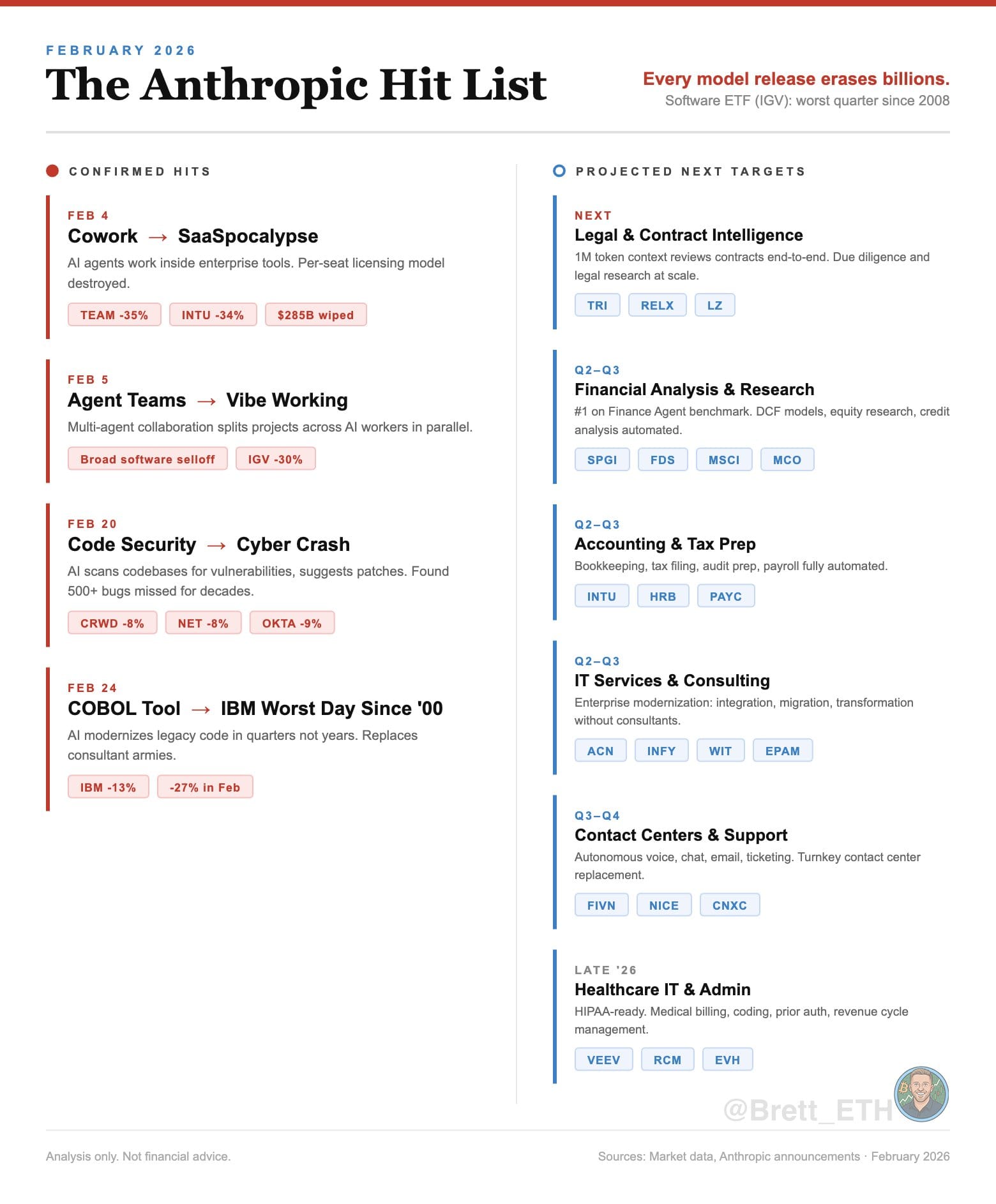
III. AI Announcements Are Shaking Up Software Stocks
Several recent AI product launches have triggered sharp sell-offs in software companies. When new AI tools show they can automate tasks like coding, legal research, accounting, or cybersecurity scanning, investors quickly reassess which companies might lose business. In some cases, stocks have dropped 10% to 30% in days. The market is signaling that AI could disrupt large parts of the traditional software industry.
The TIPP Stack
Handpicked articles from TIPP Insights & beyond
1. One Minute To Midnight—Larry C. Johnson, Ron Paul Institute for Peace and Prosperity
2. Obama Is In No Position To Lecture Us About Decency—David Harsanyi, The Daily Signal
3. Cracking Down On China’s Trade Cheating The Right Way—Ken Blackwell, The Daily Signal
4. Canadian ‘Human Rights’ Tribunal Reveals The Insidious Threat Of Transgender Ideology—Tyler O'Neil, The Daily Signal
5. Netflix-Warner Bros. Deal Falters Under Growing Political And Legal Fire—Michael J. Hough, The Daily Signal
6. Why 6,000 Public Employees Just Quit Their Unions—Reagan Campbell, The Daily Signal
7. School ‘Default Closure’ Rules Hurt The Children They’re Meant To Help—Jason Bedrick, The Daily Signal
8. Conservatives Look To Protect Truckers From ‘Unqualified’ Illegal Immigrant Drivers—Pedro Rodriguez, The Daily Signal
9. Why Are US Citizens Proud of America? New Study Reveals 2 Key Reasons—Virginia Allen, The Daily Signal
10. ‘Tremendous Interest’: Trump To Order Administration To Release Alien Files— Elizabeth Troutman Mitchell, The Daily Signal
11. 7 Historic Moments From State Of The Union Addresses—Fred Lucas, The Daily Signal
12. Pollster: Supreme Court’s Tariff Ruling Could Help GOP In Midterm Elections—Katherine Matt, The Daily Signal
13. Texas Voters Face Critical Choice On Sharia Law Proposition 10—Peter McIlvenna, The Daily Signal
14. ‘SEVERE’ THREAT TO FREE SPEECH: X Appeals EU Censorship Fine—Tyler O'Neil, The Daily Signal
15. Virginia Democrats Shelve Solar Fee That Would Have Raised Electric Bills—Reagan Campbell, The Daily Signal
📊 Market Mood — Wednesday, February 25, 2026
🟩 Futures Steady Ahead of AI Bellwethers
Markets tread cautiously higher as Nvidia and Salesforce earnings take center stage.
🟧 Nvidia Results Seen as AI Litmus Test
Investors brace for a report that could sway the broader AI trade and global equity sentiment.
🟦 Software Sector on Edge Before Salesforce
Cloud and SaaS stocks remain under pressure as traders weigh AI disruption risks and guidance outlooks.
🟨 Gold and Oil Firm Ahead of U.S.–Iran Talks
Commodities edge higher amid tariff uncertainty and geopolitical tensions in the Middle East.
🗓️ Key Economic Events — Wednesday, February 25, 2026
🟧 10:30 AM — Crude Oil Inventories
Weekly U.S. stockpile data that can move energy prices and signal shifts in supply-demand conditions.
editor-tippinsights@technometrica.com